Looking for classes? Ksquare Career Institute, Bengaluru →

Chemistry
Haloalkanes and Haloarenes
55 questions from 33 papers, each with its answer.
- 55 questions
- 33 papers
- 3.13% of Chemistry
SN1 Reaction Rate and Carbocation Stability
-
The compound that will undergo $S_N1$ reaction with the fastest rate isThe compound forming the most stable carbocation undergoes $S_N1$ reaction at the fastest rate. 1-phenylethyl bromide ($C_6H_5-CH(CH_3)-Br$) ionises to give a benzylic carbocation that is stabilised by resonance with the benzene ring (and by the methyl group). So it undergoes $S_N1$ reaction with the fastest rate.
Nitrile to Amide to Hofmann Bromamide Reaction Sequence
-
Identify the major product C formed in the following reaction sequence: $CH_3-CH_2-CH_2-I \xrightarrow{NaCN} A \xrightarrow[\text{Partial hydrolysis}]{OH^-} B \xrightarrow[Br_2]{NaOH} C \text{(major)}$$CH_3-CH_2-CH_2-I \xrightarrow{NaCN} CH_3-CH_2-CH_2-CN$ (A) (nucleophilic substitution) $CH_3-CH_2-CH_2-CN \xrightarrow[Partial\ hydrolysis]{OH^-} CH_3-CH_2-CH_2-CONH_2$ (B) $CH_3-CH_2-CH_2-CONH_2 \xrightarrow{NaOH/Br_2} CH_3-CH_2-CH_2-NH_2$ (C) (Hofmann bromamide degradation – one carbon less) So the major product C is propylamine.
Substitution (PBr3) followed by Elimination (alc. KOH)
-
Major products A and B formed in the following reaction sequence, are
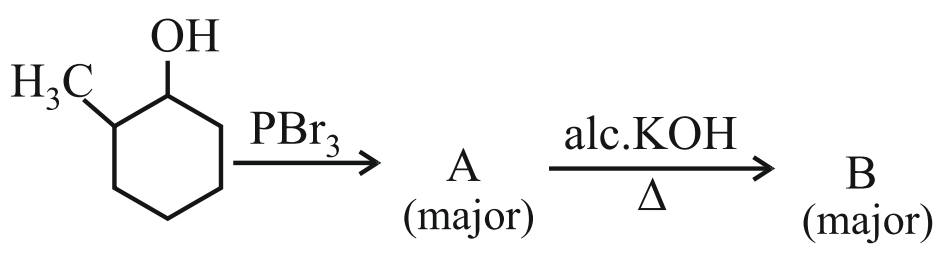
 $PBr_3$ replaces the –OH group by –Br at the same carbon: A = 1-bromo-2-methylcyclohexane.
alc. KOH, $\Delta$ causes dehydrohalogenation; by Saytzeff's rule, the more substituted alkene is the major product, with the double bond towards the carbon bearing $CH_3$: B = 1-methylcyclohexene.
That is every question in Haloalkanes and Haloarenes for this filter.
Want a score?
Answers here are not saved. Practise as a test to be marked and see your progress.
Practise as a test