Looking for classes? Ksquare Career Institute, Bengaluru →

Chemistry
Organic Chemistry - Some Basic Principles and Techniques
88 questions from 35 papers, each with its answer.
- 88 questions
- 35 papers
- 5% of Chemistry
Geometrical Isomerism
-
Which of the following compounds will exhibit cis-trans (geometrical) isomerism?Cis–trans isomerism needs restricted rotation (a C=C double bond or a ring) and two different groups on each of the doubly bonded carbon atoms.
2-Butene, $CH_3-CH=CH-CH_3$: each doubly bonded carbon has one H and one $CH_3$, so cis and trans forms exist.
1-Butanol and 2-butanol have only single bonds with free rotation (2-butanol shows optical, not geometrical, isomerism).
2-Butyne, $CH_3-C\equiv C-CH_3$, is linear about the triple bond, and each triply bonded carbon has only one substituent.
Hence 2-butene exhibits cis–trans isomerism.
Hybridisation in organic compounds
-
The state of hybridization of $C_2$, $C_3$, $C_5$ and $C_6$ of the hydrocarbon
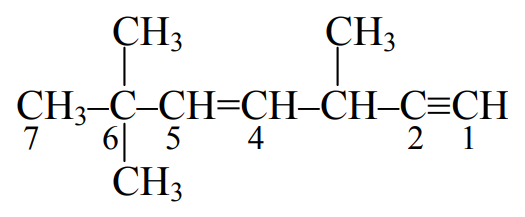
is in the following sequenceThe hybridisation of a carbon atom follows from the number of σ bonds it forms: 4 σ bonds means $sp^3$, 3 σ bonds means $sp^2$ and 2 σ bonds means sp.
$C_2$ is part of the triple bond: 2 σ bonds (and 2 π bonds), so sp.
$C_3$ is the CH carbon carrying a methyl group, with four single bonds: 4 σ bonds, so $sp^3$.
$C_5$ is part of the double bond: 3 σ bonds (and 1 π bond), so $sp^2$.
$C_6$ is the carbon bonded to three methyl groups and $C_5$, with four single bonds: 4 σ bonds, so $sp^3$.
Sequence: sp, $sp^3$, $sp^2$ and $sp^3$
That is every question in Organic Chemistry - Some Basic Principles and Techniques for this filter.
Want a score?
Answers here are not saved. Practise as a test to be marked and see your progress.
Practise as a test