Looking for classes? Ksquare Career Institute, Bengaluru →

Chemistry
Start Practice Clear paper filter
-
$HgCl_2$ and $I_2$ both when dissolved in water containing $I^-$ ions the pair of species formed is
$I^-$ forms $[HgI_4]^{2-}$ with $HgCl_2$ and $I_3^-$ with $I_2$.
In a solution containing $HgCl_2$, $I_2$ and $I^-$, both $HgCl_2$ and $I_2$ compete for $I^-$. Since the formation constant of $[HgI_4]^{2-}$ is $1.9\times10^{30}$, which is very large compared with $I_3^-$ ($K_f = 700$), $I^-$ will preferentially combine with $HgCl_2$. $HgCl_2 + 2I^- \rightarrow HgI_2\downarrow$ (red ppt) $+ 2Cl^-$ $HgI_2 + 2I^- \rightarrow [HgI_4]^{2-}$ (soluble) With excess $I^-$, $I_2$ also forms $I_3^-$, so the pair formed is $HgI_4^{2-}$ and $I_3^-$. -
Which is the incorrect statement?
Frenkel defects need a large size difference between ions.
Frenkel defect occurs in those ionic compounds in which the sizes of cation and anion are largely different, so the statement about Frenkel defect is incorrect. Non-stoichiometric ferrous oxide is $Fe_{0.93-0.96}O_{1.00}$ and it is due to metal deficiency defect, so the formula $FeO_{0.98}$ in the statement is also incorrect. Note: the source key accepts both the $FeO_{0.98}$ statement and the Frenkel-defect statement as incorrect statements. -
Of the following, which is the product formed when cyclohexanone undergoes aldol condensation followed by heating?
Aldol product dehydrates on heating to an $\alpha,\beta$-unsaturated ketone.
Two molecules of cyclohexanone undergo aldol addition in the presence of $OH^-$; on heating, dehydration gives the $\alpha,\beta$-unsaturated ketone.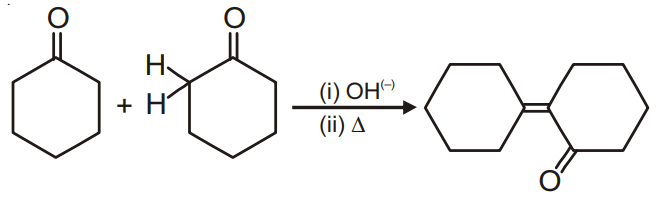
So the product is 2-cyclohexylidenecyclohexanone (two rings joined by a C=C double bond, with C=O on the ring carbon adjacent to it). -
Which one is the wrong statement?
In one-electron species, orbitals with the same n are degenerate.
The energies of the 2s-orbital and 2p-orbital in hydrogen-like atoms are equal (energy depends only on n). So the statement that 2s is lower in energy than 2p for hydrogen-like atoms is wrong. -
A gas is allowed to expand in a well insulated container against a constant external pressure of 2.5 atm from an initial volume of 2.50 L to a final volume of 4.50 L. The change in internal energy $\Delta U$ of the gas in joules will be
Insulated means q = 0, so $\Delta U = -P_{ext}\Delta V$.
$\Delta U = q + w$ For an adiabatic process, q = 0, so $\Delta U = w$ $w = -P\Delta V = -2.5\ atm\times(4.5 - 2.5)$ L $= -2.5\times2$ L-atm $= -5\times101.3$ J $= -506.5$ J $\approx -505$ J -
Consider the reactions:
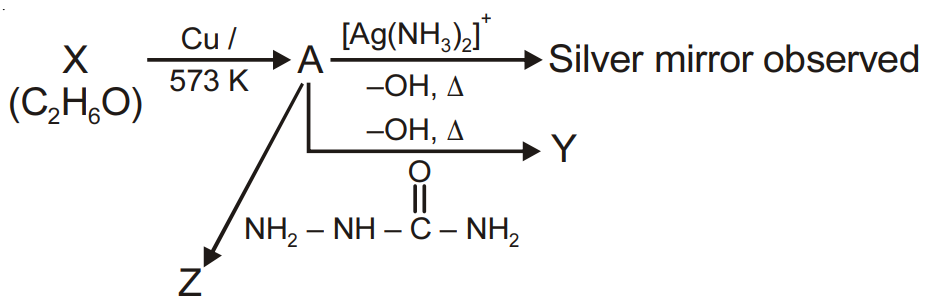
Identify A, X, Y and ZDehydrogenation of ethanol gives ethanal, which shows Tollens', aldol and semicarbazone reactions.
Since 'A' gives a positive silver mirror test, it must be an aldehyde or an $\alpha$-hydroxyketone.
Reaction with semicarbazide indicates that A can be an aldehyde or ketone.
Reaction with dilute $OH^-$ (aldol condensation) indicates that A is an aldehyde, as the aldol reaction of ketones is reversible and needs special apparatus.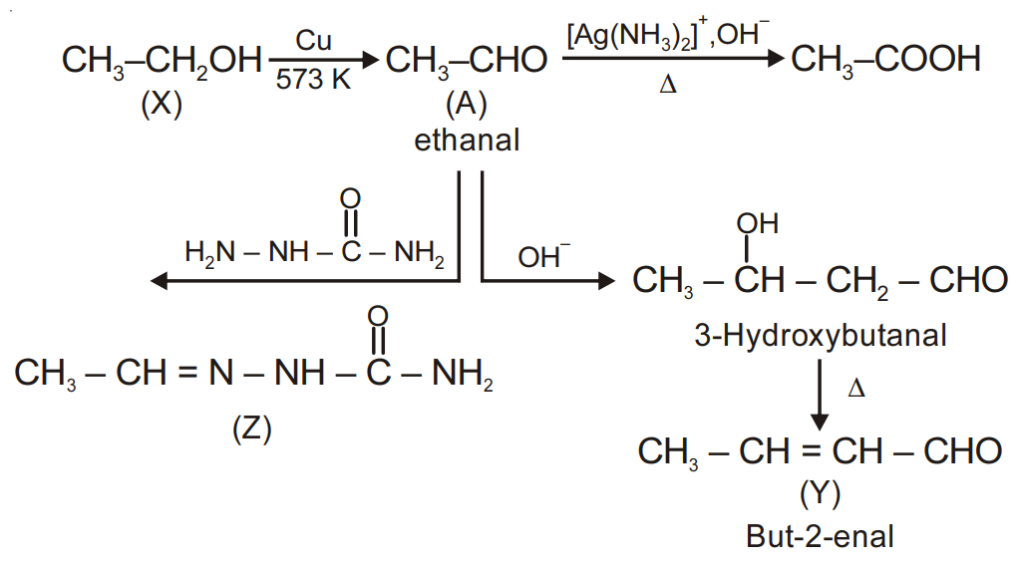
-
In the electrochemical cell: Zn|$ZnSO_4$(0.01M)||$CuSO_4$(1.0 M)|Cu, the emf of this Daniel cell is $E_1$. When the concentration of $ZnSO_4$ is changed to 1.0 M and that of $CuSO_4$ changed to 0.01 M, the emf changes to $E_2$. From the following, which one is the relationship between $E_1$ and $E_2$? (Given, $\frac{RT}{F} = 0.059$)
Smaller $[Zn^{2+}]/[Cu^{2+}]$ gives larger emf.
$E_1 = E^\circ_{cell} - \frac{2.303RT}{2F}\log\frac{(0.01)}{1}$ When the concentrations are changed: $E_2 = E^\circ_{cell} - \frac{2.303RT}{2F}\log\frac{1}{0.01}$ i.e. $E_1 > E_2$ -
In which pair of ions both the species contain S – S bond?
S–S bonds occur in thiosulphate and tetrathionate.
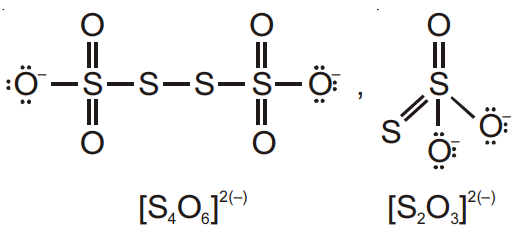
Tetrathionate $S_4O_6^{2-}$ has S–S–S–S linkage and thiosulphate $S_2O_3^{2-}$ has an S–S bond, whereas $S_2O_7^{2-}$ and $S_2O_8^{2-}$ have S–O–S and S–O–O–S linkages. -
Correct increasing order for the wavelengths of absorption in the visible region for the complexes of $Co^{3+}$ is
Stronger field ligand → larger $\Delta_o$ → shorter absorbed wavelength.
The order of the ligands in the spectrochemical series is $H_2O < NH_3 < en$. Hence the wavelength of the light observed will be in the order $[Co(H_2O)_6]^{3+} < [Co(NH_3)_6]^{3+} < [Co(en)_3]^{3+}$. Thus the wavelength absorbed will be in the opposite order, i.e. $[Co(en)_3]^{3+} < [Co(NH_3)_6]^{3+} < [Co(H_2O)_6]^{3+}$. -
Ionic mobility of which of the following alkali metal ions is lowest when aqueous solution of their salts are put under an electric field?
Heavy hydration makes $Li^+(aq)$ the largest and slowest ion.
$Li^+$, being smallest, has maximum charge density. $\therefore$ $Li^+$ is the most heavily hydrated among all alkali metal ions, so its effective size in aqueous solution is the largest. $\therefore$ It moves slowest under an electric field. -
The equilibrium constants of the following are:
$N_2 + 3H_2 \rightleftharpoons 2NH_3$, $K_1$;
$N_2 + O_2 \rightleftharpoons 2NO$, $K_2$;
$H_2 + \frac{1}{2}O_2 \rightarrow H_2O$, $K_3$.
The equilibrium constant (K) of the reaction:
$2NH_3 + \frac{5}{2}O_2 \rightleftharpoons 2NO + 3H_2O$, will beAdding reactions multiplies K; reversing inverts it; multiplying by n raises to power n.
(I) $N_2 + 3H_2 \rightleftharpoons 2NH_3$; $K_1 = \frac{[NH_3]^2}{[N_2][H_2]^3}$
(II) $N_2 + O_2 \rightleftharpoons 2NO$; $K_2 = \frac{[NO]^2}{[N_2][O_2]}$
(III) $H_2 + \frac{1}{2}O_2 \rightarrow H_2O$; $K_3 = \frac{[H_2O]}{[H_2][O_2]^{1/2}}$
(II + 3 × III – I) gives $2NH_3 + \frac{5}{2}O_2 \rightleftharpoons 2NO + 3H_2O$
$\therefore K = K_2\times K_3^3/K_1$ -
The IUPAC name of the compound
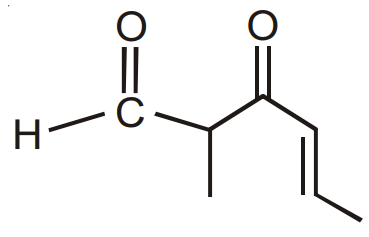 is ________.
CHO gets C1; then the keto group at C3 and C=C at C4.
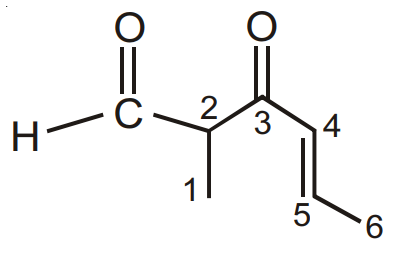
Aldehydes get higher priority over ketones and alkenes in numbering of the principal carbon chain.
$\therefore$ The name is 3-keto-2-methylhex-4-enal (3-oxo-2-methylhex-4-enal).