Looking for classes? Ksquare Career Institute, Bengaluru →

Chemistry
Start Practice Clear paper filter
Showing 1–25 of 45 questions
-
With respect to the conformers of ethane, which of the following statements is true?
Conformers differ only in dihedral angle.
There is no change in bond angles and bond lengths in the conformations of ethane. There is only a change in the dihedral angle. -
Which of the following pairs of compounds is isoelectronic and isostructural?
Both have 3 lone pairs and 2 bond pairs on the central atom (linear).
$IBr_2^-$ and $XeF_2$: the total number of valence electrons is equal in both species and both are linear. -
$HgCl_2$ and $I_2$ both when dissolved in water containing $I^-$ ions the pair of species formed is
$I^-$ forms $[HgI_4]^{2-}$ with $HgCl_2$ and $I_3^-$ with $I_2$.
In a solution containing $HgCl_2$, $I_2$ and $I^-$, both $HgCl_2$ and $I_2$ compete for $I^-$. Since the formation constant of $[HgI_4]^{2-}$ is $1.9\times10^{30}$, which is very large compared with $I_3^-$ ($K_f = 700$), $I^-$ will preferentially combine with $HgCl_2$. $HgCl_2 + 2I^- \rightarrow HgI_2\downarrow$ (red ppt) $+ 2Cl^-$ $HgI_2 + 2I^- \rightarrow [HgI_4]^{2-}$ (soluble) With excess $I^-$, $I_2$ also forms $I_3^-$, so the pair formed is $HgI_4^{2-}$ and $I_3^-$. -
Mixture of chloroxylenol and terpineol acts as
Chloroxylenol + terpineol is Dettol, an antiseptic.
A mixture of chloroxylenol and terpineol (Dettol) acts as an antiseptic. -
Which is the incorrect statement?
Frenkel defects need a large size difference between ions.
Frenkel defect occurs in those ionic compounds in which the sizes of cation and anion are largely different, so the statement about Frenkel defect is incorrect. Non-stoichiometric ferrous oxide is $Fe_{0.93-0.96}O_{1.00}$ and it is due to metal deficiency defect, so the formula $FeO_{0.98}$ in the statement is also incorrect. Note: the source key accepts both the $FeO_{0.98}$ statement and the Frenkel-defect statement as incorrect statements. -
Concentration of the $Ag^+$ ions in a saturated solution of $Ag_2C_2O_4$ is $2.2 \times 10^{-4}\ mol\ L^{-1}$. Solubility product of $Ag_2C_2O_4$ is
$[C_2O_4^{2-}] = [Ag^+]/2$; $K_{sp} = [Ag^+]^2[C_2O_4^{2-}]$.
$Ag_2C_2O_4(s) \rightleftharpoons 2Ag^+(aq) + C_2O_4^{2-}(aq)$, with concentrations 2s and s $K_{SP} = [Ag^+]^2[C_2O_4^{2-}]$ $[Ag^+] = 2.2\times10^{-4}$ M $\therefore [C_2O_4^{2-}] = \frac{2.2\times10^{-4}}{2}$ M $= 1.1\times10^{-4}$ M $\therefore K_{SP} = (2.2\times10^{-4})^2(1.1\times10^{-4}) = 5.324\times10^{-12}$ -
Of the following, which is the product formed when cyclohexanone undergoes aldol condensation followed by heating?
Aldol product dehydrates on heating to an $\alpha,\beta$-unsaturated ketone.
Two molecules of cyclohexanone undergo aldol addition in the presence of $OH^-$; on heating, dehydration gives the $\alpha,\beta$-unsaturated ketone.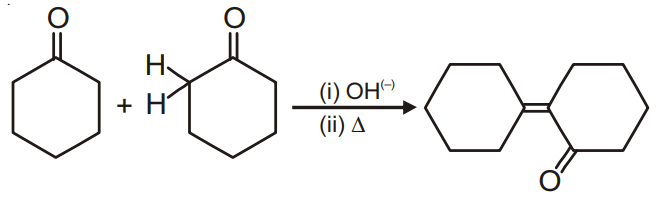
So the product is 2-cyclohexylidenecyclohexanone (two rings joined by a C=C double bond, with C=O on the ring carbon adjacent to it). -
The species, having bond angles of $120^\circ$ is
$BCl_3$ is $sp^2$ trigonal planar.
$BCl_3$ is trigonal planar ($sp^2$ B, no lone pair), with Cl–B–Cl bond angles of $120^\circ$.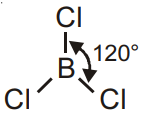
-
If molality of the dilute solution is doubled, the value of molal depression constant ($K_f$) will be
$K_f$ depends only on the solvent.
$K_f$ (molal depression constant) is a characteristic of the solvent and is independent of molality. -
Which one is the most acidic compound?
More electron-withdrawing $-NO_2$ groups at o/p positions increase acidity.
$-NO_2$ group has very strong –I and –R effects. 2,4,6-Trinitrophenol has three $-NO_2$ groups (ortho and para), which stabilise the phenoxide ion most, so it is the most acidic. -
It is because of inability of $ns^2$ electrons of the valence shell to participate in bonding that
Inert pair effect stabilises Pb(II) and makes Sn(II) reducing.
Inability of $ns^2$ electrons of the valence shell to participate in bonding on moving down the group in heavier p-block elements is called the inert pair effect. As a result, Pb(II) is more stable than Pb(IV) and Sn(IV) is more stable than Sn(II). $\therefore$ Pb(IV) is easily reduced to Pb(II), so Pb(IV) is an oxidising agent. Sn(II) is easily oxidised to Sn(IV), so Sn(II) is a reducing agent. -
Predict the correct intermediate and product in the following reaction:

Hg²⁺-catalysed hydration gives an enol that tautomerises to a ketone.
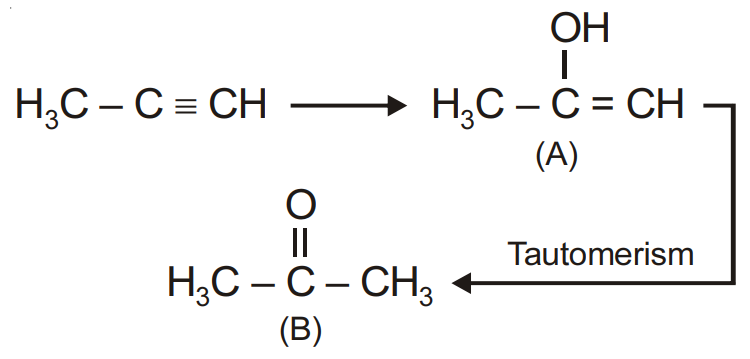
$H_3C-C\equiv CH \xrightarrow{H_2O,\ H_2SO_4,\ HgSO_4} H_3C-C(OH)=CH_2$ (A, enol)
$H_3C-C(OH)=CH_2 \xrightarrow{\text{tautomerism}} H_3C-CO-CH_3$ (B, acetone) -
Which one of the following statements is not correct?
A catalyst does not change K.
A catalyst decreases the activation energies of both the forward and backward reactions by the same amount; therefore it speeds up both forward and backward reactions equally. The equilibrium constant is therefore not affected by a catalyst at a given temperature. -
Which one is the wrong statement?
In one-electron species, orbitals with the same n are degenerate.
The energies of the 2s-orbital and 2p-orbital in hydrogen-like atoms are equal (energy depends only on n). So the statement that 2s is lower in energy than 2p for hydrogen-like atoms is wrong. -
A gas is allowed to expand in a well insulated container against a constant external pressure of 2.5 atm from an initial volume of 2.50 L to a final volume of 4.50 L. The change in internal energy $\Delta U$ of the gas in joules will be
Insulated means q = 0, so $\Delta U = -P_{ext}\Delta V$.
$\Delta U = q + w$ For an adiabatic process, q = 0, so $\Delta U = w$ $w = -P\Delta V = -2.5\ atm\times(4.5 - 2.5)$ L $= -2.5\times2$ L-atm $= -5\times101.3$ J $= -506.5$ J $\approx -505$ J -
Consider the reactions:
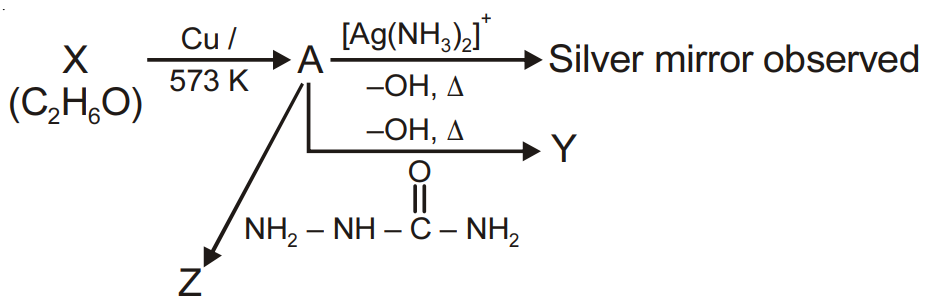
Identify A, X, Y and ZDehydrogenation of ethanol gives ethanal, which shows Tollens', aldol and semicarbazone reactions.
Since 'A' gives a positive silver mirror test, it must be an aldehyde or an $\alpha$-hydroxyketone.
Reaction with semicarbazide indicates that A can be an aldehyde or ketone.
Reaction with dilute $OH^-$ (aldol condensation) indicates that A is an aldehyde, as the aldol reaction of ketones is reversible and needs special apparatus.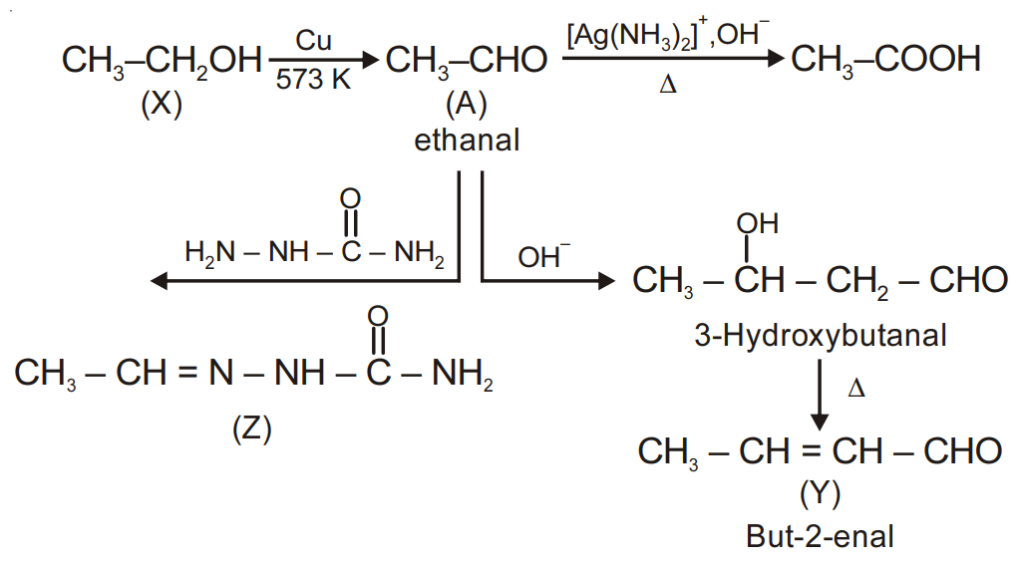
-
Which one is the correct order of acidity?
Acidity follows s-character: sp > sp² > sp³.
Correct order is $H-C\equiv C-H > H_3C-C\equiv C-H > H_2C=CH_2 > CH_3-CH_3$ Ethyne has two acidic hydrogens and propyne one; sp carbon (more s-character) makes C–H more acidic than $sp^2$, which is more acidic than $sp^3$. -
In the electrochemical cell: Zn|$ZnSO_4$(0.01M)||$CuSO_4$(1.0 M)|Cu, the emf of this Daniel cell is $E_1$. When the concentration of $ZnSO_4$ is changed to 1.0 M and that of $CuSO_4$ changed to 0.01 M, the emf changes to $E_2$. From the following, which one is the relationship between $E_1$ and $E_2$? (Given, $\frac{RT}{F} = 0.059$)
Smaller $[Zn^{2+}]/[Cu^{2+}]$ gives larger emf.
$E_1 = E^\circ_{cell} - \frac{2.303RT}{2F}\log\frac{(0.01)}{1}$ When the concentrations are changed: $E_2 = E^\circ_{cell} - \frac{2.303RT}{2F}\log\frac{1}{0.01}$ i.e. $E_1 > E_2$ -
The correct increasing order of basic strength for the following compounds is:
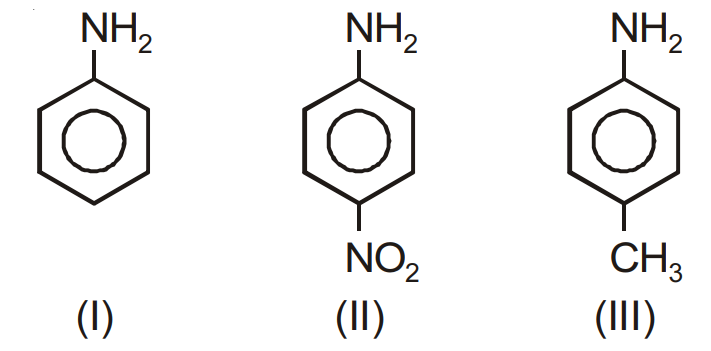
Electron-withdrawing groups reduce, and donating groups increase, amine basicity.
$-NO_2$ has a strong –R effect, which decreases the basicity; $-CH_3$ shows +R (hyperconjugation) and +I effects, which increase the basicity.
Order of basic strength: p-nitroaniline < aniline < p-toluidine, i.e. II < I < III.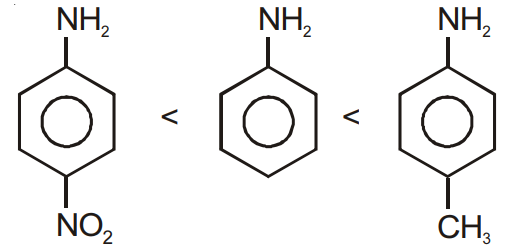
-
In which pair of ions both the species contain S – S bond?
S–S bonds occur in thiosulphate and tetrathionate.
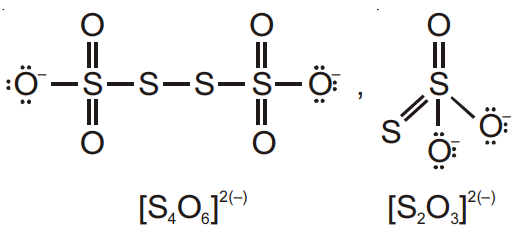
Tetrathionate $S_4O_6^{2-}$ has S–S–S–S linkage and thiosulphate $S_2O_3^{2-}$ has an S–S bond, whereas $S_2O_7^{2-}$ and $S_2O_8^{2-}$ have S–O–S and S–O–O–S linkages. -
The correct order of the stoichiometries of AgCl formed when $AgNO_3$ in excess is treated with the complexes: $CoCl_3\cdot6NH_3$, $CoCl_3\cdot5NH_3$, $CoCl_3\cdot4NH_3$ respectively is
Only counter-ion chlorides precipitate with $AgNO_3$.
The complexes are respectively $[Co(NH_3)_6]Cl_3$, $[Co(NH_3)_5Cl]Cl_2$ and $[Co(NH_3)_4Cl_2]Cl$. Only ionisable (outside-sphere) $Cl^-$ precipitates as AgCl: 3, 2 and 1 respectively. -
Match the interhalogen compounds of column I with the geometry in column II and assign the correct code
Pick the matching item from Column II for each row.
Column I
- a. XX'
- b. XX'$_3$
- c. XX'$_5$
- d. XX'$_7$
Column II
- i. T-shape
- ii. Pentagonal bipyramidal
- iii. Linear
- iv. Square-pyramidal
- v. Tetrahedral
Correct answer: a → iii, b → i, c → iv, d → ii
XX' linear, XX'₃ T-shaped, XX'₅ square pyramidal, XX'₇ pentagonal bipyramidal.
XX' – linear XX'$_3$ – example: $ClF_3$ – T-shape XX'$_5$ – example: $BrF_5$ – square pyramidal XX'$_7$ – example: $IF_7$ – pentagonal bipyramidal Correct match: a-iii, b-i, c-iv, d-ii. -
The reason for greater range of oxidation states in actinoids is attributed to
Comparable energies of 5f, 6d and 7s allow variable oxidation states.
It is a fact: the 5f, 6d and 7s levels in actinoids have comparable energies, so electrons from all of them can take part in bonding, giving a wide range of oxidation states. -
A 20 litre container at 400 K contains $CO_2$(g) at pressure 0.4 atm and an excess of SrO (neglect the volume of solid SrO). The volume of the containers is now decreased by moving the movable piston fitted in the container. The maximum volume of the container, when pressure of $CO_2$ attains its maximum value, will be (Given that: $SrCO_3(s) \rightleftharpoons SrO(s) + CO_2(g)$, $K_p$ = 1.6 atm)
$P_{CO_2}$ can rise to $K_p$ = 1.6 atm; Boyle's law with fixed n gives V = 5 L.
Maximum pressure of $CO_2$ = pressure of $CO_2$ at equilibrium. For $SrCO_3(s) \rightleftharpoons SrO(s) + CO_2(g)$: $K_p = P_{CO_2} = 1.6$ atm = maximum pressure of $CO_2$ Volume of container at this stage: $V = \frac{nRT}{P}$ ...(i) Since the container is sealed and the reaction was not earlier at equilibrium, n = constant. $n = \frac{PV}{RT} = \frac{0.4\times20}{RT}$ ...(ii) Put (ii) in (i): $V = \left[\frac{0.4\times20}{RT}\right]\frac{RT}{1.6} = 5$ L -
The correct statement regarding electrophile is
Electrophiles are neutral or positive electron-pair acceptors.
Fact: an electrophile is an electron-deficient species, either neutral or positively charged, that forms a bond by accepting an electron pair from a nucleophile.