Looking for classes? Ksquare Career Institute, Bengaluru →

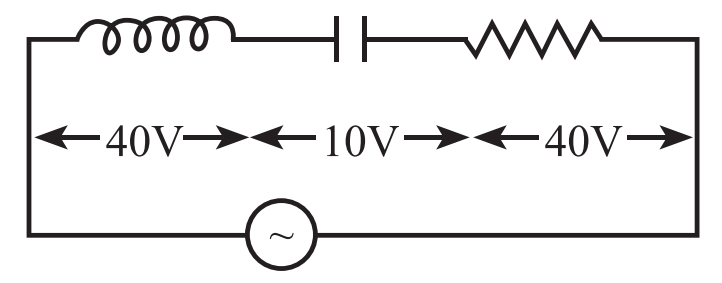
An inductor of inductance $L$, a capacitor of capacitance $C$ and a resistor of resistance $R$ are connected in series to an ac source of potential difference $V$ volts as shown in figure. Potential difference across $L$, $C$ and $R$ is 40 V, 10 V and 40 V, respectively. The amplitude of current flowing through LCR series circuit is $10\sqrt{2}\ A$. The impedance of the circuit is:
A
$5/\sqrt{2}\ \Omega$
B
$4\ \Omega$
C
$5\ \Omega$
D
$4\sqrt{2}\ \Omega$
Detailed Solution
$I_0 = 10\sqrt{2}$ A, so $I_{rms} = \frac{I_0}{\sqrt{2}} = 10$ A
$V_{rms} = \sqrt{V_R^2 + (V_L - V_C)^2} = \sqrt{40^2 + (40 - 10)^2} = 50$ V
$Z = \frac{V_{rms}}{I_{rms}} = \frac{50}{10} = 5\ \Omega$
$V_{rms} = \sqrt{V_R^2 + (V_L - V_C)^2} = \sqrt{40^2 + (40 - 10)^2} = 50$ V
$Z = \frac{V_{rms}}{I_{rms}} = \frac{50}{10} = 5\ \Omega$