Looking for classes? Ksquare Career Institute, Bengaluru →

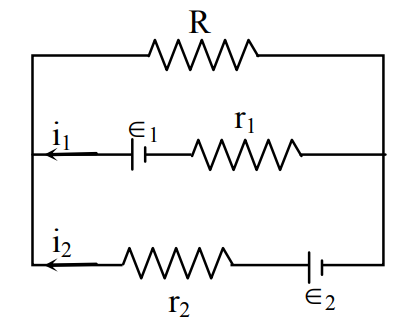
See the electrical circuit shown in this figure. Which of the following equations is a correct equation for it?
A
$\varepsilon_1 - (i_1 + i_2)R + i_1r_1 = 0$
B
$\varepsilon_1 - (i_1 + i_2)R - i_1r_1 = 0$
C
$\varepsilon_2 - i_1r_2 - \varepsilon_1 - i_1r_1 = 0$
D
$-\varepsilon_2 - (i_1 + i_2)R + i_2r_2 = 0$
Detailed Solution
In the circuit, the cell $\varepsilon_1$ (internal resistance $r_1$) carries current $i_1$ and the cell $\varepsilon_2$ (internal resistance $r_2$) carries current $i_2$; both currents combine and flow through the external resistance R.
By Kirchhoff's junction rule, the current through R is $(i_1 + i_2)$.
Apply Kirchhoff's loop rule to the loop containing $\varepsilon_1$, $r_1$ and R: the emf equals the sum of the potential drops.
Potential drop across R = $(i_1 + i_2)R$; potential drop across $r_1$ = $i_1r_1$
$\varepsilon_1 - (i_1 + i_2)R - i_1r_1 = 0$
(Similarly, for the other loop: $\varepsilon_2 - (i_1 + i_2)R - i_2r_2 = 0$.)
By Kirchhoff's junction rule, the current through R is $(i_1 + i_2)$.
Apply Kirchhoff's loop rule to the loop containing $\varepsilon_1$, $r_1$ and R: the emf equals the sum of the potential drops.
Potential drop across R = $(i_1 + i_2)R$; potential drop across $r_1$ = $i_1r_1$
$\varepsilon_1 - (i_1 + i_2)R - i_1r_1 = 0$
(Similarly, for the other loop: $\varepsilon_2 - (i_1 + i_2)R - i_2r_2 = 0$.)