Looking for classes? Ksquare Career Institute, Bengaluru →

Physics
Electrostatic Potential and Capacitance
76 questions from 37 papers, each with its answer.
- 76 questions
- 37 papers
- 4.31% of Physics
Potential due to a Charged Conducting Sphere
-
Two hollow conducting sphere of radii $R_1$ and $R_2$ ($R_1\gg R_2$) have equal charges. The potential would be:$V = \frac{1}{4\pi\epsilon_0}\cdot\frac{Q}{R}$ $\frac{1}{4\pi\epsilon_0}$ = constant and Q is the same (given), so $V \propto \frac{1}{R}$ Since $R_1 \gg R_2$, the potential is more on the smaller sphere.
Equipotential Surfaces
-
The angle between the electric lines of force and the equipotential surface is :The electric field is always perpendicular to an equipotential surface (no work is done in moving a charge along it). So the angle between the electric lines of force and the equipotential surface is $90^\circ$.
Sharing of Charge between Capacitors
-
A capacitor of capacitance $C=900\ pF$ is charged fully by 100 V battery B as shown in figure (a). Then it is disconnected from the battery and connected to another uncharged capacitor of capacitance $C=900\ pF$ as shown in figure (b). The electrostatic energy stored by the system (b) is
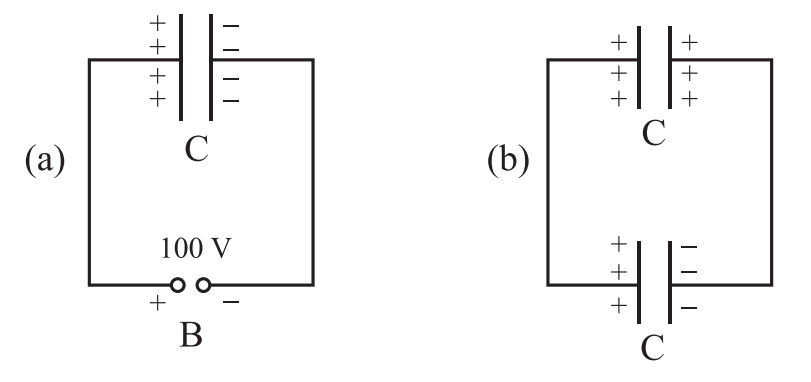 Common potential $V_c = \frac{C_1V_1 + C_2V_2}{C_1 + C_2} = \frac{C \times 100 + C \times 0}{C + C} = 50$ V Energy stored in system (b) $= 2 \times \frac{1}{2}CV_c^2 = CV_c^2$ $= 900 \times 10^{-12} \times 50 \times 50 = 2.25 \times 10^{-6}$ J
That is every question in Electrostatic Potential and Capacitance for this filter.
Want a score?
Answers here are not saved. Practise as a test to be marked and see your progress.
Practise as a test