Looking for classes? Ksquare Career Institute, Bengaluru →

Physics
Electrostatic Potential and Capacitance
76 questions from 37 papers, each with its answer.
- 76 questions
- 37 papers
- 4.31% of Physics
Energy loss on sharing charge between capacitors
-
A capacitor is charged by a battery. The battery is removed and another identical uncharged capacitor is connected in parallel. The total electrostatic energy of resulting system
Common potential V/2 halves the stored energy.
Charge on capacitor $q = CV$ When it is connected with another uncharged capacitor: $V_c = \frac{q_1 + q_2}{C_1 + C_2} = \frac{q_0}{C + C} = \frac{V}{2}$ Initial energy $U_i = \frac{1}{2}CV^2$ Final energy $U_f = \frac{1}{2}C\left(\frac{V}{2}\right)^2 + \frac{1}{2}C\left(\frac{V}{2}\right)^2 = \frac{CV^2}{4}$ Loss of energy $= U_i - U_f = \frac{CV^2}{4}$ i.e. the energy decreases by a factor of 2.
Equipotential surfaces and work done
-
The diagrams below show regions of equipotentials. A positive charge is moved from A to B in each diagram.
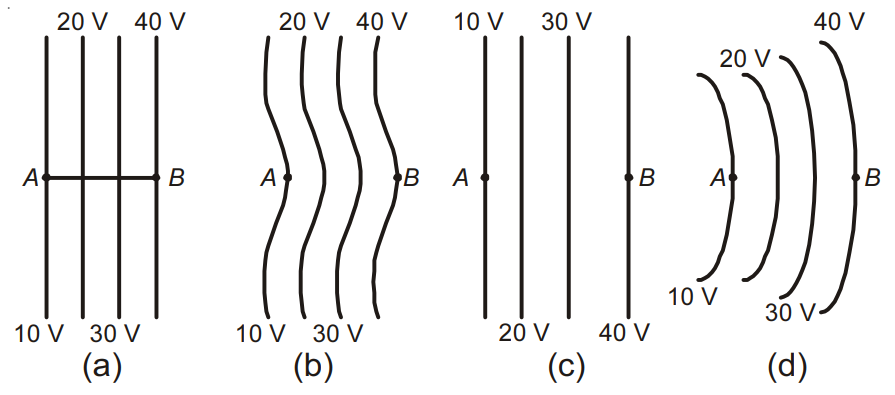
Work depends only on the potential difference between A and B.
Work done $W = q\Delta V$ $\Delta V$ between A and B is the same in all the cases, so the work done is the same in all four cases.
That is every question in Electrostatic Potential and Capacitance for this filter.
Want a score?
Answers here are not saved. Practise as a test to be marked and see your progress.
Practise as a test