Looking for classes? Ksquare Career Institute, Bengaluru →

Physics
Laws of Motion
72 questions from 37 papers, each with its answer.
- 72 questions
- 37 papers
- 4.08% of Physics
Dynamics of uniform circular motion
-
One end of string of length l is connected to a particle of mass 'm' and the other end is connected to a small peg on a smooth horizontal table. If the particle moves in circle with speed 'v', the net force on the particle (directed towards center) will be (T represents the tension in the string)
On a smooth horizontal table, tension alone supplies the centripetal force.
The centripetal force $\left(\frac{mv^2}{l}\right)$ is provided by the tension, so the net force towards the centre is equal to the tension, i.e. T.
Spring force – sudden release (cutting the string)
-
Two blocks A and B of masses 3m and m respectively are connected by a massless and inextensible string. The whole system is suspended by a massless spring as shown in figure. The magnitudes of acceleration of A and B immediately after the string is cut, are respectively
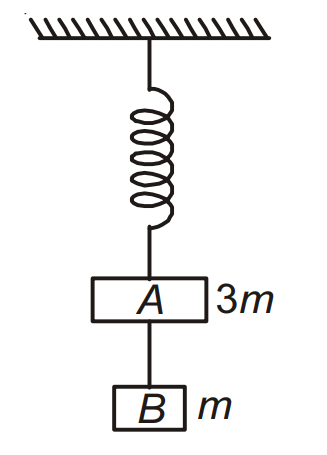
Spring force cannot change instantly; string tension vanishes.
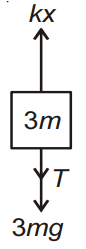
Before the string is cut: $kx = T + 3mg$ ...(1) and $T = mg$ ...(2), so $kx = 4mg$
After the string is cut, T = 0.
For A: $a = \frac{kx - 3mg}{3m} = \frac{4mg - 3mg}{3m} = \frac{g}{3}$
For B: only mg acts, so a = g
So the accelerations of A and B are $\frac{g}{3}$ and g.
That is every question in Laws of Motion for this filter.
Want a score?
Answers here are not saved. Practise as a test to be marked and see your progress.
Practise as a test