Looking for classes? Ksquare Career Institute, Bengaluru →

Physics
Motion in a Straight Line
45 questions from 30 papers, each with its answer.
- 45 questions
- 30 papers
- 2.55% of Physics
Motion under Gravity
-
The ratio of the distance traveled by a freely falling body in the $1^{st}$, $2^{nd}$, $3^{rd}$ and $4^{th}$ second :Distance in the $n^{th}$ second: $S_n = u + \frac{a}{2}(2n - 1)$ For free fall from rest, u = 0: $S_n = \frac{g}{2}(2n - 1) \propto (2n - 1)$ $S_1 : S_2 : S_3 : S_4 = [2(1)-1] : [2(2)-1] : [2(3)-1] : [2(4)-1]$ $= 1 : 3 : 5 : 7$
Position-Time Graphs
-
The displacement time graphs of two moving particle make angles of $30^\circ$ and $45^\circ$ with the x-axis as shown in the figure. The ratio of their respective velocity is :
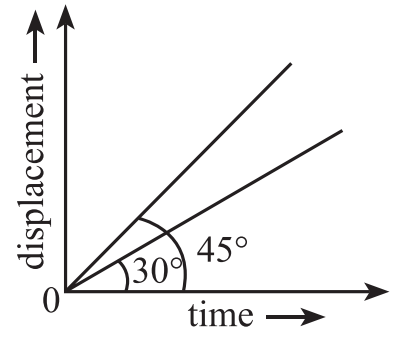 Velocity = slope of the displacement-time graph: $v = \frac{dx}{dt} = \tan\theta$ $\frac{v_1}{v_2} = \frac{\tan 30^\circ}{\tan 45^\circ} = \frac{1/\sqrt{3}}{1} = \frac{1}{\sqrt{3}}$ So $v_1 : v_2 = 1 : \sqrt{3}$
That is every question in Motion in a Straight Line for this filter.
Want a score?
Answers here are not saved. Practise as a test to be marked and see your progress.
Practise as a test