Looking for classes? Ksquare Career Institute, Bengaluru →

Physics
Semiconductor Electronics
12 questions from 4 papers, each with its answer.
- 12 questions
- 4 papers
- 0.68% of Physics
p-n junction diode – effect of temperature
-
In a p-n junction diode, change in temperature due to heating
Heating generates more electron-hole pairs, altering both forward and reverse behaviour.
Due to heating, the number of electron-hole pairs will increase, so the overall resistance of the diode will change. Due to this, both forward biasing and reverse biasing characteristics are changed. So heating affects the overall V–I characteristics of the p-n junction.
Logic gates – combination of gates
-
The given electrical network is equivalent to
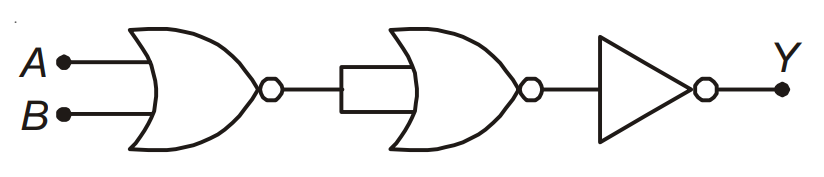
The combination reduces to $Y = \overline{A+B}$.
[add image: NOR gate followed by NOR gate (as NOT) and a NOT gate] $Y = \overline{A + B}$ So the network is equivalent to a NOR gate.
p-n junction diode – forward and reverse bias
-
Which one of the following represents forward bias diode?
Forward bias: p-side potential higher than n-side.
In forward bias, the p-type semiconductor is at a higher potential with respect to the n-type semiconductor. Only in the first circuit is the p-side (0 V) at a higher potential than the n-side (–2 V), so it is forward biased.
Logic gates – combination of OR and AND
-
To get output 1 for the following circuit, the correct choice for the input is
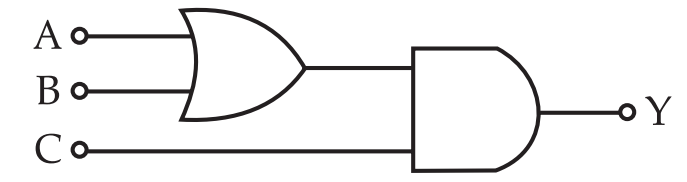
Y = (A + B)·C, so C must be 1 and at least one of A, B must be 1.
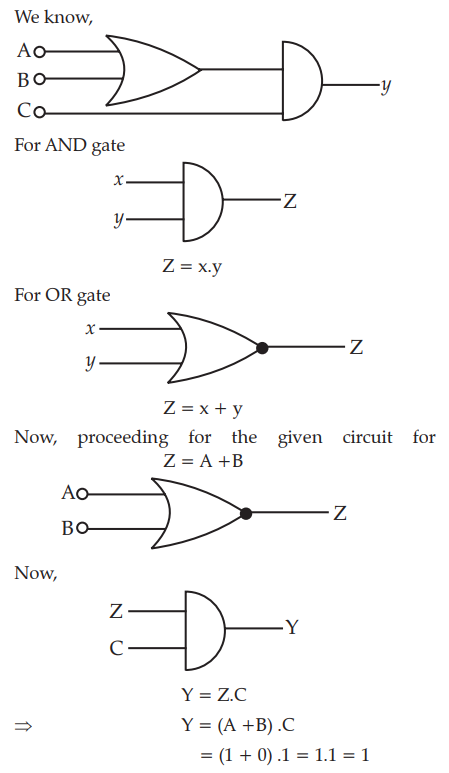
For an AND gate, Z = x·y; for an OR gate, Z = x + y.
For the given circuit, Z = A + B, and Y = Z·C = (A + B)·C.
Checking the options: A = 1, B = 0, C = 0 gives (1 + 0)·0 = 0; A = 1, B = 1, C = 0 gives 0; A = 1, B = 0, C = 1 gives (1 + 0)·1 = 1; A = 0, B = 1, C = 0 gives 0.
So the output is 1 for A = 1, B = 0, C = 1.
Ideal diode in a circuit
-
Consider the junction diode as ideal. The value of current flowing through AB is
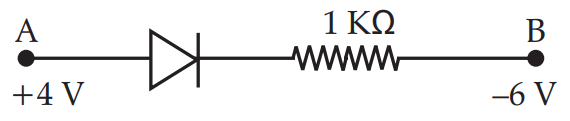
An ideal forward-biased diode has zero resistance.

The ideal diode is forward biased, so $I = \frac{V_A - V_B}{R} = \frac{4 - (-6)}{1000}$ A
$I = \frac{10}{1000} = 10^{-2}$ A
CE amplifier – voltage gain
-
For CE transistor amplifier, the audio signal voltage across the collector resistance of 2 k$\Omega$ is 4 V. If the current amplification factor of the transistor is 100 and the base resistance is 1 k$\Omega$, then the input signal voltage is:
$A_V = \beta R_C/R_B = 200$.
$\beta = 100$; $V_0 = 4$ V; $R_i = 10^{3}\ \Omega$; $R_0 = 2\times10^{3}\ \Omega$
$\frac{V_0}{V_i} = \beta\frac{R_0}{R_i} \Rightarrow \frac{4}{V_i} = 100\times\frac{2\times10^3}{10^3}$
$V_i = 20$ mV
Ideal diodes in a circuit
-
The given circuit has two ideal diodes connected as shown in the figure below. The current flowing through the resistance $R_1$ will be:
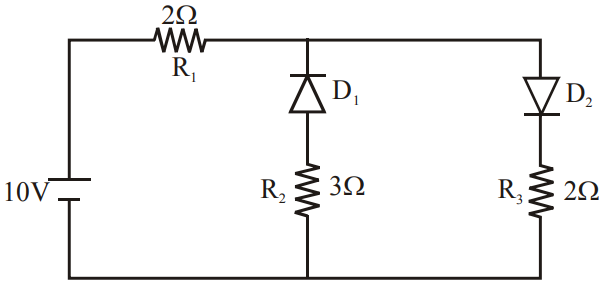
Reverse-biased branch carries no current.
Current will not flow through $D_1$ as it is reverse biased. Current flows through the cell, $R_1$, $D_2$ and $R_3$.
$\therefore i = \frac{10}{2 + 2} = 2.5$ A
Logic gates – AND followed by NAND
-
What is the output Y in the following circuit, when all the three inputs A, B, C are first 0 and then 1?
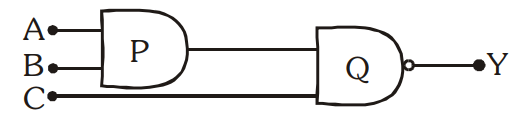
$Y = \overline{ABC}$.
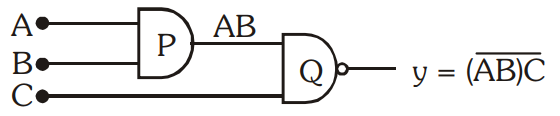
$y = \overline{(AB)C}$
For A = B = C = 0: y = 1
For A = B = C = 1: y = 0
That is every question in Semiconductor Electronics for this filter.
Want a score?
Answers here are not saved. Practise as a test to be marked and see your progress.
Practise as a test