Looking for classes? Ksquare Career Institute, Bengaluru →

Physics
Motion in a Plane
56 questions from 29 papers, each with its answer.
- 56 questions
- 29 papers
- 3.17% of Physics
Uniform Circular Motion
-
A particle moving with uniform speed in a circular path maintains;In uniform circular motion, the speed is constant but the direction of velocity changes continuously; since velocity is a vector, it is varying. The centripetal acceleration has constant magnitude $\frac{v^2}{r}$ but its direction (towards the centre) keeps changing, so acceleration is also varying. So the particle has varying velocity and varying acceleration.
-
A particle moves in a circle of radius 5 cm with constant speed and time period $0.2\pi$ s. The acceleration of the particle isR = 5 cm = $5\times10^{-2}$ m, T = $0.2\pi$ s.
Angular speed $\omega = \frac{2\pi}{T} = \frac{2\pi}{0.2\pi} = 10$ rad/s
For constant speed the only acceleration is centripetal: $a = \omega^2R$
$a = (10)^2\times5\times10^{-2} = 100\times0.05$
a = 5 m/$s^2$ -
A stone tied to the end of a string of 1 m long is whirled in a horizontal circle with a constant speed. If the stone makes 22 revolutions in 44 seconds, what is the magnitude and direction of acceleration of the stone -Frequency: $n = \dfrac{22}{44} = \dfrac{1}{2}$ revolution per second
Angular speed: $\omega = 2\pi n = 2\pi \times \dfrac{1}{2} = \pi$ rad/s
Centripetal acceleration: $a_r = \omega^2 r = (2\pi n)^2 r$
$a_r = (\pi)^2 \times 1 = \pi^2$ m s$^{-2}$
The speed is constant, so the tangential acceleration is zero: $a_T = 0$.
So the acceleration is $\pi^2$ m s$^{-2}$, directed along the radius towards the centre. -
Two particles having mass 'M' and 'm' are moving in a circular path having radius R and r respectively. If their time periods are same then the ratio of angular velocity will be : -Angular velocity: $\omega = \dfrac{2\pi}{T}$
It depends only on the time period, not on the mass or the radius.
Both particles have the same time period T, so $\omega_1 = \omega_2$.
$\dfrac{\omega_1}{\omega_2} = 1$
(Their linear speeds $v = \omega r$ are different, in the ratio R : r.)
Projectile Motion
-
A bullet is fired from a gun at the speed of $280\ m/s$ in the direction $30^\circ$ above the horizontal. The maximum height attained by the bullet is ($g=9.8\ ms^{-2}$, $\sin30^\circ=0.5$)
$h_{max}=\frac{u^2\sin^2\theta}{2g}=1000\ m$.
$h_{max}=\frac{u^2\sin^2\theta}{2g}=\frac{280\times280}{2\times9.8}\times\frac{1}{4}=1000\ m$ -
The velocity of a projectile at the initial point A is $(2\hat i + 3\hat j)$ m/s. Its velocity (in m/s) at point B is:
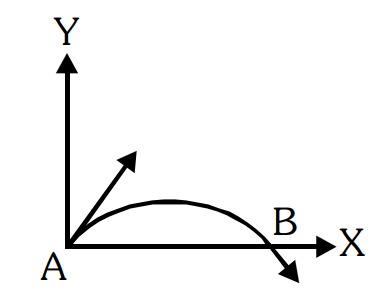 B is at the same level as A. The horizontal component of velocity stays the same and the vertical component is reversed.
So the velocity at B is $2\hat i - 3\hat j$ m/s. -
The horizontal range and the maximum height of a projectile are equal. The angle of projection of the projectile isMaximum height $H = \frac{u^2\sin^2\theta}{2g}$; range $R = \frac{2u^2\sin\theta\cos\theta}{g}$
H = R: $\frac{u^2\sin^2\theta}{2g} = \frac{2u^2\sin\theta\cos\theta}{g}$
$\sin\theta = 4\cos\theta \Rightarrow \tan\theta = 4$
$\theta = \tan^{-1}(4)$ -
A missile is fired for maximum range with an initial velocity of 20 m/s. If g = 10 m/$s^2$, the range of the missile isRange of a projectile: $R = \frac{u^2\sin2\theta}{g}$
The range is maximum when $\sin2\theta = 1$, i.e., $\theta = 45^\circ$.
$R_{max} = \frac{u^2}{g}$
$R_{max} = \frac{(20)^2}{10} = \frac{400}{10}$
$R_{max} = 40$ m -
The speed of a projectile at its maximum height is half of its initial speed. The angle of projection isLet the initial speed be $v_0$ and the angle of projection be $\theta$.
At the maximum height the vertical component of velocity is zero; only the horizontal component remains: $v = v_0\cos\theta$
Given $v = \frac{v_0}{2}$: $\frac{v_0}{2} = v_0\cos\theta$
$\cos\theta = \frac{1}{2}$
$\theta = 60^\circ$ -
For angles of projection of a projectile at angles $(45^\circ - \theta)$ and $(45^\circ + \theta)$, the horizontal ranges described by the projectile are in the ratio of :Horizontal range: $R = \dfrac{u^2\sin 2\alpha}{g}$
$R_1 = \dfrac{u^2\sin 2(45^\circ - \theta)}{g} = \dfrac{u^2\sin(90^\circ - 2\theta)}{g} = \dfrac{u^2\cos 2\theta}{g}$
$R_2 = \dfrac{u^2\sin 2(45^\circ + \theta)}{g} = \dfrac{u^2\sin(90^\circ + 2\theta)}{g} = \dfrac{u^2\cos 2\theta}{g}$
$\dfrac{R_1}{R_2} = \dfrac{\cos 2\theta}{\cos 2\theta} = 1$
In other words, $(45^\circ - \theta)$ and $(45^\circ + \theta)$ are complementary angles (their sum is $90^\circ$), and for complementary angles of projection the range is the same.
So the ranges are in the ratio 1 : 1. -
A particle is projected making angle $45^\circ$ with horizontal having kinetic energy K. The kinetic energy at highest point will be : -At the highest point, the vertical component of velocity is zero and only the horizontal component $u\cos\theta$ remains.
$K' = \dfrac{1}{2}m(u\cos\theta)^2 = K\cos^2\theta$
$K' = K\cos^2 45^\circ = K\left(\dfrac{1}{\sqrt{2}}\right)^2 = \dfrac{K}{2}$
Uniform Circular Motion – Angular Speed
-
Two particles A and B are moving in uniform circular motion in concentric circles of radius $r_A$ and $r_B$ with speed $v_A$ and $v_B$ respectively. The time period of rotation is the same. The ratio of angular speed of A to that of B will be:Given $T_A=T_B=T$. $\omega_A=\frac{2\pi}{T_A}$, $\omega_B=\frac{2\pi}{T_B}$ $\frac{\omega_A}{\omega_B}=\frac{T_B}{T_A}=\frac{T}{T}=1$ Ratio $=1:1$
Projectile motion - maximum height
-
A cricket ball is thrown by a player at a speed of 20 m/s in a direction $30^\circ$ above the horizontal. The maximum height attained by the ball during its motion is ($g=10$ m/s$^2$)$H=\frac{u^2\sin^2\theta}{2g}=\frac{(20)^2\times(1/2)^2}{2\times10}=5$ m.
Horizontal projectile motion
-
A particle (A) is dropped from a height and another particle (B) is projected in horizontal direction with speed of 5 m/s from the same height then correct statement is : -For particle A (dropped from rest): $h = \dfrac{1}{2}gt_A^2 \Rightarrow t_A = \sqrt{\dfrac{2h}{g}}$
For particle B (projected horizontally), the initial vertical velocity is zero ($u_y = 0$). The horizontal velocity does not affect the vertical motion.
In the vertical direction, using $s = ut + \dfrac{1}{2}at^2$: $h = \dfrac{1}{2}gt_B^2 \Rightarrow t_B = \sqrt{\dfrac{2h}{g}}$
So $t_A = t_B$: both reach the ground simultaneously.
Their speeds on reaching the ground are different, since B also has a horizontal velocity of 5 m/s.
So both particles will reach the ground simultaneously.
Velocity and acceleration from position coordinates
-
The x and y coordinates of the particle at any time are $x = 5t - 2t^2$ and $y = 10t$ respectively, where x and y are in meters and t in seconds. The acceleration of the particle at t = 2 s is
Differentiate twice: $a_x = -4$, $a_y = 0$ at all times.
$x = 5t - 2t^2$, $y = 10t$ $v_x = \frac{dx}{dt} = 5 - 4t$, $v_y = \frac{dy}{dt} = 10$ $a_x = \frac{dv_x}{dt} = -4$, $a_y = \frac{dv_y}{dt} = 0$ Acceleration of the particle at t = 2 s is $-4\ m/s^2$.
Vector addition and subtraction
-
If the magnitude of sum of two vectors is equal to the magnitude of difference of the two vectors, the angle between these vectors is
$|P+Q| = |P-Q|$ only when $\cos\theta = 0$.
$|\vec{P} + \vec{Q}| = |\vec{P} - \vec{Q}|$
Squaring: $P^2 + Q^2 + 2PQ\cos\theta = P^2 + Q^2 - 2PQ\cos\theta$
$\Rightarrow 4PQ\cos\theta = 0 \Rightarrow \cos\theta = 0$
$\theta = \frac{\pi}{2} = 90^\circ$
Average velocity
-
A particle is moving such that its position coordinates (x, y) are (2 m, 3 m) at time t = 0, (6 m, 7 m) at time t = 2 s and (13 m, 14 m) at time t = 5 s. Average velocity vector $(\vec V_{av})$ from t = 0 to t = 5 s is:$\vec v_{av} = \frac{\Delta\vec r}{\Delta t} = \frac{(13-2)\hat i + (14-3)\hat j}{5 - 0} = \frac{11}{5}(\hat i + \hat j)$
Motion with constant acceleration
-
A particle has initial velocity $(2\hat i + 3\hat j)$ and acceleration $(0.3\hat i + 0.2\hat j)$. The magnitude of velocity after 10 seconds will be$\vec v = \vec u + \vec at$
$= (2\hat i + 3\hat j) + (0.3\hat i + 0.2\hat j)\times10$
$= (2 + 3)\hat i + (3 + 2)\hat j = 5\hat i + 5\hat j$
$|\vec v| = \sqrt{5^2 + 5^2} = 5\sqrt2$ units
Vectors and average acceleration
-
A body is moving with velocity 30 m/s towards east. After 10 seconds its velocity becomes 40 m/s towards north. The average acceleration of the body isInitial velocity $\vec{v_i} = 30\hat{i}$ m/s (east); final velocity $\vec{v_f} = 40\hat{j}$ m/s (north).
Change in velocity $\Delta\vec{v} = \vec{v_f} - \vec{v_i} = 40\hat{j} - 30\hat{i}$
$|\Delta\vec{v}| = \sqrt{40^2 + 30^2} = \sqrt{1600 + 900} = \sqrt{2500} = 50$ m/s
Average acceleration $= \frac{|\Delta\vec{v}|}{t} = \frac{50}{10}$
= 5 m/$s^2$
Motion in a plane
-
A particle moves in x-y plane according to rule $x = a\sin\omega t$ and $y = a\cos\omega t$. The particle follows$\frac{x}{a} = \sin\omega t$ and $\frac{y}{a} = \cos\omega t$
Squaring and adding to eliminate t: $\frac{x^2}{a^2} + \frac{y^2}{a^2} = \sin^2\omega t + \cos^2\omega t = 1$
$x^2 + y^2 = a^2$
This is the equation of a circle of radius a centred at the origin.
Hence the particle follows a circular path.
Addition of vectors
-
Six vectors, $\vec{a}$ through $\vec{f}$ have the magnitudes and directions indicated in the figure. Which of the following statements is true?
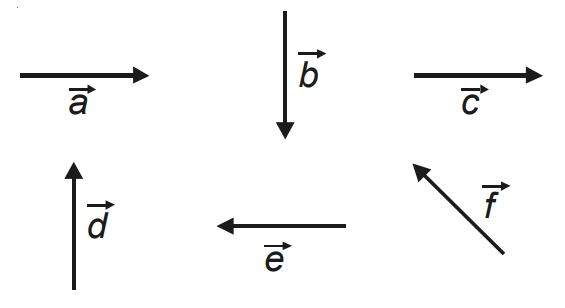 By the triangle law, if two vectors are drawn head to tail, their sum is the vector drawn from the tail of the first to the head of the second.
Using the magnitudes and directions shown in the figure, place the tail of $\vec{e}$ at the head of $\vec{d}$.
The vector from the tail of $\vec{d}$ to the head of $\vec{e}$ then has the same magnitude and direction as $\vec{f}$.
The other combinations ($\vec{b} + \vec{e}$, $\vec{b} + \vec{c}$, $\vec{d} + \vec{c}$) give resultants that do not coincide with $\vec{f}$ in direction.
Hence $\vec{d} + \vec{e} = \vec{f}$. -
If $|\vec{A} + \vec{B}| = |\vec{A}| = |\vec{B}|$ then angle between $\vec{A}$ and $\vec{B}$ will be : -$|\vec{A} + \vec{B}|^2 = A^2 + B^2 + 2AB\cos\theta$
Given $|\vec{A} + \vec{B}| = A = B$: $A^2 = A^2 + A^2 + 2A^2\cos\theta$
$\Rightarrow 0 = A^2 + 2A^2\cos\theta \Rightarrow \cos\theta = -\dfrac{1}{2}$
$\theta = 120^\circ$
Motion in a plane with constant acceleration
-
A particle has initial velocity $(3\hat{i} + 4\hat{j})$ and has acceleration $(0.4\hat{i} + 0.3\hat{j})$. Its speed after 10 s is$\vec{v} = \vec{u} + \vec{a}t$
$\vec{v} = (3\hat{i} + 4\hat{j}) + (0.4\hat{i} + 0.3\hat{j})\times10$
$\vec{v} = (3 + 4)\hat{i} + (4 + 3)\hat{j} = 7\hat{i} + 7\hat{j}$
Speed $= |\vec{v}| = \sqrt{7^2 + 7^2} = \sqrt{98}$
$= 7\sqrt{2}$ units
Position Vector and Direction
-
A particle starting from the origin (0, 0) moves in a straight line in the (x, y) plane. Its coordinates at a later time are $(\sqrt{3}, 3)$. The path of the particle makes with the x-axis an angle ofLet $\theta$ be the angle which the path of the particle makes with the x-axis.
The particle moves along the straight line from (0, 0) to $(\sqrt{3}, 3)$.
$\tan\theta = \dfrac{y}{x} = \dfrac{3}{\sqrt{3}}$
$\tan\theta = \sqrt{3}$
$\theta = \tan^{-1}(\sqrt{3}) = 60^\circ$
Scalar and Vector Products
-
$\vec{A}$ and $\vec{B}$ are two vectors and $\theta$ is the angle between them, if $|\vec{A} \times \vec{B}| = \sqrt{3}\,(\vec{A}\cdot\vec{B})$, the value of $\theta$ is$|\vec{A} \times \vec{B}| = AB\sin\theta$ and $\vec{A}\cdot\vec{B} = AB\cos\theta$
Given $|\vec{A} \times \vec{B}| = \sqrt{3}\,(\vec{A}\cdot\vec{B})$
$\Rightarrow AB\sin\theta = \sqrt{3}\,AB\cos\theta$
$\Rightarrow \tan\theta = \sqrt{3}$
$\Rightarrow \theta = 60^\circ$ -
If the angle between the vectors $\vec{A}$ and $\vec{B}$ is $\theta$, the value of the product $(\vec{B} \times \vec{A})\cdot\vec{A}$ is equal to -$\vec{B} \times \vec{A} = BA\sin\theta\,\hat{n}$, where $\hat{n}$ is a unit vector perpendicular to the plane containing $\vec{A}$ and $\vec{B}$.
$(\vec{B} \times \vec{A})\cdot\vec{A} = (BA\sin\theta)(\hat{n}\cdot\vec{A})$
Since $\hat{n}$ is perpendicular to $\vec{A}$, $\hat{n}\cdot\vec{A} = A\cos 90^\circ = 0$.
$\Rightarrow (\vec{B} \times \vec{A})\cdot\vec{A} = 0$
In general, a scalar triple product with two identical vectors is always zero.
Addition and Subtraction of Vectors
-
The vectors $\vec{A}$ and $\vec{B}$ are such that $|\vec{A} + \vec{B}| = |\vec{A} - \vec{B}|$. The angle between the two vectors is :-$|\vec{A} + \vec{B}| = |\vec{A} - \vec{B}| \Rightarrow |\vec{A} + \vec{B}|^2 = |\vec{A} - \vec{B}|^2$
$|\vec{A} + \vec{B}|^2 = A^2 + B^2 + 2AB\cos\theta$
$|\vec{A} - \vec{B}|^2 = A^2 + B^2 - 2AB\cos\theta$
$\Rightarrow A^2 + B^2 + 2AB\cos\theta = A^2 + B^2 - 2AB\cos\theta$
$\Rightarrow 4AB\cos\theta = 0 \Rightarrow \cos\theta = 0$
$\Rightarrow \theta = 90^\circ$
Scalar Product of Vectors
-
If a vector $2\hat{i} + 3\hat{j} + 8\hat{k}$ is perpendicular to the vector $4\hat{j} - 4\hat{i} + \alpha\hat{k}$, then the value of $\alpha$ isTwo vectors are perpendicular when their scalar (dot) product is zero.
$(2\hat{i} + 3\hat{j} + 8\hat{k})\cdot(-4\hat{i} + 4\hat{j} + \alpha\hat{k}) = 0$
$2 \times (-4) + 3 \times 4 + 8 \times \alpha = 0$
$-8 + 12 + 8\alpha = 0$
$8\alpha = -4$
$\alpha = -\dfrac{1}{2}$ -
The vector sum of two forces is perpendicular to their vector differences. In that case, the forces :Two vectors are perpendicular if their dot product is zero.
$(\vec{A} + \vec{B})\cdot(\vec{A} - \vec{B}) = 0$
$\Rightarrow A^2 - \vec{A}\cdot\vec{B} + \vec{B}\cdot\vec{A} - B^2 = 0$
Since $\vec{A}\cdot\vec{B} = \vec{B}\cdot\vec{A}$, the middle terms cancel: $A^2 - B^2 = 0$
$\Rightarrow A = B$
So the forces are equal in magnitude. They need not be equal as vectors, since their directions can be different (if they were equal vectors, their difference would be zero).
Projectile Motion: Range
-
Two projectiles of same mass and with same velocity are thrown at an angle $60^\circ$ and $30^\circ$ with the horizontal, then which quantity will remain same :Horizontal range: $R = \dfrac{u^2\sin 2\theta}{g} = \dfrac{2u^2\sin\theta\cos\theta}{g}$
For $\theta = 60^\circ$: $\sin 120^\circ = \dfrac{\sqrt{3}}{2}$; for $\theta = 30^\circ$: $\sin 60^\circ = \dfrac{\sqrt{3}}{2}$. The ranges are equal.
In general, the range is the same for angles of projection $\theta$ and $90^\circ - \theta$.
Time of flight ($\dfrac{2u\sin\theta}{g}$) and maximum height ($\dfrac{u^2\sin^2\theta}{2g}$) are larger for $60^\circ$.
So the horizontal range remains the same.
That is every question in Motion in a Plane for this filter.
Want a score?
Answers here are not saved. Practise as a test to be marked and see your progress.
Practise as a test