Looking for classes? Ksquare Career Institute, Bengaluru →

Physics
Electromagnetic Waves
49 questions from 34 papers, each with its answer.
- 49 questions
- 34 papers
- 2.78% of Physics
Properties of Electromagnetic Waves
-
The property which is not of an electromagnetic wave travelling in free space is that;Electromagnetic waves are produced by accelerating charges, not by charges moving with uniform speed (a charge moving with constant velocity does not radiate). The other properties – speed $\frac{1}{\sqrt{\mu_0\varepsilon_0}}$, transverse nature and equal energy densities in the electric and magnetic fields – are all true for EM waves in free space. So 'they originate from charges moving with uniform speed' is not a property of EM waves.
-
Which of the following statements is false for the properties of electromagnetic waves?Electromagnetic waves can travel through vacuum; they need no material medium (true).
$\vec{E}$ and $\vec{B}$ oscillate in phase, so they reach their maxima and minima at the same place and time (true).
The average energy densities of the electric and magnetic fields are equal: $\frac{1}{2}\varepsilon_0E^2 = \frac{B^2}{2\mu_0}$ (true).
$\vec{E}$ and $\vec{B}$ are perpendicular to each other, and both are perpendicular to the direction of propagation; they are not parallel to each other.
Hence the false statement is that the electric and magnetic field vectors are parallel to each other.
Electromagnetic Waves – E and B Amplitudes
-
In a plane electromagnetic wave travelling in free space, the electric field component oscillates sinusoidally at a frequency of $2.0\times10^{10}\ Hz$ and amplitude $48\ Vm^{-1}$. Then the amplitude of oscillating magnetic field is: (Speed of light in free space $=3\times10^8\ ms^{-1}$)
$B_0=\frac{E_0}{c}=1.6\times10^{-7}\ T$.
$B=\frac{E}{C}=\frac{48}{3\times10^8}=16\times10^{-8}=1.6\times10^{-7}\ T$
Electromagnetic Waves in a Medium
-
When light propagates through a material medium of relative permittivity $\epsilon_r$ and relative permeability $\mu_r$, the velocity of light, $v$ is given by : ($c$ - velocity of light in vacuum)Refractive index of the medium $n = \sqrt{\epsilon_r\mu_r}$ $n = \frac{c}{v} \Rightarrow v = \frac{c}{n}$ $v = \frac{c}{\sqrt{\epsilon_r\mu_r}}$
Electromagnetic Spectrum
-
The energy of the em waves is of the order of 15 keV. To which part of the spectrum does it belong?$\lambda = \frac{hc}{E} = \frac{12400\ \text{eV Å}}{15000\ \text{eV}} \approx 0.826$ Å
Since $\lambda < 100$ Å, the radiation is X-rays. -
The decreasing order of wavelength of infrared, microwave, ultraviolet and gamma rays isThe electromagnetic spectrum in order of decreasing wavelength is: radio waves, microwaves, infrared, visible, ultraviolet, X-rays, gamma rays.
Typical wavelengths: microwaves about $10^{-1}$ to $10^{-3}$ m, infrared about $10^{-3}$ to $7\times10^{-7}$ m, ultraviolet about $4\times10^{-7}$ to $10^{-9}$ m, gamma rays less than $10^{-12}$ m.
Picking the four given radiations in this order gives microwave > infrared > ultraviolet > gamma rays.
Hence the decreasing order of wavelength is microwave, infrared, ultraviolet, gamma rays. -
If $\lambda_v$, $\lambda_x$ and $\lambda_m$ represent the wavelengths of visible light, x-rays and microwaves respectively, then -The electromagnetic spectrum in decreasing order of wavelength is: radio waves, microwaves, infrared, visible light, ultraviolet, X-rays, gamma rays.
Microwaves have wavelengths of about 1 mm to 0.3 m.
Visible light has wavelengths of about 400 nm to 700 nm.
X-rays have wavelengths of about $10^{-8}$ m to $10^{-13}$ m.
So $\lambda_m \gt \lambda_v \gt \lambda_x$ -
Which of the following rays are not electromagnetic wavesElectromagnetic waves are oscillating electric and magnetic fields travelling at the speed of light; they carry no charge and no rest mass.
X-rays, $\gamma$-rays and heat rays (infrared) are all parts of the electromagnetic spectrum.
$\beta$-rays are streams of fast-moving electrons emitted from nuclei in beta decay. They are charged material particles and are deflected by electric and magnetic fields.
So $\beta$-rays are not electromagnetic waves. -
Which is having minimum wavelength : -Increasing order of wavelength in the electromagnetic spectrum: $\gamma$-rays $\lt$ X-rays $\lt$ ultraviolet $\lt$ visible $\lt$ infrared $\lt$ microwaves $\lt$ radio waves.
Cosmic rays are extremely high energy radiation/particles coming from outer space. Their energy is even higher than that of $\gamma$-rays, so their associated wavelength is the shortest.
So, as per the answer key, cosmic rays have the minimum wavelength. -
The frequency order for $\gamma$-rays (b), X-rays (a), UV-rays (c) :In the electromagnetic spectrum, frequency increases as wavelength decreases.
Order of frequency: $\gamma$-rays $\gt$ X-rays $\gt$ ultraviolet rays.
With the given labels: b ($\gamma$) $\gt$ a (X-rays) $\gt$ c (UV).
So the order is b > a > c.
Electromagnetic Waves – Energy Transport
-
Light with an average flux of $20\ W/cm^2$ falls on a non-reflecting surface at normal incidence having surface area $20\ cm^2$. The energy received by the surface during time span of 1 minute is:Energy received = intensity × area × time $= 20\ W/cm^2 \times 20\ cm^2 \times 60\ s = 24 \times 10^3$ J
Electromagnetic Spectrum – Visible Light
-
Which colour of the light has the longest wavelength?Among the given colours (red, blue, green, violet), red has the longest wavelength.
Relation between E and B in an EM wave
-
The ratio of the magnitude of the magnetic field and electric field intensity of a plane electromagnetic wave in free space of permeability $\mu_0$ and permittivity $\varepsilon_0$ is (Given that c - velocity of light in free space)$|E|=c|B| \Rightarrow \frac{|B|}{|E|}=\frac{1}{c}$.
-
In an electromagnetic wave in free space the root mean square value of the electric field is $E_{rms}$ = 6 V/m. The peak value of the magnetic field is
$B_{rms} = E_{rms}/c$ and $B_0 = \sqrt{2}B_{rms}$.
$\frac{E_{rms}}{B_{rms}} = c \Rightarrow B_{rms} = \frac{E_{rms}}{c} = \frac{6}{3\times10^{8}} = 2\times10^{-8}$ T $B_{rms} = \frac{B_0}{\sqrt{2}} \Rightarrow B_0 = \sqrt{2}B_{rms}$ $= \sqrt{2}\times2\times10^{-8} = 2.83\times10^{-8}$ T
Speed of EM waves in a medium
-
For a transparent medium relative permeability and permittivity, $\mu_r$ and $\varepsilon_r$ are 1.0 and 1.44 respectively. The velocity of light in this medium would be,$v=\frac{c}{\sqrt{\mu_r\varepsilon_r}}=\frac{3\times10^8}{\sqrt{1.44}}=2.5\times10^8$ m/s.
Electromagnetic spectrum - applications
-
The following table presents the part of the electromagnetic spectrum and their corresponding major applications. Choose the correct option.
Pick the matching item from Column II for each row.
Column I
- P. Microwave
- Q. UV rays
- R. Gamma rays
- S. Radio wave
Column II
- I. For purifying the water
- II. For warming the food
- III. For AM and FM communication systems
- IV. For treating the Cancer cells
Correct answer: P → II, Q → I, R → IV, S → III
Microwaves are used for warming food (P-II); UV rays for purifying water (Q-I); gamma rays for treating cancer cells (R-IV); radio waves for AM and FM communication systems (S-III).
Nature of electromagnetic waves – E, B and direction of propagation
-
An em wave is propagating in a medium with a velocity $\vec{V} = V\hat{i}$. The instantaneous oscillating electric field of this em wave is along +y axis. Then the direction of oscillating magnetic field of the em wave will be along
$\vec{E}\times\vec{B}$ points along the propagation direction.
$\vec{E}\times\vec{B} \parallel \vec{V}$ $(E\hat{j})\times(\vec{B}) \parallel V\hat{i}$ Since $\hat{j}\times\hat{k} = \hat{i}$, $\vec{B} = B\hat{k}$ So the magnetic field oscillates along the +z direction.
Sources of electromagnetic waves
-
Out of the following options which one can be used to produce a propagating electromagnetic wave?
Only accelerated charges radiate EM waves.
A stationary charge produces only an electric field, not a magnetic field.
A chargeless particle produces neither an electric nor a magnetic field.
An accelerating charge produces both an electric field and a time-varying magnetic field, which varies with space, leading to generation of an EM wave.
A charge moving at constant velocity produces only constant electric and magnetic fields, so it cannot produce an electromagnetic wave.
Momentum of electromagnetic radiation
-
A radiation of energy 'E' falls normally on a perfectly reflecting surface. The momentum transferred to the surface is (C = velocity of light):Momentum of the incident radiation $= \frac{E}{C}$; on perfect reflection it reverses.
Momentum transferred $= \frac{E}{C} - \left(-\frac{E}{C}\right) = \frac{2E}{C}$
Microwaves
-
The condition under which a microwave oven heats up a food item containing water molecules most efficiently is:A microwave oven heats food most efficiently when the microwave frequency matches the resonant frequency of water molecules, so that energy is transferred efficiently to them.
Electromagnetic waves
-
The electric field associated with an e.m. wave in vacuum is given by $\vec E = \hat i\,40\cos(kz - 6\times10^8t)$, where E, z and t are in volt/m, meter and seconds respectively. The value of wave vector k isComparing with $E = E_0\cos(kz - \omega t)$: $\omega = 6\times10^8$ rad/s
Wave speed in vacuum: $c = \frac{\omega}{k} \Rightarrow 3\times10^8 = \frac{6\times10^8}{k}$
$k = 2$ $m^{-1}$ -
The ratio of amplitude of magnetic field to the amplitude of electric field for an electromagnetic wave propagating in vacuum is equal toIn an electromagnetic wave in vacuum, $\frac{E_0}{B_0} = c$.
So $\frac{B_0}{E_0} = \frac{1}{c}$, the reciprocal of the speed of light in vacuum.
Nature of electromagnetic waves
-
The electric and the magnetic field, associated with an e.m. wave, propagating along the +z-axis, can be represented byIn an electromagnetic wave, $\vec{E}$, $\vec{B}$ and the direction of propagation are mutually perpendicular, and the wave travels along $\vec{E}\times\vec{B}$.
For propagation along +z we need $\vec{E}\times\vec{B}$ along $\hat{k}$.
$\hat{i}\times\hat{j} = \hat{k}$, so $\vec{E} = E_0\hat{i}$, $\vec{B} = B_0\hat{j}$ gives propagation along +z.
Checking the others: $\hat{j}\times\hat{k} = \hat{i}$ (along +x), $\hat{k}\times\hat{i} = \hat{j}$ (along +y), $\hat{j}\times\hat{i} = -\hat{k}$ (along −z).
Hence $\vec{E} = E_0\hat{i}$, $\vec{B} = B_0\hat{j}$. -
The electric and magnetic field of an electromagnetic wave areA time-varying magnetic field produces an electric field and a time-varying electric field produces a magnetic field; this mutual generation sustains the wave.
In an electromagnetic wave, $\vec{E} \perp \vec{B}$, and both are perpendicular to the direction of propagation.
Both $\vec{E}$ and $\vec{B}$ are in the same phase: they reach their maximum and zero values at the same time and place.
$E = E_0\sin(\omega t - kx)$
$B = B_0\sin(\omega t - kx)$
The electromagnetic wave travels in the direction of $\vec{E} \times \vec{B}$.
So the electric and magnetic fields are in phase and perpendicular to each other. -
The velocity of electromagnetic wave is parallel to : -In an electromagnetic wave, $\vec{E}$ and $\vec{B}$ are perpendicular to each other and to the direction of propagation.
The direction of propagation (and of energy flow, the Poynting vector) is along $\vec{E} \times \vec{B}$.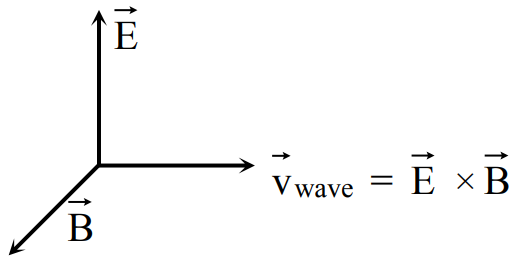
Example: if $\vec{E}$ is along $\hat{i}$ and $\vec{B}$ along $\hat{j}$, the wave travels along $\hat{i} \times \hat{j} = \hat{k}$.
So the velocity of an electromagnetic wave is parallel to $\vec{E} \times \vec{B}$.
Speed of Electromagnetic Waves
-
The velocity of electromagnetic radiation in a medium of permittivity $\varepsilon_0$ and permeability $\mu_0$ is given by :From Maxwell's equations, the speed of an electromagnetic wave in a medium of permittivity $\varepsilon$ and permeability $\mu$ is $v = \dfrac{1}{\sqrt{\mu\varepsilon}}$.
Here the medium has permittivity $\varepsilon_0$ and permeability $\mu_0$.
$C = \dfrac{1}{\sqrt{\mu_0 \varepsilon_0}}$ = velocity of the electromagnetic wave through the medium.
Dimension check: $\mu_0\varepsilon_0$ has the dimensions of $\dfrac{1}{(\text{speed})^2}$, so only $\dfrac{1}{\sqrt{\mu_0\varepsilon_0}}$ has the dimensions of speed.
Numerically this is $3 \times 10^{8}$ m/s for free space.
Infrared Radiation and Greenhouse Effect
-
What is the cause of "Green house effect" : -Sunlight (mostly visible radiation) passes through the atmosphere and heats the earth's surface.
The warm earth re-radiates this energy as infrared (heat) radiation of long wavelength.
Greenhouse gases such as $CO_2$, water vapour and methane absorb this infrared radiation and do not let it escape into space, so the earth's surface stays warm.
So the greenhouse effect is caused by infrared rays.
That is every question in Electromagnetic Waves for this filter.
Show all 49 questions Next: Ray Optics and Optical Instruments
Want a score?
Answers here are not saved. Practise as a test to be marked and see your progress.
Practise as a test