Looking for classes? Ksquare Career Institute, Bengaluru →

Physics
Dual Nature of Radiation and Matter
82 questions from 38 papers, each with its answer.
- 82 questions
- 38 papers
- 4.65% of Physics
de Broglie Wavelength
-
A photon and an electron (mass $m$) have the same energy $E$. The ratio $(\lambda_{\text{photon}} / \lambda_{\text{electron}})$ of their de Broglie wavelengths is ($c$ is the speed of light):
Photon wavelength is $\lambda_p = \frac{hc}{E}$ and electron wavelength is $\lambda_e = \frac{h}{\sqrt{2mE}}$. Their ratio is $\frac{\lambda_p}{\lambda_e} = c\sqrt{\frac{2m}{E}}$.
For a photon: $E = \frac{h c}{\lambda_p} \implies \lambda_p = \frac{h c}{E}$. For a non-relativistic electron of energy $E$: $p = \sqrt{2mE} \implies \lambda_e = \frac{h}{p} = \frac{h}{\sqrt{2mE}}$. Taking the ratio: $\frac{\lambda_{\text{photon}}}{\lambda_{\text{electron}}} = \frac{h c / E}{h / \sqrt{2mE}} = c \frac{\sqrt{2mE}}{E} = c \sqrt{\frac{2m}{E}}$. -
The graph which shows the variation of the de Broglie wavelength ($\lambda$) of a particle and its associated momentum ($p$) is :de Broglie wavelength $\lambda = \frac{h}{p}$, so $\lambda \propto \frac{1}{p}$ The graph of $\lambda$ vs p is a rectangular hyperbola.
-
A proton and an $\alpha$-particle are accelerated from rest to the same energy. The de Broglie wavelengths $\lambda_p$ and $\lambda_\alpha$ are in the ratio,$\lambda=\frac{h}{\sqrt{2mK}}$; with equal K, $\frac{\lambda_p}{\lambda_\alpha}=\sqrt{\frac{m_\alpha}{m_p}}=\sqrt{\frac{4m}{m}}=2:1$.
-
Which of the following figures represent the variation of particle momentum and the associated de-Broglie wavelength?$\lambda = \frac{h}{p} \Rightarrow p \propto \frac{1}{\lambda}$
Momentum is inversely proportional to wavelength, so the p–$\lambda$ graph is a rectangular hyperbola: momentum decreases as wavelength increases. -
If the kinetic energy of the particle is increased to 16 times its previous value, the percentage change in the de-Broglie wavelength of the particle is:$\lambda = \frac{h}{\sqrt{2mK}}$
$\frac{\lambda_1}{\lambda_2} = \sqrt{\frac{K_2}{K_1}} = \sqrt{16} = 4 \Rightarrow \lambda_2 = \frac{\lambda_1}{4}$
% change $= \frac{1 - 4}{4}\times100 = -75\%$, i.e. a decrease of 75%. -
Electrons used in an electron microscope are accelerated by a voltage of 25 kV. If the voltage is increased to 100 kV then the de-Broglie wavelength associated with the electrons wouldFor an electron accelerated through a potential difference V, kinetic energy = eV and momentum $p = \sqrt{2meV}$.
de Broglie wavelength $\lambda = \frac{h}{p} = \frac{h}{\sqrt{2meV}}$, so $\lambda \propto \frac{1}{\sqrt{V}}$
$\frac{\lambda_2}{\lambda_1} = \sqrt{\frac{V_1}{V_2}} = \sqrt{\frac{25}{100}} = \frac{1}{2}$
$\lambda_2 = \frac{\lambda_1}{2}$
So the wavelength decreases by 2 times.
Note: the source prints '100 km'; it is 100 kV. -
If particles are moving with same velocity, then De-Broglie wavelength is maximum for : -de Broglie wavelength: $\lambda = \dfrac{h}{mv}$
For the same velocity, $\lambda \propto \dfrac{1}{m}$; the lightest particle has the longest wavelength.
Masses: $\alpha$-particle $\approx$ 4 u, proton $\approx$ 1 u, neutron $\approx$ 1 u, $\beta$-particle (electron) $\approx \dfrac{1}{1837}$ u.
The $\beta$-particle (electron) has the smallest mass.
So the de Broglie wavelength is maximum for the $\beta$-particle.
Experimental Study of Photoelectric Effect
-
Which of the following options represent the variation of photoelectric current with property of light shown on the x-axis?
Choose the correct answer from the options given below: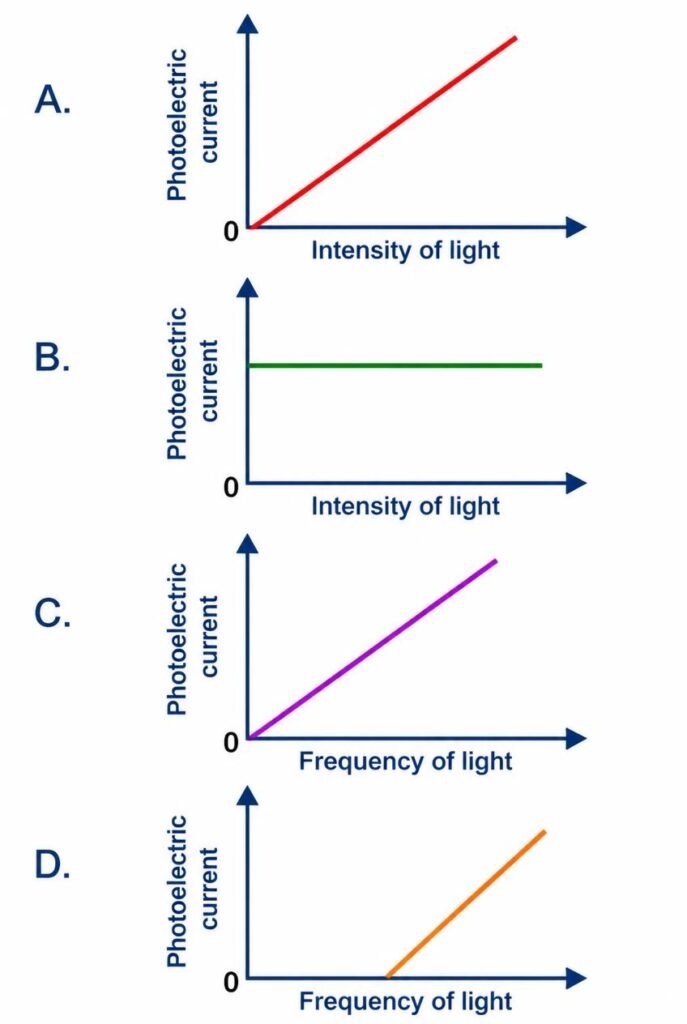
Photoelectric current is directly proportional to the intensity of incident radiation for frequency above threshold, represented by graph A only.
The number of photoelectrons emitted per second (and hence saturation photoelectric current) is directly proportional to the intensity of the incident light (provided $\nu > \nu_0$). Thus, a plot of photoelectric current against intensity is a straight line passing through the origin (Graph A). Photoelectric current does not vary linearly with frequency above threshold (stopping potential does), so C and D are incorrect representations.
Photoelectric Effect
-
The work functions of Caesium (Cs), Potassium (K) and Sodium (Na) are $2.14\ eV$, $2.30\ eV$ and $2.75\ eV$ respectively. If incident electromagnetic radiation has an incident energy of $2.20\ eV$, which of these photosensitive surfaces may emit photoelectrons?
Photoemission needs $\phi<2.20\ eV$; only caesium qualifies.
Incident energy $=2.20\ eV$ If $\phi2.20\ eV$: no electron emission. Only caesium will emit electrons. -
For photoelectric emission from certain metal the cutoff frequency is $\nu$. If radiation of frequency $2\nu$ impinges on the metal plate, the maximum possible velocity of the emitted electron will be (m is the electron mass):$h(2\nu) = h\nu + \frac{1}{2}mv_{max}^2$
$v_{max} = \sqrt{\frac{2h\nu}{m}}$ -
In photoelectric emission process from a metal of work function 1.8 eV, the kinetic energy of most energetic electrons is 0.5 eV. The corresponding stopping potential isThe stopping potential $V_0$ is the retarding potential that just stops the most energetic photoelectrons.
$eV_0 = KE_{max}$
$eV_0 = 0.5$ eV
$V_0 = 0.5$ V
The work function (1.8 eV) is not needed, because the maximum kinetic energy is given directly. -
Photoelectric emission occurs only when the incident light has more than a certain minimumA photon of energy $h\nu$ can eject an electron only if its energy is at least equal to the work function $\phi_0$ of the metal.
$h\nu \geq \phi_0$, i.e., $\nu \geq \nu_0 = \frac{\phi_0}{h}$
$\nu_0$ is the threshold frequency; below it no emission occurs, however intense the light.
Intensity and power only decide the number of photoelectrons; in terms of wavelength there is a maximum (not a minimum) value for emission.
Hence the light must have more than a certain minimum frequency. -
When monochromatic radiation of intensity I falls on a metal surface, the number of photoelectrons and their maximum kinetic energy are N and T respectively. If the intensity of radiation is 2I, the number of emitted electrons and their maximum kinetic energy are respectivelyIntensity of monochromatic light is proportional to the number of photons falling per second; each photon can eject one electron.
So the number of photoelectrons is proportional to the intensity: doubling I doubles the number to 2N.
Maximum kinetic energy: $KE_{max} = h\nu - \phi_0$, which depends only on the frequency of the light and the work function, not on the intensity.
The frequency is unchanged, so the maximum kinetic energy remains T.
Hence the values are 2N and T. -
The number of photoelectrons emitted for light of a frequency $\nu$ (higher than the threshold frequency $\nu_0$) is proportional toIn the photoelectric effect one photon ejects at most one electron, provided $\nu > \nu_0$.
The number of photoelectrons emitted per second therefore depends on the number of photons falling on the surface per second.
For light of a given frequency, the number of photons per second is proportional to the intensity of the light.
The frequency (and $\nu - \nu_0$) decides only the maximum kinetic energy of the photoelectrons: $KE_{max} = h(\nu - \nu_0)$.
Hence the number of photoelectrons is proportional to the intensity of light. -
A 5 watt source emits monochromatic light of wavelength 5000 Å. When placed 0.5 m away, it liberates photoelectrons from a photosensitive metallic surface. When the source is moved to a distance of 1.0 m, the number of photoelectrons liberated will be reduced by a factor ofThe number of photoelectrons emitted per second is proportional to the intensity of the incident light: $N_E \propto$ intensity.
For a point source, intensity $\propto \dfrac{1}{(\text{distance})^2}$
$\therefore N_E \propto \dfrac{1}{d^2}$
$\dfrac{N_2}{N_1} = \left(\dfrac{d_1}{d_2}\right)^2 = \left(\dfrac{0.5}{1.0}\right)^2 = \dfrac{1}{4}$
Therefore, as the distance is doubled, the number of photoelectrons decreases to $\dfrac{1}{4}$ of its value, i.e. it is reduced by a factor of 4.
The wavelength is unchanged, so the energy of each photoelectron is not affected.
Photoelectric Effect – Stopping Potential
-
The light rays having photons of energy 4.2 eV are falling on a metal surface having a work function of 2.2 eV. The stopping potential of the surface is:By Einstein's equation $h\nu=\phi+eV_s$: $4.2\ eV=2.2\ eV+eV_s \Rightarrow eV_s=2$ eV, so $V_s=2$ V.
-
Photons with energy 5 eV are incident on a cathode C in a photoelectric cell. The maximum energy of emitted photoelectrons is 2 eV. When photons of energy 6 eV are incident on C, no photoelectrons will reach the anode A, if the stopping potential of A relative to C is:
Work function 3 eV; 6 eV photons need 3 V retarding potential.
$eV_s = \frac{1}{2}mv_{max}^2 = h\nu - \phi_0$
$2 = 5 - \phi_0 \Rightarrow \phi_0 = 3$ eV
In the second case: $eV_s = 6 - 3 = 3$ eV $\Rightarrow V_s = 3$ V
$\therefore V_{AC} = -3$ V
Einstein's photoelectric equation
-
The threshold frequency of a photoelectric metal is $\nu_0$. If light of frequency $4\nu_0$ is incident on this metal, then the maximum kinetic energy of emitted electrons will be$h\nu=h\nu_0+KE_{max} \Rightarrow h(4\nu_0)=h\nu_0+KE_{max} \Rightarrow KE_{max}=3h\nu_0$.
-
The threshold frequency for a photosensitive metal is $3.3\times10^{14}$ Hz. If light of frequency $8.2\times10^{14}$ Hz is incident on this metal, the cut-off voltage for the photoelectric emission is nearlyEinstein's equation: $eV_0 = h\nu - h\nu_0 = h(\nu - \nu_0)$
$\nu - \nu_0 = (8.2 - 3.3)\times10^{14} = 4.9\times10^{14}$ Hz
$V_0 = \frac{h(\nu - \nu_0)}{e} = \frac{6.63\times10^{-34}\times4.9\times10^{14}}{1.6\times10^{-19}}$
$V_0 = \frac{3.25\times10^{-19}}{1.6\times10^{-19}} = 2.03$ V
$V_0 \approx 2$ V -
Light of two different frequencies whose photons have energies 1 eV and 2.5 eV respectively illuminate a metallic surface whose work function is 0.5 eV successively. Ratio of maximum speeds of emitted electrons will beEinstein's equation: $\frac{1}{2}mv_{max}^2 = h\nu - \phi_0$
First light: $KE_1 = 1 - 0.5 = 0.5$ eV
Second light: $KE_2 = 2.5 - 0.5 = 2.0$ eV
Since $KE \propto v^2$: $\frac{v_1}{v_2} = \sqrt{\frac{KE_1}{KE_2}} = \sqrt{\frac{0.5}{2.0}} = \sqrt{\frac{1}{4}}$
$\frac{v_1}{v_2} = \frac{1}{2}$, i.e., 1 : 2 -
When photons of energy $h\nu$ fall on an aluminium plate (of work function $E_0$), photoelectrons of maximum kinetic energy $K$ are ejected. If the frequency of the radiation is doubled, the maximum kinetic energy of the ejected photoelectrons will beEinstein's photoelectric equation: photon energy = work function + maximum kinetic energy.
In the first case: $h\nu = E_0 + K$ ...(1)
When the frequency is doubled, the photon energy becomes $2h\nu$: $2h\nu = E_0 + K'$ ...(2)
Subtracting (1) from (2): $h\nu = K' - K$
$\Rightarrow K' = K + h\nu$
Note that the kinetic energy is more than doubled, since $K' = 2K + E_0$. -
The work functions for metals A, B and C are respectively 1.92 eV, 2.0 eV and 5 eV. According to Einstein's equation, the metals which will emit photo electrons for a radiation of wavelength 4100 Å is/are -Photoelectrons are emitted only if the energy of the incident photon is greater than the work function of the metal.
Energy of a photon: $E = \dfrac{hc}{\lambda}$. A convenient form is $E\,(\text{eV}) = \dfrac{12400}{\lambda\,(\text{Å})}$
$E = \dfrac{12400}{4100} \approx 3$ eV
Metal A: work function 1.92 eV $\lt$ 3 eV, so A emits photoelectrons.
Metal B: work function 2.0 eV $\lt$ 3 eV, so B emits photoelectrons.
Metal C: work function 5 eV $\gt$ 3 eV, so C does not emit photoelectrons.
So the metals that will emit photoelectrons are A and B only. -
According to Einstein's photoelectric equation, the graph between the kinetic energy of photoelectrons ejected and the frequency of incident radiation is :-Einstein's photoelectric equation: $h\nu = \phi + KE_{max}$
$\Rightarrow KE_{max} = h\nu - \phi = h\nu - h\nu_0$, where $\nu_0$ is the threshold frequency.
This is a straight line of the form $y = mx + c$ with slope $h$ (positive, same for all metals) and intercept $-\phi$ on the KE axis.
For $\nu \lt \nu_0$ no photoelectrons are emitted, so the kinetic energy is zero (the graph does not exist below $\nu_0$).
KE becomes zero exactly at $\nu = \nu_0$ and then increases linearly with $\nu$.
So the graph is a straight line with positive slope that starts from a non-zero frequency (the threshold frequency) on the frequency axis. -
By photoelectric effect, Einstein proved :Einstein explained the photoelectric effect by assuming that light consists of quanta (photons), each with energy $E = h\nu$.
A photon gives all its energy to one electron: $h\nu = \phi + KE_{max}$.
This explained why the electron energy depends on frequency and why there is a threshold frequency, which the wave theory could not explain.
So by the photoelectric effect, Einstein established $E = h\nu$ (the quantum nature of light).
Threshold wavelength
-
The work function of a photosensitive material is 4.0 eV. The longest wavelength of light that can cause photon emission from the substance is (approximately)$\phi=\frac{hc}{\lambda_0} \Rightarrow \lambda_0=\frac{12400}{4}$ Å $=3100$ Å $=310$ nm.
Photocurrent and stopping potential - effect of intensity
-
A beam of light falls on a metal surface such that photo-electrons are generated. If power of the light source starts to decrease linearly with time t, then variation of the photocurrent I and magnitude of the stopping potential |V| with time is best represented by:$P=\frac{nhc}{\lambda}=nh\nu$. If the power decreases, the number of photons n decreases but the frequency remains the same, since the source is the same. So the photocurrent decreases while the stopping potential remains the same.
de Broglie wavelength of thermal neutrons
-
The de-Broglie wavelength of a neutron in thermal equilibrium with heavy water at a temperature T (Kelvin) and mass m, is
Thermal KE = $\frac{3}{2}kT$, so $\lambda = h/\sqrt{3mkT}$.
de-Broglie wavelength $\lambda = \frac{h}{mv} = \frac{h}{\sqrt{2m(KE)}}$ $= \frac{h}{\sqrt{2m\left(\frac{3}{2}kT\right)}}$ $\lambda = \frac{h}{\sqrt{3mkT}}$
Davisson and Germer experiment
-
In the Davisson and Germer experiment, the velocity of electrons emitted from the electron gun can be increased byIn the electron gun, electrons emitted by the heated filament are accelerated towards the anode by the potential difference V applied between the anode and the filament.
Energy gained: $\frac{1}{2}mv^2 = eV$, so $v = \sqrt{\frac{2eV}{m}}$
Thus $v \propto \sqrt{V}$: the velocity increases when the accelerating potential difference is increased.
Changing the filament current only changes the filament temperature and hence the number of electrons emitted, not their final velocity.
Hence the velocity is increased by increasing the potential difference between the anode and filament.
Photon picture of light
-
A source $S_1$ is producing $10^{15}$ photons per second of wavelength 5000 Å. Another source $S_2$ is producing $1.02\times10^{15}$ photons per second of wavelength 5100 Å. Then (power of $S_2$)/(power of $S_1$) is equal toEnergy of one photon: $E = \frac{hc}{\lambda}$
Power of a source = number of photons emitted per second × energy of each photon: $P = \frac{nhc}{\lambda}$
$\frac{P_2}{P_1} = \frac{n_2}{n_1}\times\frac{\lambda_1}{\lambda_2}$
$\frac{P_2}{P_1} = \frac{1.02\times10^{15}}{10^{15}}\times\frac{5000}{5100} = 1.02\times\frac{1}{1.02}$
$\frac{P_2}{P_1} = 1.00$ -
Monochromatic light of wavelength 667 nm is produced by a helium neon laser. The power emitted is 9 mW. The number of photons arriving per second on the average at a target irradiated by this beam isEnergy of one photon: $E = \frac{hc}{\lambda} = \frac{6.63\times10^{-34}\times3\times10^8}{667\times10^{-9}}$
$E = 2.98\times10^{-19}$ J $\approx 3\times10^{-19}$ J
Power = number of photons per second × energy of each photon: $P = nE$
$n = \frac{P}{E} = \frac{9\times10^{-3}}{3\times10^{-19}}$
$n = 3\times10^{16}$ photons per second -
Monochromatic light of frequency $6.0 \times 10^{14}$ Hz is produced by a laser. The power emitted is $2 \times 10^{-3}$ W. The number of photons emitted, on the average, by the source per second isEnergy of one photon: $E = h\nu$
If $n$ photons are emitted per second, the power is $P = nh\nu$
$\Rightarrow n = \dfrac{P}{h\nu}$
$n = \dfrac{2 \times 10^{-3}}{6.6 \times 10^{-34} \times 6 \times 10^{14}}$
$n = \dfrac{2 \times 10^{-3}}{3.96 \times 10^{-19}}$
$n \approx 5 \times 10^{15}$ photons per second
Photoelectric Effect and Photocell
-
A photo-cell employs photoelectric effect to convert :-A photocell is a device that converts light energy into electrical energy using the photoelectric effect.
When light of frequency above the threshold frequency falls on the photocathode, photoelectrons are emitted and collected by the anode, giving a photoelectric current.
The number of photoelectrons emitted per second is directly proportional to the intensity of the incident light.
So a change in the intensity of illumination produces a proportional change in the photoelectric current. This is how photocells are used in light meters, automatic doors and burglar alarms.
The work function is a property of the cathode material and does not change with intensity.
A change in frequency changes the maximum kinetic energy of the photoelectrons (and the stopping potential), not the saturation current.
So a photocell converts a change in the intensity of illumination into a change in photoelectric current.
Momentum of a Photon
-
The momentum of a photon of energy 1 MeV in kg m/s, will be -For a photon, $E = pc$
$\Rightarrow p = \dfrac{E}{c}$
$E = 1$ MeV $= 10^{6} \times 1.6 \times 10^{-19}$ J $= 1.6 \times 10^{-13}$ J
$p = \dfrac{10^{6} \times 1.6 \times 10^{-19}}{3 \times 10^{8}}$
$p = 5.33 \times 10^{-22}$ kg m s$^{-1}$
$p \approx 5 \times 10^{-22}$ kg m/s
Effect of Intensity on Photoelectric Effect
-
A photoelectric cell is illuminated by a point source of light 1 m away. When the source is shifted to 2m then -For a point source, intensity at distance r: $I \propto \dfrac{1}{r^2}$.
When the distance is doubled from 1 m to 2 m, the intensity becomes $\dfrac{1}{4}$ of the initial value.
The number of photoelectrons emitted per second is proportional to the intensity (number of photons falling per second). So the number of electrons emitted becomes a quarter of the initial number.
The energy of each photoelectron depends only on the frequency of light ($KE_{max} = h\nu - \phi$), not on intensity, so it does not change.
So the number of electrons emitted is a quarter of the initial number.
Planck's Constant
-
The value of Planck's constant is : -From $E = h\nu$: $h = \dfrac{E}{\nu}$, so its unit is joule/(1/second) = J s.
1 J = 1 kg m$^2$ s$^{-2}$, so J s = kg m$^2$ s$^{-2}$ $\times$ s = kg m$^2$ s$^{-1}$.
So $h = 6.63 \times 10^{-34}$ J s $= 6.63 \times 10^{-34}$ kg m$^2$/s.
J/s and J s$^{-1}$ are units of power, not of Planck's constant.
Threshold Frequency
-
When ultraviolet rays incident on metal plate then photoelectric effect does not occur, it occurs by incidence of : -Photoelectric emission occurs only if the frequency of the incident radiation is greater than the threshold frequency of the metal ($h\nu \gt \phi$).
Ultraviolet rays do not cause emission, so the threshold frequency of this metal is higher than the frequency of ultraviolet light.
Hence only radiation of still higher frequency (shorter wavelength) can cause emission.
Infrared, radio waves and visible light all have lower frequencies than ultraviolet, so they cannot. X-rays have a higher frequency than ultraviolet.
So photoelectric effect occurs by incidence of X-rays.
Properties of Cathode Rays
-
Which of the following is not the property of cathode rays : -Cathode rays are streams of fast-moving electrons.
They travel in straight lines and cast shadows of objects placed in their path; they produce fluorescence when they strike certain materials; and they heat objects on which they fall.
Being negatively charged, they are deflected by electric and magnetic fields.
So the statement that is not a property of cathode rays is: it does not deflect in an electric field.
Particle Nature of Light
-
Which one among these shows particle nature of light.Interference, diffraction and polarisation can be explained only by the wave nature of light. Refraction can be explained by the wave theory too.
The photoelectric effect (instant emission, threshold frequency, and kinetic energy depending on frequency but not intensity) cannot be explained by waves.
Einstein explained it by treating light as made of particles (photons) of energy $h\nu$.
So the photoelectric effect shows the particle nature of light.
Effect of Intensity on Photoelectric Current
-
A photo-cell is illuminated by a source of light, which is placed at a distance d from the cell. If the distance becomes d/2, then number of electrons emitted per second will be : -For a point source, intensity $I \propto \dfrac{1}{d^2}$.
When the distance is halved, the intensity becomes $\dfrac{1}{(1/2)^2} = 4$ times.
The number of photoelectrons emitted per second is proportional to the intensity (number of photons per second).
So the number of electrons emitted per second becomes four times.
Charge and Mass of Electron
-
Who evaluated the mass of electron indirectly with help of charge :J. J. Thomson measured the specific charge $\dfrac{e}{m}$ of the electron, but not e or m separately.
R. A. Millikan measured the charge of the electron, $e = 1.6 \times 10^{-19}$ C, by the oil drop experiment.
Using Thomson's value of $\dfrac{e}{m}$, the mass of the electron was then calculated: $m = \dfrac{e}{(e/m)} = 9.1 \times 10^{-31}$ kg.
So Millikan evaluated the mass of the electron indirectly with the help of its charge.
That is every question in Dual Nature of Radiation and Matter for this filter.
Want a score?
Answers here are not saved. Practise as a test to be marked and see your progress.
Practise as a test