Looking for classes? Ksquare Career Institute, Bengaluru →

Physics
Ray Optics and Optical Instruments
89 questions from 36 papers, each with its answer.
- 89 questions
- 36 papers
- 5.05% of Physics
Compound Microscope
-
A microscope has an objective of focal length $2\text{ cm}$, eyepiece of focal length $4\text{ cm}$ and the tube length of $40\text{ cm}$. If the distance of distinct vision of eye is $25\text{ cm}$, the magnification in the microscope is:
Magnification is $m = \frac{L}{f_o} \times \frac{D}{f_e} = \frac{40}{2} \times \frac{25}{4} = 125$.
The magnifying power of a compound microscope is given by $m = m_o \times m_e = \left(\frac{L}{f_o}\right) \left(\frac{D}{f_e}\right)$. Substituting the given values: $m = \left(\frac{40}{2}\right) \times \left(\frac{25}{4}\right) = 20 \times 6.25 = 125$.
Combination of Thin Lenses in Contact
-
In a certain camera, a combination of four similar thin convex lenses are arranged axially in contact. Then the power of the combination and the total magnification in comparison to the power ($p$) and magnification ($m$) for each lens will be, respectively:
Powers in contact add algebraically ($P = 4p$), while successive magnifications multiply ($M = m^4$).
When thin lenses are placed in contact, their focal powers add algebraically: $P = p_1 + p_2 + p_3 + p_4 = 4p$. For successive lenses, the total linear magnification is the product of individual magnifications: $M = m_1 \times m_2 \times m_3 \times m_4 = m^4$. -
Two thin lenses are of same focal lengths ($f$), but one is convex and the other one is concave. When they are placed in contact with each other, the equivalent focal length of the combination will be:
$\frac{1}{f_{comb}}=\frac{1}{f}-\frac{1}{f}=0$, so $f_{comb}=\infty$.
$F_{convex}=f$, $F_{concave}=-f$ $\frac{1}{f_{comb}}=\frac{1}{F_{convex}}+\frac{1}{F_{concave}}=\frac{1}{f}-\frac{1}{f}$ $\Rightarrow f_{comb}=\infty$
Refraction through a Prism
-
A thin prism of angle $15^\circ$ made of glass of refractive index $\mu_1 = 1.5$ is combined with another prism of glass of refractive index $\mu_2 = 1.75$. The combination of the prisms produces dispersion without deviation. The angle of the second prism should beDeviation produced by a thin prism: $\delta = (\mu - 1)A$
For dispersion without deviation, the two prisms are placed oppositely so that their deviations cancel: $\delta_1 = \delta_2$
$(\mu_1 - 1)A_1 = (\mu_2 - 1)A_2$
$(1.5 - 1)\times15^\circ = (1.75 - 1)\times A_2$
$7.5^\circ = 0.75A_2$
$A_2 = 10^\circ$ -
A ray of light is incident on a $60^\circ$ prism at the minimum deviation position. The angle of refraction at the first face (i.e., incident face) of the prism isFor a prism, $r_1 + r_2 = A$, where $r_1$ and $r_2$ are the angles of refraction at the two faces.
At minimum deviation the ray passes symmetrically through the prism: $r_1 = r_2 = r$
$2r = A$
$r = \frac{A}{2} = \frac{60^\circ}{2}$
$r = 30^\circ$
Astronomical Telescope
-
A small telescope has an objective of focal length 140 cm and an eye piece of focal length 5.0 cm. The magnifying power of telescope for viewing a distant object is:Magnifying power of a telescope (normal adjustment) $m = \frac{f_o}{f_e}$ $m = \frac{140}{5} = 28$
-
The magnifying power of a telescope is 9. When it is adjusted for parallel rays the distance between the objective and eyepiece is 20 cm. The focal lengths of lenses areIn normal adjustment: $f_o + f_e = 20$ cm ...(i)
Magnifying power: $\frac{f_o}{f_e} = 9 \Rightarrow f_o = 9f_e$ ...(ii)
From (i) and (ii): $10f_e = 20 \Rightarrow f_e = 2$ cm
$f_o = 18$ cm
Total Internal Reflection
-
Which of the following is not due to total internal reflection?Brilliance of diamond: its critical angle is very small (about $24.4^\circ$), so light entering it suffers repeated total internal reflections.
Optical fibre: light is guided along the fibre by repeated total internal reflection at the core–cladding boundary.
Mirage: light from an object is totally internally reflected at the hot, rarer air layers near the ground.
Apparent depth of a pond: light from the bottom simply bends away from the normal on passing from water to air, making the pond look shallower. This is ordinary refraction; no total internal reflection is involved.
Hence the difference between apparent and real depth of a pond is not due to total internal reflection. -
A ray of light travelling in a transparent medium of refractive index $\mu$ falls on a surface separating the medium from air at an angle of incidence of $45^\circ$. For which of the following values of $\mu$ can the ray undergo total internal reflection?Total internal reflection occurs when the angle of incidence exceeds the critical angle C, where $\sin C = \frac{1}{\mu}$.
Condition: $i > C$, i.e., $\sin i > \sin C = \frac{1}{\mu}$
$\mu > \frac{1}{\sin45^\circ} = \sqrt{2}$
$\mu > 1.414$
Among the given values only 1.50 is greater than 1.414.
Hence $\mu = 1.50$.
Lens Maker's Formula and Power of a Lens
-
A biconvex lens has radii of curvature, 20 cm each. If the refractive index of the material of the lens is 1.5, the power of the lens is :$R_1 = +20$ cm, $R_2 = -20$ cm, $\mu = \frac{3}{2}$ $P = \frac{1}{f} = (\mu - 1)\left(\frac{1}{R_1} - \frac{1}{R_2}\right)$ $P = \left(\frac{3}{2} - 1\right)\left(\frac{1}{0.2} + \frac{1}{0.2}\right) = \frac{1}{2}\left(\frac{2}{0.2}\right) = +5$ D
Optical Instruments – Astronomical Telescope
-
A lens of large focal length and large aperture is best suited as an objective of an astronomical telescope since:Magnifying power $MP = \frac{f_o}{f_e}$ – a large focal length of the objective gives higher magnification. Resolving power $RP = \frac{a}{1.22\lambda}$ – a large aperture gives better resolution and hence better quality of image. A large area of the objective also gathers more light, improving visibility. So all of the above reasons are correct.
Refraction through lenses - ray diagrams for concave lens
-
In a concave lens, a ray of light emanating from the object parallel to the principal axis of the lens, after refraction:
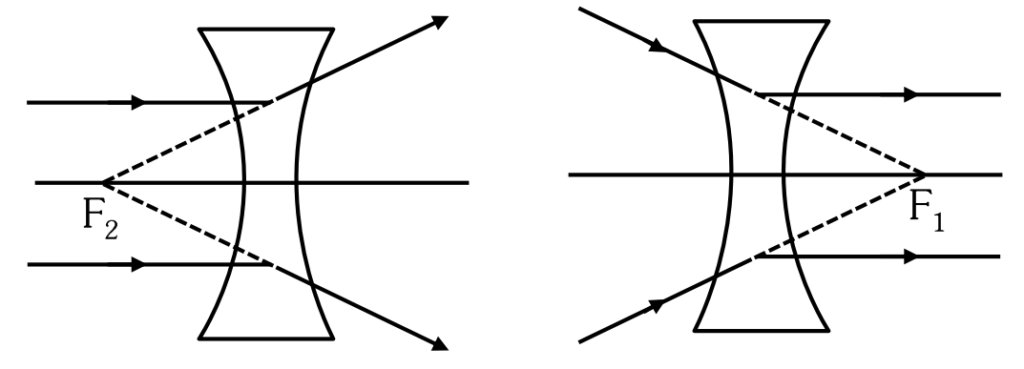
A concave (diverging) lens makes a ray parallel to the principal axis diverge after refraction, so that it appears to come from the focus on the same side as the object. By NCERT's convention, the focus on the side of the source of light is called the first focal point ($F_1$), and the other is the second focal point ($F_2$). On this basis the answer is: the ray appears to diverge from the first principal focus. Note: ALLEN marks this answer as per NCERT but states that conceptually the question should be treated as bonus, because by the standard definition of foci the diverging ray appears to come from the second principal focus.
Lens maker's formula
-
When a biconvex lens of glass having refractive index 1.47 is dipped in a liquid, it acts as a plane sheet of glass. This implies that the liquid must have refractive index$\frac{1}{f} = \left(\frac{\mu_2}{\mu_1} - 1\right)\left(\frac{1}{R_1} - \frac{1}{R_2}\right)$, where $\mu_2$ is for glass and $\mu_1$ for the liquid
A plane sheet has $f = \infty$, i.e. $\frac{1}{f} = 0$
$\frac{\mu_2}{\mu_1} - 1 = 0 \Rightarrow \mu_1 = \mu_2 = 1.47$
So the liquid has refractive index equal to that of glass. -
A convex lens is dipped in a liquid whose refractive index is equal to the refractive index of the lens. Then its focal length willLens maker's formula for a lens in a medium: $\dfrac{1}{f} = (\mu - 1)\left(\dfrac{1}{R_1} - \dfrac{1}{R_2}\right)$, where $\mu = \dfrac{\mu_{lens}}{\mu_{liquid}}$ is the relative refractive index.
Here $\mu_{lens} = \mu_{liquid}$, so $\mu = 1$.
$\dfrac{1}{f} = (1 - 1)\left(\dfrac{1}{R_1} - \dfrac{1}{R_2}\right) = 0$
$\therefore f = \infty$
Light passes through the lens without any bending (the lens becomes practically invisible), so its focal length becomes infinite.
Rainbow - primary and secondary
-
During a cloudy day, a primary and a secondary rainbow may be created, then the:The primary rainbow is formed after one total internal reflection inside the water droplet, while the secondary rainbow is formed after two internal reflections. The secondary rainbow appears above the primary rainbow.
Power of a lens - cut lens
-
An equiconvex lens has power P. It is cut into two symmetrical halves by a plane containing the principal axis. The power of one part will be:Cutting along a plane containing the principal axis does not change the radii of curvature of either half, so the focal length and hence power remain P.
Optical bench - index correction
-
Which of the following measurements require 'index correction'?Index correction (also known as bench correction) is applied in the optical bench experiment, which is used to find the focal length of lenses.
Total Internal Reflection
-
In total internal reflection when the angle of incidence is equal to the critical angle for the pair of media in contact, what will be angle of refraction?When the angle of incidence equals the critical angle $i_C$, the refracted ray grazes along the surface of separation. So the angle of refraction is $90^\circ$.
Astronomical telescope – magnification and resolving power
-
An astronomical refracting telescope will have large angular magnification and high angular resolution, when it has an objective lens of
Magnification ∝ $f_0$ and resolving power ∝ D of the objective.
For a telescope, angular magnification $= \frac{f_0}{f_E}$ So, focal length of the objective lens should be large. Angular resolution $= \frac{D}{1.22\lambda}$ should be large. So, the objective should have large focal length ($f_0$) and large diameter D.
Reflection – rotation of a plane mirror
-
A beam of light from a source L is incident normally on a plane mirror fixed at a certain distance x from the source. The beam is reflected back as a spot on a scale placed just above the source L. When the mirror is rotated through a small angle $\theta$, the spot of the light is found to move through a distance y on the scale. The angle $\theta$ is given by
Reflected ray turns through $2\theta$.
When the mirror is rotated by angle $\theta$, the reflected ray is rotated by $2\theta$.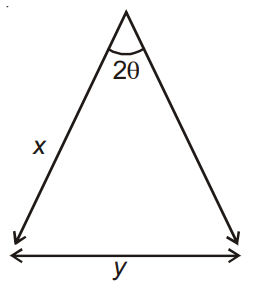
$\frac{y}{x} = 2\theta \Rightarrow \theta = \frac{y}{2x}$
Thin prisms – dispersion without deviation
-
A thin prism having refracting angle 10° is made of glass of refractive index 1.42. This prism is combined with another thin prism of glass of refractive index 1.7. This combination produces dispersion without deviation. The refracting angle of second prism should be
Net deviation $(\mu-1)A$ of the two prisms must cancel.
$(\mu - 1)A + (\mu' - 1)A' = 0$ $|(\mu - 1)A| = |(\mu' - 1)A'|$ $(1.42 - 1)\times10 = (1.7 - 1)A'$ $4.2 = 0.7A'$ $A' = 6^\circ$
Prism – minimum deviation
-
The angle of incidence for a ray of light at a refracting surface of a prism is 45°. The angle of prism is 60°. If the ray suffers minimum deviation through the prism, the angle of minimum deviation and refractive index of the material of the prism respectively, are
At minimum deviation i = e; then use the prism formula.
For minimum deviation, i = e = 45°, so $\delta_m = i + e - A = 45^\circ + 45^\circ - 60^\circ = 30^\circ$
$\mu = \frac{\sin\left(\frac{A + \delta_m}{2}\right)}{\sin\left(\frac{A}{2}\right)} = \frac{\sin45^\circ}{\sin30^\circ} = \frac{1/\sqrt{2}}{1/2}$
$\mu = \sqrt{2}$
Combination of thin lenses
-
Two thin lenses of focal lengths $f_1$ and $f_2$ are in contact and coaxial. The power of the combination is -Power of a lens is the reciprocal of its focal length: $P = \dfrac{1}{f}$
For thin lenses in contact the powers add: $P = P_1 + P_2$
$P = \dfrac{1}{f_1} + \dfrac{1}{f_2}$
$P = \dfrac{f_2 + f_1}{f_1 f_2}$
So the power of the combination is $\dfrac{f_1 + f_2}{f_1 f_2}$. -
A convex lens and a concave lens, each having same focal length of 25 cm, are put in contact to form a combination of lenses. The power in diopters of the combination is :-For thin lenses in contact, the powers add: $P = P_1 + P_2 = \dfrac{1}{f_1} + \dfrac{1}{f_2}$
Convex lens: $f_1 = +25$ cm. Concave lens: $f_2 = -25$ cm.
$P = \dfrac{1}{25} + \dfrac{1}{(-25)}$
$P = 0$
In diopters: $P_1 = \dfrac{100}{25} = +4$ D and $P_2 = -4$ D, so $P = 0$.
The combination behaves like a plane glass plate, with infinite focal length and zero power.
Refraction – real and apparent depth
-
An air bubble in a glass slab with refractive index 1.5 (near normal incidence) is 5 cm deep when viewed from one surface and 3 cm deep when viewed from the opposite face. The thickness (in cm) of the slab is:
Real depths from both faces add up to the thickness.
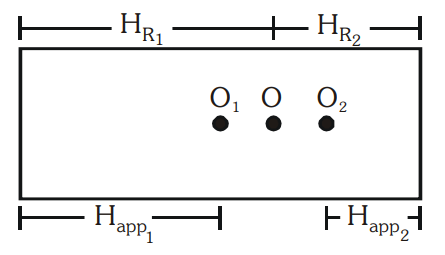
$H_{app} = \frac{H_R}{\mu_g} \Rightarrow H_R = \mu_gH_{app}$
Thickness $= H_{R_1} + H_{R_2} = \mu_g[H_{app_1} + H_{app_2}] = \frac{3}{2}[5 + 3] = 12$ cm
Defects of vision – myopia
-
A person can see clearly objects only when they lie between 50 cm and 400 cm from his eyes. In order to increase the maximum distance of distinct vision to infinity, the type and power of the correcting lens, the person has to use, will be:
Concave lens with f equal to the far point distance.
To correct myopia, the far point must go to infinity: v = –4 m, u = –∞.
$P = \frac{1}{f} = \frac{1}{v} - \frac{1}{u} = \frac{1}{-4} - \frac{1}{-\infty} = -0.25$ D
The negative sign implies a concave lens.
Optical instruments
-
If the focal length of objective lens is increased then magnifying power of:Microscope: $M = \frac{LD}{f_0f_e} \propto \frac{1}{f_0}$, so it decreases.
Telescope: $M = \frac{f_0}{f_e} \propto f_0$, so it increases.
Refractive Index
-
The frequency of a light wave in a material is $2 \times 10^{14}$ Hz and wavelength is 5000 Å. The refractive index of material will beSpeed of the wave in the material: $v = n\lambda$, where $n$ is the frequency.
Here $n = 2 \times 10^{14}$ Hz and $\lambda = 5000$ Å $= 5000 \times 10^{-10}$ m
$v = 2 \times 10^{14} \times 5000 \times 10^{-10}$
$v = 10^{8}$ m/s
Refractive index of the material: $\mu = \dfrac{c}{v}$
$\mu = \dfrac{3 \times 10^{8}}{10^{8}} = 3$
Apparent Depth and Normal Shift
-
A microscope is focused on a mark on a piece of paper and then a slab of glass of thickness 3 cm and refractive index 1.5 is placed over the mark. How should the microscope be moved to get the mark in focus again :-When a glass slab is placed over the mark, the mark appears raised because of refraction.
Apparent depth $= \dfrac{t}{\mu} = \dfrac{3}{1.5} = 2$ cm
Upward shift of the mark (normal shift) $= t\left(1 - \dfrac{1}{\mu}\right)$
$= 3\left(1 - \dfrac{1}{1.5}\right) = 3 \times \dfrac{1}{3}$
$= 1$ cm
The image of the mark is 1 cm closer to the microscope, so the microscope must be moved 1 cm upward to bring the mark into focus again.
Refraction
-
A ray of light travelling in air has wavelength λ, frequency n, velocity v and intensity I. If this ray enters into water then these parameters are λ', n', v' and I' respectively. Which relation is correctWhen light passes from one medium to another, its frequency remains unchanged, because the frequency is set by the source.
Speed decreases in water ($v' = \dfrac{v}{\mu}$), and so does the wavelength ($\lambda' = \dfrac{\lambda}{\mu}$).
Some light is reflected at the surface, so the intensity also decreases.
So the correct relation is n = n'.
Total Internal Reflection: Optical Fibres
-
Optical fibres are based on : -An optical fibre has a glass core of higher refractive index surrounded by a cladding of lower refractive index.
Light entering the core strikes the core–cladding boundary at an angle greater than the critical angle, so it undergoes total internal reflection again and again and travels along the fibre with very little loss, even when the fibre bends.
So optical fibres are based on total internal reflection.
Natural Phenomena: Rainbow
-
Rainbow is formed due to :Sunlight entering a raindrop is refracted and dispersed into its colours, because the refractive index of water is different for different colours.
The light is then reflected from the back surface of the drop (internal reflection) and refracted again as it comes out, separating the colours further.
Each colour emerges at a particular angle (about $40^\circ$–$42^\circ$ for the primary bow), so we see a band of colours.
So, as per the answer key, the rainbow is formed due to total internal reflection and dispersion.
Reflection by Plane Mirror
-
A tall man of height 6 feet wants to see his full image. Then required minimum length of the mirror will be :To see the full image in a vertical plane mirror, rays from the top of the head and from the feet must reflect into the eyes.
By the laws of reflection, these rays strike the mirror at points halfway (in height) between the eye and the head, and between the eye and the feet.
So the minimum length of the mirror is half the height of the person: $\dfrac{h}{2} = \dfrac{6}{2} = 3$ feet.
This does not depend on the distance from the mirror.
That is every question in Ray Optics and Optical Instruments for this filter.
Want a score?
Answers here are not saved. Practise as a test to be marked and see your progress.
Practise as a test