Looking for classes? Ksquare Career Institute, Bengaluru →

Physics
Ray Optics and Optical Instruments
89 questions from 36 papers, each with its answer.
- 89 questions
- 36 papers
- 5.05% of Physics
Refraction through a Prism
-
Find the value of the angle of emergence from the prism. Refractive index of the glass is $\sqrt{3}$.
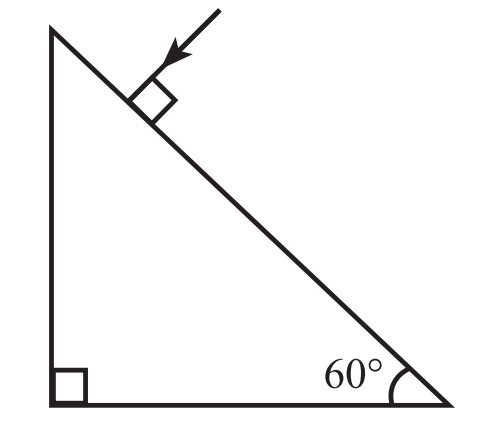 The ray enters normally, so $r_1 = 0^\circ$. Prism angle A = $30^\circ$, so $r_2 = A - r_1 = 30^\circ$.
Snell's law at the second face: $\sqrt{3}\sin 30^\circ = 1 \times \sin e$
$\sin e = \frac{\sqrt{3}}{2} \Rightarrow e = 60^\circ$ -
For the angle of minimum deviation of a prism to be equal to its refracting angle, the prism must be made of a material whose refractive index$\mu = \frac{\sin\left(\frac{A + \delta_m}{2}\right)}{\sin\left(\frac{A}{2}\right)}$
With $\delta_m = A$: $\mu = \frac{\sin A}{\sin\frac{A}{2}} = \frac{2\sin\frac{A}{2}\cos\frac{A}{2}}{\sin\frac{A}{2}} = 2\cos\frac{A}{2}$
At minimum deviation $i = \frac{A + \delta_m}{2} = A$, and i must be less than $90^\circ$, so A lies between $0^\circ$ and $90^\circ$.
For A → $0^\circ$, $\mu$ → 2; for A = $90^\circ$, $\mu = 2\cos45^\circ = \sqrt2$.
So $\mu$ lies between 2 and $\sqrt2$.
Astronomical Telescope
-
In an astronomical telescope in normal adjustment a straight black line of length L is drawn on inside part of objective lens. The eye-piece forms a real image of this line. The length of this image is I. The magnification of the telescope is:
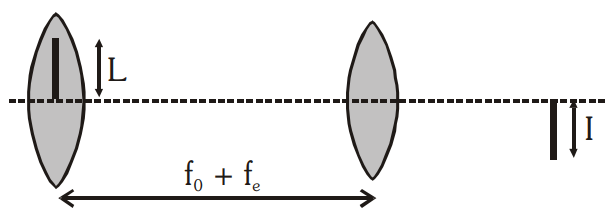
In normal adjustment the objective is at distance $u = -(f_0 + f_e)$ from the eyepiece.
Magnification by the eyepiece: $\frac{I}{L} = \frac{f_e}{f_e + u} = \frac{f_e}{f_e - (f_0 + f_e)} \Rightarrow \frac{I}{L} = \frac{f_e}{f_0}$ (in magnitude)
$M = \frac{f_0}{f_e} = \frac{L}{I}$
Total Internal Reflection
-
For the given incident ray as shown in figure, the condition of total internal reflection of this ray the minimum refractive index of prism will be : -
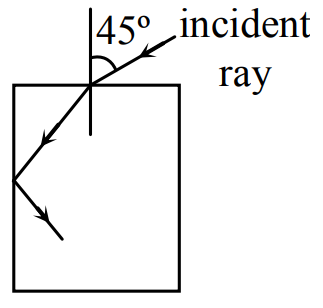 Let the ray refract at the top face with angle of refraction r. It then meets the vertical face at an angle of incidence $90^\circ - r$, because the two faces are perpendicular.
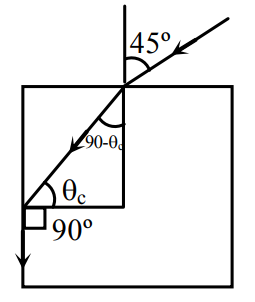
For the minimum refractive index, the ray just suffers total internal reflection at the side face: $90^\circ - r = \theta_c$, so $r = 90^\circ - \theta_c$.
Snell's law at the top face: $1 \cdot \sin 45^\circ = \mu\sin(90^\circ - \theta_c) = \mu\cos\theta_c$
Since $\sin\theta_c = \dfrac{1}{\mu}$: $\cos\theta_c = \dfrac{\sqrt{\mu^2 - 1}}{\mu}$, so $\mu\cos\theta_c = \sqrt{\mu^2 - 1}$
$\dfrac{1}{\sqrt{2}} = \sqrt{\mu^2 - 1} \Rightarrow \mu^2 = 1 + \dfrac{1}{2} = \dfrac{3}{2}$
$\Rightarrow \mu = \sqrt{\dfrac{3}{2}}$
Alternate (objective) method: for this arrangement $\mu = \sqrt{1 + \sin^2\theta}$, so $\mu = \sqrt{1 + \sin^2 45^\circ} = \sqrt{1 + \dfrac{1}{2}} = \sqrt{\dfrac{3}{2}}$.
Refraction at Lenses – Lens Maker's Formula and Combination
-
In the figure shown here, what is the equivalent focal length of the combination of lenses (Assume that all layers are thin)?
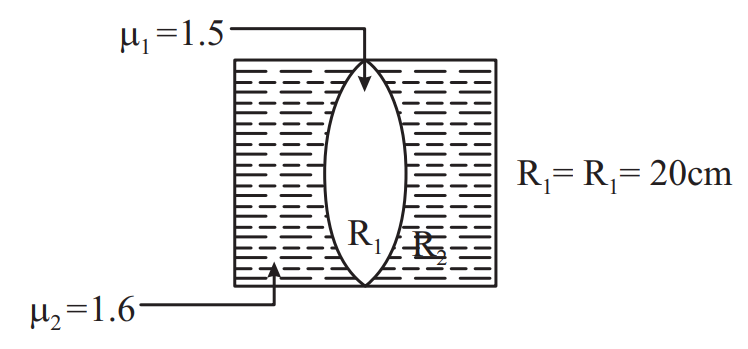
Using $\frac{1}{f}=(\mu-1)\left(\frac{1}{R_1}-\frac{1}{R_2}\right)$ for each layer and adding: $f_{net}=-100\ cm$.
$\frac{1}{f_1}=(1.6-1)\left(\frac{1}{\infty}-\frac{1}{20}\right)=-\frac{3}{100}$ $\frac{1}{f_2}=(1.5-1)\left(\frac{1}{20}-\frac{1}{-20}\right)=\frac{1}{20}$ $\frac{1}{f_3}=\frac{1}{f_1}=-\frac{3}{100}$ $\frac{1}{f_{net}}=\frac{1}{f_1}+\frac{1}{f_2}+\frac{1}{f_3}=-\frac{3}{50}+\frac{1}{20}$ $\Rightarrow f_{net}=-100\ cm$
Refraction by Lenses and Reflection by a Plane Mirror
-
A point object is placed at a distance of 60 cm from a convex lens of focal length 30 cm. If a plane mirror were put perpendicular to the principal axis of the lens and at a distance of 40 cm from it, the final image would be formed at a distance of:
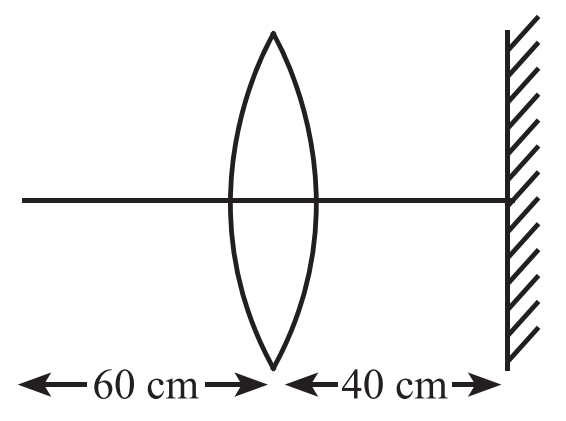 Refraction by the lens: u = –60 cm, f = +30 cm ⇒ $v = \frac{uf}{u + f} = \frac{-60 \times 30}{-60 + 30} = 60$ cm
This image is 20 cm behind the mirror and acts as a virtual object;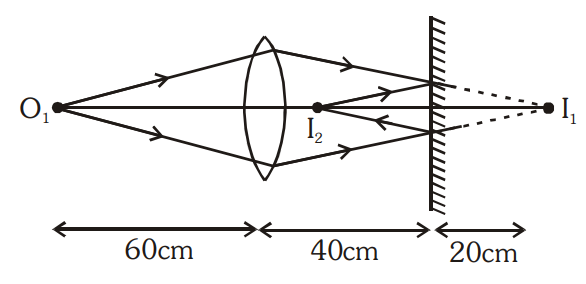
the mirror forms a real image 20 cm in front of it, i.e. 20 cm from the lens.
Refraction again by the lens (light travelling back): u = –20 cm, f = +30 cm ⇒ $v = \frac{-20 \times 30}{-20 + 30} = -60$ cm So the final image is virtual, 60 cm from the lens,
i.e. 20 cm behind the plane mirror.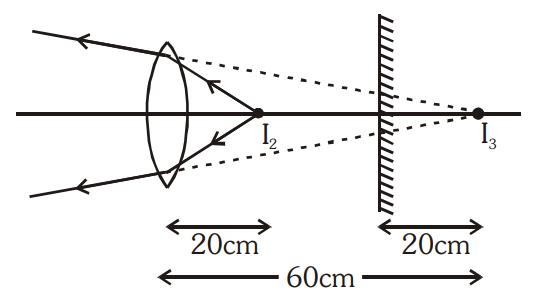
Combination of lenses
-
Two identical thin plano-convex glass lenses (refractive index 1.5) each having radius of curvature of 20 cm are placed with their convex surfaces in contact at the centre. The intervening space is filled with oil of refractive index 1.7. The focal length of the combination is
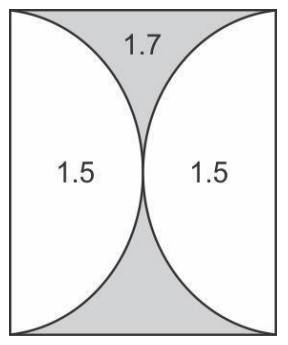
$\frac{1}{f} = \frac{1}{f_1} + \frac{1}{f_2} + \frac{1}{f_3}$; lens maker's formula $\frac{1}{f} = (\mu - 1)\left(\frac{1}{R_1} - \frac{1}{R_2}\right)$
$\frac{1}{f_1} = (1.5 - 1)\left(\frac{1}{20} - \frac{1}{\infty}\right) = \frac{1}{40}$ $cm^{-1}$
$\frac{1}{f_2} = (1.7 - 1)\left(-\frac{1}{20} - \frac{1}{20}\right) = -\frac{7}{100}$ $cm^{-1}$
$\frac{1}{f_3} = (1.5 - 1)\left(\frac{1}{20} - \frac{1}{\infty}\right) = \frac{1}{40}$ $cm^{-1}$
$\frac{1}{f} = \frac{1}{40} - \frac{7}{100} + \frac{1}{40} = \frac{5 - 14 + 5}{200} = -\frac{1}{50}$ $cm^{-1}$
$f = -50$ cm
Lens Maker's Formula and Combination of Lenses
-
Two similar thin equi-convex lenses, of focal length $f$ each, are kept coaxially in contact with each other such that the focal length of the combination is $F_1$. When the space between the two lenses is filled with glycerin (which has the same refractive index ($\mu=1.5$) as that of glass) then the equivalent focal length is $F_2$. The ratio $F_1:F_2$ will be:In air, the two lenses in contact: $\frac{1}{F_1}=\frac{1}{f}+\frac{1}{f}=\frac{2}{f}$ When glycerine ($\mu=1.5$, same as glass) fills the space, the glycerine forms a concave lens of focal length $-f$: $\frac{1}{F_2}=\frac{1}{f}+\frac{1}{f}-\frac{1}{f}=\frac{1}{f}$ $\frac{F_1}{F_2}=\frac{f/2}{f}=\frac{1}{2}$ $F_1:F_2=1:2$
That is every question in Ray Optics and Optical Instruments for this filter.
Want a score?
Answers here are not saved. Practise as a test to be marked and see your progress.
Practise as a test