Looking for classes? Ksquare Career Institute, Bengaluru →

Physics
Electrostatic Potential and Capacitance
76 questions from 37 papers, each with its answer.
- 76 questions
- 37 papers
- 4.31% of Physics
Energy Stored in a Capacitor
-
The energy required to charge a parallel plate condenser of plate separation $d$ and plate area of cross-section $A$ such that the uniform electric field between the plates is $E$, is :Capacitance of the parallel plate condenser: $C = \dfrac{\varepsilon_0 A}{d}$
Potential difference when the field between the plates is $E$: $V = Ed$
Energy stored in the capacitor: $U = \dfrac{1}{2}CV^2$
$U = \dfrac{1}{2}\left(\dfrac{\varepsilon_0 A}{d}\right)(Ed)^2$
$U = \dfrac{1}{2}\varepsilon_0 E^2 Ad$
While charging, the cell delivers charge $Q = CV$ at a constant potential difference $V$, so the energy given by the cell is $W = QV = CV^2$.
$W = \left(\dfrac{\varepsilon_0 A}{d}\right)(Ed)^2 = \varepsilon_0 E^2 Ad$
Energy given by the cell = energy stored in the capacitor + energy lost in the process of charging, and the energy lost equals the energy stored.
So the energy required $= 2 \times$ energy stored in the capacitor $= \varepsilon_0 E^2 Ad$.
Capacitors in series-parallel combination (bridge network)
-
Five capacitors of capacitances $C_1 = C_2 = C_3 = C_4 = 10\ \mu F$ and $C_5 = 2.5\ \mu F$ are connected as shown, along with a battery of 50 V. The equivalent capacitance and the charges on each capacitor respectively are:
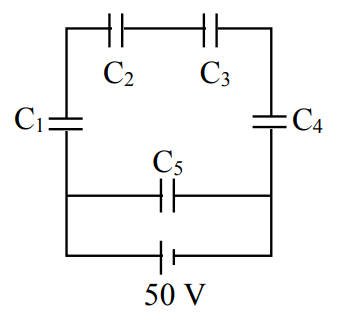 $C_1 = C_2 = C_3 = C_4 = 10\ \mu F$, $C_5 = 2.5\ \mu F$
$C_1$, $C_2$, $C_3$, $C_4$ are in series: $\frac{1}{C'} = 4 \times \frac{1}{10} \Rightarrow C' = 2.5\ \mu F$
$C'$ is in parallel with $C_5$ across the 50 V battery.
$C_{eq} = C' + C_5 = 2.5 + 2.5 = 5\ \mu F$
$q_{C_1} = q_{C_2} = q_{C_3} = q_{C_4} = 50 \times 2.5 = 125\ \mu C$
$q_{C_5} = 50 \times 2.5 = 125\ \mu C$ So $C_{eq}$ = 5 $\mu F$ and the charge is 125 $\mu C$ on all capacitors.
Potential due to a uniformly charged sphere
-
A unit positive point charge is taken slowly through an infinitesimally thin tube that is inside a charged dielectric sphere of radius R, having uniform positive charge density $\rho$, as shown in the figure. The initial and final positions of the charge are marked by A and B at distance 2R and 3R respectively, from the centre of the sphere. In this process, the magnitude of the total work done on the point charge is $\frac{\rho R^2}{n\varepsilon_0}$. The value of n is: ($\varepsilon_0$ is the permittivity of vacuum)
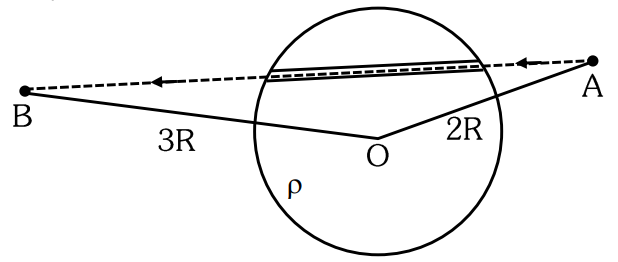 $W=q\Delta V=q(V_B-V_A)=1\left(\frac{kQ}{3R}-\frac{kQ}{2R}\right)=-\frac{kQ}{6R}$. With $Q=\rho\times\frac{4}{3}\pi R^3$: $|W|=\frac{1}{4\pi\varepsilon_0}\cdot\frac{\rho\frac{4}{3}\pi R^3}{6R}=\frac{\rho R^2}{18\varepsilon_0}$, so n = 18.
Capacitor with multiple dielectrics
-
A parallel-plate capacitor of area A, plate separation d and capacitance C is filled with four dielectric materials having dielectric constants $k_1$, $k_2$, $k_3$ and $k_4$ as shown in the figure below. If a single dielectric material is to be used to have the same capacitance C in this capacitor, then its dielectric constant k is given by:
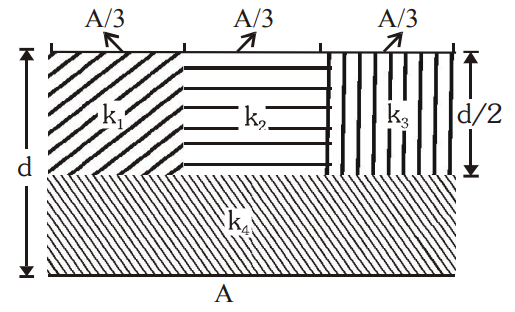
Three side-by-side dielectrics add in parallel; that block is in series with $k_4$.
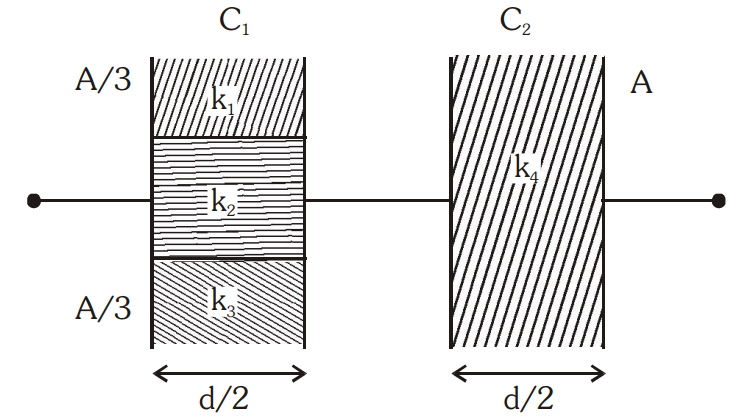
$\frac{1}{C} = \frac{1}{C_1} + \frac{1}{C_2}$
$\frac{d}{A\varepsilon_0k} = \frac{1}{\frac{A}{3}\varepsilon_0\frac{(k_1 + k_2 + k_3)}{d/2}} + \frac{1}{\frac{A\varepsilon_0k_4}{d/2}}$
$\Rightarrow \frac{2}{k} = \frac{3}{k_1 + k_2 + k_3} + \frac{1}{k_4}$
Potential due to charged shells
-
Three concentric spherical shells have radii a, b and c (a < b < c) and have surface charge densities $\sigma$, $-\sigma$ and $\sigma$ respectively. If $V_A$, $V_B$ and $V_C$ denote the potentials of the three shells, then, for c = a + b, we haveCharges on the shells: $q_A = 4\pi a^2\sigma$, $q_B = -4\pi b^2\sigma$, $q_C = 4\pi c^2\sigma$
Potential of a shell of radius R and charge q: $\frac{q}{4\pi\varepsilon_0R}$ at any point on or inside it, and $\frac{q}{4\pi\varepsilon_0r}$ at an outside point at distance r.
$V_A = \frac{1}{4\pi\varepsilon_0}\left(\frac{q_A}{a} + \frac{q_B}{b} + \frac{q_C}{c}\right) = \frac{\sigma}{\varepsilon_0}(a - b + c)$
$V_B = \frac{1}{4\pi\varepsilon_0}\left(\frac{q_A}{b} + \frac{q_B}{b} + \frac{q_C}{c}\right) = \frac{\sigma}{\varepsilon_0}\left(\frac{a^2}{b} - b + c\right)$
$V_C = \frac{1}{4\pi\varepsilon_0}\left(\frac{q_A + q_B + q_C}{c}\right) = \frac{\sigma}{\varepsilon_0}\left(\frac{a^2 - b^2 + c^2}{c}\right)$
Put c = a + b: $V_A = \frac{\sigma}{\varepsilon_0}(2a)$
$V_C = \frac{\sigma}{\varepsilon_0}\left[\frac{(a - b)(a + b)}{a + b} + (a + b)\right] = \frac{\sigma}{\varepsilon_0}(a - b + a + b) = \frac{\sigma}{\varepsilon_0}(2a)$
$V_B = \frac{\sigma}{\varepsilon_0}\left(\frac{a^2}{b} + a\right)$, which is not equal to $\frac{\sigma}{\varepsilon_0}(2a)$ since $a \neq b$
Hence $V_C = V_A \neq V_B$.
That is every question in Electrostatic Potential and Capacitance for this filter.
Want a score?
Answers here are not saved. Practise as a test to be marked and see your progress.
Practise as a test