Looking for classes? Ksquare Career Institute, Bengaluru →

Physics
Current Electricity
130 questions from 38 papers, each with its answer.
- 130 questions
- 38 papers
- 7.37% of Physics
Kirchhoff's Laws and Cells in a Circuit
-
The magnitude and direction of the current in the following circuit is
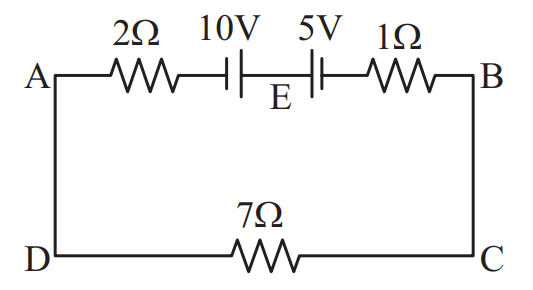
The circuit reduces to a $10\ \Omega$ resistor with a 5 V cell, so $i=0.5\ A$.
The circuit can be redrawn as an equivalent circuit (10 Ω resistor with a 5 V cell). $\Rightarrow i=\frac{5}{10}=0.5\ A$
Combination of Resistors – Power Dissipation
-
Six similar bulbs are connected as shown in the figure with a DC source of emf $E$, and zero internal resistance. The ratio of power consumption by the bulbs when (i) all are glowing and (ii) in the situation when two from section A and one from section B are glowing, will be:
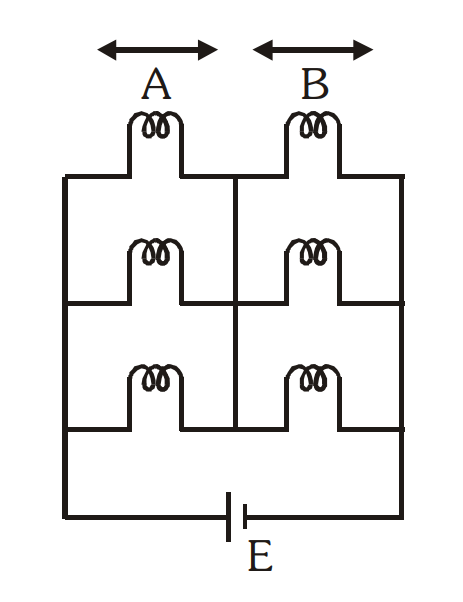 (i) All bulbs glowing: $R_{eq}=\frac{R}{3}+\frac{R}{3}=\frac{2R}{3}$
$P_i=\frac{E^2}{R_{eq}}=\frac{3E^2}{2R}$
(ii) Two from section A and one from section B glowing: $R_{eq}=\frac{R}{2}+R=\frac{3R}{2}$
$P_f=\frac{2E^2}{3R}$
$\frac{P_i}{P_f}=\frac{3E^2}{2R}\times\frac{3R}{2E^2}=\frac{9}{4}$
Ratio $=9:4$
Ideal Voltmeter and Ammeter in Circuits
-
In the circuits shown below, the readings of the voltmeters and the ammeters will be:
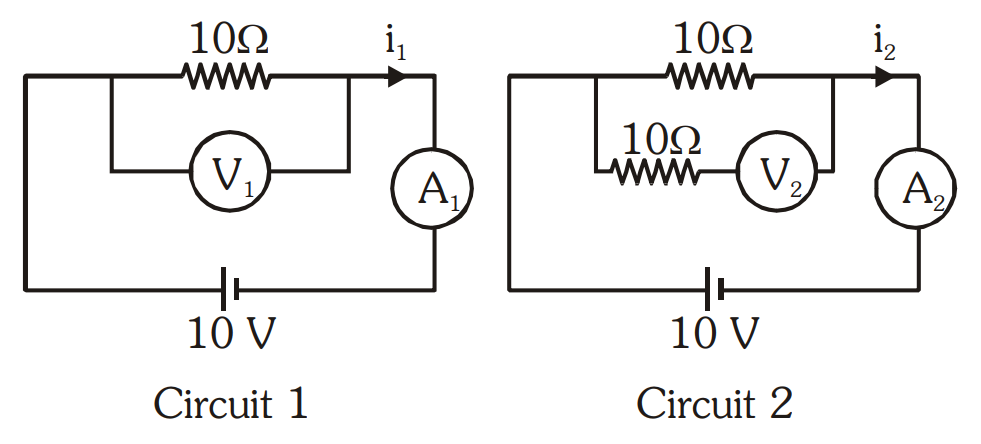 For an ideal voltmeter the resistance is infinite and for an ideal ammeter the resistance is zero.
$i_1=i_2=\frac{10\ V}{10\ \Omega}=1\ A$
$V_1=i_1\times10=10\ V$, $V_2=i_2\times10=10\ V$
So $V_1=V_2$ and $i_1=i_2$.
Infinite ladder network
-
The equivalent resistance of the infinite network given below is:
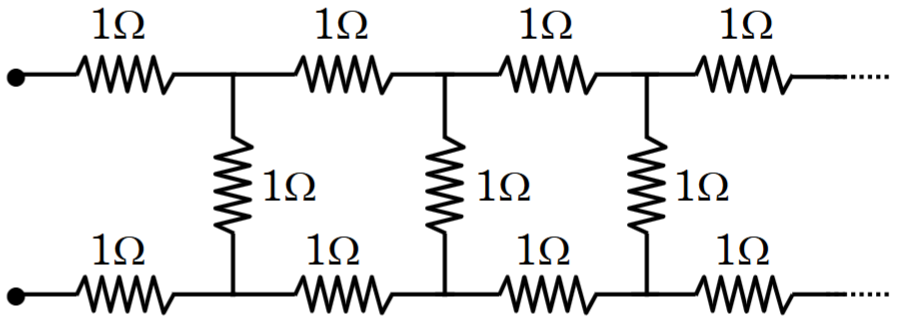 Let the equivalent resistance be $x$. Removing one repeated section, the rest of the network (x) is in parallel with the 1 $\Omega$ rung, in series with the two 1 $\Omega$ resistors: $\frac{x\times1}{x+1}+2=x \Rightarrow x^2-2x-2=0 \Rightarrow x=\frac{2\pm2\sqrt{3}}{2}=1\pm\sqrt{3}$. Neglecting the negative value, $x=(1+\sqrt{3})\ \Omega$.
Potentiometer and combination of resistors
-
The sliding contact C is at one fourth of the length of the potentiometer wire (AB) from A as shown in the circuit diagram. If the resistance of the wire AB is $R_0$, then the potential drop (V) across the resistor R is
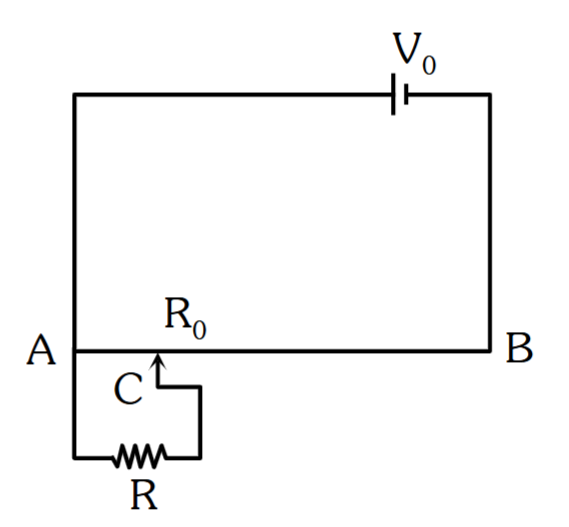 Portion AC has resistance $\frac{R_0}{4}$, in parallel with R; portion CB ($\frac{3R_0}{4}$) is in series. $R_{eq}=\frac{\frac{R_0}{4}R}{\frac{R_0}{4}+R}+\frac{3R_0}{4}=\frac{R_0(16R+3R_0)}{4(R_0+4R)}$. With $I=\frac{V_0}{R_{eq}}$, $V_R=I\times\frac{\frac{R_0}{4}R}{\frac{R_0}{4}+R}=\frac{4V_0R}{16R+3R_0}$.
Joule heating with time-varying current
-
The charge following through a resistance R varies with time t as $Q = at - bt^2$, where a and b are positive constants. The total heat produced in R is
Integrate $I^2R$ from t = 0 until the current becomes zero.
Current $I = \frac{dQ}{dt} = a - 2bt$; I = 0 at $t = \frac{a}{2b}$.
$dW = I^2R\,dt$
$W = \int_0^{a/2b}(a - 2bt)^2R\,dt = R\left[a^2t + \frac{4b^2t^3}{3} - \frac{4abt^2}{2}\right]_0^{a/2b}$
$W = R\left[\frac{a^3}{2b} + \frac{a^3}{6b} - \frac{a^3}{2b}\right] = \frac{Ra^3}{2b}\times\frac{1}{3}$
$W = \frac{Ra^3}{6b}$
That is every question in Current Electricity for this filter.
Want a score?
Answers here are not saved. Practise as a test to be marked and see your progress.
Practise as a test