Looking for classes? Ksquare Career Institute, Bengaluru →

Physics
Electric Charges and Fields
42 questions from 29 papers, each with its answer.
- 42 questions
- 29 papers
- 2.38% of Physics
Electric Dipole in a Non-uniform Electric Field
-
A dipole is placed in an electric field as shown. In which direction will it move?
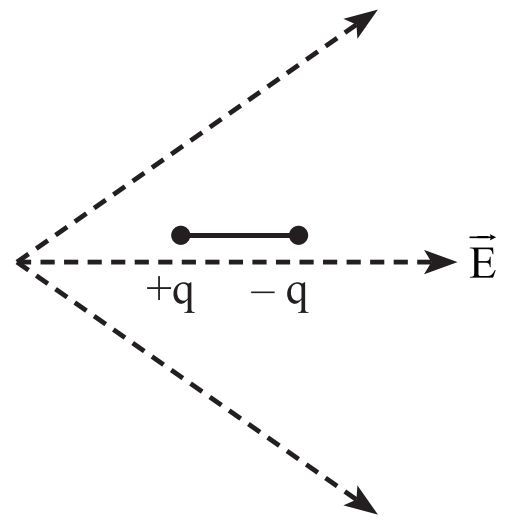
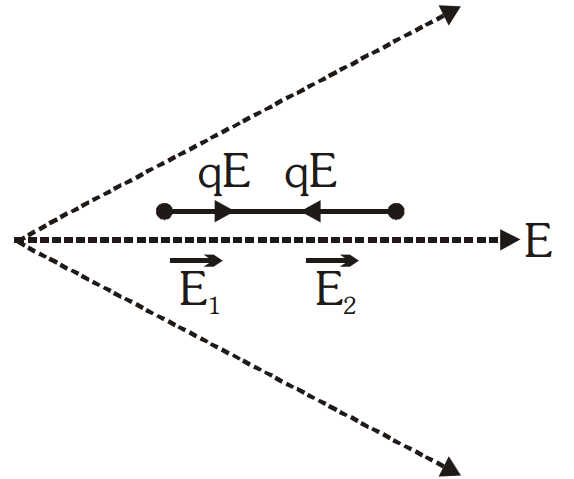
The field lines are closer at the charge +q, so $|E_1| > |E_2|$.
The force on +q (towards the right) is greater than the force on –q (towards the left), so the net force on the dipole acts towards the right.
A system always moves so as to decrease its potential energy. So the dipole moves towards the right as its potential energy decreases.
Coulomb's Law
-
Two pith balls carrying equal charges are suspended from a common point by strings of equal length, the equilibrium separation between them is r. Now the strings are rigidly clamped at half the height. The equilibrium separation between the balls now becomes:
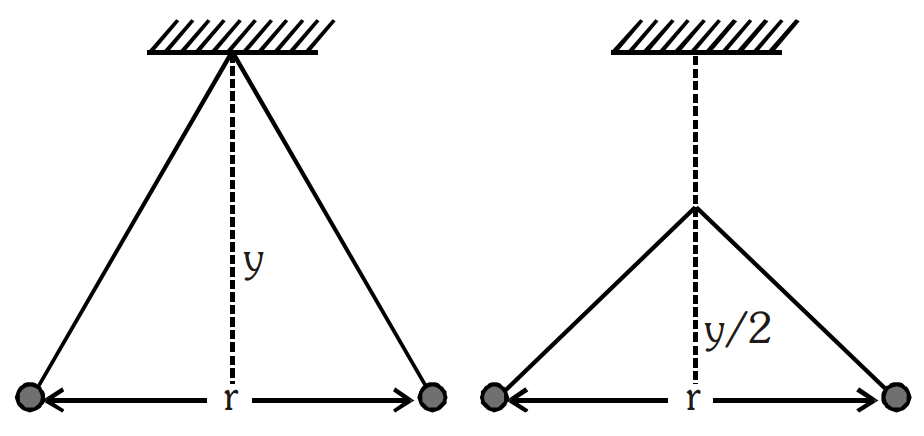 $\tan\theta = \frac{F}{mg} \Rightarrow \frac{r/2}{y} = \frac{kq^2}{r^2mg} \Rightarrow y \propto r^3$
$\left(\frac{r'}{r}\right)^3 = \frac{y/2}{y}$
$r' = r\left(\frac{1}{2}\right)^{1/3} = \frac{r}{\sqrt[3]{2}}$
Equilibrium of suspended charged spheres
-
Two identical charged spheres suspended from a common point by two massless strings of lengths l, are initially at a distance d (d << l) apart because of their mutual repulsion. The charges begin to leak from both the spheres at a constant rate. As a result, the spheres approach each other with a velocity v. Then, v varies as a function of the distance x between the sphere, as
$q \propto x^{3/2}$; constant dq/dt gives $v \propto x^{-1/2}$.
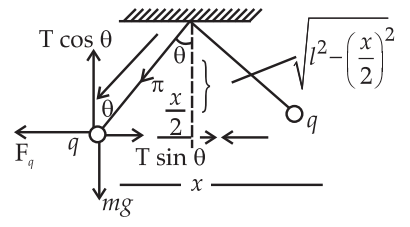
$T\cos\theta = mg$ ...(i) and $T\sin\theta = F_q$ ...(ii), so $\tan\theta = \frac{F_q}{mg}$
For $l >> x$: $\tan\theta \approx \frac{x}{2l}$, so $\frac{q^2}{4\pi\varepsilon_0x^2mg} = \frac{x}{2l}$
$q^2 = \frac{4\pi\varepsilon_0mg}{2l}x^3 \Rightarrow q \propto x^{3/2}$
Differentiating: $\frac{dq}{dt} \propto \frac{3}{2}x^{1/2}\frac{dx}{dt} \Rightarrow \frac{dq}{dt} \propto \sqrt{x}\,v$
Since $\frac{dq}{dt}$ is constant, $v \propto \frac{1}{\sqrt{x}} = x^{-1/2}$
Electric Field of a Continuous Charge Distribution
-
Electric field at centre O of semicircle of radius 'a' having linear charge density $\lambda$ is given by
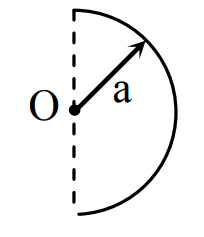 For a charged circular arc subtending angle $\alpha$ at the centre, the field at the centre is $E = \dfrac{2K\lambda}{a}\sin\dfrac{\alpha}{2}$ (the components along the arc's symmetry axis add, and the perpendicular components cancel).
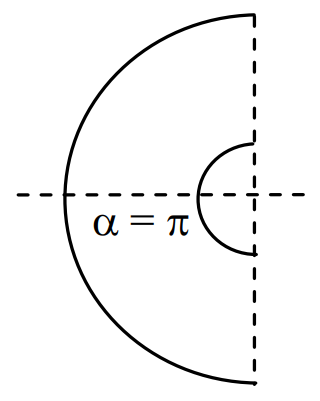
For a semicircle, $\alpha = \pi$, so $\sin\dfrac{\pi}{2} = 1$:
$E = \dfrac{2K\lambda}{a} = \dfrac{2\lambda}{4\pi\varepsilon_0 a}$
$E = \dfrac{\lambda}{2\pi\varepsilon_0 a}$
That is every question in Electric Charges and Fields for this filter.
Show all 42 questions Next: Electrostatic Potential and Capacitance
Want a score?
Answers here are not saved. Practise as a test to be marked and see your progress.
Practise as a test