Looking for classes? Ksquare Career Institute, Bengaluru →

Physics
Electric Charges and Fields
42 questions from 29 papers, each with its answer.
- 42 questions
- 29 papers
- 2.38% of Physics
Coulomb's Law and Charge Sharing
-
Two identical charged conducting spheres A and B have their centres separated by a certain distance. Charge on each sphere is $q$ and the force of repulsion between them is $F$. A third identical uncharged conducting sphere is brought in contact with sphere A first and then with B and finally removed from both. New force of repulsion between spheres A and B is best given as:
After touching A, charge on A and C becomes $q/2$. Touching B gives $(q/2 + q)/2 = 3q/4$. Force becomes $F' \propto (q/2)(3q/4) = \frac{3}{8} F$.
Initially, force between spheres A and B is $F = \frac{k q^2}{r^2}$. When an uncharged identical sphere C touches A, charge is shared equally: $q_A' = q/2$, $q_C' = q/2$. Next, C touches B (which has charge $q$): the total charge $(q/2 + q) = 3q/2$ is shared equally, so $q_B' = \frac{3q/2}{2} = \frac{3q}{4}$. Finally, sphere C is removed. The new electrostatic repulsive force between A and B is $F' = \frac{k q_A' q_B'}{r^2} = \frac{k (q/2)(3q/4)}{r^2} = \frac{3}{8} \frac{k q^2}{r^2} = \frac{3F}{8}$.
Dipole in a Uniform External Field
-
An electric dipole with dipole moment $5 \times 10^{-6}\text{ C m}$ is aligned with the direction of a uniform electric field of magnitude $4 \times 10^5\text{ N/C}$. The dipole is then rotated through an angle of $60^\circ$ with respect to the electric field. The change in the potential energy of the dipole is:
Change in potential energy is $\Delta U = -pE \cos 60^\circ - (-pE) = \frac{1}{2} pE = \frac{1}{2} (5 \times 10^{-6})(4 \times 10^5) = 1.0\text{ J}$.
The potential energy of an electric dipole in an external electric field is $U(\theta) = -p E \cos\theta$. Initially aligned: $\theta_1 = 0^\circ \implies U_1 = -pE \cos 0^\circ = -pE$. After rotating by $60^\circ$: $\theta_2 = 60^\circ \implies U_2 = -pE \cos 60^\circ = -\frac{1}{2} pE$. Change in potential energy: $\Delta U = U_2 - U_1 = -\frac{1}{2} pE - (-pE) = \frac{1}{2} pE$. Substituting the values: $\Delta U = \frac{1}{2} \times (5 \times 10^{-6}\text{ C m}) \times (4 \times 10^5\text{ N/C}) = \frac{2.0}{2} = 1.0\text{ J}$.
Electric Flux and Gauss's Law
-
If $\oint_S \vec{E}\cdot d\vec{S}=0$ over a surface, then:
Zero net flux means flux entering equals flux leaving.
$\oint\vec{E}\cdot d\vec{S}=0\Rightarrow\phi_{net}=\phi_{in}-\phi_{out}=0\Rightarrow\phi_{in}=\phi_{out}$
Electric Dipole – Field at Large Distance
-
Two point charges $-q$ and $+q$ are placed at a distance of $L$, as shown in the figure [add image]. The magnitude of electric field intensity at a distance $R$ ($R\gg L$) varies asThe two charges form an electric dipole. At a large distance ($R \gg L$): $E = \frac{kp}{R^3}\sqrt{1 + 3\cos^2\theta}$ $\therefore E \propto \frac{1}{R^3}$
Gauss's Law – Field of a Uniformly Charged Spherical Shell
-
A hollow metal sphere of radius $R$ is uniformly charged. The electric field due to the sphere at a distance $r$ from the centre:The charge $Q$ is distributed over the surface of the hollow metal sphere. (i) For $rR$ (outside): $q_{en}=Q$, so $E_0\cdot4\pi r^2=\frac{Q}{\epsilon_0}\Rightarrow E_0=\frac{Q}{4\pi\epsilon_0r^2}\propto\frac{1}{r^2}$ So the field is zero for $rR$.
Coulomb's Law
-
Two positive ions, each carrying a charge q, are separated by a distance d. If F is the force of repulsion between the ions, the number of electrons missing from each ion will be (e being the charge on an electron)If n electrons are missing from each ion, its charge is q = ne.
Coulomb's law: $F = \frac{1}{4\pi\varepsilon_0}\frac{q^2}{d^2} = \frac{1}{4\pi\varepsilon_0}\frac{n^2e^2}{d^2}$
$n^2 = \frac{4\pi\varepsilon_0Fd^2}{e^2}$
$n = \sqrt{\frac{4\pi\varepsilon_0Fd^2}{e^2}}$ -
The unit of permittivity of free space $\varepsilon_0$ is :-Coulomb's law: $F = \dfrac{1}{4\pi\varepsilon_0}\dfrac{q_1 q_2}{r^2}$
Rearranging: $\varepsilon_0 = \dfrac{q_1 q_2}{4\pi F r^2}$
$4\pi$ is a pure number, so the unit of $\varepsilon_0 = \dfrac{\text{Coulomb} \times \text{Coulomb}}{\text{Newton} \times \text{metre}^2}$
$[\varepsilon_0] = \dfrac{\text{Coulomb}^2}{\text{Newton metre}^2}$, i.e. $C^2 N^{-1} m^{-2}$
So the unit of permittivity of free space is Coulomb$^2$/Newton metre$^2$.
Gauss's law
-
A sphere encloses an electric dipole with charge $\pm3\times10^{-6}$ C. What is the total electric flux across the sphere?By Gauss's law $\phi=\frac{q_{in}}{\varepsilon_0}$; the net enclosed charge of a dipole is zero, so the flux is zero.
-
The electric field in a certain region is acting radially outward and is given by E = Ar. A charge contained in a sphere of radius 'a' centred at the origin of the field, will be given byThe field is radial, so $\phi = \oint \vec E\cdot d\vec s = E(4\pi a^2)$.
At r = a: $\phi = Aa\times 4\pi a^2 = 4\pi Aa^3$
Gauss's law: $\phi = \frac{q}{\varepsilon_0}$
$q = 4\pi\varepsilon_0Aa^3$ -
A charge Q is enclosed by a Gaussian spherical surface of radius R. If the radius is doubled, then the outward electric flux willBy Gauss's law, the total outward electric flux through a closed surface is $\phi_E = \frac{Q_{enclosed}}{\varepsilon_0}$
The flux depends only on the charge enclosed, not on the size or shape of the surface.
When the radius is doubled, the charge enclosed is still Q.
(The field at the surface becomes one-fourth while the area becomes four times, so their product is unchanged.)
Hence the outward electric flux remains the same. -
A charge q is located at the centre of a cube. The electric flux through any face is -By Gauss's law, the total flux through the closed surface of the cube is $\dfrac{q}{\varepsilon_0}$.
The charge is at the centre, so by symmetry the flux is shared equally among the 6 faces.
Electric flux through any face $= \dfrac{\text{total flux}}{\text{number of faces}} = \dfrac{q/\varepsilon_0}{6} = \dfrac{q}{6\varepsilon_0}$
Writing this in the form of the options: $\dfrac{q}{6\varepsilon_0} = \dfrac{4\pi q}{6(4\pi\varepsilon_0)}$
So the flux through any face is $\dfrac{4\pi q}{6(4\pi\varepsilon_0)}$. -
A charge Q $\mu C$ is placed at the centre of a cube, the flux coming out from any surface will be : -By Gauss's law, the total flux through the cube $= \dfrac{q}{\varepsilon_0}$.
The charge is at the centre, so by symmetry each of the 6 faces gets an equal share: flux through one face $= \dfrac{q}{6\varepsilon_0}$.
The charge is Q $\mu C$ $= Q \times 10^{-6}$ C.
Flux through any face $= \dfrac{Q}{6\varepsilon_0} \times 10^{-6}$
Torque on an electric dipole
-
An electric dipole is placed at an angle of 30° with an electric field intensity $2 \times 10^{5}$ N/C. It experiences a torque equal to 4 Nm. The charge on the dipole, if the dipole length is 2 cm, is:
$\tau = qlE\sin\theta$.
$\tau = pE\sin\theta = qlE\sin\theta$
$4 = q\times2\times10^{-2}\times2\times10^{5}\times\sin30^\circ$
$\Rightarrow q = 2$ mC
Note: the source's substitution line prints the dipole length as $2\times16^{-3}$, a typo for $2\times10^{-2}$ m (2 cm), which is used here.
Electric dipole in a uniform field
-
An electric dipole of moment 'p' is placed in an electric field of intensity 'E'. The dipole acquires a position such that the axis of the dipole makes an angle $\theta$ with the direction of the field. Assuming that the potential energy of the dipole to be zero when $\theta = 90^\circ$, the torque and the potential energy of the dipole will respectively beTorque: $\vec\tau = \vec p\times\vec E$, so $\tau = pE\sin\theta$
Potential energy = work done in rotating the dipole from $90^\circ$ to $\theta$: $U = \int_{90^\circ}^{\theta}pE\sin\theta\,d\theta = -pE\cos\theta$
i.e. $U = -\vec p\cdot\vec E = -pE\cos\theta$
So the torque is $pE\sin\theta$ and the potential energy is $-pE\cos\theta$.
Applications of Gauss's law
-
The electric field at a distance $\frac{3R}{2}$ from the centre of a charged conducting spherical shell of radius R is E. The electric field at a distance $\frac{R}{2}$ from the centre of the sphere isThe point at $\frac{R}{2}$ lies inside the conducting shell.
Take a spherical Gaussian surface of radius $\frac{R}{2}$ concentric with the shell. All the charge of a conductor resides on its outer surface, so the charge enclosed is zero.
By Gauss's law, $E\times4\pi r^2 = \frac{q_{enclosed}}{\varepsilon_0} = 0$
So the field at every point inside the shell is zero, whatever the field E outside (at $\frac{3R}{2}$) may be.
Electric field at $\frac{R}{2}$ = zero
Electric flux
-
A square surface of side L meter in the plane of the paper is placed in a uniform electric field E (volt/m) acting along the same plane at an angle $\theta$ with the horizontal side of the square as shown in figure. The electric flux linked to the surface, in units of volt-m, is
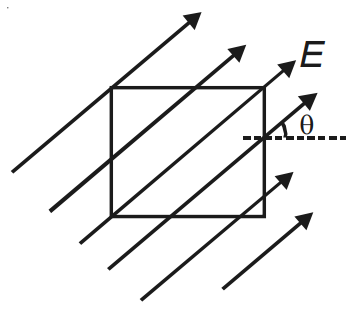 Electric flux: $\phi = \vec{E}\cdot\vec{S} = ES\cos\alpha$, where $\alpha$ is the angle between the field and the area vector.
The area vector of the square is perpendicular to its plane, i.e., perpendicular to the plane of the paper.
The field lies in the plane of the paper, so it is perpendicular to the area vector: $\alpha = 90^\circ$, whatever the angle $\theta$ is.
$\phi = EL^2\cos90^\circ = 0$
The field lines only skim along the surface and none pass through it, so the flux is zero. -
A square surface of side $L$ metres is in the plane of the paper. A uniform electric field $\vec{E}$ (volt/m), also in the plane of the paper, is limited only to the lower half of the square surface (see figure). The electric flux in SI units associated with the surface is :-
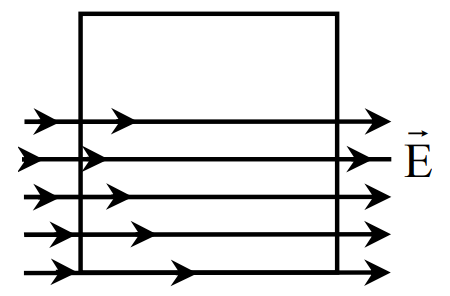 Electric flux through a surface: $\phi = \vec{E}\cdot\vec{S} = ES\cos\theta$, where $\theta$ is the angle between the field and the area vector.
The area vector of the square is perpendicular to its plane, i.e. perpendicular to the plane of the paper.
The electric field lies in the plane of the paper, so it is perpendicular to the area vector: $\theta = 90^\circ$.
$\phi = ES\cos 90^\circ = 0$
The field lines run along the surface and none of them passes through it, so the flux is zero whether the field covers the whole square or only half of it.
Dipole in a Uniform Electric Field
-
An electric dipole has the magnitude of its charge as q and its dipole moment is p. It is placed in a uniform electric field E. If its dipole moment is along the direction of the field, the force on it and its potential energy are respectively :-In a uniform field, the charge $+q$ experiences force $qE$ along the field and $-q$ experiences force $qE$ opposite to the field. The net force is zero.
(In general $F = p\dfrac{dE}{dr}$, which is zero because E is constant.)
Potential energy of a dipole: $U = -\vec{p}\cdot\vec{E} = -pE\cos\theta$
When $\vec{p}$ is along $\vec{E}$, $\theta = 0^\circ$ and $U = -pE$, which is the minimum possible value (stable equilibrium).
So the force is zero and the potential energy is minimum. -
A dipole of moment $\vec{p}$ is placed in uniform electric field $\vec{E}$ then torque acting on it is given by : -The two charges of the dipole experience equal and opposite forces qE, which form a couple.
Torque magnitude $= qE \times 2a\sin\theta = pE\sin\theta$, directed perpendicular to both $\vec{p}$ and $\vec{E}$.
In vector form: $\vec{\tau} = \vec{p} \times \vec{E}$
(The dot product $-\vec{p}\cdot\vec{E}$ gives the potential energy, which is a scalar.)
That is every question in Electric Charges and Fields for this filter.
Show all 42 questions Next: Electrostatic Potential and Capacitance
Want a score?
Answers here are not saved. Practise as a test to be marked and see your progress.
Practise as a test