Looking for classes? Ksquare Career Institute, Bengaluru →

Physics
Electromagnetic Induction
40 questions from 30 papers, each with its answer.
- 40 questions
- 30 papers
- 2.27% of Physics
Inductors in DC Circuits
-
AB is a part of an electrical circuit with elements from A to B: inductor ($L = 1\text{ H}$), DC battery of $5\text{ V}$ with positive terminal towards A, and resistor ($R = 2\,\Omega$). The potential difference $V_A - V_B$ at the instant when current $i = 2\text{ A}$ is directed from A to B and is increasing at a rate of $1\text{ amp/second}$ is:
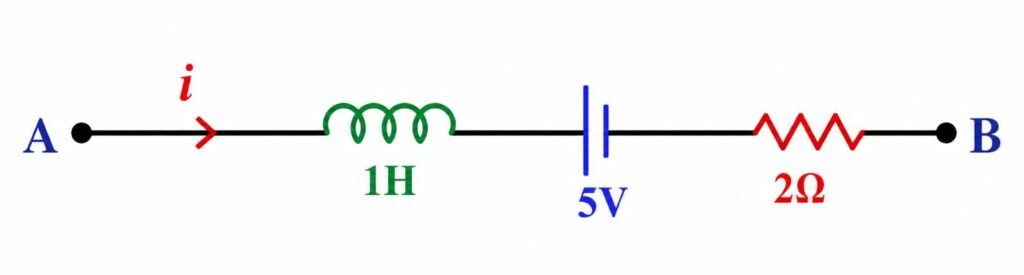
Applying Kirchhoff's voltage rule from A to B: $V_A - L \frac{di}{dt} - 5 - iR = V_B$, wait, in the diagram the battery has + on A side, so $V_A - V_B = 1 + 5 + 4 = 10\text{ V}$.
Writing the potential equation from A to B along the direction of current: $V_A - L\frac{di}{dt} - V_{battery} - iR = V_B \implies V_A - V_B = L\frac{di}{dt} + V_{battery} + iR$. Given $L = 1\text{ H}$, $\frac{di}{dt} = 1\text{ A/s}$, $V_{battery} = 5\text{ V}$, $i = 2\text{ A}$, and $R = 2\,\Omega$: $V_A - V_B = (1)(1) + 5 + (2)(2) = 1 + 5 + 4 = 10\text{ V}$.
Energy Stored in an Inductor
-
The magnetic energy stored in an inductor of inductance $4\ \mu H$ carrying a current of $2\ A$ is:
$U=\frac{1}{2}LI^2=8\ \mu J$.
Magnetic energy stored in an inductor $=\frac{1}{2}LI^2=\frac{1}{2}\times4\times10^{-6}\times(2)^2=8\ \mu J$ -
The magnetic potential energy stored in a certain inductor is 25 mJ, when the current in the inductor is 60 mA. This inductor is of inductance
$L = 2U/I^2$.
Energy stored in inductor $U = \frac{1}{2}LI^2$ $25\times10^{-3} = \frac{1}{2}\times L\times(60\times10^{-3})^2$ $L = \frac{25\times2\times10^{6}\times10^{-3}}{3600} = \frac{500}{36}$ $= 13.89$ H
Magnetic Flux
-
A square loop of side 1 m and resistance $1\ \Omega$ is placed in a magnetic field of 0.5 T. If the plane of loop is perpendicular to the direction of the magnetic field, the magnetic flux through the loop is :The plane of the loop is perpendicular to B, so the area vector is parallel to B (angle = 0). $\phi = BA\cos 0^\circ = 0.5 \times (1)^2 \times 1 = 0.5$ Wb
-
A circular disc of radius 0.2 metre is placed in a uniform magnetic field of induction $\dfrac{1}{\pi}\left(\dfrac{Wb}{m^2}\right)$ in such a way that its axis makes an angle of $60^\circ$ with $\vec{B}$. The magnetic flux linked with the disc is -Area of the disc: $A = \pi r^2 = \pi (0.2)^2 = 0.04\pi$ m$^2$
The axis of the disc is along its area vector, so the angle between $\vec{A}$ and $\vec{B}$ is $\theta = 60^\circ$.
Magnetic flux: $\phi = BA\cos\theta$
$\phi = \dfrac{1}{\pi} \times 0.04\pi \times \cos 60^\circ$
$\phi = 0.04 \times \dfrac{1}{2}$
$\phi = 0.02$ Wb
Mutual Inductance
-
Two coils of self inductances 2 mH and 8 mH are placed so close together that the effective flux in one coil is completely linked with the other. The mutual inductance between these coils is :Mutual inductance of two coils: $M = K\sqrt{L_1 L_2}$, where $K$ is the coefficient of coupling.
The flux of one coil is completely linked with the other, so the coupling is perfect: $K = 1$.
Here $L_1 = 2$ mH and $L_2 = 8$ mH.
$M = \sqrt{2 \times 8} = \sqrt{16}$
$M = 4$ mH
Faraday's Law of Induction
-
The magnetic flux linked to a circular coil of radius R is: $\phi=2t^3+4t^2+2t+5$ Wb. The magnitude of induced emf in the coil at $t=5$ s is:$|e|=\left|\frac{d\phi}{dt}\right|=6t^2+8t+2$. At $t=5$ s: $e=6(25)+8(5)+2=150+40+2=192$ V.
Eddy Currents
-
In which of the following devices, the eddy current effect is not used?An electric heater does not involve eddy currents; it works on the Joule heating effect. Induction furnaces, magnetic braking in trains and electromagnets make use of eddy currents.
Self-inductance of a solenoid
-
Consider a long solenoid of length l and radius r. If n is the number of turns per unit length and $\mu_0$ is the permeability of free space, the inductance of the solenoid is:$L=n^2\mu_0Al$ with $A=\pi r^2$, so $L=\mu_0\pi n^2r^2l$.
-
A long solenoid has 1000 turns. When a current of 4 A flows through it, the magnetic flux linked with each turn of the solenoid is $4 \times 10^{-3}$ Wb. The self-inductance of the solenoid is
$L = N\phi/I$.
Total flux linked with the solenoid $= N\phi = 1000\times4\times10^{-3}$ Wb = 4 Wb
Self-inductance: $N\phi = LI \Rightarrow 4 = L\times4$
L = 1 H
Motional EMF in a rotating rod
-
A cycle wheel of radius 0.5 m is rotated with constant angular velocity of 10 rad/s in a region of magnetic field of 0.1 T which is perpendicular to the plane of the wheel. The EMF generated between its centre and the rim is,$E=\frac{1}{2}B\omega l^2=\frac{1}{2}\times0.1\times10\times(0.5)^2=0.125$ V.
AC generator
-
A wire loop is rotated in magnetic field. The frequency of change of direction of the induced e.m.f. is:The induced emf in a rotating loop is sinusoidal. In one revolution it changes direction twice, once every half rotation.
Faraday's law
-
A coil of resistance 400 $\Omega$ is placed in a magnetic field. If the magnetic flux $\phi$ (Wb) linked with the coil varies with time t (sec) as $\phi = 50t^2 + 4$, the current in the coil at t = 2 sec is$|\text{emf}| = \frac{d\phi}{dt} = \frac{d}{dt}(50t^2 + 4) = 100t$
At t = 2 s, emf = 100 × 2 = 200 V
$i = \frac{\text{emf}}{R} = \frac{200}{400} = 0.5$ A
Self Inductance
-
A long solenoid has 500 turns. When a current of 2 ampere is passed through it, the resulting magnetic flux linked with each turn of the solenoid is $4 \times 10^{-3}$ Wb. The self-inductance of the solenoid is -Total flux linkage = flux through each turn $\times$ number of turns.
$N\phi = 500 \times 4 \times 10^{-3} = 2$ Wb
By definition of self-inductance, total flux linkage $N\phi = LI$.
$\Rightarrow L = \dfrac{N\phi}{I} = \dfrac{2}{2} = 1$ H
So the self-inductance of the solenoid is 1.0 henry.
Faraday's Law and Induced Charge
-
The magnetic flux through a circuit of resistance R changes by an amount $\Delta\phi$ in a time $\Delta t$. Then the total quantity of electric charges Q that passes any point in the circuit during the time $\Delta t$ is represented by :-By Faraday's law, the induced emf: $e = \dfrac{\Delta\phi}{\Delta t}$ (magnitude)
Induced current: $I = \dfrac{e}{R} = \dfrac{1}{R}\dfrac{\Delta\phi}{\Delta t}$
Current is also the rate of flow of charge: $I = \dfrac{\Delta Q}{\Delta t}$
So $\dfrac{\Delta Q}{\Delta t} = \dfrac{1}{R}\dfrac{\Delta\phi}{\Delta t}$
$\Rightarrow Q = \dfrac{\Delta\phi}{R}$
Note that the induced charge depends only on the change in flux and the resistance, not on how fast the flux changes.
Growth of Current in LR Circuit
-
A coil of 40 henry inductance is connected in series with a resistance of 8 ohm and the combination is joined to the terminals of a 2 volt battery. The time constant of the circuit is :-For an LR circuit, the time constant is $\tau = \dfrac{L}{R}$. It does not depend on the battery emf.
$\tau = \dfrac{40}{8} = 5$ seconds
(The battery voltage only decides the final steady current $I_0 = \dfrac{E}{R} = \dfrac{2}{8} = 0.25$ A.)
That is every question in Electromagnetic Induction for this filter.
Want a score?
Answers here are not saved. Practise as a test to be marked and see your progress.
Practise as a test