Looking for classes? Ksquare Career Institute, Bengaluru →

Physics
Work, Energy and Power
71 questions from 36 papers, each with its answer.
- 71 questions
- 36 papers
- 4.02% of Physics
Work-Energy Theorem
-
The kinetic energies of two similar cars A and B are $100\text{ J}$ and $225\text{ J}$ respectively. On applying brakes, car A stops after $1000\text{ m}$ and car B stops after $1500\text{ m}$. If $F_A$ and $F_B$ are the forces applied by the brakes on cars A and B, respectively, then the ratio $F_A / F_B$ is:
From work-energy theorem, $F = \frac{KE}{s}$. Therefore, $F_A / F_B = \frac{100/1000}{225/1500} = \frac{0.10}{0.15} = \frac{2}{3}$.
According to the Work-Energy Theorem, work done by the braking force equals the change in kinetic energy: $W = F \cdot s = \Delta KE \implies F = \frac{KE}{s}$. For car A: $F_A = \frac{100\text{ J}}{1000\text{ m}} = 0.10\text{ N}$. For car B: $F_B = \frac{225\text{ J}}{1500\text{ m}} = 0.15\text{ N}$. The ratio is $\frac{F_A}{F_B} = \frac{0.10}{0.15} = \frac{2}{3}$. -
A body of mass 1 kg is thrown upwards with a velocity 20 m/s. It momentarily comes to rest after attaining a height of 18 m. How much energy is lost due to air friction? (g = 10 m/$s^2$)Initial kinetic energy: $K_i = \frac{1}{2}mu^2 = \frac{1}{2}\times1\times(20)^2 = 200$ J
At the highest point the body is at rest, so all its remaining energy is potential: $U = mgh = 1\times10\times18 = 180$ J
Energy lost due to air friction = initial energy − final energy
= 200 − 180
= 20 J
Instantaneous Power
-
At any instant of time $t$, the displacement of any particle is given by $2t-1$ (SI unit) under the influence of force of 5N. The value of instantaneous power is (in SI unit):Instantaneous velocity $v = \frac{ds}{dt} = \frac{d}{dt}(2t - 1) = 2\ ms^{-1}$ Instantaneous power $P = Fv = 5 \times 2 = 10$ W
Perfectly Inelastic Collision
-
Two bodies A and B of same mass undergo completely inelastic one dimensional collision. The body A moves with velocity $v_1$ while body B is at rest before collision. The velocity of the system after collision is $v_2$. The ratio $v_1 : v_2$ is;Applying conservation of momentum: $mv_1 + 0 = 2mv_2$ $\Rightarrow v_2 = \frac{v_1}{2}$ $\frac{v_1}{v_2} = \frac{v_1}{v_1/2} = 2$ $v_1 : v_2 = 2 : 1$
Potential Energy of a Spring
-
The potential energy of a long spring when stretched by 2 cm is $U$. If the spring is stretched by 8 cm, potential energy stored in it will be:
Spring PE is $\frac{1}{2}kx^2$, so 4 times the stretch gives $16U$.
Potential energy stored in the spring $=\frac{1}{2}kx^2$ Now $\frac{1}{2}k(2)^2=U$ and $\frac{1}{2}k(8)^2=U'$ (say) $\Rightarrow U'=\frac{64}{4}U=16U$ -
The potential energy of a long spring when stretched by 2 cm is $U$. If the spring is stretched by 8 cm the potential energy stored in it is :-Potential energy stored in a spring stretched by $x$: $U = \dfrac{1}{2}Kx^2$
$U = \dfrac{1}{2}K(2)^2$ and $U' = \dfrac{1}{2}K(8)^2$
$\Rightarrow \dfrac{U'}{U} = \left(\dfrac{8}{2}\right)^2 = 16$
$\Rightarrow U' = 16U$ -
A mass of 0.5 kg moving with a speed of 1.5 m/s on a horizontal smooth surface, collides with a nearly weightless spring of force constant k = 50 N/m. The maximum compression of the spring would be :-
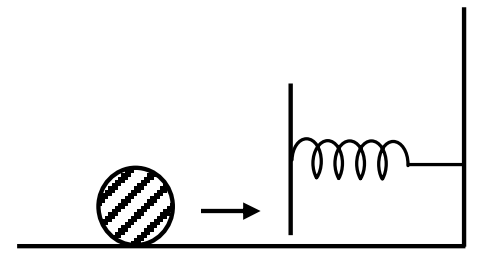 The surface is smooth, so mechanical energy is conserved. At maximum compression the mass momentarily stops, and all its kinetic energy is stored as elastic potential energy of the spring.
According to the question: $\dfrac{1}{2}mv^2 = \dfrac{1}{2}kx^2$
$\Rightarrow x = v\sqrt{\dfrac{m}{k}}$
$x = 1.5\sqrt{\dfrac{0.5}{50}} = 1.5\sqrt{0.01} = 1.5 \times 0.1$
$x = 0.15$ m
So the maximum compression of the spring is 0.15 m. -
When a long spring is stretched by 2 cm, its potential energy is U. If the spring is stretched by 10 cm, the potential energy stored in it will be :Potential energy stored in a stretched spring: $U = \dfrac{1}{2}kx^2$, so $U \propto x^2$.
$U = \dfrac{1}{2}k(2)^2$ and $U' = \dfrac{1}{2}k(10)^2$
$\dfrac{U'}{U} = \dfrac{10^2}{2^2} = 25$
$U' = 25U$ -
Two springs A and B having spring constants $K_A$ and $K_B$ ($K_A = 2K_B$) are stretched by applying force of equal magnitude. If energy stored in spring A is E then energy stored in B will be : -Energy stored in a spring: $E = \dfrac{1}{2}kx^2$. With force $F = kx$, $x = \dfrac{F}{k}$:
$E = \dfrac{kx^2}{2} = \dfrac{k^2x^2}{2k} = \dfrac{F^2}{2k}$
The force is equal, so $E \propto \dfrac{1}{k}$.
$\dfrac{E_B}{E_A} = \dfrac{K_A}{K_B} = 2 \Rightarrow E_B = 2E$
Power
-
The energy that will be ideally radiated by a 100 kW transmitter in 1 hour is :$E = P \times t = 100 \times 10^3 \times 3600$ $= 36 \times 10^7$ J
-
Water falls from a height of 60 m at the rate of 15 kg/s to operate a turbine. The losses due to frictional force are 10% of the input energy. How much power is generated by the turbine? ($g=10\ m/s^2$)$P_{in} = \frac{mgh}{t} = 15 \times 10 \times 60 = 9000$ W Losses are 10%, so $P_{out} = 90\%$ of $P_{in} = 0.9 \times 9000 = 8100$ W = 8.1 kW
-
A particle of mass M starting from rest undergoes uniform acceleration. If the speed acquired in time T is V, the power delivered to the particle isBy the work–energy theorem, work done on the particle = gain in kinetic energy: $W = \frac{1}{2}MV^2 - 0 = \frac{1}{2}MV^2$
This work is delivered in time T.
Power delivered (average) = $\frac{W}{T}$
$P = \frac{1}{2}\frac{MV^2}{T}$ -
Water falls from a height of 60 m at the rate of 15 kg/s to operate a turbine. The losses due to frictional forces are 10 % of energy. How much power is generated by the turbine ? ($g = 10$ m/s$^2$)Energy available per second to operate the turbine $= \dfrac{m}{t}\,g\,h$
$= 15 \times 10 \times 60 = 9000$ joule per second
Power supplied to the turbine = 9000 W
Power lost due to friction = 10 percent of 9000 = 900 W
Power generated by the turbine $= 9000 - 900 = 8100$ W
$= 8.1$ kW
Second approach: $P_{generated} = P_{input} \times \dfrac{90}{100} = \dfrac{mgh}{t} \times \dfrac{90}{100} = 15 \times 10 \times 60 \times \dfrac{90}{100} = 8.1$ kW -
If $\vec{F} = (60\hat{i} + 15\hat{j} - 3\hat{k})$ N and $\vec{V} = (2\hat{i} - 4\hat{j} + 5\hat{k})$ m/s, then instantaneous power is :Instantaneous power: $P = \vec{F}\cdot\vec{v}$
$P = (60\hat{i} + 15\hat{j} - 3\hat{k})\cdot(2\hat{i} - 4\hat{j} + 5\hat{k})$
$= (60)(2) + (15)(-4) + (-3)(5) = 120 - 60 - 15$
$P = 45$ watt
Equivalence of Mass and Energy
-
The energy equivalent of 0.5 g of a substance is:$E = mc^2 = 0.5 \times 10^{-3} \times (3 \times 10^8)^2$ $= 4.5 \times 10^{13}$ J
Work Done by a Variable Force
-
A force $F=20+10y$ acts on a particle in $y$-direction where $F$ is in newton and $y$ in meter. Work done by this force to move the particle from $y=0$ to $y=1$ m is:Work done by a variable force: $W=\int_{y_i}^{y_f}F\,dy$, with $y_i=0$, $y_f=1\ m$ $W=\int_0^1(20+10y)\,dy=\left[20y+\frac{10y^2}{2}\right]_0^1$ $W=20+5=25\ J$
-
Force F on a particle moving in a straight line varies with distance d as shown in the figure. The work done on the particle during its displacement of 12 m is
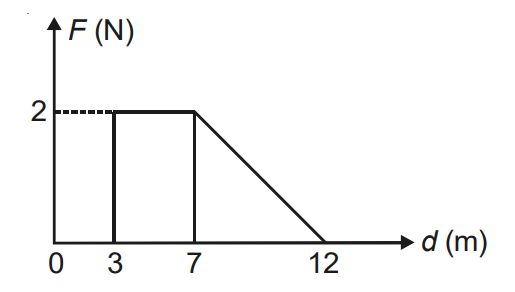 Work done = area under the force–distance graph.
From the graph, the force is 2 N from d = 3 m to d = 7 m and then falls uniformly to zero at d = 12 m.
Area of the rectangle (3 m to 7 m) = $2\times(7 - 3) = 8$ J
Area of the triangle (7 m to 12 m) = $\frac{1}{2}\times(12 - 7)\times2 = 5$ J
Total work = 8 + 5 = 13 J -
A force F acting on an object varies with distance $x$ as shown here.
(F = 3 N from $x$ = 0 to $x$ = 3 m, and then decreases linearly to zero at $x$ = 6 m.)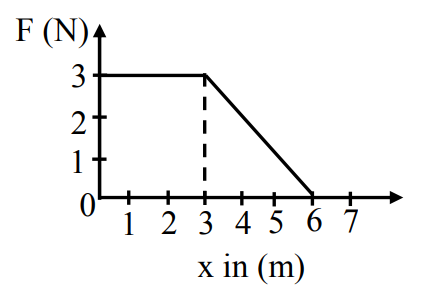
The force is in N and $x$ in m. The work done by the force in moving the object from $x$ = 0 to $x$ = 6 m isWork done by a variable force: $W = \int F\,dx$ = area under the F-x graph.
From $x$ = 0 to 3 m the force is constant at 3 N: area of the rectangle $= 3 \times 3 = 9$ J
From $x$ = 3 m to 6 m the force falls linearly from 3 N to 0: area of the triangle $= \dfrac{1}{2} \times 3 \times 3 = 4.5$ J
Total work $W = (3 \times 3) + \dfrac{1}{2} \times (3)(3)$
$W = 9 + 4.5 = 13.5$ J
Power as rate of doing work
-
The power of a crane, which lifts a mass of 1000 kg to a height of 20 m in 10 s is: ($g = 9.8\ m/s^2$)Power of crane $= \frac{mgh}{t} = \frac{1000 \times 9.8 \times 20}{10}$ $= 19.6 \times 1000$ W = 19.6 kW
Elastic collision and energy conservation
-
Bob B of mass m at rest is hanging vertically from the ceiling via a massless string of length 10 m, as shown in the figure. Point mass A of mass m travelling horizontally with speed 10 ms$^{-1}$ hits bob B elastically. The bob B rises h meter after the collision. Taking the acceleration due to gravity g = 10 ms$^{-2}$ and neglecting the size of the bob, the value of h is:
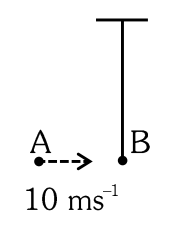 The masses are equal and the collision is head-on and elastic, so the velocities interchange: B moves off with 10 m/s. By conservation of mechanical energy, $\frac{1}{2}mv^2=mgh \Rightarrow h=\frac{v^2}{2g}=\frac{100}{20}=5$ m.
Collisions – coefficient of restitution
-
A moving block having mass m, collides with another stationary block having mass 4m. The lighter block comes to rest after collision. When the initial velocity of the lighter block is v, then the value of coefficient of restitution (e) will be
Momentum conservation gives $v/4$ for the heavy block; $e = (v/4)/v$.
According to the law of conservation of linear momentum, $mv + 4m\times0 = 4mv' + 0 \Rightarrow v' = \frac{v}{4}$ $e = \frac{\text{Relative velocity of separation}}{\text{Relative velocity of approach}} = \frac{v/4}{v}$ $e = \frac{1}{4} = 0.25$
Motion in a vertical circle
-
What is the minimum velocity with which a body of mass m must enter a vertical loop of radius R so that it can complete the loop?
Needs $\sqrt{gR}$ at the top, hence $\sqrt{5gR}$ at the bottom.
At the top, the minimum condition is $\frac{mv_1^2}{R} = mg \Rightarrow v_1 = \sqrt{Rg}$
Conservation of energy: $\frac{1}{2}mv^2 = \frac{1}{2}mv_1^2 + mg(2R)$
$\frac{mv^2}{2} = \frac{mgR}{2} + 2mgR = \frac{5mgR}{2}$
$v = \sqrt{5gR}$
Elastic collision of equal masses
-
Two identical balls A and B having velocities of 0.5 m/s and –0.3 m/s respectively collide elastically in one dimension. The velocities of B and A after the collision respectively will be:
Equal masses in an elastic head-on collision exchange velocities.
Since both bodies are identical and the collision is elastic, the velocities are interchanged after collision.
$v_A = -0.3$ m/s and $v_B = 0.5$ m/s
Work done by a constant force (dot product)
-
A particle moves from a point $(-2\hat{i} + 5\hat{j})$ to $(4\hat{j} + 3\hat{k})$ when a force of $(4\hat{i} + 3\hat{j})$ N is applied. How much work has been done by the force?
$W = \vec{F}\cdot\Delta\vec{r}$.
Displacement $\vec{s} = (4\hat{j} + 3\hat{k}) - (-2\hat{i} + 5\hat{j}) = 2\hat{i} - \hat{j} + 3\hat{k}$
$W = \vec{F}\cdot\vec{s} = (4\hat{i} + 3\hat{j})\cdot(2\hat{i} - \hat{j} + 3\hat{k}) = 8 - 3 = 5$ J
Collisions
-
Two particles of masses $m_1$, $m_2$ move with initial velocities $u_1$ and $u_2$. On collision, one of the particles gets excited to a higher level, after absorbing energy $\varepsilon$. If final velocities of particles be $v_1$ and $v_2$ then we must haveTotal energy is conserved in any collision:
Initial KE = Final KE + excitation energy
$\frac{1}{2}m_1u_1^2 + \frac{1}{2}m_2u_2^2 = \frac{1}{2}m_1v_1^2 + \frac{1}{2}m_2v_2^2 + \varepsilon$
$\frac{1}{2}m_1u_1^2 + \frac{1}{2}m_2u_2^2 - \varepsilon = \frac{1}{2}m_1v_1^2 + \frac{1}{2}m_2v_2^2$ -
A mass m moving horizontally (along the x-axis) with velocity v collides and sticks to a mass of 3m moving vertically upward (along the y-axis) with velocity 2v. The final velocity of the combination isThe masses stick together, so the collision is perfectly inelastic; linear momentum is conserved.
Initial momentum = $m(v\hat{i}) + 3m(2v\hat{j}) = mv\hat{i} + 6mv\hat{j}$
Final momentum = $(m + 3m)\vec{V} = 4m\vec{V}$
$4m\vec{V} = mv\hat{i} + 6mv\hat{j}$
$\vec{V} = \frac{mv\hat{i} + 6mv\hat{j}}{4m}$
$\vec{V} = \frac{1}{4}v\hat{i} + \frac{3}{2}v\hat{j}$
Work done by a constant force
-
A uniform force of $(3\hat i + \hat j)$ newton acts on a particle of mass 2 kg. Hence the particle is displaced from position $(2\hat i + \hat k)$ meter to position $(4\hat i + 3\hat j - \hat k)$ meter. The work done by the force on the particle is:$W = \vec F\cdot\vec S = (3\hat i + \hat j)\cdot[(4 - 2)\hat i + (3 - 0)\hat j + (-1 - 1)\hat k]$
$= (3\hat i + \hat j)\cdot(2\hat i + 3\hat j - 2\hat k) = 3(2) + 1(3) + 0(-2) = 9$ J
Potential energy
-
The potential energy of a system increases if work is donePotential energy is defined only for conservative forces, by the relation $\Delta U = -W_{conservative}$
When the system does work against a conservative force, the work done by that conservative force is negative.
Then $\Delta U = -(\text{negative}) = $ positive, i.e., the potential energy increases (for example, raising a body against gravity or compressing a spring).
When a conservative force does work upon the system, U decreases; work involving non-conservative forces does not get stored as potential energy.
Hence the potential energy increases when work is done by the system against a conservative force.
Work Done Against Friction
-
300 J of work is done in sliding a 2 kg block up an inclined plane of height 10 m. Taking $g = 10$ m/s$^2$, work done against friction isBy the work-energy theorem, $W_{net} = \Delta KE$. The block is slid up slowly, so $\Delta KE = 0$.
$\Rightarrow 300 - W_{gravity} - W_{friction} = 0$
Work done against gravity $= mgh = (2)(10)(10) = 200$ J
$\Rightarrow W_{friction} = 300 - mgh$
$= 300 - 200$
$= 100$ J
Relation between Kinetic Energy and Momentum
-
A particle of mass $m_1$ is moving with a velocity $v_1$ and another particle of mass $m_2$ is moving with a velocity $v_2$. Both of them have the same momentum but their different kinetic energies are $E_1$ and $E_2$ respectively. If $m_1 \gt m_2$ then :Kinetic energy in terms of momentum: $E = \dfrac{1}{2}mv^2 = \dfrac{(mv)^2}{2m} = \dfrac{p^2}{2m}$
Both particles have the same momentum p, so $E \propto \dfrac{1}{m}$
$\dfrac{E_1}{E_2} = \dfrac{m_2}{m_1}$
Since $m_1 \gt m_2$, $\dfrac{E_1}{E_2} \lt 1$
$\Rightarrow E_1 \lt E_2$
Kinetic Energy in Free Fall
-
A ball of mass 2 kg and another of mass 4 kg are dropped together from a 60 feet tall building. After a fall of 30 feet each towards earth, their respective kinetic energies will be in the ratio of-Both balls are dropped from rest and fall the same height h = 30 ft. In free fall the velocity does not depend on mass.
Here $v_1 = v_2 = \sqrt{2gh}$
$\dfrac{KE_1}{KE_2} = \dfrac{\frac{1}{2}m_1v_1^2}{\frac{1}{2}m_2v_2^2} = \dfrac{m_1}{m_2}$
$= \dfrac{2}{4} = \dfrac{1}{2}$
So their kinetic energies are in the ratio 1 : 2.
Conservation of Mechanical Energy
-
A child is sitting on a swing. Its minimum and maximum heights from the ground are 0.75 m and 2 m respectively, its maximum speed will beAt the highest point the swing momentarily stops; at the lowest point the speed is maximum.
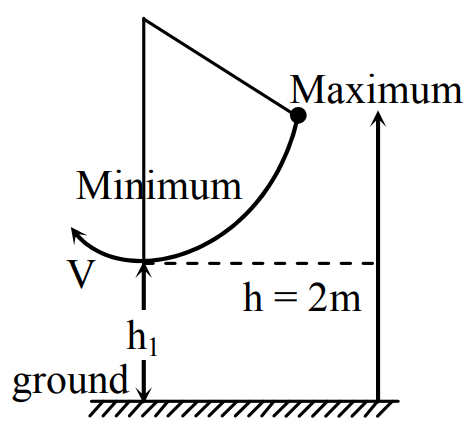
Apply conservation of mechanical energy between the maximum and minimum points:
$mgh = mgh_1 + \dfrac{1}{2}mV^2$
$V = \sqrt{2g(h - h_1)} = \sqrt{2 \times 10 \times (2 - 0.75)} = \sqrt{25}$
$V = 5$ m/s -
A man is slipping on a frictionless inclined plane and a bag falls down from the same height. Then the speed of both is related as :On a frictionless incline only gravity does work (the normal force does no work).
By conservation of energy, for both the man and the bag: $mgh = \dfrac{1}{2}mv^2 \Rightarrow v = \sqrt{2gh}$
The speed depends only on the height fallen, not on the path or the mass. (The times taken are different.)
So $V_B = V_m$. -
The bob of simple pendulum having length l, is displaced from mean position to an angular position $\theta$ with respect to vertical. If it is released, then velocity of bob at lowest position :At angle $\theta$, the bob is at height $h = l - l\cos\theta = l(1 - \cos\theta)$ above the lowest point.
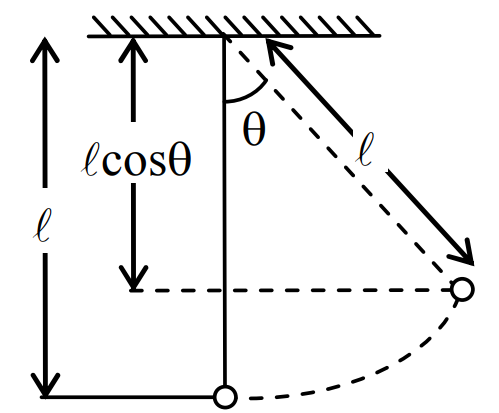
Potential energy at the extreme position = kinetic energy at the mean position:
$mgl(1 - \cos\theta) = \dfrac{1}{2}mv^2$
$v = \sqrt{2gl(1 - \cos\theta)}$
Work and Efficiency of Machines
-
250 N force is required to raise 75 kg mass from a pulley. If rope is pulled 12 m then the load is lifted to 3 m, the efficiency of pulley system will be : -Efficiency $\eta = \dfrac{\text{useful work}}{\text{total work}} = \dfrac{mgh}{F \times d}$
Useful work $= 75 \times 10 \times 3 = 2250$ J (taking g = 10 m/s$^2$)
Total work done by the effort $= 250 \times 12 = 3000$ J
$\eta = \dfrac{2250}{3000} = 0.75 = 75$ percent
That is every question in Work, Energy and Power for this filter.
Show all 71 questions Next: System of Particles and Rotational Motion
Want a score?
Answers here are not saved. Practise as a test to be marked and see your progress.
Practise as a test