Looking for classes? Ksquare Career Institute, Bengaluru →

Physics
Thermodynamics
54 questions from 37 papers, each with its answer.
- 54 questions
- 37 papers
- 3.06% of Physics
Mixing of Gases
-
A container has two chambers of volumes $V_1 = 2\text{ litres}$ and $V_2 = 3\text{ litres}$ separated by a partition made of a thermal insulator. The chambers contains $n_1 = 5$ and $n_2 = 4\text{ moles}$ of ideal gas at pressures $p_1 = 1\text{ atm}$ and $p_2 = 2\text{ atm}$, respectively. When the partition is removed, the mixture attains an equilibrium pressure of:
Total internal energy is conserved, so $P_f V_{total} = P_1 V_1 + P_2 V_2 \implies P_f = \frac{1(2) + 2(3)}{2 + 3} = \frac{8}{5} = 1.6\text{ atm}$.
For ideal gases insulated from the surroundings, internal energy is conserved upon free mixing: $U = U_1 + U_2$. Since internal energy of an ideal gas is $U = \frac{f}{2} n R T = \frac{f}{2} P V$, we have: $\frac{f}{2} P_f (V_1 + V_2) = \frac{f}{2} P_1 V_1 + \frac{f}{2} P_2 V_2 \implies P_f = \frac{P_1 V_1 + P_2 V_2}{V_1 + V_2}$. Substituting the values: $P_f = \frac{(1\text{ atm} \times 2\text{ L}) + (2\text{ atm} \times 3\text{ L})}{2\text{ L} + 3\text{ L}} = \frac{2 + 6}{5} = \frac{8}{5} = 1.6\text{ atm}$.
First Law of Thermodynamics - Isobaric Work
-
Two gases A and B are filled at the same pressure in separate cylinders with movable pistons of radius $r_A$ and $r_B$, respectively. On supplying an equal amount of heat to both the systems reversibly under constant pressure, the pistons of gas A and B are displaced by $16\text{ cm}$ and $9\text{ cm}$, respectively. If the change in their internal energy is the same, then the ratio $r_A / r_B$ is equal to:
Since $Q$ and $\Delta U$ are equal, work done $W = P \Delta V$ is identical. $\pi r_A^2 (16) = \pi r_B^2 (9) \implies r_A / r_B = 3/4$.
From the first law of thermodynamics: $Q = \Delta U + W$. Since equal heat $Q_A = Q_B$ is supplied and internal energy change is identical $\Delta U_A = \Delta U_B$, the work done by both gases must be equal: $W_A = W_B$. At constant pressure $P$: $W = P \Delta V \implies P \Delta V_A = P \Delta V_B \implies \Delta V_A = \Delta V_B$. For a cylindrical piston of radius $r$ displaced by $d$: $\Delta V = (\pi r^2) d$. Thus: $\pi r_A^2 (16\text{ cm}) = \pi r_B^2 (9\text{ cm}) \implies \frac{r_A^2}{r_B^2} = \frac{9}{16} \implies \frac{r_A}{r_B} = \sqrt{\frac{9}{16}} = \frac{3}{4}$.
Carnot Engine and Efficiency
-
A Carnot engine has an efficiency of 50% when its source is at a temperature $327^\circ C$. The temperature of the sink is:
$\eta=1-\frac{T_{sink}}{T_{source}}$ gives $T_{sink}=300\ K=27^\circ C$.
$\eta=1-\frac{T_{sink}}{T_{source}}=0.5\Rightarrow\frac{T_{sink}}{T_{source}}=0.5$ $\Rightarrow T_{sink}=\frac{1}{2}\times(273+327)=\frac{1}{2}\times600=300\ K=27^\circ C$
Thermodynamic Processes
-
In which of the following processes, heat is neither absorbed nor released by a system?In an adiabatic process there is no exchange of heat between the system and the surroundings, i.e. $\Delta Q=0$. Hence heat is neither absorbed nor released in an adiabatic process.
-
An ideal gas is compressed to half its initial volume by means of several processes. Which of the process results in the maximum work done on the gas?
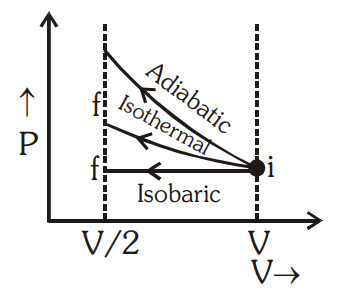
Work done on the gas equals the area under the P–V curve; the adiabatic curve is the steepest, so it encloses the largest area.
$W_{isochoric} = 0$ and $W_{adiabatic} > W_{isothermal} > W_{isobaric}$ -
One mole of an ideal gas goes from an initial state A to final state B via two processes: It first undergoes isothermal expansion from volume V to 3V and then its volume is reduced from 3V to V at constant pressure. The correct P-V diagram representing the two processes is:Isothermal expansion: PV = constant, so as the volume goes from V to 3V the pressure falls along a rectangular hyperbola.
Then the volume is reduced from 3V back to V at constant pressure: a horizontal straight line directed towards smaller volume.
So the diagram shows a falling hyperbola from A (at V) to 3V, followed by a horizontal line back to V ending at B, which lies below A. -
In thermodynamic processes which of the following statements is not true?Adiabatic process: no heat is exchanged, so the system is insulated from the surroundings, and for an ideal gas $PV^\gamma$ = constant. Both statements are true.
Isothermal process: the temperature remains constant (true).
Isochoric process: it is the volume that remains constant; the pressure changes with temperature ($P \propto T$).
The process in which pressure remains constant is the isobaric process.
Hence the statement that is not true is 'In an isochoric process pressure remains constant'.
First law of thermodynamics
-
An electric heater supplies heat to a system at a rate of 100 W. If the system performs work at a rate of 75 J/s, then the rate at which internal energy increases will be:From the first law of thermodynamics: $\frac{dQ}{dt} = \frac{dU}{dt} + \frac{dW}{dt}$ $100 = \frac{dU}{dt} + 75$ $\frac{dU}{dt} = 100 - 75 = 25$ W
-
1 g of water, of volume 1 cm$^3$ at $100^\circ C$, is converted into steam at same temperature under normal atmospheric pressure ($=1\times10^5$ Pa). The volume of steam formed equals 1671 cm$^3$. If the specific latent heat of vaporisation of water is 2256 J/g, the change in internal energy is,$Q=\Delta U+P\Delta V \Rightarrow 1\times2256=\Delta U+10^5\times(1670\times10^{-6}) \Rightarrow \Delta U=2256-167=2089$ J.
-
During an isothermal expansion, a confined ideal gas does −150 J of work against its surroundings. This implies thatFirst law of thermodynamics: $Q = \Delta U + W$, where W is the work done by the gas.
For an ideal gas the internal energy depends only on temperature; in an isothermal process $\Delta T = 0$, so $\Delta U = 0$.
Given W = −150 J.
$Q = 0 + (-150) = -150$ J
The negative sign means heat has left the gas.
Hence 150 J of heat has been removed from the gas. -
If $\Delta U$ and $\Delta W$ represent the increase in internal energy and work done by the system respectively in a thermodynamical process, which of the following is true?First law of thermodynamics: $\Delta Q = \Delta U + \Delta W$
In an adiabatic process no heat is exchanged: $\Delta Q = 0$
$0 = \Delta U + \Delta W$, so $\Delta U = -\Delta W$
In an isothermal process of an ideal gas the temperature is constant, so $\Delta U = 0$ and $\Delta Q = \Delta W$; neither isothermal relation given is true.
Hence $\Delta U = -\Delta W$ in an adiabatic process. -
The internal energy change in a system that has absorbed 2 kcal of heat and done 500 J of work isHeat absorbed: $Q = 2$ kcal $= 2\times1000\times4.2$ J $= 8400$ J
Work done by the system: W = 500 J
First law of thermodynamics: $Q = \Delta U + W$
$\Delta U = Q - W = 8400 - 500$
$\Delta U = 7900$ J
Work done in adiabatic process
-
In an adiabatic expansion, the temperature of one mole of an ideal monatomic gas ($\gamma=5/3$) decreases from 60 K to 50 K. The work done by the gas in the process is: (Take the universal gas constant as R = 8.3 J mol$^{-1}$ K$^{-1}$)$W=\frac{\mu R\Delta T}{1-\gamma}=\frac{1\times8.3\times(-10)}{1-\frac{5}{3}}=\frac{3\times8.3\times10}{2}=124.5$ J.
Cyclic process - first law
-
One mole of an ideal monatomic gas undergoes a cyclic process as shown in the figure. The total heat supplied to the gas is:
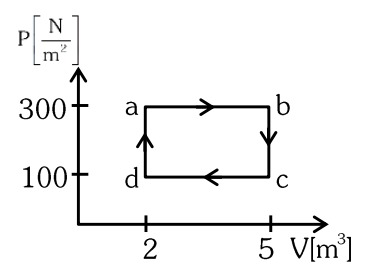 For a cyclic process $\Delta U=0$, so the heat supplied equals the work done, which is the area of the rectangle: $Q=(300-100)(5-2)=200\times3=600$ J.
Isobaric process and first law of thermodynamics
-
The volume (V) of a monatomic gas varies with its temperature (T), as shown in the graph. The ratio of work done by the gas, to the heat absorbed by it, when it undergoes a change from state A to state B, is
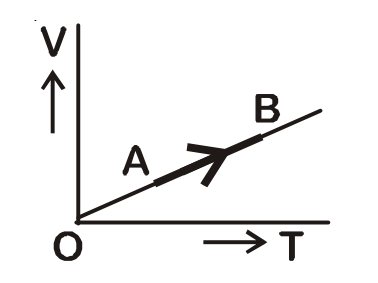
For an isobaric process $W/Q = R/C_p = 2/5$ for a monatomic gas.
The V–T graph is a straight line through the origin, so the given process is isobaric. $dQ = nC_p\,dT = n\left(\frac{5}{2}R\right)dT$ (monatomic gas) $dW = P\,dV = nR\,dT$ Required ratio $= \frac{dW}{dQ} = \frac{nR\,dT}{n\left(\frac{5}{2}R\right)dT} = \frac{2}{5}$ So the ratio of work done to heat absorbed is $\frac{2}{5}$.
Carnot engine efficiency
-
The efficiency of an ideal heat engine working between the freezing point and boiling point of water, is
$\eta = 1 - T_2/T_1$ with $T_1 = 373$ K and $T_2 = 273$ K.
Efficiency of ideal heat engine, $\eta = \left(1 - \frac{T_2}{T_1}\right)$ $T_2$ : sink temperature, $T_1$ : source temperature $\%\eta = \left(1 - \frac{T_2}{T_1}\right)\times 100 = \left(1 - \frac{273}{373}\right)\times 100$ $= \left(\frac{100}{373}\right)\times 100 = 26.8\%$
Refrigerators
-
The coefficient of performance of a refrigerator is 5. If the temperature inside freezer is $-20^\circ C$, the temperature of the surroundings to which it rejects heat is:$COP = \frac{T_L}{T_H - T_L}$, with $T_L = 253$ K
$5 = \frac{253}{T_H - 253} \Rightarrow T_H = \frac{6}{5}\times 253 = 303.6$ K
$T_H \approx 31^\circ C$
Work in a cyclic process
-
A gas is taken through the cycle A → B → C → A, as shown. What is the net work done by the gas?
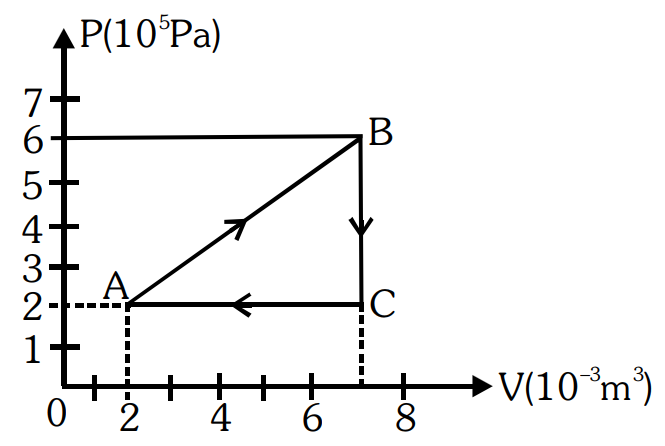 Net work done = area of triangle ABC
$= \frac{1}{2}\times[(7 - 2)\times10^{-3}][(6 - 2)\times10^5] = 1000$ J
Adiabatic process
-
A monoatomic gas at pressure $P_1$ and volume $V_1$ is compressed adiabatically to $\frac{1}{8}$th its original volume. What is the final pressure of the gas?For an adiabatic process: $PV^\gamma$ = constant; for a monoatomic gas $\gamma = \frac{5}{3}$
$P_1V_1^{5/3} = P_2\left(\frac{V_1}{8}\right)^{5/3}$
$P_2 = P_1(8)^{5/3}$
$(8)^{5/3} = (2^3)^{5/3} = 2^5 = 32$
$P_2 = 32P_1$
Entropy
-
When 1 kg of ice at $0^\circ C$ melts to water at $0^\circ C$, the resulting change in its entropy, taking latent heat of ice to be 80 cal/g, isHeat absorbed in melting: $Q = mL = 1000\ g\times80\ cal/g = 8\times10^4$ cal
Melting takes place at the constant temperature T = $0^\circ C$ = 273 K.
Change in entropy $\Delta S = \frac{Q}{T}$
$\Delta S = \frac{8\times10^4}{273}$
$\Delta S \approx 293$ cal/K
Note: the source prints the latent heat as '80 cal/°C'; the correct unit, cal/g, is used here.
Cyclic Process
-
If $Q$, $E$ and $W$ denote respectively the heat added, change in internal energy and the work done in a closed cycle process, then :In a cyclic process the system returns to its initial state, so the initial and final states are the same.
Internal energy is a state function; it depends only on the state of the system.
Therefore the initial and final internal energies are equal and the change in internal energy is zero: $E = 0$.
From the first law, $Q = E + W$, so for a cycle $Q = W$.
$Q$ and $W$ are not zero in general (the work equals the area enclosed by the cycle on the P-V diagram); they are only equal to each other.
Hence the correct relation is $E = 0$.
Carnot Engine
-
An ideal gas heat engine operates in Carnot cycle between $227^\circ C$ and $127^\circ C$. It absorbs $6 \times 10^{4}$ cals of heat at higher temperature. Amount of heat converted to work is :-$T_1 = 227 + 273 = 500$ K (source) and $T_2 = 127 + 273 = 400$ K (sink)
Efficiency: $\eta = \dfrac{W}{Q_1} = 1 - \dfrac{T_2}{T_1}$
$\eta = 1 - \dfrac{400}{500} = 0.2$
$W = Q_1\left(1 - \dfrac{T_2}{T_1}\right) = 6 \times 10^{4} \times 0.2$
$W = 1.2 \times 10^{4}$ cals -
An ideal gas heat engine operates in a Carnot cycle between $227^\circ C$ and $127^\circ C$. It absorbs 6 kcal at the higher temperature. The amount of heat (in kcal) converted into work is equal to -Convert temperatures to kelvin: $T_1 = 227 + 273 = 500$ K, $T_2 = 127 + 273 = 400$ K.
Efficiency of a Carnot engine: $\eta = 1 - \dfrac{T_2}{T_1} = \dfrac{W}{Q}$
$\eta = 1 - \dfrac{400}{500} = 0.2$
$W = \eta Q = 0.2 \times 6 = 1.2$ kcal
So 1.2 kcal of heat is converted into work. -
The efficiency of Carnot engine is 50% and temperature of sink is 500K. If temperature of source is kept constant and its efficiency raised to 60%, then the required temperature of the sink will be : -Efficiency of a Carnot engine: $\eta = 1 - \dfrac{T_2}{T_1}$, where $T_1$ is the source and $T_2$ the sink temperature.
For 50 percent: $0.5 = 1 - \dfrac{500}{T_1} \Rightarrow T_1 = 1000$ K
For 60 percent with the same source: $0.6 = 1 - \dfrac{T_2}{1000}$
$\Rightarrow T_2 = 0.4 \times 1000 = 400$ K
So the sink temperature must be lowered to 400 K. -
A scientist says that the efficiency of his heat engine which works at source temperature $127^\circ C$ and sink temperature $27^\circ C$ is 26%, thenA Carnot engine is an ideal engine, so its efficiency is the maximum possible for any engine working between the same two temperatures (Carnot's theorem).
$T_1 = 127 + 273 = 400$ K, $T_2 = 27 + 273 = 300$ K
$\eta_{max} = \dfrac{T_1 - T_2}{T_1} \times 100 = \dfrac{400 - 300}{400} \times 100 = 25$ percent
The claimed efficiency of 26 percent is more than the maximum possible 25 percent.
Therefore a 26 percent efficient engine is impossible.
Reversible and Irreversible Processes
-
Which of the following processes is reversibleA reversible process is one that can be retraced in the opposite direction, so that the system and the surroundings pass through exactly the same states in reverse order.
It must be carried out very slowly (quasi-statically), with the system always in equilibrium, and without dissipative effects such as friction, resistance or heat flow across a finite temperature difference.
A slow isothermal compression of a gas, in contact with a heat reservoir at the same temperature, satisfies these conditions; it can be reversed by an equally slow isothermal expansion. So it is a reversible process.
Transfer of heat by conduction or radiation takes place from a hotter to a colder body across a finite temperature difference; heat never flows back by itself, so these are irreversible.
Electrical (Joule) heating of a nichrome wire is a dissipative process; the heat produced cannot be converted back into electrical energy in the same way, so it is irreversible.
So the reversible process is isothermal compression.
That is every question in Thermodynamics for this filter.
Want a score?
Answers here are not saved. Practise as a test to be marked and see your progress.
Practise as a test