Looking for classes? Ksquare Career Institute, Bengaluru →

Physics
Oscillations
63 questions from 34 papers, each with its answer.
- 63 questions
- 34 papers
- 3.57% of Physics
Energy and Velocity in Simple Harmonic Motion
-
Two identical point masses P and Q, suspended from two separate massless springs of spring constants $k_1$ and $k_2$ respectively, oscillate vertically. If their maximum speeds are the same, the ratio $(A_Q / A_P)$ of the amplitude $A_Q$ of mass Q to the amplitude $A_P$ of mass P is:
$v_{max} = \omega A = \sqrt{k/m} A$. Equating maximum speeds gives $\sqrt{k_1} A_P = \sqrt{k_2} A_Q \implies A_Q / A_P = \sqrt{k_1 / k_2}$.
For simple harmonic oscillation of a mass-spring system, the maximum velocity is $v_{max} = \omega A = \sqrt{\frac{k}{m}} A$. Given that both masses are identical ($m_P = m_Q = m$) and have equal maximum velocities: $v_{max,P} = v_{max,Q} \implies \sqrt{\frac{k_1}{m}} A_P = \sqrt{\frac{k_2}{m}} A_Q$. Rearranging for the ratio of amplitudes: $\frac{A_Q}{A_P} = \sqrt{\frac{k_1}{k_2}}$.
Amplitude and Time Period in SHM
-
If $x=5\sin\left(\pi t + \frac{\pi}{3}\right)$ m represents the motion of a particle executing simple harmonic motion, the amplitude and time period of motion, respectively, are;Comparing with $x = A\sin(\omega t + \phi)$: A = 5 m and $\omega = \pi$ rad $s^{-1}$ $T = \frac{2\pi}{\omega} = \frac{2\pi}{\pi} = 2$ s So amplitude = 5 m and time period = 2 s.
Simple Pendulum Time Period
-
If the mass of the bob in simple pendulum is increased to thrice its original mass and its length is made half its original length, then the new time period of oscillation is $\frac{x}{2}$ times its original time period. Then the value of $x$ is:Time period of a pendulum $T = 2\pi\sqrt{\frac{l}{g}}$ (independent of the mass of the bob) $T' = 2\pi\sqrt{\frac{l}{2g}} = \frac{1}{\sqrt{2}}T$ $\frac{x}{2}T = \frac{1}{\sqrt{2}}T \Rightarrow \sqrt{2}x = 2$ $x = \frac{2}{\sqrt{2}} = \sqrt{2}$
Simple Pendulum
-
Two spherical bobs of masses $M_A$ and $M_B$ are hung vertically from two strings of length $l_A$ and $l_B$ respectively. They are executing SHM with frequency relation $f_A = 2f_B$, then :Frequency of a simple pendulum: $f = \dfrac{1}{2\pi}\sqrt{\dfrac{g}{l}}$, so $f \propto \dfrac{1}{\sqrt{l}}$; it does not depend on the mass of the bob.
$\dfrac{f_A}{f_B} = \sqrt{\dfrac{l_B}{l_A}}$
$2 = \sqrt{\dfrac{l_B}{l_A}} \Rightarrow 4 = \dfrac{l_B}{l_A}$
$l_A = \dfrac{l_B}{4}$
Energy in Simple Harmonic Motion
-
A particle of mass m oscillates with simple harmonic motion between points $x_1$ and $x_2$, the equilibrium position being O. Its potential energy is plotted. It will be as given below in the graph :Potential energy in SHM: $U = \dfrac{1}{2}kx^2$, where x is the displacement from the equilibrium position O.
This is the equation of a parabola.
U is minimum (zero) at O ($x = 0$) and increases on both sides, reaching its maximum value $\dfrac{1}{2}kA^2$ at the extreme points $x_1$ and $x_2$.
U is never negative and is symmetric about O.
So the graph is an upward opening parabola with its minimum at O. -
The potential energy of a simple harmonic oscillator when the particle is half way to its end point is -Total energy of the oscillator: $E = \dfrac{1}{2}ka^2$, where a is the amplitude.
Half way to the end point, $x = \dfrac{a}{2}$.
$PE = \dfrac{1}{2}kx^2 = \dfrac{1}{2}k\left(\dfrac{a}{2}\right)^2 = \dfrac{1}{4} \times \dfrac{1}{2}ka^2$
$PE = \dfrac{E}{4}$
(The remaining $\dfrac{3}{4}E$ is kinetic energy at that point.) -
Displacement between max. P.E. position and max. K.E. position for a particle executing simple harmonic motion is : -In SHM of amplitude a, the kinetic energy is maximum at the mean position ($x = 0$), where the speed is maximum.
The potential energy is maximum at the extreme positions, $x = -a$ and $x = +a$.
[add image: extreme position x = $-a$ (PE max), mean position x = 0 (KE max), extreme position x = $+a$ (PE max)]
So the displacement from the position of maximum KE to a position of maximum PE is either $+a$ or $-a$.
So the displacement is $\pm a$. -
The total energy of particle performing SHM depends on : -Total energy of a particle in SHM: $E = \dfrac{1}{2}Ka^2$, where K is the force constant and a the amplitude.
It is the same at every position x (it is shared between KE and PE), so it does not depend on x.
Writing $E = \dfrac{1}{2}m\omega^2a^2$ with $K = m\omega^2$, the mass is already included in K.
So the total energy depends on K and a.
Spring-Mass System
-
The period of oscillation of a mass M suspended from a spring of negligible mass is T. If along with it another mass M is also suspended, the period of oscillation will now beTime period of a spring–mass system: $T = 2\pi\sqrt{\frac{M}{k}}$, so $T \propto \sqrt{M}$
When another mass M is added, the total mass becomes 2M.
$\frac{T_2}{T_1} = \sqrt{\frac{M + M}{M}} = \sqrt{2}$
$T_2 = \sqrt{2}T$
Simple Harmonic Motion – Displacement, Velocity and Acceleration
-
The phase difference between displacement and acceleration of a particle in a simple harmonic motion is:If $y = A\sin\omega t$, then $v = \frac{dy}{dt} = A\omega\cos\omega t$ $a = \frac{dv}{dt} = -A\omega^2\sin\omega t = A\omega^2\sin(\omega t + \pi)$ So the phase difference between displacement and acceleration is $\pi$ rad.
Simple Harmonic Motion – Velocity
-
Average velocity of a particle executing SHM in one complete vibration is:In one complete vibration, the particle returns to its initial position, so displacement is zero. Average velocity $=\frac{\text{Displacement}}{\text{Time interval}}=\frac{y_f-y_i}{T}=\frac{0}{T}=0$
Simple pendulum - time period and length
-
Savitha, a XI standard student, while conducting an experiment to determine the effective length of a simple pendulum L, notes down the data of time taken to complete 30 oscillations as 60 s and hence calculates the length of the simple pendulum as: (Take $\pi^2 = 9.8$ and $g = 9.8\ m/s^2$)Time period $T = \frac{60}{30} = 2$ s $T = 2\pi\sqrt{\frac{l}{g}}$ $2 = 2\pi\sqrt{\frac{l}{\pi^2}}$ (since $g = \pi^2 = 9.8$) $l \approx 1$ m
Restoring force in SHM
-
The restoring force of a spring with a block attached to the free end of the spring is represented byRestoring force of a spring is $F=-kx$, a straight line through the origin with negative slope.
Periodic and non-periodic functions
-
Identify the function which represents a non periodic motion.Periodic motion is represented by sine and cosine (harmonic) functions and their combinations. $e^{-\omega t}$ decreases monotonically and never repeats, so it is non-periodic.
Simple harmonic motion - distance in one period
-
The distance covered by a particle undergoing SHM in one time period is (amplitude = A):In one time period the particle goes from the mean position to +A, back to the mean position, to -A and back, covering a distance of 4A.
Simple harmonic motion – acceleration and time period
-
A pendulum is hung from the roof of a sufficiently high building and is moving freely to and fro like a simple harmonic oscillator. The acceleration of the bob of the pendulum is 20 m/s$^2$ at a distance of 5 m from the mean position. The time period of oscillation is
$\omega = \sqrt{a/y} = 2$ rad/s, so $T = \pi$ s.
$|a| = \omega^2 y$ $20 = \omega^2(5) \Rightarrow \omega = 2$ rad/s $T = \frac{2\pi}{\omega} = \frac{2\pi}{2} = \pi$ s
Combination of springs
-
Two springs of spring constants $k_1$ and $k_2$ are joined in series. The effective spring constant of the combination is given by -When springs are joined in series, the same force F acts in each spring, and the total extension is the sum of the individual extensions.
$x = x_1 + x_2 \Rightarrow \dfrac{F}{k_{eff}} = \dfrac{F}{k_1} + \dfrac{F}{k_2}$
So in series: $\dfrac{1}{k_{eff}} = \dfrac{1}{k_1} + \dfrac{1}{k_2} + \dots$
For two springs: $\dfrac{1}{k_{eff}} = \dfrac{k_1 + k_2}{k_1 k_2}$
$\Rightarrow k_{eff} = \dfrac{k_1 k_2}{k_1 + k_2}$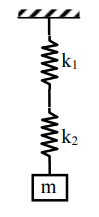
(For springs in parallel the constants would simply add: $k_{eff} = k_1 + k_2$.)
Spring–mass system – time period
-
A body of mass m is attached to the lower end of a spring whose upper end is fixed. The spring has negligible mass. When the mass m is slightly pulled down and released, it oscillates with a time period of 3s. When the mass m is increased by 1 kg, the time period of oscillations becomes 5 s. The value of m in kg is:
$T^2 \propto m$.
$T = 2\pi\sqrt{\frac{m}{k}}$
$3 = 2\pi\sqrt{\frac{m}{k}}$ ...(1), $5 = 2\pi\sqrt{\frac{m + 1}{k}}$ ...(2)
$\frac{(1)^2}{(2)^2}$: $\frac{9}{25} = \frac{m}{m + 1} \Rightarrow m = \frac{9}{16}$
Superposition of SHMs
-
When two displacements represented by $y_1 = a\sin(\omega t)$ and $y_2 = b\cos(\omega t)$ are superimposed the motion is$y_2 = b\cos\omega t = b\sin\left(\omega t + \frac{\pi}{2}\right)$
Both SHMs have the same frequency, so the resultant motion is also SHM.
$A = \sqrt{a^2 + b^2 + 2ab\cos\phi}$ with $\phi = \frac{\pi}{2}$
$A = \sqrt{a^2 + b^2}$
Velocity in SHM
-
A particle executing simple harmonic motion of amplitude 5 cm has maximum speed of 31.4 cm/s. The frequency of its oscillation is :Maximum speed in SHM: $v_{max} = a\omega = a(2\pi f)$
$\Rightarrow f = \dfrac{v_{max}}{2\pi a}$
Here $v_{max} = 31.4$ cm/s and $a = 5$ cm.
$f = \dfrac{31.4}{2\pi \times 5} = \dfrac{31.4}{10\pi}$
$f = \dfrac{31.4}{31.4} = 1$ Hz
SHM
-
A particle is executing a simple harmonic motion. Its maximum acceleration is $\alpha$ and maximum velocity is $\beta$. Then, its time period of vibration will be:Maximum acceleration $= \omega^2A = \alpha$; maximum velocity $= \omega A = \beta$
$\omega = \frac{\alpha}{\beta}$
$T = \frac{2\pi}{\omega} = \frac{2\pi\beta}{\alpha}$
Acceleration in SHM
-
The oscillation of a body on a smooth horizontal surface is represented by the equation, $X = A\cos(\omega t)$ where X = displacement at time t, $\omega$ = frequency of oscillation. Which one of the following graphs shows correctly the variation of 'a' with 't'?$x = A\cos\omega t$
$v = \frac{dx}{dt} = -A\omega\sin\omega t$
$a = \frac{dv}{dt} = -A\omega^2\cos\omega t$
So the a–t graph is a negative cosine curve: it starts at $-A\omega^2$ at t = 0. -
Two simple harmonic motions of angular frequency 100 and 1000 rad s$^{-1}$ have the same displacement amplitude. The ratio of their maximum accelerations is -Acceleration in SHM: $a = -\omega^2 x$, so the maximum acceleration is $a_{max} = \omega^2 A$.
Both motions have the same amplitude $A$.
$\dfrac{a_1}{a_2} = \dfrac{\omega_1^2 A}{\omega_2^2 A} = \dfrac{\omega_1^2}{\omega_2^2}$
$\dfrac{a_1}{a_2} = \dfrac{(100)^2}{(1000)^2} = \dfrac{10^4}{10^6}$
$\dfrac{a_1}{a_2} = \dfrac{1}{10^2}$
So the ratio of the maximum accelerations is $1 : 10^{2}$.
Damped oscillations
-
The damping force on an oscillator is directly proportional to the velocity. The units of the constant of proportionality are$F = -kv \Rightarrow k = \frac{F}{v}$
Unit of k $= \frac{N}{m\,s^{-1}} = \frac{kg\,m\,s^{-2}}{m\,s^{-1}} = kg\,s^{-1}$
Simple harmonic motion
-
A simple pendulum performs simple harmonic motion about x = 0 with an amplitude a and time period T. The speed of the pendulum at $x = a/2$ will beSpeed in SHM at displacement x: $v = \omega\sqrt{a^2 - x^2}$, with $\omega = \frac{2\pi}{T}$
At $x = \frac{a}{2}$: $v = \frac{2\pi}{T}\sqrt{a^2 - \frac{a^2}{4}}$
$v = \frac{2\pi}{T}\sqrt{\frac{3a^2}{4}} = \frac{2\pi}{T}\times\frac{\sqrt{3}a}{2}$
$v = \frac{\pi a\sqrt{3}}{T}$
Velocity and Acceleration in SHM
-
The phase difference between the instantaneous velocity and acceleration of a particle executing simple harmonic motion isLet the displacement be $y = A\sin\omega t$
Instantaneous velocity: $v = \dfrac{dy}{dt} = A\omega\cos\omega t = A\omega\sin\left(\omega t + \dfrac{\pi}{2}\right)$
Acceleration: $a = \dfrac{dv}{dt} = -A\omega^2\sin\omega t = A\omega^2\sin(\omega t + \pi)$
Phase of the velocity $= \omega t + \dfrac{\pi}{2}$ and phase of the acceleration $= \omega t + \pi$
Phase difference: $\phi = (\omega t + \pi) - \left(\omega t + \dfrac{\pi}{2}\right)$
$\phi = \dfrac{\pi}{2} = 0.5\pi$ -
Which one of the following statements is true for the speed 'v' and the acceleration 'a' of a particle executing simple harmonic motionFor SHM $x = A\sin\omega t$:
Velocity: $v = \omega\sqrt{A^2 - x^2}$
Acceleration: $a = -\omega^2 x$
At the mean position ($x = 0$): $v = v_{max} = A\omega$ and $a = 0$.
At the extreme positions ($x = \pm A$): $v = 0$ and $a = a_{max} = \omega^2 A$.
So in SHM, if $v = v_{max}$ then $a = 0$, and if $v = 0$ then $a = a_{max}$.
The true statement is: when 'v' is maximum, a is zero.
Energy in SHM
-
The particle executing simple harmonic motion has a kinetic energy $K_0\cos^2\omega t$. The maximum values of the potential energy and the total energy are respectivelyWe have $U + K = E$, where $U$ = potential energy, $K$ = kinetic energy and $E$ = total energy.
In S.H.M., when the potential energy is maximum the kinetic energy is zero, and vice-versa.
$\therefore U_{max} + 0 = E \Rightarrow U_{max} = E$
Further, K.E. $= \dfrac{1}{2}m\omega^2a^2\cos^2\omega t$
But by the question, K.E. $= K_0\cos^2\omega t$, so $K_0 = \dfrac{1}{2}m\omega^2a^2$
Hence the total energy is $E = \dfrac{1}{2}m\omega^2a^2 = K_0$
$\therefore U_{max} = K_0$ and $E = K_0$.
Displacement in SHM
-
A particle executes simple harmonic oscillation with an amplitude $a$. The period of oscillation is $T$. The minimum time taken by the particle to travel half of the amplitude from the equilibrium position isStarting from the equilibrium position, the displacement is $y = a\sin\left(\dfrac{2\pi}{T}\right)t$
According to the problem, $y = \dfrac{a}{2}$
$\dfrac{a}{2} = a\sin\left(\dfrac{2\pi}{T}\right)t$
$\sin\left(\dfrac{2\pi}{T}\right)t = \dfrac{1}{2}$
$\Rightarrow \dfrac{\pi}{6} = \left(\dfrac{2\pi}{T}\right)t$
$\Rightarrow t = \dfrac{T}{12}$
This is the minimum time taken by the particle to travel half of the amplitude from the equilibrium position.
Periodic and Oscillatory Motion
-
The circular motion of a particle with constant speed is -A periodic motion repeats itself after equal intervals of time. A particle moving in a circle with constant speed returns to the same point after every time period $T = \dfrac{2\pi r}{v}$, so the motion is periodic.
Simple harmonic motion is a to and fro motion along a straight line about a mean position, under a restoring force proportional to the displacement ($F = -kx$).
Uniform circular motion is not a to and fro motion along a line, and the centripetal force is not of the form $-kx$ along the path, so it is not simple harmonic.
However, the projection of uniform circular motion on any diameter executes SHM.
So the circular motion with constant speed is periodic but not simple harmonic.
Forced Oscillations and Resonance
-
In case of a forced vibration, the resonance wave becomes very sharp when the :In forced oscillations, the amplitude becomes maximum when the driving frequency equals the natural frequency (resonance).
The amplitude at resonance is limited only by damping: smaller damping gives a much larger amplitude at resonance, and the amplitude falls off quickly when the frequency moves away from resonance.
So the resonance curve becomes very sharp (narrow and tall) when the damping force is small (negligible).
The sharpness is measured by the quality factor Q; a sharp resonance means a large (not small) Q.
So the resonance becomes very sharp when the damping force is small.
That is every question in Oscillations for this filter.
Want a score?
Answers here are not saved. Practise as a test to be marked and see your progress.
Practise as a test