Looking for classes? Ksquare Career Institute, Bengaluru →

Physics
Electrostatic Potential and Capacitance
76 questions from 37 papers, each with its answer.
- 76 questions
- 37 papers
- 4.31% of Physics
Combination of Capacitors
-
Three capacitors each of capacitance C and of breakdown voltage V are joined in series. The capacitance and breakdown voltage of the combination will beFor capacitors in series: $\frac{1}{C_{eq}} = \frac{1}{C} + \frac{1}{C} + \frac{1}{C} = \frac{3}{C}$
$C_{eq} = \frac{C}{3}$
In series the applied voltage divides among the capacitors; since they are identical, each gets one-third of the total.
Each capacitor can withstand V, so the combination can withstand V + V + V = 3V before breakdown.
Hence the capacitance is $\frac{C}{3}$ and the breakdown voltage is 3V. -
Three capacitors each of capacity 4 $\mu F$ are to be connected in such a way that the effective capacitance is 6 $\mu F$. This can be done by -Check each arrangement (C = 4 $\mu F$):
All in series: $\dfrac{C}{3} = \dfrac{4}{3}\ \mu F$
All in parallel: $3C = 12\ \mu F$
Two in series and this pair in parallel with the third: $\dfrac{C}{2} + C = 2 + 4 = 6\ \mu F$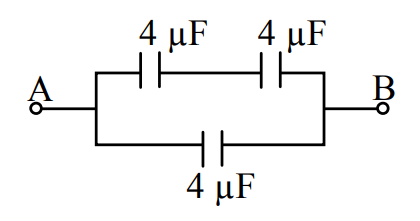
Two in parallel and this pair in series with the third: $\dfrac{8 \times 4}{8 + 4} = \dfrac{8}{3}\ \mu F$
So $C_{AB} = (2 + 4)\ \mu F = 6\ \mu F$ is obtained by connecting two in series and one in parallel.
Potential due to a Charged Conducting Sphere
-
Two hollow conducting sphere of radii $R_1$ and $R_2$ ($R_1\gg R_2$) have equal charges. The potential would be:$V = \frac{1}{4\pi\epsilon_0}\cdot\frac{Q}{R}$ $\frac{1}{4\pi\epsilon_0}$ = constant and Q is the same (given), so $V \propto \frac{1}{R}$ Since $R_1 \gg R_2$, the potential is more on the smaller sphere.
Equipotential Surfaces
-
The angle between the electric lines of force and the equipotential surface is :The electric field is always perpendicular to an equipotential surface (no work is done in moving a charge along it). So the angle between the electric lines of force and the equipotential surface is $90^\circ$.
Sharing of Charge between Capacitors
-
A capacitor of capacity $C_1$ charged upto V volt and then connected to an uncharged capacitor $C_2$. Then final P.D. across each will beWhen two capacitors are connected, charge flows until both are at the same (common) potential. The total charge is conserved.
Common potential: $V_{common} = \dfrac{\text{total charge}}{\text{total capacitance}} = \dfrac{C_1V_1 + C_2V_2}{C_1 + C_2}$
Here $V_1 = V$ and $V_2 = 0$ (uncharged):
$V_{common} = \dfrac{C_1V}{C_1 + C_2}$
So the final p.d. across each capacitor is $\dfrac{C_1V}{C_1 + C_2}$.
Energy Stored in a Capacitor
-
A parallel plate capacitor has a uniform electric field $\vec{E}$ in the space between the plates. If the distance between the plates is $d$ and the area of each plate is $A$, the energy stored in the capacitor is: ($\epsilon_0$ = permittivity of free space)$U = \frac{1}{2}CV^2$ with $C = \frac{\epsilon_0A}{d}$ and $V = Ed$ $U = \frac{1}{2}\left(\frac{\epsilon_0A}{d}\right)(Ed)^2 = \frac{1}{2}\epsilon_0E^2Ad$
-
A parallel plate capacitor has a uniform electric field E in the space between the plates. If the distance between the plates is d and area of each plate is A, the energy stored in the capacitor isEnergy $= \frac{1}{2}CV^2$, with $C = \frac{\varepsilon_0A}{d}$ and $V = Ed$
$= \frac{1}{2}\times\frac{\varepsilon_0A}{d}\times(Ed)^2$
$= \frac{1}{2}\varepsilon_0E^2Ad$ -
A parallel plate condenser has a uniform electric field E (V/m) in the space between the plates. If the distance between the plates is d (m) and area of each plate is A ($m^2$), the energy (joules) stored in the condenser isEnergy stored per unit volume in an electric field (energy density): $u = \frac{1}{2}\varepsilon_0E^2$
The field is uniform and confined to the space between the plates, whose volume = Ad.
Energy stored = energy density × volume
$U = \frac{1}{2}\varepsilon_0E^2\times Ad$
Check: $U = \frac{1}{2}CV^2 = \frac{1}{2}\frac{\varepsilon_0A}{d}(Ed)^2 = \frac{1}{2}\varepsilon_0E^2Ad$ -
Energy per unit volume for a capacitor having area A and separation d kept at potential difference V is given by : -Energy stored: $U = \dfrac{1}{2}CV^2$ with $C = \dfrac{\varepsilon_0A}{d}$
Volume between the plates $= Ad$
Energy density $u = \dfrac{U}{Ad} = \dfrac{\frac{1}{2}\frac{\varepsilon_0A}{d}V^2}{Ad} = \dfrac{1}{2}\varepsilon_0\dfrac{V^2}{d^2}$
(Since $E = \dfrac{V}{d}$, this is $\dfrac{1}{2}\varepsilon_0E^2$.)
$\dfrac{1}{2}CV^2$ and $\dfrac{Q^2}{2C}$ are the total energy, not the energy per unit volume.
Dielectrics and Polarisation – Polar Molecules
-
Polar molecules are the molecules:In polar molecules, the centres of positive and negative charges are separated by some distance even in the absence of an external field. So they have a permanent electric dipole moment.
Relation between Electric Field and Potential
-
In a certain region of space with volume $0.2\ m^3$, the electric potential is found to be 5 V throughout. The magnitude of electric field in this region is:$E = -\frac{dV}{dr}$ Since the potential is constant (5 V) throughout the region, $\frac{dV}{dr} = 0$, so E = 0.
Parallel plate capacitor
-
The distance between the two plates of a parallel plate capacitor is doubled and the area of each plate is halved. If C is its initial capacitance, its final capacitance is equal to:$C=\frac{A\varepsilon_0}{d}$. New capacitance $C'=\frac{(A/2)\varepsilon_0}{2d}=\frac{C}{4}$.
-
A parallel plate air capacitor is charged to a potential difference of $V$ volts. After disconnecting the charging battery the distance between the plates of the capacitor is increased using an insulating handle. As a result the potential difference between the plates :-After the battery is disconnected the plates are isolated, so the charge $Q$ on the capacitor remains constant.
Capacitance of a parallel plate capacitor: $C = \dfrac{\varepsilon_0 A}{d}$
When the distance $d$ between the plates is increased, the capacitance $C$ decreases.
Potential difference: $V = \dfrac{Q}{C}$
Since $Q$ is constant and $C$ decreases, $V$ increases.
(The field $E = \dfrac{Q}{\varepsilon_0 A}$ stays the same, and $V = Ed$ increases with $d$.)
Equipotential surfaces and work done
-
The diagrams below show regions of equipotentials. A positive charge is moved from A to B in each diagram.
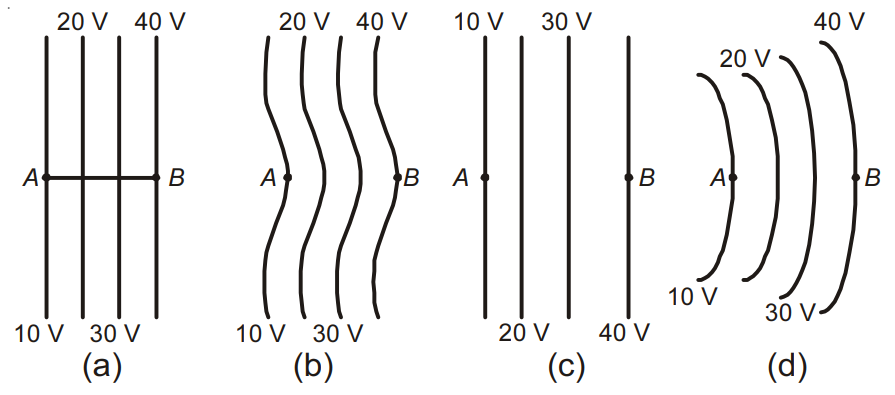
Work depends only on the potential difference between A and B.
Work done $W = q\Delta V$ $\Delta V$ between A and B is the same in all the cases, so the work done is the same in all four cases. -
As per this diagram a point charge $+q$ is placed at the origin O. Work done in taking another point charge $-Q$ from the point A, coordinates $(0, a)$, to another point B, coordinates $(a, 0)$, along the straight path AB is
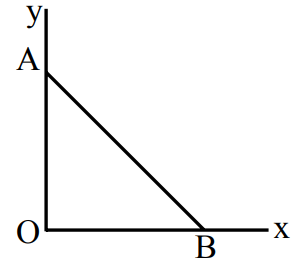 The work done by an external agent in moving a charge $Q'$ from A to B is $W = Q'(V_B - V_A)$; it depends only on the end points, not on the path.
Points A $(0, a)$ and B $(a, 0)$ are both at a distance $a$ from the charge $+q$ at the origin.
$V_A = \dfrac{1}{4\pi\varepsilon_0}\dfrac{q}{a}$ and $V_B = \dfrac{1}{4\pi\varepsilon_0}\dfrac{q}{a}$, so $V_A = V_B$.
Work done $= (-Q)(V_B - V_A) = \dfrac{1}{4\pi\varepsilon_0}\left[\dfrac{(-qQ)}{a} - \dfrac{(-qQ)}{a}\right]$
$= 0$
A and B lie on the same equipotential surface (a sphere of radius $a$ about the charge), so no net work is done even along the straight path AB.
Relation between field and potential
-
If potential (in volts) in a region is expressed as $V(x,y,z) = 6xy - y + 2yz$, the electric field (in N/C) at point (1, 1, 0) is:$\vec E = -\left(\frac{\partial V}{\partial x}\hat i + \frac{\partial V}{\partial y}\hat j + \frac{\partial V}{\partial z}\hat k\right)$
$\vec E = -(6y)\hat i - (6x - 1 + 2z)\hat j - (2y)\hat k$
At (1, 1, 0): $\vec E = -(6\hat i + 5\hat j + 2\hat k)$ -
The electric potential V at any point (x, y, z), all in meters, in space is given by $V = 4x^2$ volt. The electric field at the point (1, 0, 2) in volt/meter isThe electric field is the negative gradient of the potential: $E_x = -\frac{\partial V}{\partial x}$, $E_y = -\frac{\partial V}{\partial y}$, $E_z = -\frac{\partial V}{\partial z}$
$V = 4x^2$ depends only on x, so $E_y = E_z = 0$.
$E_x = -\frac{\partial}{\partial x}(4x^2) = -8x$
At the point (1, 0, 2), x = 1: $E_x = -8$ V/m
The negative sign shows the field is along the negative X-axis.
So the field is 8 V/m along the negative X-axis.
Potential of a charged conductor
-
A conducting sphere of radius R is given a charge Q. The electric potential and the electric field at the centre of the sphere respectively are:At the centre of a charged conducting sphere, $E = 0$ and $V = \frac{Q}{4\pi\varepsilon_0R}$.
Potential in a uniform field
-
A, B and C are three points in a uniform electric field. The electric potential is:
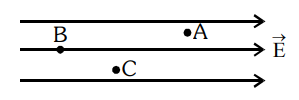 Electric potential decreases in the direction of the electric field, so it is maximum at B, the point farthest back along the field.
Potential due to a system of charges
-
Four point charges −Q, −q, 2q and 2Q are placed, one at each corner of the square. The relation between Q and q for which the potential at the centre of the square is zero isAll four corners are at the same distance x from the centre.
$V = \frac{k(-Q)}{x} + \frac{k(-q)}{x} + \frac{k(2q)}{x} + \frac{k(2Q)}{x} = 0$
$-Q - q + 2q + 2Q = 0 \Rightarrow Q + q = 0$
$Q = -q$
Dielectrics and capacitors
-
Two parallel metal plates having charges +Q and −Q face each other at a certain distance between them. If the plates are now dipped in kerosene oil tank, the electric field between the plates willElectric field between the plates in vacuum (air): $E_0 = \frac{\sigma}{\varepsilon_0}$, where $\sigma = \frac{Q}{A}$
The plates are isolated, so the charge Q (and $\sigma$) stays the same when they are dipped in kerosene.
Kerosene is a dielectric with dielectric constant K > 1; it gets polarised and its induced charges set up a field opposing the original field.
Field in the medium: $E = \frac{\sigma}{K\varepsilon_0} = \frac{E_0}{K}$
Since K > 1, $E < E_0$.
Hence the electric field between the plates will decrease.
Energy Stored in Capacitors
-
Two condensers, one of capacity $C$ and other of capacity $\dfrac{C}{2}$, are connected to a V-volt battery, as shown.
(The two condensers are connected in parallel across the battery.)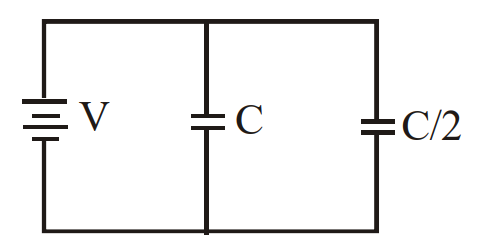
The work done in charging fully both the condensers isThe two condensers are in parallel across the battery, so each is charged to the potential difference $V$.
Equivalent capacitance: $C_{eq} = C + \dfrac{C}{2} = \dfrac{3C}{2}$
Work done in charging = change in the stored energy $= \dfrac{1}{2}C_{eq}V^2$
$= \dfrac{1}{2}\left(C + \dfrac{C}{2}\right)V^2$
$= \dfrac{1}{2}\left(\dfrac{3C}{2}\right)V^2$
$= \dfrac{3}{4}CV^2$
Potential Energy of a Dipole in an External Field
-
An electric dipole of moment $\vec{p}$ is lying along a uniform electric field $\vec{E}$. The work done in rotating the dipole by $90^\circ$ is :-Work done in rotating a dipole from angle $\theta_1$ to $\theta_2$ with the field: $W = pE(\cos\theta_1 - \cos\theta_2)$
Initially the dipole lies along the field, so $\theta_1 = 0^\circ$; finally $\theta_2 = 90^\circ$.
$W = pE(\cos 0^\circ - \cos 90^\circ)$
$W = pE(1 - 0)$
$W = pE$
Equivalently, the potential energy changes from $-pE$ to 0, an increase of $pE$.
Work Done by Electric Field
-
A bullet of mass 2 g is having a charge of 2 $\mu C$. Through what potential difference must it be accelerated, starting from rest, to acquire a speed of 10 m/s ?Work done by the electric field on the charge = gain in kinetic energy.
Use $qV_{acc} = \dfrac{1}{2}mv^2$
$m = 2$ g $= 2 \times 10^{-3}$ kg, $q = 2\ \mu C = 2 \times 10^{-6}$ C, $v = 10$ m/s
$\dfrac{1}{2}mv^2 = \dfrac{1}{2} \times 2 \times 10^{-3} \times 10^2 = 0.1$ J
$V = \dfrac{0.1}{2 \times 10^{-6}} = 5 \times 10^4$ V
$V = 50$ kV
Electrostatics of Conductors
-
Some charge is being given to a conductor. Then its potential : -In electrostatic equilibrium, the electric field inside a conductor is zero (E = 0), and all the charge resides on the outer surface.
Since $E = -\dfrac{dV}{dr} = 0$, the potential does not change from point to point inside.
So the potential is the same everywhere inside and on the surface; the conductor is an equipotential body.
So the potential remains the same throughout the conductor.
That is every question in Electrostatic Potential and Capacitance for this filter.
Want a score?
Answers here are not saved. Practise as a test to be marked and see your progress.
Practise as a test