Looking for classes? Ksquare Career Institute, Bengaluru →

Physics
Electrostatic Potential and Capacitance
76 questions from 37 papers, each with its answer.
- 76 questions
- 37 papers
- 4.31% of Physics
Capacitors with Dielectric Slabs
-
The plates of a parallel plate capacitor are separated by $d$. Two slabs of different dielectric constant $K_1$ and $K_2$ with thickness $\frac{3}{8}d$ and $\frac{d}{2}$, respectively are inserted in the capacitor. Due to this, the capacitance becomes two times larger than when there is nothing between the plates. If $K_1 = 1.25\,K_2$, the value of $K_1$ is:
Using series capacitor formulation with remaining air gap $d/8$, we find $K_2 = 32/15$ and $K_1 = 1.25 \times K_2 = 8/3 \approx 2.66$.
Remaining air thickness is $t_{air} = d - \left(\frac{3d}{8} + \frac{d}{2}\right) = d - \frac{7d}{8} = \frac{d}{8}$. The equivalent capacitance is given by: $\frac{d_{eff}}{\epsilon_0 A} = \frac{t_1}{K_1 \epsilon_0 A} + \frac{t_2}{K_2 \epsilon_0 A} + \frac{t_{air}}{\epsilon_0 A}$. Since $C_{new} = 2 C_0$, $d_{eff} = \frac{d}{2}$. Thus: $\frac{d}{2} = \frac{3d}{8K_1} + \frac{d}{2K_2} + \frac{d}{8} \implies \frac{1}{2} - \frac{1}{8} = \frac{3}{8K_1} + \frac{1}{2K_2} \implies \frac{3}{8} = \frac{3}{8K_1} + \frac{4}{8K_2} \implies 3 = \frac{3}{K_1} + \frac{4}{K_2}$. Given $K_1 = 1.25 K_2 = \frac{5}{4} K_2$: $3 = \frac{3}{(5/4)K_2} + \frac{4}{K_2} = \frac{12}{5K_2} + \frac{20}{5K_2} = \frac{32}{5K_2} \implies K_2 = \frac{32}{15}$. Therefore, $K_1 = \frac{5}{4} \times \frac{32}{15} = \frac{8}{3} \approx 2.667$.
Combination of Capacitors
-
In the following circuit, the equivalent capacitance between terminal $A$ and terminal $B$ is:
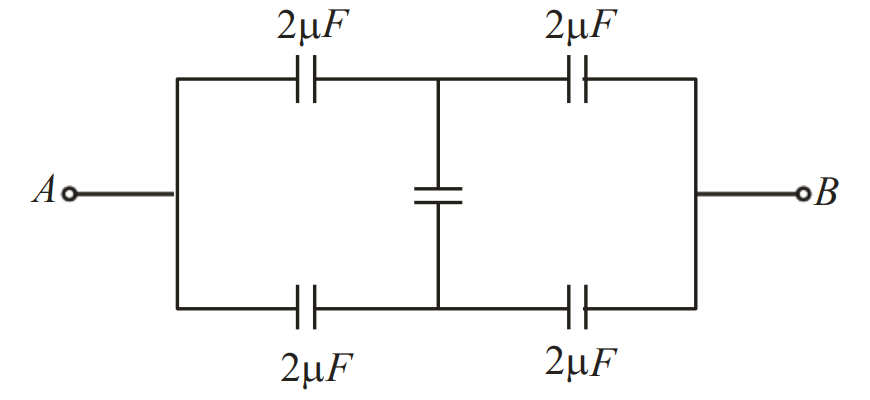
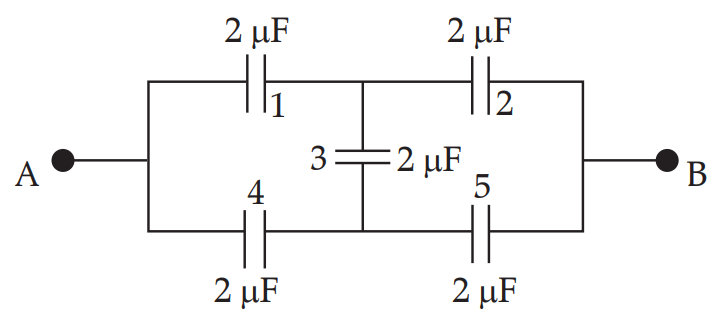
The bridge is balanced (all capacitors equal), so the middle capacitor can be neglected. Upper branch: two 2 $\mu F$ in series $= 1\ \mu F$ Lower branch: two 2 $\mu F$ in series $= 1\ \mu F$ The two branches are in parallel: $C = 1 + 1 = 2\ \mu F$ -
The equivalent capacitance of the system shown in the following circuit is:
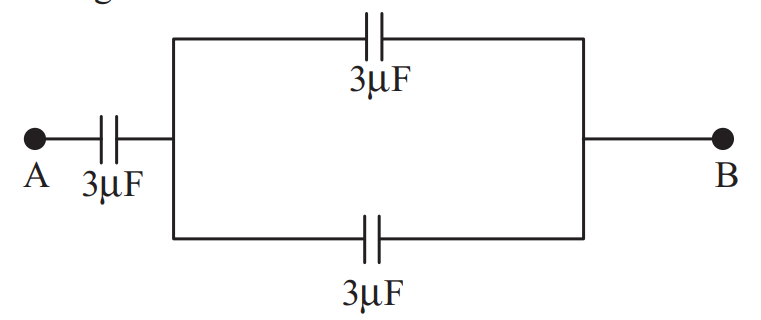
Two $3\ \mu F$ in parallel give $6\ \mu F$, which is in series with $3\ \mu F$: $2\ \mu F$.
$3\ \mu F$ and $3\ \mu F$ in parallel $\Rightarrow C_{eqv}=3+3=6\ \mu F$ Now $C'_{eqv}=\frac{3\times6}{9}=2\ \mu F$ -
The effective capacitances of two capacitors are 3 $\mu F$ and 16 $\mu F$, when they are connected in series and parallel respectively. The capacitance of two capacitors are:Series: $\frac{C_1C_2}{C_1+C_2}=3$; parallel: $C_1+C_2=16$. So $C_1C_2=48$. $(C_1-C_2)^2=(C_1+C_2)^2-4C_1C_2=256-192=64 \Rightarrow C_1-C_2=8$. Hence $C_1=12\ \mu F$, $C_2=4\ \mu F$.
-
The equivalent capacitance of the combination shown in the figure is:
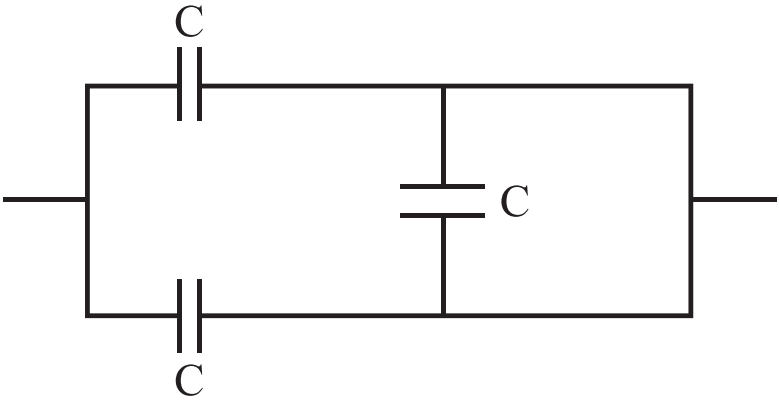
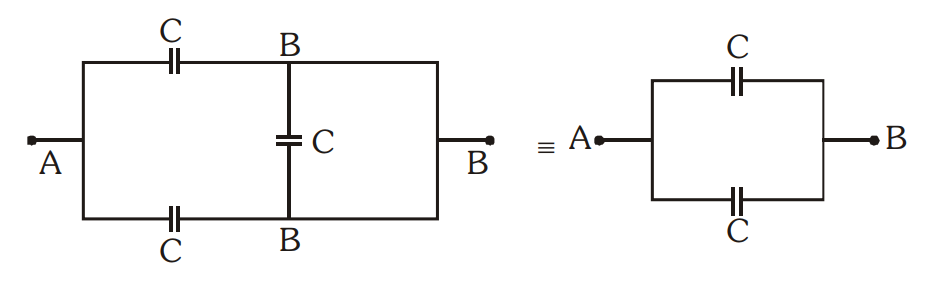
Both plates of the middle capacitor are connected to the same point (B–B), so it gets short-circuited.
The remaining two capacitors are in parallel: $C_{eq} = C + C = 2C$ -
A series combination of $n_1$ capacitors, each of value $C_1$, is charged by a source of potential difference 4V. When another parallel combination of $n_2$ capacitors, each of value $C_2$, is charged by a source of potential difference V, it has the same (total) energy stored in it, as the first combination has. The value of $C_2$, in terms of $C_1$, is thenSeries combination of $n_1$ capacitors each of $C_1$: $C_s = \frac{C_1}{n_1}$
Energy stored at potential difference 4V: $U_1 = \frac{1}{2}C_s(4V)^2 = \frac{1}{2}\frac{C_1}{n_1}\times16V^2 = \frac{8C_1V^2}{n_1}$
Parallel combination of $n_2$ capacitors each of $C_2$: $C_p = n_2C_2$
Energy stored at potential difference V: $U_2 = \frac{1}{2}n_2C_2V^2$
Given $U_1 = U_2$: $\frac{8C_1V^2}{n_1} = \frac{1}{2}n_2C_2V^2$
$C_2 = \frac{16C_1}{n_1n_2}$ -
A network of four capacitors of capacity equal to $C_1 = C$, $C_2 = 2C$, $C_3 = 3C$ and $C_4 = 4C$ are connected to a battery as shown in the figure. The ratio of the charges on $C_2$ and $C_4$ is -
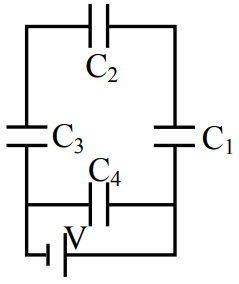 $C_4 = 4C$ is connected directly across the battery, so $Q_4 = 4CV$.
$C_1$, $C_2$ and $C_3$ are in series: $\dfrac{1}{C_s} = \dfrac{1}{C} + \dfrac{1}{2C} + \dfrac{1}{3C} = \dfrac{6 + 3 + 2}{6C} = \dfrac{11}{6C}$
$C_s = \dfrac{6C}{11}$
Capacitors in series carry the same charge, so $Q_2 = C_sV = \dfrac{6CV}{11}$
$\dfrac{Q_2}{Q_4} = \dfrac{6CV}{11} \times \dfrac{1}{4CV}$
$\dfrac{Q_2}{Q_4} = \dfrac{6}{44} = \dfrac{3}{22}$
Electric Dipole Potential
-
Assertion (A): The potential ($V$) at any axial point, at 2 m distance ($r$) from the centre of the dipole of dipole moment vector $\vec{P}$ of magnitude, $4\times10^{-6}$ C m, is $\pm 9\times 10^{3}$ V. (Take $\frac{1}{4\pi\epsilon_0} = 9\times10^{9}$ SI units)Reason (R): $V = \pm \frac{2P}{4\pi\epsilon_0 r^2}$, where $r$ is the distance of any axial point, situated at 2 m from the centre of the dipole.Potential at an axial point due to a dipole: $V = \pm\frac{1}{4\pi\varepsilon_0}\frac{p}{r^2}$ $V = \pm 9 \times 10^9 \times \frac{4 \times 10^{-6}}{(2)^2} = \pm 9 \times 10^3$ V So the Assertion is true. The Reason gives $V = \pm\frac{2p}{4\pi\varepsilon_0 r^2}$, which is not the correct expression (the factor 2 appears in the axial electric field, not the potential). So the Reason is false. Hence A is true but R is false.
Potential due to a Charged Spherical Shell
-
A thin spherical shell is charged by some source. The potential difference between the two points $C$ and $P$ (in $V$) shown in the figure is; (Take $\frac{1}{4\pi\epsilon_0}=9\times10^{9}$ SI units, $R=3$ cm, $q=1\mu C$)
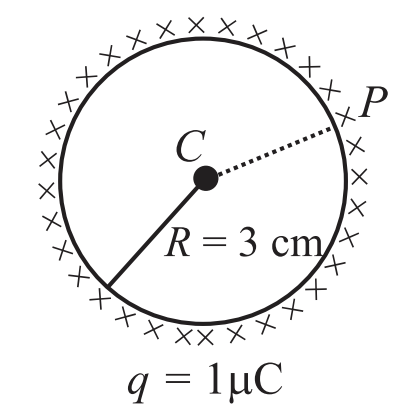 The electric potential due to a uniformly charged spherical shell is constant everywhere inside the shell and equal to its value on the surface. Hence $V_C = V_P$ $\therefore$ Potential difference = 0
-
The variation of electrostatic potential with radial distance r from the centre of a positively charged metallic thin shell of radius R is given by the graphInside a uniformly charged thin spherical shell, the potential is constant (equal to the potential at the surface). Outside, the potential falls off as $\dfrac{1}{r}$, exactly as for a point charge at the centre. This corresponds to a curve that is flat for $rR$.
Parallel Plate Capacitor connected to a Battery
-
If the plates of a parallel plate capacitor connected to a battery are moved close to each other, then A. the charge stored in it, increases. B. the energy stored in it, decreases. C. its capacitance increases. D. the ratio of charge to its potential remains the same. E. the product of charge and voltage increases. Choose the most appropriate answer from the options given below:$C = \frac{\varepsilon_0 A}{d}$; as d decreases, C increases (C true). The battery remains connected, so V = constant. $q = CV \propto C$, so the charge increases (A true). Energy stored $U = \frac{1}{2}CV^2$ increases as C increases, so B ('energy decreases') is false. $\frac{q}{V} = C$ increases, so D is false. $qV = CV^2$ also increases (E true). So A, C and E only are correct.
Potential due to an Electric Dipole
-
An electric dipole is placed as shown in the figure.
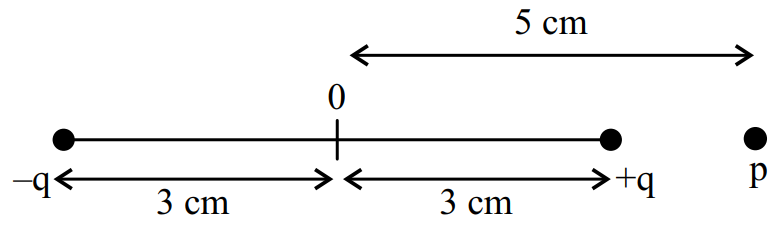 The electric potential (in $10^2\ V$) at point P due to the dipole is ($\epsilon_0$ = permittivity of free space and $\frac{1}{4\pi\epsilon_0}=K$):
$V_P=V_{+q}+V_{-q}=\left(\frac{Kq}{2}-\frac{Kq}{8}\right)\times10^2=\frac{3Kq}{8}\times10^2$.
$V_P=V_q+V_{-q}$ $=\left(\frac{Kq}{5-3}+\frac{K(-q)}{5+3}\right)\times10^2$ $=\left(\frac{Kq}{2}-\frac{Kq}{8}\right)\times10^2$ $=\left(\frac{3Kq}{8}\right)\times10^2$
Sharing of Charge between Capacitors
-
A capacitor of capacitance $C=900\ pF$ is charged fully by 100 V battery B as shown in figure (a). Then it is disconnected from the battery and connected to another uncharged capacitor of capacitance $C=900\ pF$ as shown in figure (b). The electrostatic energy stored by the system (b) is
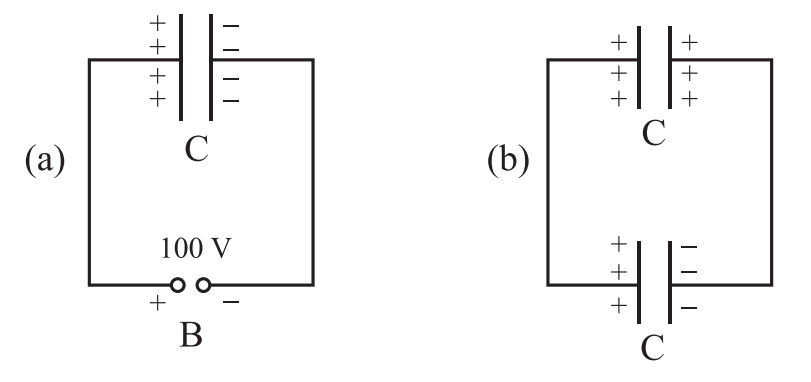 Common potential $V_c = \frac{C_1V_1 + C_2V_2}{C_1 + C_2} = \frac{C \times 100 + C \times 0}{C + C} = 50$ V Energy stored in system (b) $= 2 \times \frac{1}{2}CV_c^2 = CV_c^2$ $= 900 \times 10^{-12} \times 50 \times 50 = 2.25 \times 10^{-6}$ J
-
A capacitor is charged with a battery and energy stored is U. After disconnecting battery another capacitor of same capacity is connected in parallel with it. Then energy stored in each capacitor is :Initial energy: $U = \dfrac{q^2}{2C}$, where q is the charge on the capacitor.
After the battery is disconnected and an identical uncharged capacitor is connected in parallel, the charge q is shared. Common potential:
$V_{common} = \dfrac{q_1 + q_2}{C_1 + C_2} = \dfrac{q + 0}{C + C} = \dfrac{q}{2C}$
Energy on each capacitor $= \dfrac{1}{2}CV_{common}^2 = \dfrac{1}{2}C\left(\dfrac{q}{2C}\right)^2 = \dfrac{q^2}{8C} = \dfrac{1}{4} \cdot \dfrac{q^2}{2C}$
$= \dfrac{U}{4}$
(The total energy is $\dfrac{U}{2}$; the other half is lost as heat in the connecting wires.)
Conductors – Charge Distribution on Connected Spheres
-
Two charged spherical conductors of radii $R_1$ and $R_2$ are connected by a wire. Then the ratio of surface charge densities of the spheres ($\sigma_1/\sigma_2$) is:For a conducting sphere: $E = \frac{\sigma}{\epsilon_0}$ and $V = \frac{\sigma R}{\epsilon_0}$ When connected by a wire, both spheres have the same potential: $V_1 = V_2$ $\sigma_1R_1 = \sigma_2R_2 \Rightarrow \frac{\sigma_1}{\sigma_2} = \frac{R_2}{R_1}$
Energy Stored in a Capacitor
-
A 12 pF capacitor is connected to a 50 V battery, the electrostatic energy stored in the capacitor in nJ is$U=\dfrac{1}{2}CV^2=\dfrac{1}{2}\times12\times10^{-12}\times(50)^2=15\times10^{-9}\ J=15$ nJ.
Electric Potential – Combination of Charged Drops
-
Twenty seven drops of same size are charged at 220 V each. They combine to form a bigger drop. Calculate the potential of the bigger drop.Volume is conserved: $\frac{4}{3}\pi R^3 = 27 \times \frac{4}{3}\pi r^3 \Rightarrow R = 3r$ $V = \frac{kq}{r} \Rightarrow \frac{V_1}{V_2} = \frac{q_1}{q_2}\cdot\frac{r_2}{r_1}$ $\frac{220}{V_2} = \frac{q}{27q} \times \frac{3r}{r} = \frac{1}{9}$ $V_2 = 220 \times 9 = 1980$ V
Dielectrics – Permittivity and Capacitance
-
The capacitance of a parallel plate capacitor with air as medium is $6\ \mu F$. With the introduction of a dielectric medium, the capacitance becomes $30\ \mu F$. The permittivity of the medium is: ($\epsilon_0=8.85\times10^{-12}\ C^2N^{-1}m^{-2}$)$C = KC_0 \Rightarrow K = \frac{C}{C_0} = \frac{30}{6} = 5$ $K = \frac{\epsilon}{\epsilon_0} \Rightarrow \epsilon = K\epsilon_0 = 5 \times 8.85 \times 10^{-12}$ $\epsilon = 0.44 \times 10^{-10}\ C^2N^{-1}m^{-2}$
Electric Potential due to an Electric Dipole
-
A short electric dipole has a dipole moment of $16\times10^{-9}\ C\,m$. The electric potential due to the dipole at a point at a distance of 0.6 m from the centre of the dipole, situated on a line making an angle of $60^\circ$ with the dipole axis is: ($\frac{1}{4\pi\epsilon_0}=9\times10^9\ N\,m^2/C^2$)Potential due to a short dipole at a general point: $V = \frac{kp\cos\theta}{r^2}$ $V = \frac{9 \times 10^9 \times 16 \times 10^{-9} \times \cos 60^\circ}{(0.6)^2} = \frac{144 \times 0.5}{0.36}$ $V = 200$ V
Energy loss on sharing charge between two capacitors
-
Consider two uncharged capacitors of equal capacitance 200 pF. One of them is charged by a 100 V supply and disconnected. Now this capacitor is connected to the uncharged capacitor. The amount of electrostatic energy lost in the process is:Heat loss $\Delta H = \frac{1}{2}\frac{C_1 C_2}{C_1 + C_2}(V_1 - V_2)^2$ $= \frac{1}{2}\left(\frac{200 \times 200}{200 + 200}\right)(100 - 0)^2 \times 10^{-12}$ J $= 50 \times 10^4 \times 10^{-12}$ J $= 5 \times 10^{-7}$ J $= 0.5 \times 10^{-6}$ J
Properties of conductors in electrostatic equilibrium
-
Which of the following statements are correct? I. Inside a conductor, the electrostatic field is zero. II. Electric field at the surface of a charged conductor does not depend on its surface charge density. III. The interior of a charged conductor can have no excess charge in the static situation. IV. At the surface of a charged conductor, the electrostatic field must be normal to the surface at every point. V. The electrostatic potential is zero everywhere inside a charged conductor. Choose the CORRECT answer from the options given below:I. Inside a conductor, the electrostatic field = 0 (True) II. Electric field at the surface of a conductor $E = \frac{\sigma}{\epsilon_0}$ depends on $\sigma$ (False) III. The interior of a charged conductor has no excess charge in the static situation (True) IV. At the surface of a charged conductor, E is perpendicular to the surface at every point (True) V. $E_{in} = 0$, so $V_{in}$ = constant, not necessarily zero (False) So I, III and IV only are correct.
Concept of capacitance
-
The capacitance of a capacitor with charge q and a potential difference V depends onCapacitance $C=\dfrac{q}{V}$ is a constant for a given capacitor, independent of q and V individually; it depends only on the geometry of the capacitor (and the medium between the plates).
Electric potential due to a point charge
-
The value of electric potential at a distance of 9 cm from the point charge $4\times10^{-7}$ C is [Given $\dfrac{1}{4\pi\varepsilon_0}=9\times10^9\ N\,m^2\,C^{-2}$]:$V=\dfrac{kq}{r}=\dfrac{9\times10^9\times4\times10^{-7}}{9\times10^{-2}}=4\times10^4$ V.
Capacitor partially filled with dielectric slab
-
A parallel plate capacitor having cross-sectional area A and separation d has air in between the plates. Now an insulating slab of same area but thickness d/2 is inserted between the plates as shown in figure having dielectric constant K(= 4). The ratio of new capacitance to its original capacitance will be,
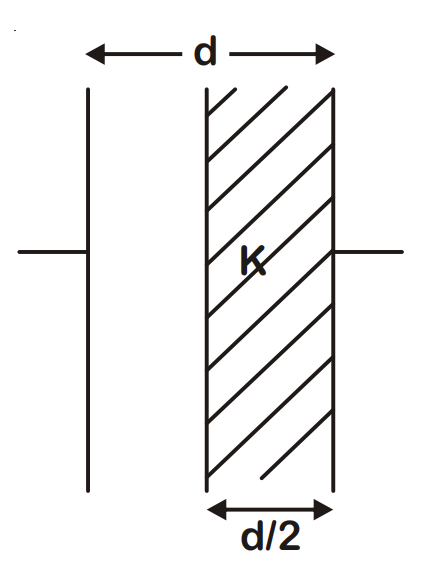 Original capacitance $C_0=\dfrac{\varepsilon_0A}{d}$. With a slab of thickness $d/2$ and dielectric constant K inserted, new capacitance $C=\dfrac{\varepsilon_0A}{\dfrac{d}{2}+\dfrac{d/2}{K}}=\dfrac{\varepsilon_0A}{\dfrac{d}{2}\left(1+\dfrac{1}{K}\right)}$. With $K=4$: $C=\dfrac{\varepsilon_0A}{\dfrac{d}{2}\times\dfrac{5}{4}}=\dfrac{8\varepsilon_0A}{5d}$. Ratio $\dfrac{C}{C_0}=\dfrac{8}{5}$, i.e. 8:5.
Series-parallel combination of capacitors
-
The equivalent capacitance of the arrangement shown in figure is:
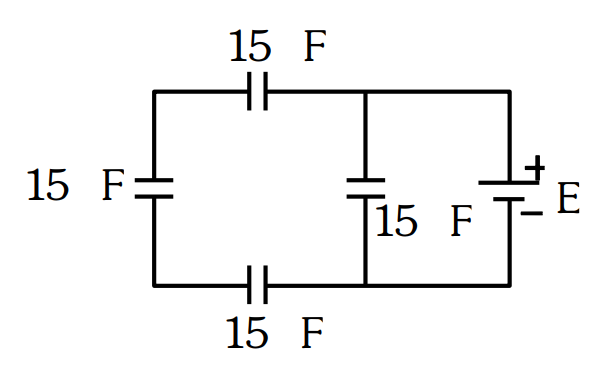 Analysing the given network of four 15 $\mu F$ capacitors: two in series give an equivalent of $\dfrac{15\times15}{15+15}=7.5\ \mu F$; combined appropriately with the others as per the figure gives $C_{eq}=5+15=20\ \mu F$.
Electric field outside a charged conducting sphere
-
If a conducting sphere of radius R is charged. Then the electric field at a distance r(r > R) from the centre of the sphere would be, (V = potential on the surface of the sphere)$V=\dfrac{KQ}{R}\Rightarrow KQ=VR$. $E=\dfrac{KQ}{r^2}=\dfrac{VR}{r^2}$.
Parallel plate capacitor
-
A parallel plate air capacitor has capacity 'C', distance of separation between plates is 'd' and potential difference 'V' is applied between the plates. Force of attraction between the plates of the parallel plate air capacitor is:$F = \frac{Q^2}{2\varepsilon_0A}$
$Q = CV$ and $C = \frac{\varepsilon_0A}{d} \Rightarrow \varepsilon_0A = Cd$
$F = \frac{C^2V^2}{2Cd} = \frac{CV^2}{2d}$
Potential due to a system of charges and work done
-
Six charges $+q$, $-q$, $+q$, $-q$, $+q$ and $-q$ are fixed at the corners of a hexagon of side d as shown in the figure. The work done in bringing a charge $q_0$ to the centre of the hexagon from infinity is: ($\varepsilon_0$ - permittivity of free space)
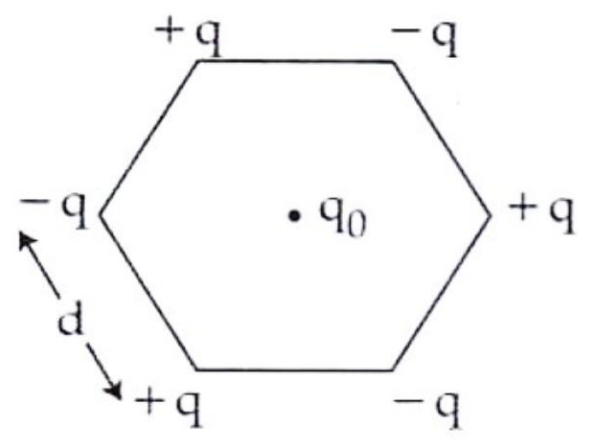 All six charges are at the same distance d from the centre; three are $+q$ and three are $-q$, so the potential at the centre $V_0=0$. Work done $W_{\infty\rightarrow0}=q_0\Delta V=q_0(0)=0$.
Charge sharing between conducting spheres
-
Two metal spheres, one of radius R and the other of radius 2R respectively have the same surface charge density $\sigma$. They are brought in contact and separated. What will be the new surface charge densities on them?$Q_1=\sigma4\pi R^2$, $Q_2=\sigma4\pi(2R)^2$, so $Q_{net}=20\pi\sigma R^2$. After contact the potentials are equal, so $\frac{Q_1'}{Q_2'}=\frac{R}{2R}=\frac{1}{2}$: $Q_1'=\frac{20}{3}\pi\sigma R^2$, $Q_2'=\frac{40}{3}\pi\sigma R^2$. $\sigma_1=\frac{Q_1'}{4\pi R^2}=\frac{5}{3}\sigma$, $\sigma_2=\frac{Q_2'}{4\pi(2R)^2}=\frac{5}{6}\sigma$.
Energy loss on sharing charge between capacitors
-
Two identical capacitors C1 and C2 of equal capacitance are connected as shown in the circuit. Terminals a and b of the key k are connected to charge capacitor C1 using battery of emf V volt. Now disconnecting a and b the terminals b and c are connected. Due to this, what will be the percentage loss of energy?
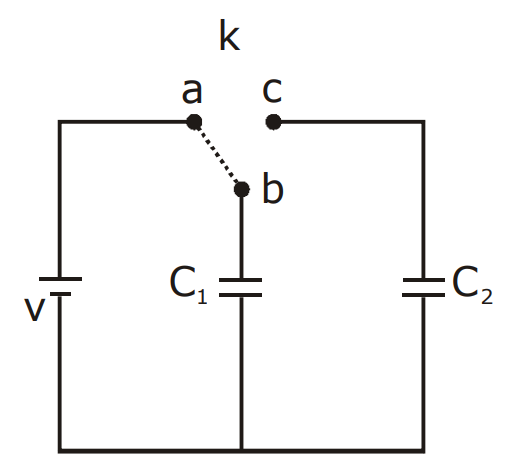 $U_i=\frac{1}{2}CV^2$. Loss on connecting $=\frac{C\cdot C}{2(C+C)}(V-0)^2=\frac{1}{4}CV^2$. Percentage loss $=\frac{CV^2/4}{CV^2/2}\times100=50\%$.
-
A capacitor is charged by a battery. The battery is removed and another identical uncharged capacitor is connected in parallel. The total electrostatic energy of resulting system
Common potential V/2 halves the stored energy.
Charge on capacitor $q = CV$ When it is connected with another uncharged capacitor: $V_c = \frac{q_1 + q_2}{C_1 + C_2} = \frac{q_0}{C + C} = \frac{V}{2}$ Initial energy $U_i = \frac{1}{2}CV^2$ Final energy $U_f = \frac{1}{2}C\left(\frac{V}{2}\right)^2 + \frac{1}{2}C\left(\frac{V}{2}\right)^2 = \frac{CV^2}{4}$ Loss of energy $= U_i - U_f = \frac{CV^2}{4}$ i.e. the energy decreases by a factor of 2. -
A capacitor of 2 $\mu F$ is charged as shown in the figure. When the switch S is turned to position 2, the percentage of its stored energy dissipated is
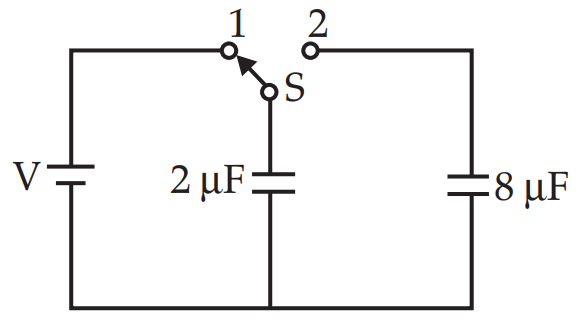
Fraction lost $= C_2/(C_1 + C_2) = 8/10$.
Given $C_1 = 2\ \mu F$, $C_2 = 8\ \mu F$.
Case I (switch at 1): energy stored $E_1 = \frac{1}{2}C_1V^2 = \frac{1}{2}(2\times10^{-6})V^2$ ...(i)
Case II (switch at 2): charge flows from $C_1$ to $C_2$ until both are at the same potential $V_1 = \frac{q}{C_1 + C_2} = \frac{C_1V}{C_1 + C_2}$ (here $q = C_1V$).
Final energy $E_2 = \frac{1}{2}(C_1 + C_2)V_1^2 = \frac{1}{2}(2 + 8)\times10^{-6}\left(\frac{2V}{10}\right)^2 = \frac{4\times10^{-6}V^2}{2\times10}$
Percentage loss $= \left(\frac{E_1 - E_2}{E_1}\right)\times100 = \frac{\frac{2\times10^{-6}V^2}{2} - \frac{4\times10^{-6}V^2}{20}}{\frac{2\times10^{-6}V^2}{2}}\times100 = 80\%$
So 80% of the stored energy is dissipated.
Energy stored in combination of capacitors
-
Three identical capacitors, P, Q and S, each of the capacitance C, are connected to a battery of voltage V, as shown in the figure. If the energy stored in the capacitor P and total energy stored in the system are $U_P$ and $U_T$, respectively, then the ratio $\frac{U_P}{U_T}$ is:
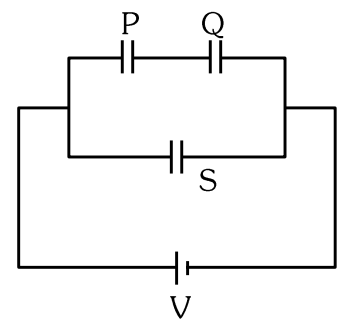 P and Q are in series, so each gets charge $\frac{CV}{2}$; S is directly across V with charge CV. $U_P=\frac{1}{2}\frac{(CV/2)^2}{C}=\frac{1}{8}CV^2$. $U_T=\frac{1}{8}CV^2+\frac{1}{8}CV^2+\frac{1}{2}CV^2=\frac{3}{4}CV^2$. $\frac{U_P}{U_T}=\frac{1/8}{3/4}=\frac{1}{6}$.
Energy conservation in electric field
-
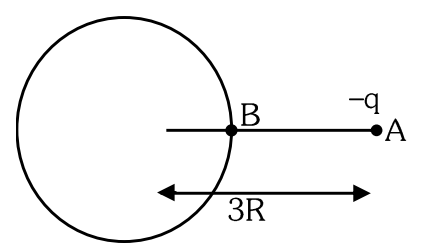
Consider a fixed uniformly charged insulating sphere with radius R and total charge +Q. A point charge -q (q << Q) with mass m is released from rest at a distance of 3R from the centre of the charged sphere. When the point charge reaches the surface of the sphere, its speed is: ($\varepsilon_0$ is the permittivity of vacuum, neglect gravitational forces).
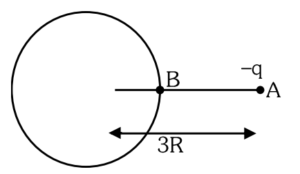 Energy conservation: $K_A+U_A=K_B+U_B \Rightarrow -\frac{kQq}{3R}=\frac{1}{2}mv^2-\frac{kQq}{R} \Rightarrow \frac{2}{3}\frac{kQq}{R}=\frac{1}{2}mv^2 \Rightarrow v=\sqrt{\frac{Qq}{3\pi\varepsilon_0mR}}$.
Force between plates of a parallel plate capacitor
-
The electrostatic force between the metal plates of an isolated parallel plate capacitor C having a charge Q and area A, is
$F = Q^2/2A\varepsilon_0$ contains no d.
For an isolated capacitor, Q = constant. $F_{plate} = \frac{Q^2}{2A\varepsilon_0}$ So F is independent of the distance between the plates.
Capacitor with dielectric
-
A parallel plate air capacitor of capacitance C is connected to a cell of emf V and then disconnected from it. A dielectric slab of dielectric constant K which can just fill the air gap of the capacitor is now inserted in it. Which of the following is incorrect?On charging, $Q = CV$. After disconnecting, the charge cannot change, so the charge is conserved — the statement that it is not conserved is incorrect.
With the dielectric: $C' = KC$ and $V' = \frac{V}{K}$ (potential difference decreases K times).
$U_i = \frac{1}{2}CV^2$, $U_f = \frac{1}{2}C'V'^2 = \frac{1}{2}KC\left(\frac{V}{K}\right)^2 = \frac{U_i}{K}$ (energy decreases K times).
$\Delta U = U_f - U_i = \frac{1}{2}CV^2\left(\frac{1}{K} - 1\right)$
Relation between field and potential
-
In a region, the potential is represented by $V(x, y, z) = 6x - 8xy - 8y + 6yz$, where V is in volts and x, y, z are in metres. The electric force experienced by a charge of 2 coulomb situated at point (1, 1, 1) is:$\vec E = -\frac{\partial V}{\partial x}\hat i - \frac{\partial V}{\partial y}\hat j - \frac{\partial V}{\partial z}\hat k = -[(6 - 8y)\hat i + (-8x - 8 + 6z)\hat j + (6y)\hat k]$
At (1, 1, 1): $\vec E = 2\hat i + 10\hat j - 6\hat k$
$|\vec E| = \sqrt{2^2 + 10^2 + 6^2} = \sqrt{140} = 2\sqrt{35}$ N/C
$F = qE = 2\times 2\sqrt{35} = 4\sqrt{35}$ N -
The electric potential at a point (x, y, z) is given by $V = -x^2y - xz^3 + 4$. The electric field $\vec{E}$ at that point is$\vec{E} = -\left(\hat{i}\frac{\partial V}{\partial x} + \hat{j}\frac{\partial V}{\partial y} + \hat{k}\frac{\partial V}{\partial z}\right)$
$\frac{\partial V}{\partial x} = -2xy - z^3$, so $E_x = 2xy + z^3$
$\frac{\partial V}{\partial y} = -x^2$, so $E_y = x^2$
$\frac{\partial V}{\partial z} = -3xz^2$, so $E_z = 3xz^2$
$\vec{E} = \hat{i}(2xy + z^3) + \hat{j}x^2 + \hat{k}3xz^2$
Dielectrics in capacitors
-
Two thin dielectric slabs of dielectric constants $K_1$ and $K_2$ ($K_1 < K_2$) are inserted between plates of a parallel plate capacitor, as shown in the figure. The variation of electric field 'E' between the plates with distance 'd' as measured from plate P is correctly shown by:
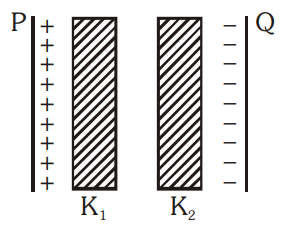 Electric field inside a dielectric $E \propto \frac{1}{K}$
As $K_1 E_2$: the field drops in the first slab and drops further in the second, returning to the air value between and outside the slabs.
Potential due to a system of charges
-
Three charges, each +q, are placed at the corners of an isosceles triangle ABC of sides BC and AC, 2a. D and E are the mid points of BC and CA. The work done in taking a charge Q from D to E is
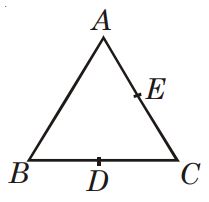 Work done in moving a charge Q from D to E: $W = Q(V_E - V_D)$
BC = AC = 2a. D is the midpoint of BC, so DB = DC = a; E is the midpoint of CA, so EC = EA = a.
By the symmetry of the isosceles triangle about the bisector of angle C, the distance of D from A equals the distance of E from B: AD = BE.
$V_D = \frac{q}{4\pi\varepsilon_0}\left(\frac{1}{a} + \frac{1}{a} + \frac{1}{AD}\right)$
$V_E = \frac{q}{4\pi\varepsilon_0}\left(\frac{1}{a} + \frac{1}{a} + \frac{1}{BE}\right)$
Since AD = BE, $V_D = V_E$.
$W = Q(V_E - V_D) = 0$ -
Four electric charges +q, +q, −q and −q are placed at the corners of a square of side 2L (see figure). The electric potential at point A, midway between the two charges +q and +q, is
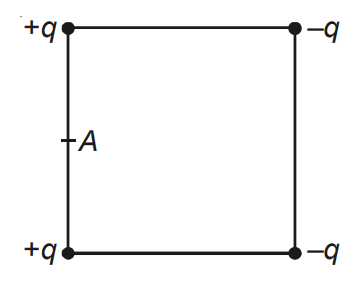 A is the midpoint of the side joining the two +q charges, so each +q is at a distance L from A.
Each −q charge is at the far corners: its distance from A is $\sqrt{(2L)^2 + L^2} = \sqrt{5}L$
Potential at A due to the two +q charges: $V_+ = 2\times\frac{1}{4\pi\varepsilon_0}\frac{q}{L} = \frac{1}{4\pi\varepsilon_0}\frac{2q}{L}$
Potential at A due to the two −q charges: $V_- = -2\times\frac{1}{4\pi\varepsilon_0}\frac{q}{\sqrt{5}L} = -\frac{1}{4\pi\varepsilon_0}\frac{2q}{\sqrt{5}L}$
$V_A = V_+ + V_- = \frac{1}{4\pi\varepsilon_0}\frac{2q}{L}\left(1 - \frac{1}{\sqrt{5}}\right)$ -
Charges $+q$ and $-q$ are placed at points A and B respectively which are a distance $2L$ apart, C is the midpoint between A and B. The work done in moving a charge $+Q$ along the semicircle CRD is
(The semicircle CRD is centred at B and has radius $L$; D lies on the line AB produced, at a distance $L$ beyond B.)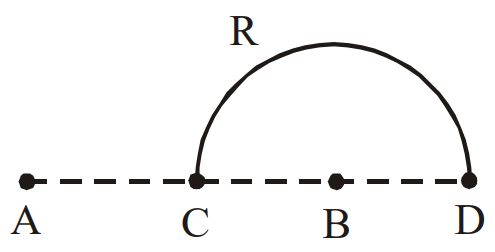
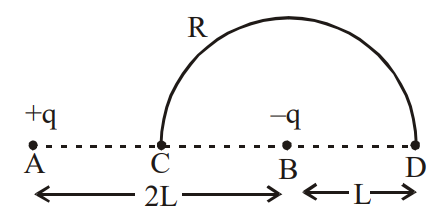
The work done in moving a charge in an electrostatic field depends only on the end points: $W = Q(V_D - V_C)$.
C is equidistant ($L$) from $+q$ and $-q$, so the potential at C is $V_C = \dfrac{Kq}{L} - \dfrac{Kq}{L} = 0$, where $K = \dfrac{1}{4\pi\varepsilon_0}$.
D is at a distance $3L$ from A ($+q$) and $L$ from B ($-q$).
Potential at D: $V_D = K\left(\dfrac{-q}{L}\right) + \dfrac{Kq}{3L} = -\dfrac{2}{3}\dfrac{Kq}{L}$
Potential difference: $V_D - V_C = -\dfrac{2}{3}\dfrac{Kq}{L} = \dfrac{1}{4\pi\varepsilon_0}\left(-\dfrac{2}{3}\cdot\dfrac{q}{L}\right)$
Work done $= Q(V_D - V_C) = -\dfrac{2}{3} \times \dfrac{1}{4\pi\varepsilon_0}\dfrac{qQ}{L}$
$W = -\dfrac{qQ}{6\pi\varepsilon_0 L}$
Capacitance of a spherical conductor
-
Two metallic spheres of radii 1 cm and 3 cm are given charges of $-1\times10^{-2}$ C and $5\times10^{-2}$ C, respectively. If these are connected by a conducting wire, the final charge on the bigger sphere isWhen connected, the spheres reach a common potential: $V = \frac{Q_1 + Q_2}{C_1 + C_2}$
Charge on the bigger sphere: $Q_2' = C_2V = \left(\frac{C_2}{C_1 + C_2}\right)(Q_1 + Q_2)$
For a sphere $C = 4\pi\varepsilon_0R$, so $C_1 = 4\pi\varepsilon_0R_1$ and $C_2 = 4\pi\varepsilon_0R_2$
$Q_2' = \left(\frac{R_2}{R_1 + R_2}\right)(Q_1 + Q_2) = \left(\frac{3}{3 + 1}\right)(5 - 1)\times10^{-2}$
$Q_2' = \frac{3}{4}\times4\times10^{-2} = 3\times10^{-2}$ C
Potential and Field of a Point Charge
-
The electric potential at a point in free space due to a charge $Q$ coulomb is $Q \times 10^{11}$ volts. The electric field at that point is -For a point charge: $V = \dfrac{Q}{4\pi\varepsilon_0 r}$ and $E = \dfrac{Q}{4\pi\varepsilon_0 r^2}$
Given $V = Q \times 10^{11} = \dfrac{Q}{4\pi\varepsilon_0 r}$
$\Rightarrow r = \dfrac{1}{4\pi\varepsilon_0 \times 10^{11}}$
Dividing the two expressions: $E = \dfrac{V}{r}$
$E = Q \times 10^{11} \times 4\pi\varepsilon_0 \times 10^{11}$
$E = 4\pi\varepsilon_0 Q \times 10^{22}$ volt m$^{-1}$
Potential Energy of a System of Charges
-
Two charges $q_1$ and $q_2$ are placed 30 cm apart, as shown in the figure. A third charge $q_3$ is moved along the arc of a circle of radius 40 cm from C to D. The change in the potential energy of the system is $\dfrac{q_3}{4\pi\varepsilon_0}k$, where $k$ is -
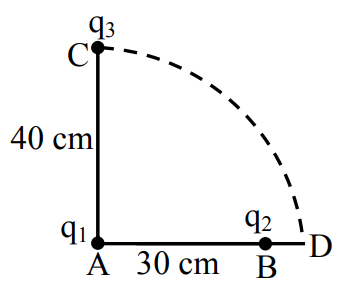 Initially $q_3$ is at C: AC = 0.4 m, and BC $= \sqrt{0.4^2 + 0.3^2} = 0.5$ m.
$U_i = \dfrac{1}{4\pi\varepsilon_0}\left[\dfrac{q_1 q_3}{0.4} + \dfrac{q_1 q_2}{0.3} + \dfrac{q_2 q_3}{0.5}\right]$
Finally $q_3$ is at D: AD = 0.4 m and BD = 0.4 $-$ 0.3 = 0.1 m.
$U_f = \dfrac{1}{4\pi\varepsilon_0}\left[\dfrac{q_1 q_3}{0.4} + \dfrac{q_1 q_2}{0.3} + \dfrac{q_2 q_3}{0.1}\right]$
The distance of $q_3$ from $q_1$ does not change (it moves on a circle centred at A), so only the $q_2q_3$ term changes.
$\Delta U = U_f - U_i = \dfrac{q_2 q_3}{4\pi\varepsilon_0}\left[\dfrac{1}{0.1} - \dfrac{1}{0.5}\right] = \dfrac{q_2 q_3}{4\pi\varepsilon_0}(10 - 2)$
$\Delta U = \dfrac{q_3}{4\pi\varepsilon_0}(8q_2)$
$\Rightarrow k = 8q_2$ -
Identical charges (–q) are placed at each corner of a cube of side 'b' then electrical potential energy of charge (+q) which is placed at centre of cube will beThe distance from the centre of a cube of side b to any corner is half the body diagonal: $r = \dfrac{\sqrt{3}b}{2}$.
There are 8 corners, each with charge $-q$, all at the same distance r from the central charge $+q$.
Electric potential energy $= 8 \times \dfrac{1}{4\pi\varepsilon_0}\dfrac{(q)(-q)}{\sqrt{3}b/2}$
$= -\dfrac{8 \times 2q^2}{4\pi\varepsilon_0\sqrt{3}b} = -\dfrac{4q^2}{\sqrt{3}\pi\varepsilon_0 b}$
So the potential energy of the central charge is $\dfrac{-4q^2}{\sqrt{3}\pi\varepsilon_0 b}$.
That is every question in Electrostatic Potential and Capacitance for this filter.
Want a score?
Answers here are not saved. Practise as a test to be marked and see your progress.
Practise as a test