Looking for classes? Ksquare Career Institute, Bengaluru →

Physics
Magnetism and Matter
38 questions from 28 papers, each with its answer.
- 38 questions
- 28 papers
- 2.15% of Physics
Magnetic Moment of a Bent Bar Magnet
-
An iron bar of length $L$ has magnetic moment $M$. It is bent at the middle of its length such that the two arms make an angle $60^\circ$ with each other. The magnetic moment of this new magnet is:Initially, M = ml (m = pole strength, l = length). When the rod is bent at the middle, each arm is $\frac{l}{2}$ and the arms make $60^\circ$ with each other. [add image: bar bent at the middle into two arms of length l/2 at $60^\circ$] Effective length $l_{eff} = 2 \times \frac{l}{2}\sin 30^\circ = \frac{l}{2}$ $M' = m \times \frac{l}{2} = \frac{M}{2}$
-
The magnetic moment of an iron bar is M. It is now bent in such a way that it forms an arc section of a circle subtending an angle of $60^\circ$ at the centre. The magnetic moment of this arc section isFrom $R\theta=L$ (arc length equals original bar length), $R=\dfrac{L}{\theta}=\dfrac{3L}{\pi}$ (for $\theta=\pi/3$). The new magnetic moment (effective dipole length is the chord $2R\sin30^\circ$): $M'=m(2R)\sin30^\circ=m\times2\times\dfrac{3L}{\pi}\times\dfrac{1}{2}=\dfrac{3mL}{\pi}=\dfrac{3M}{\pi}$.
Force on Magnetic/Conducting Sheets near a Pole
-
A sheet is placed on a horizontal surface in front of a strong magnetic pole. A force is needed to: A. hold the sheet there if it is magnetic. B. hold the sheet there if it is non-magnetic. C. move the sheet away from the pole with uniform velocity if it is conducting. D. move the sheet away from the pole with uniform velocity if it is both, non-conducting and non-polar. Choose the correct statement(s) from the options given below:A. A magnetic sheet experiences a magnetic force (attraction) near the pole, so a force is needed to hold it there – correct. B. A non-magnetic sheet does not interact significantly with the magnetic field, so no force is needed to hold it – incorrect. C. When a conducting sheet is moved away from the pole, eddy currents are induced which oppose the motion (Lenz's law), so a force is needed to keep it moving with uniform velocity – correct. D. A non-conducting, non-polar sheet does not interact significantly with the magnetic field, so no force is needed – incorrect. So A and C only are correct.
Magnetic Susceptibility of Materials
-
Match List-I with List-II regarding the magnetic susceptibility of different classes of materials.
Pick the matching item from Column II for each row.
Column I
- A. Diamagnetic
- B. Ferromagnetic
- C. Paramagnetic
- D. Non-magnetic
Column II
- I. $\chi = 0$
- II. $0 > \chi \geq -1$
- III. $\chi \gg 1$
- IV. $0 < \chi < \varepsilon$ (a small positive number)
Correct answer: A → II, B → III, C → IV, D → I
Diamagnetic material: $0 > \chi \geq -1$ Ferromagnetic material: $\chi \gg 1$ Paramagnetic material: $0 < \chi < \varepsilon$ (a small positive number) Non-magnetic material: $\chi = 0$ Correct match: A-II, B-III, C-IV, D-I.
Magnetisation and Magnetic Intensity – Susceptibility and Permeability
-
An iron rod of susceptibility 599 is subjected to a magnetising field of $1200\ A\,m^{-1}$. The permeability of the material of the rod is: ($\mu_0=4\pi\times10^{-7}\ T\,m\,A^{-1}$)$\chi_m = 599 \Rightarrow \mu_r = 1 + \chi_m = 600$ $\mu = \mu_r\mu_0 = 600 \times 4\pi \times 10^{-7} = 2400\pi \times 10^{-7}$ $\mu = 2.4\pi \times 10^{-4}\ T\,m\,A^{-1}$
Earth's Magnetism – Angle of Dip
-
At a point A on the earth's surface the angle of dip, $\delta=+25^\circ$. At a point B on the earth's surface the angle of dip, $\delta=-25^\circ$. We can interpret that:Angle of dip is the angle made by the earth's resultant magnetic field with the horizontal. Dip is zero at the equator, positive in the northern hemisphere (field points downward) and negative in the southern hemisphere. So A ($\delta=+25^\circ$) is in the northern hemisphere and B ($\delta=-25^\circ$) is in the southern hemisphere.
Bar magnet in a uniform magnetic field
-
The magnetic potential energy, when a magnetic bar of magnetic moment $\vec{m}$ is placed perpendicular to the magnetic field $\vec{B}$ isPotential energy of a magnetic dipole is $U=-\vec{M}\cdot\vec{B}=-MB\cos\theta$. Since the bar is placed perpendicular to $\vec{B}$, $\theta=90^\circ$, so $U=-MB\cos 90^\circ=0$.
-
A bar magnet is oscillating in the Earth's magnetic field with a period T. What happens to this period and motion if its mass is quadrupled -For small oscillations of a magnet in a uniform field, the restoring torque is proportional to the angular displacement, so the motion is simple harmonic with
$T = 2\pi\sqrt{\dfrac{I}{MB}}$, where I is the moment of inertia and M the magnetic moment.
The moment of inertia is proportional to the mass ($I \propto$ mass, dimensions unchanged), so when the mass is quadrupled, $I' = 4I$. The magnetic moment is unchanged.
$T' = 2\pi\sqrt{\dfrac{4I}{MB}} = 2 \times 2\pi\sqrt{\dfrac{I}{MB}} = 2T$
So the motion remains simple harmonic, with time period 2T.
Magnetic susceptibility and permeability - diamagnetism
-
The incorrect relation for a diamagnetic material (all the symbols carry their usual meaning and $\varepsilon$ is a small positive number) isFor diamagnetic material, $0\le\mu_r<1$ and $\chi=\mu_r-1\Rightarrow -1\le\chi<0$; also $\mu_r=\mu/\mu_0<1\Rightarrow \mu<\mu_0$. Option (d), $1<\mu_r<1+\varepsilon$, describes a paramagnetic material, so it is the incorrect relation for diamagnetism.
Oscillation of a magnetic needle (vibration magnetometer)
-
The magnetic moment and moment of inertia of a magnetic needle as shown are, respectively, $1.0\times10^{-2}\ A\,m^2$ and $\dfrac{10^{-6}}{\pi^2}\ kg\,m^2$. If it completes 10 oscillations in 10 s, the magnitude of the magnetic field is
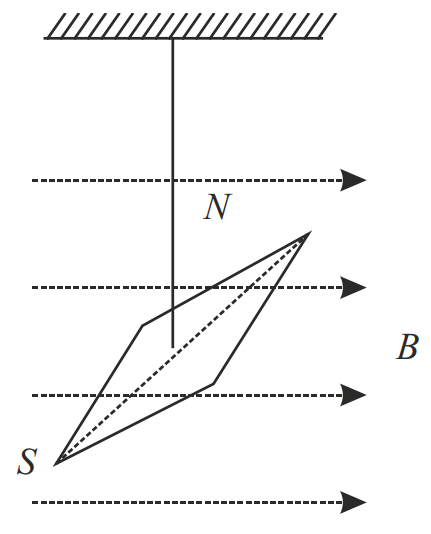 Time period $T=2\pi\sqrt{\dfrac{I}{MB}}$. $T=\dfrac{t}{n}=\dfrac{10}{10}=1$ s. $1=2\pi\sqrt{\dfrac{10^{-6}/\pi^2}{1.0\times10^{-2}\times B}}\Rightarrow B=0.4\times10^{-3}\ T=0.4$ mT.
Curie's law - susceptibility of a paramagnetic material
-
The variation of susceptibility ($\chi$) with absolute temperature (T) for a paramagnetic material is represented as:By Curie's law for a paramagnetic material, $\chi\propto\dfrac{1}{T}$. So a graph of $\chi$ vs $\dfrac{1}{T}$ will be a straight line through the origin.
Diamagnetic materials – energy considerations
-
A thin diamagnetic rod is placed vertically between the poles of an electromagnet. When the current in the electromagnet is switched on, then the diamagnetic rod is pushed up, out of the horizontal magnetic field. Hence the rod gains gravitational potential energy. The work required to do this comes from
The energy is ultimately supplied by the source driving the electromagnet.
Energy of the current source will be converted into the potential energy of the rod. So the work comes from the current source.
Earth's magnetism – apparent angle of dip
-
If $\theta_1$ and $\theta_2$ be the apparent angles of dip observed in two vertical planes at right angles to each other, then the true angle of dip $\theta$ is given by
$\cot\theta_1 = \cot\theta/\cos\alpha$ and $\cot\theta_2 = \cot\theta/\sin\alpha$; squaring and adding gives the relation.
$\cot^2\theta = \cot^2\theta_1 + \cot^2\theta_2$ (standard relation for apparent dips in two perpendicular vertical planes)
Bar magnet in a uniform field – torque and work
-
A bar magnet is hung by a thin cotton thread in a uniform horizontal magnetic field and is in equilibrium state. The energy required to rotate it by 60° is W. Now the torque required to keep the magnet in this new position is:
Divide $MB\sin\theta$ by $MB(1-\cos\theta)$.
$\tau = MB\sin60^\circ$ ...(1)
$W = MB(1 - \cos60^\circ)$ ...(2)
From (1) and (2): $\frac{\tau}{W} = \frac{\sqrt{3}/2}{1/2} \Rightarrow \tau = \sqrt{3}W$
Magnetic dipole moment
-
Following figures show the arrangement of bar magnets in different configurations. Each magnet has magnetic dipole moment $\vec m$. Which configuration has highest net magnetic dipole moment?
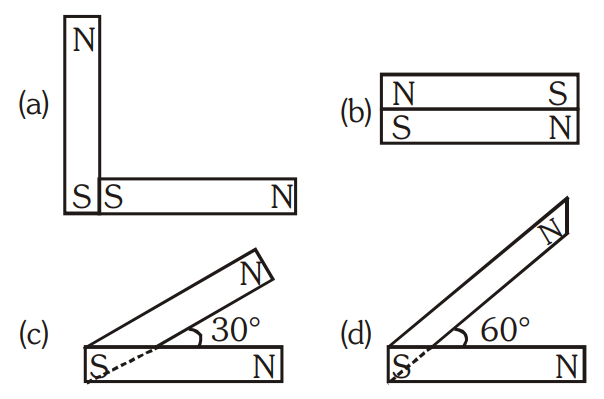 Net magnetic moment $= 2M\cos\frac{\theta}{2}$, where $\theta$ is the angle between the two moments.
It is maximum for the smallest angle, i.e. configuration (c) with $\theta = 30^\circ$. -
A bar magnet of length 'l' and magnetic dipole moment 'M' is bent in the form of an arc as shown in figure. The new magnetic dipole moment will be
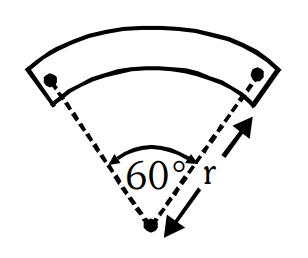 Let the pole strength be m; then $M = ml$.
After bending into an arc subtending $60^\circ$: $r\left(\frac{\pi}{3}\right) = l \Rightarrow r = \frac{3l}{\pi}$
Distance between the poles $= 2r\sin\frac{60^\circ}{2} = r$
$M' = m\times2\left(\frac{3l}{\pi}\right)\left(\frac{1}{2}\right) = \frac{3ml}{\pi} = \frac{3M}{\pi}$
Magnetic dipole in a uniform field
-
A magnetic needle suspended parallel to a magnetic field requires $\sqrt3$ J of work to turn it through $60^\circ$. The torque needed to maintain the needle in this position will beWork done $= U_f - U_i = -MB\cos60^\circ - (-MB\cos0^\circ) = MB\left(1 - \frac{1}{2}\right) = \frac{MB}{2}$
$\sqrt3 = \frac{MB}{2} \Rightarrow MB = 2\sqrt3$ J
Torque needed: $\tau = MB\sin60^\circ = 2\sqrt3\times\frac{\sqrt3}{2}$
$\tau = 3$ J
Oscillation of a magnet in a magnetic field
-
A vibration magnetometer placed in magnetic meridian has a small bar magnet. The magnet executes oscillations with a time period of 2 sec in earth's horizontal magnetic field of 24 microtesla. When a horizontal field of 18 microtesla is produced opposite to the earth's field by placing a current carrying wire, the new time period of magnet will beTime period of a magnet oscillating in a field B: $T = 2\pi\sqrt{\frac{I}{MB}}$, so $T \propto \frac{1}{\sqrt{B}}$
Initial field: $B_1 = 24\ \mu T$
The applied field is opposite to the earth's field, so the net field is $B_2 = 24 - 18 = 6\ \mu T$
$\frac{T_2}{T_1} = \sqrt{\frac{B_1}{B_2}} = \sqrt{\frac{24}{6}} = 2$
$T_2 = 2\times2 = 4$ s
Oscillations of a Magnet in a Magnetic Field
-
Two bar magnets having same geometry with magnetic moments M and 2M, are firstly placed in such a way that their similar poles are same side then its time period of oscillation is $T_1$. Now the polarity of one of the magnets is reversed then time period of oscillation is $T_2$, then : -Time period of a magnet oscillating in a uniform field: $T = 2\pi\sqrt{\dfrac{I}{MB}}$, so $T \propto \dfrac{1}{\sqrt{M}}$ (the moment of inertia I is the same in both cases).
Case I (similar poles together): $M_1 = 2M + M = 3M$
Case II (one reversed): $M_2 = 2M - M = M$
$\dfrac{T_1}{T_2} = \sqrt{\dfrac{M_2}{M_1}} = \sqrt{\dfrac{M}{3M}} = \dfrac{1}{\sqrt{3}} \Rightarrow T_2 = \sqrt{3}T_1$
So $T_1 \lt T_2$.
That is every question in Magnetism and Matter for this filter.
Want a score?
Answers here are not saved. Practise as a test to be marked and see your progress.
Practise as a test