Looking for classes? Ksquare Career Institute, Bengaluru →

Physics
Thermal Properties of Matter
49 questions from 30 papers, each with its answer.
- 49 questions
- 30 papers
- 2.78% of Physics
Thermal Conduction in Series
-
Three identical heat conducting rods are connected in series as shown in the figure. The rods on the sides have thermal conductivity $2K$ while that in the middle has thermal conductivity $K$. The left end of the combination is maintained at temperature $3T$ and the right end at $T$. The rods are thermally insulated from outside. In steady state, temperature at the left junction is $T_1$ and that at the right junction is $T_2$. The ratio $T_1 / T_2$ is:
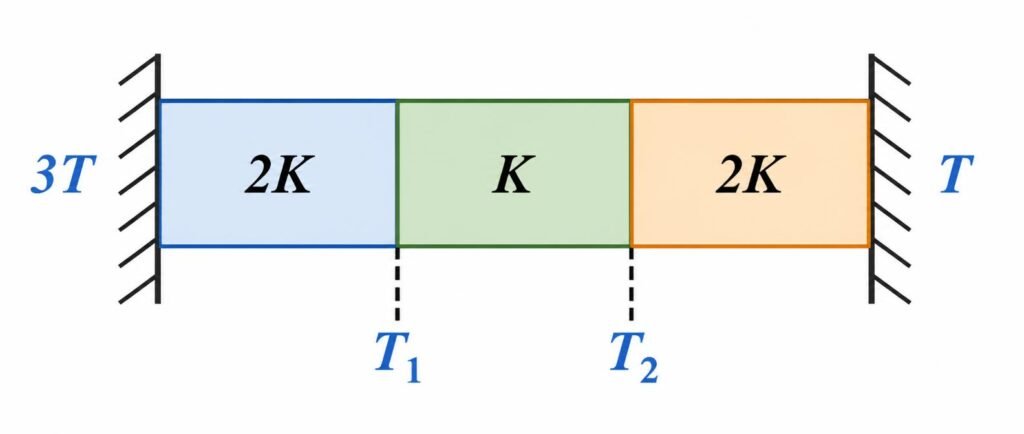
Steady-state heat rate is constant. Junction temperatures evaluate to $T_1 = \frac{5T}{2}$ and $T_2 = \frac{3T}{2}$, giving $T_1 / T_2 = 5/3$.
Since the rods are in series and insulated, the steady-state heat current is equal across all three sections: $H = \frac{2KA(3T - T_1)}{L} = \frac{KA(T_1 - T_2)}{L} = \frac{2KA(T_2 - T)}{L}$. Setting the thermal resistances: $R_1 = \frac{L}{2KA} = \frac{R}{2}$, $R_2 = \frac{L}{KA} = R$, $R_3 = \frac{L}{2KA} = \frac{R}{2}$. Total thermal resistance is $R_{eq} = \frac{R}{2} + R + \frac{R}{2} = 2R$. The heat current is $H = \frac{3T - T}{2R} = \frac{2T}{2R} = \frac{T}{R}$. Then: $3T - T_1 = H R_1 = \left(\frac{T}{R}\right)\left(\frac{R}{2}\right) = \frac{T}{2} \implies T_1 = 3T - \frac{T}{2} = \frac{5T}{2}$. Similarly, $T_2 - T = H R_3 = \frac{T}{2} \implies T_2 = T + \frac{T}{2} = \frac{3T}{2}$. Thus, the ratio is $\frac{T_1}{T_2} = \frac{5T/2}{3T/2} = \frac{5}{3}$.
Newton's Law of Cooling
-
A cup of coffee cools from $90^\circ C$ to $80^\circ C$ in $t$ minutes, when the room temperature is $20^\circ C$. The time taken by a similar cup of coffee to cool from $80^\circ C$ to $60^\circ C$ at a room temperature same at $20^\circ C$ is:Newton's law of cooling (average form): $\frac{T_1 - T_2}{t} = K\left[\frac{T_1 + T_2}{2} - T_0\right]$ First cup: $\frac{90 - 80}{t} = K\left[\frac{90 + 80}{2} - 20\right] = 65K$ ...(1) Second cup: $\frac{80 - 60}{t'} = K\left[\frac{80 + 60}{2} - 20\right] = 50K$ ...(2) Dividing (1) by (2): $\frac{t'}{2t} = \frac{65}{50} \Rightarrow t' = \frac{13}{5}t$
-
An object kept in a large room having air temperature of $25^\circ C$ takes 12 minutes to cool from $80^\circ C$ to $70^\circ C$. The time taken to cool for the same object from $70^\circ C$ to $60^\circ C$ would be nearly:$\frac{T_1-T_2}{t}=K\left(\frac{T_1+T_2}{2}-T_s\right)$. First: $\frac{10}{12}=K(75-25) \Rightarrow K=\frac{1}{60}$. Second: $\frac{10}{t}=\frac{1}{60}(65-25) \Rightarrow t=15$ min.
-
A body cools from a temperature 3T to 2T in 10 minutes. The room temperature is T. Assume that Newton's law of cooling is applicable. The temperature of the body at the end of next 10 minutes will be:
Use the average-temperature form of Newton's law twice.
Newton's law of cooling: $\frac{T_1 - T_2}{t} = k\left(\frac{T_1 + T_2}{2} - T\right)$
$\frac{3T - 2T}{10} = k\left(\frac{5T}{2} - T\right) \Rightarrow \frac{T}{10} = k\left(\frac{3T}{2}\right)$ ...(i)
$\frac{2T - T'}{10} = k\left(\frac{2T + T'}{2} - T\right) = k\left(\frac{T'}{2}\right)$ ...(ii)
Solving (i) and (ii): $T' = \frac{3}{2}T$ -
Certain quantity of water cools from $70^\circ C$ to $60^\circ C$ in the first 5 minutes and to $54^\circ C$ in the next 5 minutes. The temperature of the surroundings is:Newton's law of cooling: $\frac{\theta_1 - \theta_2}{t} = k\left[\frac{\theta_1 + \theta_2}{2} - \theta_0\right]$
$\frac{70 - 60}{5} = k[65 - \theta_0] \Rightarrow 2 = k[65 - \theta_0]$ ...(i)
$\frac{60 - 54}{5} = k[57 - \theta_0] \Rightarrow \frac{6}{5} = k[57 - \theta_0]$ ...(ii)
Dividing (i) by (ii): $\frac{10}{6} = \frac{65 - \theta_0}{57 - \theta_0} \Rightarrow \theta_0 = 45^\circ C$
Specific Heat Capacity and Calorimetry
-
The quantities of heat required to raise the temperature of two solid copper spheres of radii $r_1$ and $r_2$ ($r_1=1.5\,r_2$) through 1 K are in the ratio:$\Delta Q = ms\Delta T = \left(\frac{4}{3}\pi r^3\rho\right)s\Delta T$ Same material and same $\Delta T$, so $\Delta Q \propto r^3$ $\frac{\Delta Q_1}{\Delta Q_2} = \left(\frac{r_1}{r_2}\right)^3 = (1.5)^3 = \frac{27}{8}$
Thermal Expansion
-
A copper rod of 88 cm and an aluminum rod of unknown length have their increase in length independent of increase in temperature. The length of aluminum rod is: ($\alpha_{Cu}=1.7\times10^{-5}\ K^{-1}$ and $\alpha_{Al}=2.2\times10^{-5}\ K^{-1}$)The difference in lengths is independent of temperature, so the increases in length must be equal: $\alpha_{Cu}L_{Cu}=\alpha_{Al}L_{Al}$ $1.7\times10^{-5}\times88=2.2\times10^{-5}\times L_{Al}$ $L_{Al}=\frac{1.7\times88}{2.2}=68\ cm$
Thermal conduction and insulation
-
Houses made of concrete roofs overlaid with foam keep the room hotter during summer.The foam layer forms an insulation that prohibits heat transfer (it contains trapped air pockets, which are poor conductors of heat). Hence roofs with foam insulation actually keep the room cooler, not hotter, during summer — so Assertion A is false while Reason R is true.
Specific heat capacity
-
Water is used as a coolant in a nuclear reactor because of itsWater is used as a coolant because of its high specific heat capacity, which allows it to absorb large amounts of heat with a relatively small rise in temperature.
Wien's displacement law - colour and temperature
-
Three stars A, B, C have surface temperatures $T_A, T_B, T_C$ respectively. Star A appears bluish, star B appears reddish and star C yellowish. Hence,By Wien's displacement law, higher temperature corresponds to shorter peak wavelength (bluer colour). Since blue light has the shortest wavelength, followed by yellow, then red: $T_A$(bluish)$>T_C$(yellowish)$>T_B$(reddish).
Thermal conduction - junction temperature
-
Two rods one made of copper and other made of steel of the same length and same cross sectional area are joined together. The thermal conductivity of copper and steel are 385 J s$^{-1}$K$^{-1}$m$^{-1}$ and 50 J s$^{-1}$K$^{-1}$m$^{-1}$ respectively. The free ends of copper and steel are held at $100^\circ C$ and $0^\circ C$ respectively. The temperature at the junction is, nearly:In steady state the heat current is equal: $\frac{K_{Cu}A(100-\theta)}{l}=\frac{K_{steel}A(\theta-0)}{l} \Rightarrow 385(100-\theta)=50\theta \Rightarrow \theta=\frac{38500}{435}\approx88.5^\circ C$.
Black body radiation – Wien's law and Stefan's law
-
The power radiated by a black body is P and it radiates maximum energy at wavelength, $\lambda_0$. If the temperature of the black body is now changed so that it radiates maximum energy at wavelength $\frac{3}{4}\lambda_0$, the power radiated by it becomes nP. The value of n is
Wien's law gives $T' = 4T/3$; Stefan's law gives $P \propto T^4$.
We know, $\lambda_{max}T$ = constant (Wien's law) So, $\lambda_{max_1}T_1 = \lambda_{max_2}T_2$ $\Rightarrow \lambda_0T = \frac{3\lambda_0}{4}T'$ $\Rightarrow T' = \frac{4}{3}T$ So, $\frac{P_2}{P_1} = \left(\frac{T'}{T}\right)^4 = \left(\frac{4}{3}\right)^4 = \frac{256}{81}$
Thermal conduction – rods in parallel
-
Two rods A and B of different materials are welded together as shown in figure. Their thermal conductivities are $K_1$ and $K_2$. The thermal conductivity of the composite rod will be
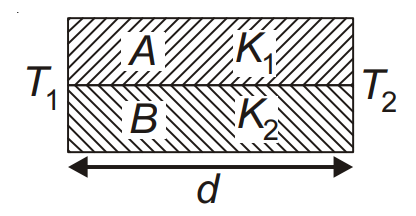
Rods side by side (equal area) give the average conductivity.
Thermal current $H = H_1 + H_2 = \frac{K_1A(T_1 - T_2)}{d} + \frac{K_2A(T_1 - T_2)}{d}$ $\frac{K_{EQ}\,2A(T_1 - T_2)}{d} = \frac{A(T_1 - T_2)}{d}(K_1 + K_2)$ $K_{EQ} = \frac{K_1 + K_2}{2}$
Stefan–Boltzmann law
-
Assuming the sun to have a spherical outer surface of radius $r$, radiating like a black body at temperature $t^\circ C$, the power received by a unit surface (normal to the incident rays) at a distance $R$ from the centre of the sun is
where $\sigma$ is the Stefan's constant.Absolute temperature of the sun: $T = (t + 273)$ K
Power radiated per unit area of a black body $= \sigma T^4$
Surface area of the sun $= 4\pi r^2$
Total power radiated by the sun at $t^\circ C$ $= \sigma(t + 273)^4 \times 4\pi r^2$
At a distance $R$ this power is spread uniformly over a sphere of area $4\pi R^2$.
Power received by a unit surface $= \dfrac{\sigma(t + 273)^4\,4\pi r^2}{4\pi R^2}$
$= \dfrac{r^2\sigma(t + 273)^4}{R^2}$ -
For a black body at temperature $727^\circ C$, its radiating power is 60 watt and temperature of surrounding is $227^\circ C$. If temperature of black body is changed to $1227^\circ C$ then its radiating power will be : -Net power radiated by a black body in surroundings at $T_0$: $P \propto (T^4 - T_0^4)$ (Stefan's law).
Convert to kelvin: $T_1 = 1000$ K, $T_2 = 1500$ K, $T_0 = 500$ K.
$\dfrac{P_2}{P_1} = \dfrac{1500^4 - 500^4}{1000^4 - 500^4} = \dfrac{500^4(3^4 - 1)}{500^4(2^4 - 1)} = \dfrac{80}{15}$
$\dfrac{P_2}{60} = \dfrac{80}{15} \Rightarrow P_2 = 320$ W
So the radiating power becomes 320 W.
Black body radiation – Wien's displacement law
-
A black body is at a temperature of 5760 K. The energy of radiation emitted by the body at wavelength 250 nm is $U_1$, at wavelength 500 nm is $U_2$ and that at 1000 nm is $U_3$. Wien's constant, $b = 2.88 \times 10^{6}$ nmK. Which of the following is correct?'Out of Syllabus'
Thermal conduction
-
A slab of stone of area 0.36 $m^2$ and thickness 0.1 m is exposed on the lower surface to steam at $100^\circ C$. A block of ice at $0^\circ C$ rests on the upper surface of the slab. In one hour 4.8 kg of ice is melted. The thermal conductivity of slab is (Given latent heat of fusion of ice = $3.36\times10^5$ J $kg^{-1}$)Heat conducted through the slab in time t melts the ice: $Q = \frac{KA(\Delta T)t}{L} = mL_f$
$K = \frac{mL_f\times L}{A(\Delta T)t} = \frac{4.8\times3.36\times10^5\times0.1}{0.36\times100\times3600}$
$K = \frac{161280}{129600} = \frac{56}{45} = 1.24$ J/m/s/$^\circ C$ -
A cylindrical metallic rod in thermal contact with two reservoirs of heat at its two ends conducts an amount of heat Q in time t. The metallic rod is melted and the material is formed into a rod of half the radius of the original rod. What is the amount of heat conducted by the new rod, when placed in thermal contact with the two reservoirs in time t?Heat conducted in time t: $Q = \frac{KA(T_1 - T_2)t}{L}$, so for the same material, temperatures and time, $Q \propto \frac{A}{L}$
New radius = $\frac{r}{2}$, so new area $A' = \pi\left(\frac{r}{2}\right)^2 = \frac{A}{4}$
The volume of metal is unchanged: $A'L' = AL$, so $L' = \frac{AL}{A/4} = 4L$
$\frac{Q'}{Q} = \frac{A'}{A}\times\frac{L}{L'} = \frac{1}{4}\times\frac{1}{4} = \frac{1}{16}$
$Q' = \frac{Q}{16}$
Calorimetry
-
Steam at $100^\circ C$ is passed into 20 g of water at $10^\circ C$. When water acquires a temperature of $80^\circ C$, the mass of water present will be: [Take specific heat of water = 1 cal $g^{-1}$ $^\circ C^{-1}$ and latent heat of steam = 540 cal $g^{-1}$]Heat lost by steam = heat gained by water: $mL_v + ms_w\Delta\theta = m_Ws_W\Delta\theta_W$
$m\times 540 + m\times 1\times(100 - 80) = 20\times 1\times(80 - 10)$
$m = 2.5$ g
Total mass of water = 20 + 2.5 = 22.5 g
Stefan's law
-
The total radiant energy per unit area, normal to the direction of incidence, received at a distance R from the centre of a star of radius r, whose outer surface radiates as a black body at a temperature T K, is given by (where $\sigma$ is Stefan's constant)By Stefan's law, a black body radiates energy $\sigma T^4$ per unit area per second.
Total power radiated by the star: $P = \sigma T^4\times4\pi r^2$
At a distance R this power is spread uniformly over a sphere of area $4\pi R^2$.
Energy received per unit area per second (normal to the direction of incidence): $I = \frac{P}{4\pi R^2} = \frac{\sigma T^4\times4\pi r^2}{4\pi R^2}$
$I = \frac{\sigma r^2T^4}{R^2}$
Conduction: Slabs in Series
-
Consider a compound slab consisting of two different materials having equal thicknesses and thermal conductivities K and 2K, respectively. The equivalent thermal conductivity of the slab is -Heat flows through the two layers one after the other, so they are in series. Thermal resistance of a slab: $R = \dfrac{l}{KA}$.
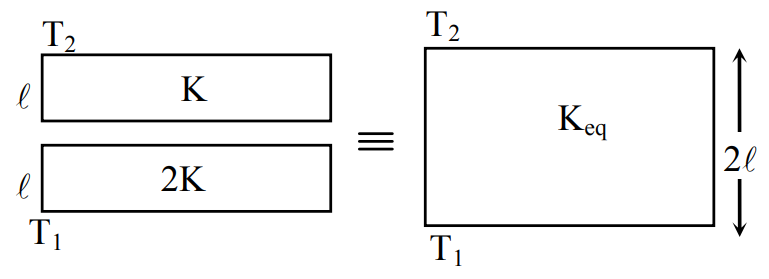
For series connection: $R_{eq} = R_1 + R_2$
$\dfrac{2l}{K_{eq}A} = \dfrac{l}{KA} + \dfrac{l}{2KA}$
$\dfrac{2}{K_{eq}} = \dfrac{1}{K} + \dfrac{1}{2K} = \dfrac{3}{2K}$
$\Rightarrow K_{eq} = \dfrac{4}{3}K$
That is every question in Thermal Properties of Matter for this filter.
Want a score?
Answers here are not saved. Practise as a test to be marked and see your progress.
Practise as a test