Looking for classes? Ksquare Career Institute, Bengaluru →

Physics
Laws of Motion
72 questions from 37 papers, each with its answer.
- 72 questions
- 37 papers
- 4.08% of Physics
Friction on an Inclined Plane
-
A plank with a box on it at one end is gradually raised about the other end. As the angle of inclination with the horizontal reaches $30^\circ$, the box starts to slip and slides 4.0 m down the plank in 4.0 s. The coefficients of static and kinetic friction between the box and the plank will be, respectively:
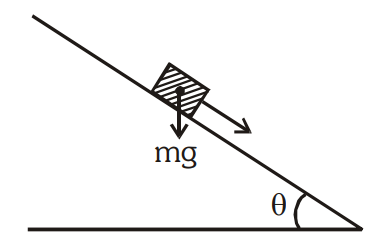 $\mu_s = \tan 30^\circ = \frac{1}{\sqrt3} \approx 0.6$
$a = g\sin30^\circ - \mu_kg\cos30^\circ$
$s = ut + \frac{1}{2}at^2$: $4 = \frac{1}{2}\left[\frac{g}{2} - \mu_k\frac{\sqrt3 g}{2}\right]\times 16$
$\mu_k \approx 0.5$
Newton's Third Law and Contact Force
-
A horizontal force 10 N is applied to a block A as shown in figure [add image]. The mass of blocks A and B are 2 kg and 3 kg, respectively. The blocks slide over a frictionless surface. The force exerted by block A on block B is:
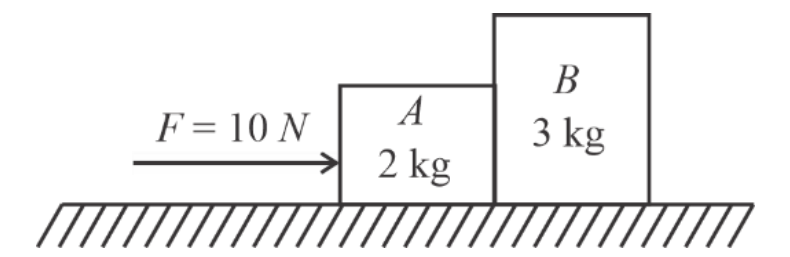 Common acceleration $a = \frac{F}{m_A + m_B} = \frac{10}{2 + 3} = 2\ ms^{-2}$ Force exerted by A on B (normal reaction) $= m_B \times a = 3 \times 2 = 6$ N
Friction and Pseudo Force
-
Calculate the maximum acceleration of a moving car so that a body lying on the floor of the car remains stationary. The coefficient of static friction between the body and the floor is $0.15$ ($g=10\ ms^{-2}$).
In the car's frame, $f=ma\le\mu N=\mu mg$, so $a_{max}=1.5\ ms^{-2}$.
In the frame of the car: $N=mg$ and $f=ma$ $f\le\mu N\Rightarrow a\le\mu g\Rightarrow a\le1.5\ ms^{-2}$ or $a_{max}=1.5\ ms^{-2}$
Conservation of Momentum
-
A shell of mass $m$ is at rest initially. It explodes into three fragments having mass in the ratio $2:2:1$. If the fragments having equal mass fly off along mutually perpendicular directions with speed $v$, the speed of the third (lighter) fragment is:Masses of fragments: $\frac{2m}{5}, \frac{2m}{5}, \frac{m}{5}$ By conservation of momentum (initial momentum = 0): $0 = \frac{2m}{5}(-v\hat{i}) + \frac{2m}{5}(-v\hat{j}) + \frac{m}{5}\vec{v}'$ $\Rightarrow \vec{v}' = 2v\hat{i} + 2v\hat{j}$ $v' = \sqrt{(2v)^2 + (2v)^2} = 2\sqrt{2}\,v$
-
An explosion breaks a rock into three parts in a horizontal plane. Two of them go off at right angles to each other. The first part of mass 1 kg moves with a speed of 12 $ms^{-1}$ and the second part of mass 2 kg moves with 8 $ms^{-1}$ speed. If the third part flies off with 4 $ms^{-1}$ speed, then its mass is:
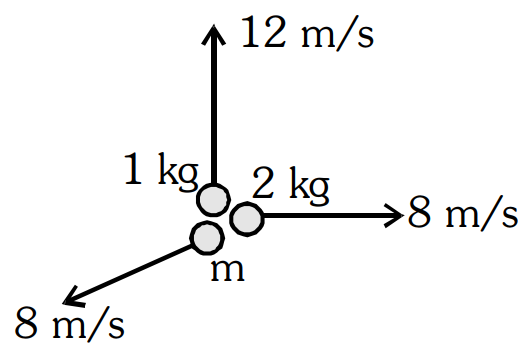
By conservation of momentum, the third part balances the resultant of the first two:
$m(4) = \sqrt{(1\times12)^2 + (2\times8)^2} = 20$
$m = 5$ kg
Motion on an Inclined Plane
-
A small block slides down on a smooth inclined plane, starting from rest at time $t=0$. Let $S_n$ be the distance travelled by the block in the interval $t=n-1$ to $t=n$. Then, the ratio $\frac{S_n}{S_{n+1}}$ is:Starting from rest with constant acceleration a, distance in the $n^{th}$ second: $S_n = \frac{a}{2}(2n - 1)$ $S_{n+1} = \frac{a}{2}(2(n+1) - 1) = \frac{a}{2}(2n + 1)$ $\frac{S_n}{S_{n+1}} = \frac{2n - 1}{2n + 1}$
-
When an object is shot from the bottom of a long smooth inclined plane kept at an angle $60^\circ$ with horizontal, it can travel a distance $x_1$ along the plane. But when the inclination is decreased to $30^\circ$ and the same object the shot with the same velocity, it can travel $x_2$ distance. Then $x_1:x_2$ will be:On a smooth incline the retardation is $g\sin\theta$, so the stopping distance is $x=\frac{u^2}{2g\sin\theta}$. $x_1=\frac{u^2}{2g\sin60^\circ}$, $x_2=\frac{u^2}{2g\sin30^\circ}$ $\frac{x_1}{x_2}=\frac{\sin30^\circ}{\sin60^\circ}=\frac{1/2}{\sqrt{3}/2}=\frac{1}{\sqrt{3}}$ $x_1:x_2=1:\sqrt{3}$
Newton's Laws – Connected Bodies (Atwood Machine)
-
Two bodies of mass 4 kg and 6 kg are tied to the ends of a massless string. The string passes over a pulley which is frictionless (see figure). The acceleration of the system in terms of acceleration due to gravity ($g$) is:
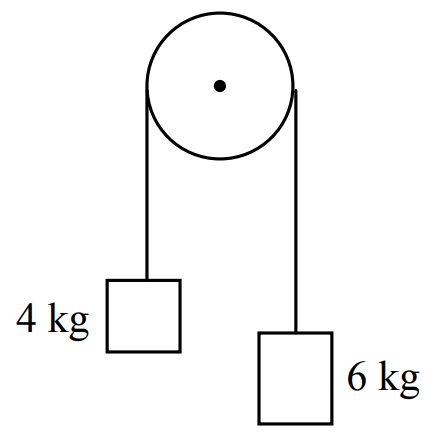 $a = \frac{(m_1 - m_2)g}{m_1 + m_2}$, where $m_1 > m_2$ $a = \frac{(6 - 4)g}{6 + 4} = \frac{g}{5}$
Friction and Circular Motion
-
A block of mass 10 kg is in contact against the inner wall of a hollow cylindrical drum of radius 1 m. The coefficient of friction between the block and the inner wall of the cylinder is 0.1. The minimum angular velocity needed for the cylinder to keep the block stationary when the cylinder is vertical and rotating about its axis, will be: ($g=10\ m/s^2$)The normal reaction from the wall provides the centripetal force: $N=mr\omega^2$ For equilibrium of the block, limiting friction must balance weight: $f_L=\mu N\ge mg$ $\mu mr\omega^2\ge mg\Rightarrow\omega\ge\sqrt{\frac{g}{\mu r}}$ $\omega_{min}=\sqrt{\frac{10}{0.1\times1}}=10\ rad/s$
Dynamics of Uniform Circular Motion – Vertical Circle
-
A mass $m$ is attached to a thin wire and whirled in a vertical circle. The wire is most likely to break when:At the lowest point: $T-mg=\frac{mu^2}{l}\Rightarrow T=mg+\frac{mu^2}{l}$ Both weight and speed contribute maximally to tension at the lowest point, so the tension is maximum there and the wire is most likely to break when the mass is at the lowest point.
Newton's First Law – Equilibrium of Concurrent Forces
-
A particle moving with velocity $\vec{V}$ is acted by three forces shown by the vector triangle PQR. The velocity of the particle will:
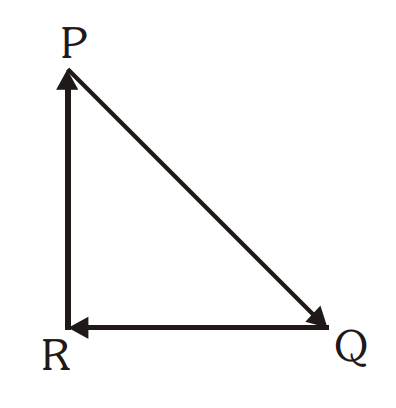 The three forces form a closed triangle taken in the same order, so $\vec{F}_{net}=0$.
$m\frac{d\vec{v}}{dt}=0\Rightarrow\vec{v}=$ constant
So the velocity of the particle remains constant.
Resultant of perpendicular forces, Newton's second law
-
The magnitude and direction of the acceleration produced in a body of mass 5 kg when two mutually perpendicular forces 8 N and 6 N act on it, are respectively:$F_{res} = \sqrt{6^2 + 8^2} = 10$ N $a = \frac{F_{res}}{m} = \frac{10}{5} = 2\ m/s^2$ $\tan\theta = \frac{6}{8} = \frac{3}{4}$ (angle measured from the 8 N force) So a = 2 $ms^{-2}$ at $\tan^{-1}\left(\frac{3}{4}\right)$ with the 8 N force.
Friction - maximum acceleration without relative sliding
-
A box of mass 15 kg is kept on the floor of a stationary trolley. The coefficient of static friction between the box and the trolley is 0.12. Keeping the box in stationary state over the trolley, the maximum acceleration with which the trolley can be moved horizontally in $m\,s^{-2}$ is: ($g = 10\ m/s^2$)In the trolley frame, a pseudo force $ma$ acts on the box opposite to the acceleration; static friction must balance it. For the maximum acceleration: $ma_{max} = f_{lim} = \mu mg$ $a_{max} = \mu g = 0.12 \times 10 = 1.2\ m/s^2$
Circular motion - centripetal force
-
A bob is whirled in a horizontal circle by means of a string at an initial speed of 10 rpm. If the tension in the string is quadrupled while keeping the radius constant, the new speed is:For horizontal circular motion, $T=m\omega^2 r$. For constant $m$ and $r$, $T\propto\omega^2$. Given $T'=4T$, so $\omega'=2\omega=2\times10=20$ rpm.
Motion on a frictionless inclined plane
-
A box of mass 5 kg is pulled by a cord, up along a frictionless plane inclined at $30^\circ$ with the horizontal. The tension in the cord is 30 N. The acceleration of the box is (Take $g=10\ m\,s^{-2}$)$F_{net}=Ma=T-Mg\sin30^\circ$. $30-5\times10\times\dfrac{1}{2}=5a\Rightarrow 30-25=5a\Rightarrow a=1\ m\,s^{-2}$.
Connected bodies with friction - pulley systems
-
Calculate the acceleration of the block and trolly system shown in the figure. The coefficient of kinetic friction between the trolly and the surface is 0.05. ($g=10\ m/s^2$, mass of the string is negligible and no other friction exists).
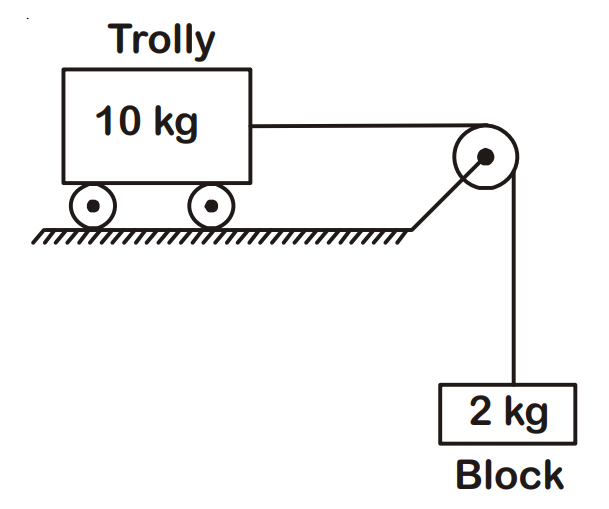 For the hanging block (2 kg): $2g-T=2a$. For the trolley (10 kg) on the surface with friction: $T-\mu(10)g=10a$. Adding: $2g-\mu(10)g=12a\Rightarrow a=\dfrac{2(10)-0.05\times10\times10}{12}=\dfrac{20-5}{12}=\dfrac{15}{12}=1.25\ m/s^2$.
Vertical circular motion - tension at the lowest point
-
A point mass 'm' is moved in a vertical circle of radius 'r' with the help of a string. The velocity of the mass is $\sqrt{7gr}$ at the lowest point. The tension in the string at the lowest point isAt the lowest point, $T-mg=\dfrac{mv^2}{r}=\dfrac{m(7gr)}{r}=7mg\Rightarrow T=7mg+mg=8mg$.
Friction on an inclined plane - limiting equilibrium
-
A block of mass 2 kg is placed on inclined rough surface AC (as shown in figure) of coefficient of friction $\mu$. If $g=10 m s^{-2}$, the net force (in N) on the block will be:
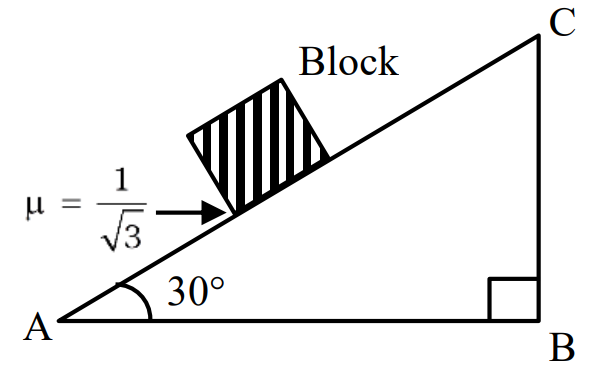 $\tan30^\circ=\dfrac{1}{\sqrt3}=\mu$. Since $\mu=\tan\theta$, the block is exactly on the verge of sliding and remains at rest (limiting friction balances the component of gravity along the incline), so the net force on it must be zero.
Impulse-momentum theorem - collision with a wall
-
A 1 kg object strikes a wall with velocity 1 m s$^{-1}$ at an angle of $60^\circ$ with the wall and reflects at the same angle. If it remains in contact with wall for 0.1 s, then the force exerted on the wall is:-$F=\left|\dfrac{\Delta\vec p}{\Delta t}\right|=\dfrac{2mv\sin\theta}{t}=\dfrac{2(1)(1)\sin60^\circ}{0.1}=10\sqrt3$ N.
Conservation of linear momentum
-
An object flying in air with velocity $(20\hat{i}+25\hat{j}-12\hat{k})$ suddenly breaks in two pieces whose masses are in the ratio 1 : 5. The smaller mass flies off with a velocity $(100\hat{i}+35\hat{j}+8\hat{k})$. The velocity of the larger piece will be:$m\vec{v}_0=\frac{m}{6}\vec{v}_1+\frac{5m}{6}\vec{v}_2 \Rightarrow 6(20\hat{i}+25\hat{j}-12\hat{k})=(100\hat{i}+35\hat{j}+8\hat{k})+5\vec{v}_2 \Rightarrow \vec{v}_2=4\hat{i}+23\hat{j}-16\hat{k}$.
-
A man of 50 kg mass is standing in a gravity free space at a height of 10 m above the floor. He throws a stone of 0.5 kg mass downwards with a speed 2 m/s. When the stone reaches the floor, the distance of the man above the floor will beThere is no gravity and no external force, so the total momentum of man + stone stays zero.
When the stone is thrown down at 2 m/s, the man recoils upward: $m_1v_1 = m_2v_2$, so $v_2 = \frac{0.5\times2}{50} = 0.02$ m/s
Time taken by the stone to reach the floor (it moves with constant speed): $t = \frac{10}{2} = 5$ s
Distance moved up by the man in this time = $0.02\times5 = 0.1$ m
(Equivalently, $m_1x_1 = m_2x_2$ gives $x_2 = \frac{0.5\times10}{50} = 0.1$ m.)
Height of the man above the floor = 10 + 0.1 = 10.1 m -
An explosion blows a rock into three parts. Two parts go off at right angles to each other. These two are, 1 kg first part moving with a velocity of 12 m $s^{-1}$ and 2 kg second part moving with a velocity of 8 m $s^{-1}$. If the third part flies off with a velocity of 4 m $s^{-1}$, its mass would beThe rock is initially at rest, so the total momentum after the explosion must be zero.
Momentum of the first part: $p_1 = 1\times12 = 12$ kg m/s
Momentum of the second part: $p_2 = 2\times8 = 16$ kg m/s
These are at right angles, so their resultant is $\sqrt{12^2 + 16^2} = \sqrt{400} = 20$ kg m/s
The third part must have an equal and opposite momentum: $m_3\times4 = 20$
$m_3 = 5$ kg -
A 1 kg stationary bomb is exploded in three parts having mass 1 : 1 : 3 respectively. Parts having same mass move in perpendicular directions with velocity 30 m s$^{-1}$, then the velocity of bigger part will be : -Let the masses be m, m and 3m. The bomb was at rest, so the total momentum after the explosion is zero.
The two equal parts have momenta 30m each, in perpendicular directions. Their resultant is $\sqrt{(30m)^2 + (30m)^2} = 30\sqrt{2}m$.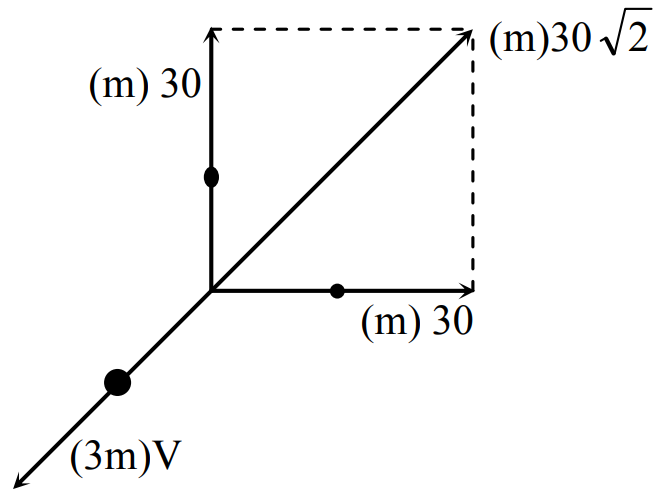
Apply conservation of linear momentum: the third part's momentum must be equal and opposite to this resultant.
$3mV = 30\sqrt{2}m$
$V = 10\sqrt{2}$ m s$^{-1}$ -
A mass of 1 kg is thrown up with a velocity of 100 m/s. After 5 seconds, it explodes into two parts. One part of mass 400 g comes down with a velocity 25 m/s. Calculate the velocity of other part :Velocity after 5 seconds (taking g = 10 m/s$^2$): $v = 100 - 10 \times 5 = 50$ m/s upward.
The explosion is due to internal forces, so momentum is conserved just before and just after it. Take upward as $+\hat{j}$:
$1 \times 50\hat{j} = 0.4 \times 25(-\hat{j}) + 0.6\vec{v}$
$50\hat{j} + 10\hat{j} = 0.6\vec{v}$
$\vec{v} = \dfrac{60\hat{j}}{0.6} = 100\hat{j}$ m/s
So the other part moves with 100 m/s upward.
Friction - contact force
-
A body of mass m is kept on a rough horizontal surface (coefficient of friction = $\mu$). A horizontal force is applied on the body, but it does not move. The resultant of normal reaction and the frictional force acting on the object is given by F, where F is:$N=mg$ and static friction $f\le\mu mg$. The resultant contact force is $\sqrt{N^2+f^2}\le\sqrt{(mg)^2+(\mu mg)^2}=mg\sqrt{1+\mu^2}$.
Pseudo force – block on accelerating wedge
-
A block of mass m is placed on a smooth inclined wedge ABC of inclination $\theta$ as shown in the figure. The wedge is given an acceleration 'a' towards the right. The relation between a and $\theta$ for the block to remain stationary on the wedge is
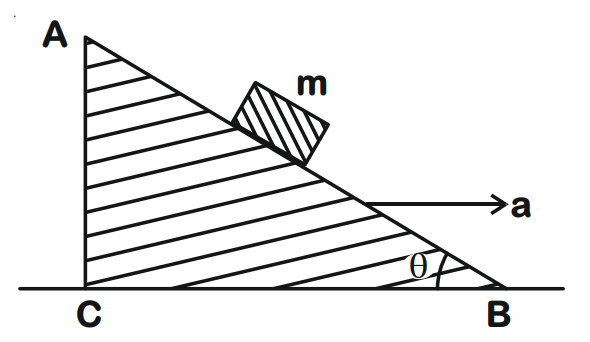
Balance the pseudo force ma and gravity with the normal reaction: $a = g\tan\theta$.
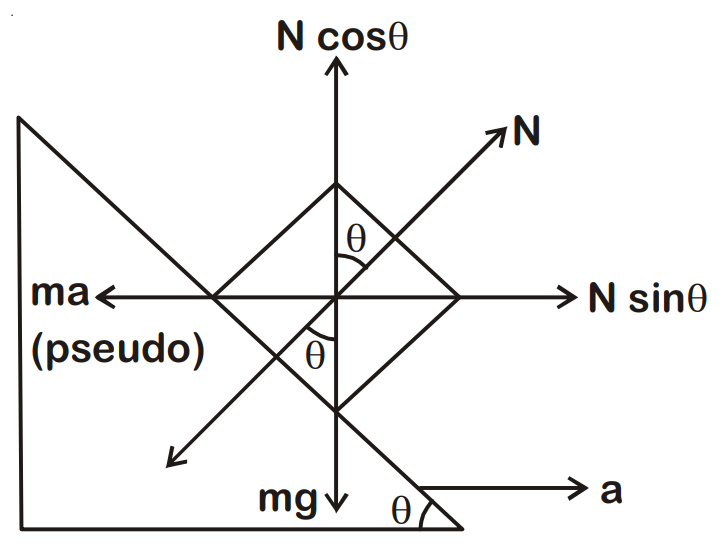
In the non-inertial frame,
$N\sin\theta = ma$ ...(i)
$N\cos\theta = mg$ ...(ii)
$\tan\theta = \frac{a}{g}$
$a = g\tan\theta$
Spring force – sudden release (cutting the string)
-
Two blocks A and B of masses 3m and m respectively are connected by a massless and inextensible string. The whole system is suspended by a massless spring as shown in figure. The magnitudes of acceleration of A and B immediately after the string is cut, are respectively
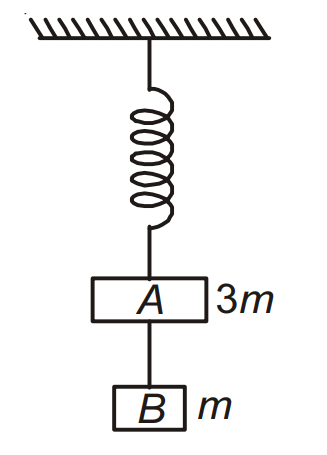
Spring force cannot change instantly; string tension vanishes.
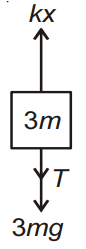
Before the string is cut: $kx = T + 3mg$ ...(1) and $T = mg$ ...(2), so $kx = 4mg$
After the string is cut, T = 0.
For A: $a = \frac{kx - 3mg}{3m} = \frac{4mg - 3mg}{3m} = \frac{g}{3}$
For B: only mg acts, so a = g
So the accelerations of A and B are $\frac{g}{3}$ and g.
Banking of roads with friction
-
A car is negotiating a curved road of radius R. The road is banked at angle $\theta$. The coefficient of friction between the tyres of the car and the road is $\mu_s$. The maximum safe velocity on this road is
Friction acts down the slope at maximum speed.
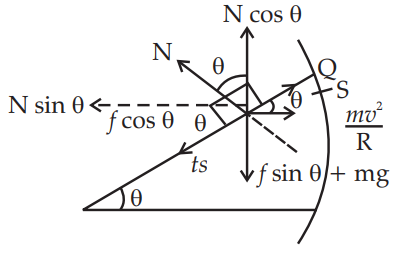
Vertical: $N\cos\theta = mg + f\sin\theta \Rightarrow mg = N\cos\theta - f\sin\theta$ ...(i)
Horizontal: $N\sin\theta + f\cos\theta = \frac{mv^2}{R}$ ...(ii)
Dividing (ii) by (i) with $f = \mu_sN$: $\frac{v^2}{Rg} = \frac{\sin\theta + \mu_s\cos\theta}{\cos\theta - \mu_s\sin\theta}$
$v = \sqrt{Rg\left[\frac{\tan\theta + \mu_s}{1 - \mu_s\tan\theta}\right]}$
Impulse – oblique collision with a wall
-
A rigid ball of mass m strikes a rigid wall at 60° and gets reflected without loss of speed as shown in the figure below. The value of impulse imparted by the wall on the ball will be:
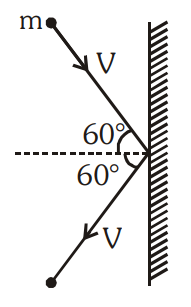
Only the normal component reverses: $2mV\cos60^\circ$.
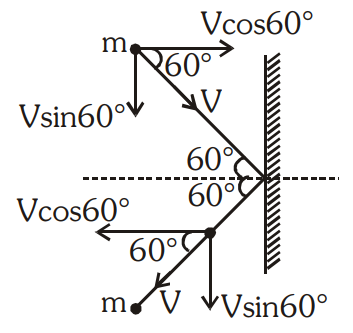
$\Delta\vec{V} = \vec{V}_f - \vec{V}_i = (-V\cos60^\circ\hat{i} - V\sin60^\circ\hat{j}) - (V\cos60^\circ\hat{i} - V\sin60^\circ\hat{j})$
$\Delta\vec{V} = -2V\cos60^\circ\hat{i}$
Impulse $I = |\Delta\vec{P}| = m|\Delta\vec{V}| = m(2V\cos60^\circ) = mV$
Friction and pulley systems
-
A block A of mass $m_1$ rests on a horizontal table. A light string connected to it passes over a frictionless pulley at the edge of table and from its other end another block B of mass $m_2$ is suspended. The coefficient of kinetic friction between the block and the table is $\mu_k$. When the block A is sliding on the table, the tension in the string isFor B: $m_2g - T = m_2a$ ...(i)
For A: $T - \mu_k m_1 g = m_1a$ ...(ii)
Adding (i) and (ii): $a = \frac{(m_2 - \mu_k m_1)g}{m_1 + m_2}$
From (i): $T = m_2(g - a) = m_2g\left[1 - \frac{m_2 - \mu_k m_1}{m_1+m_2}\right]$
$T = \frac{m_1m_2(1+\mu_k)g}{m_1+m_2}$ -
A system consists of three masses $m_1$, $m_2$ and $m_3$ connected by a string passing over a pulley P. The mass $m_1$ hangs freely and $m_2$ and $m_3$ are on a rough horizontal table (the coefficient of friction = $\mu$). The pulley is frictionless and of negligible mass. The downward acceleration of mass $m_1$ is: (Assume $m_1 = m_2 = m_3 = m$)
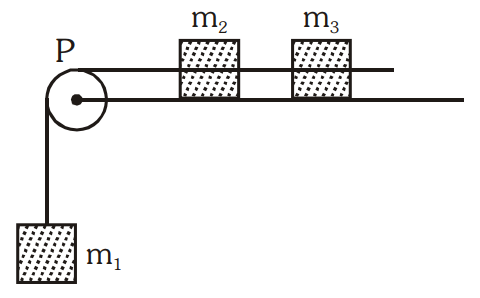 Acceleration $= \frac{\text{Net force in the direction of motion}}{\text{Total mass of system}}$
$a = \frac{m_1g - \mu(m_2 + m_3)g}{m_1 + m_2 + m_3} = \frac{g}{3}(1 - 2\mu)$
Newton's second law
-
A balloon with mass 'm' is descending down with an acceleration 'a' (where a < g). How much mass should be removed from it so that it starts moving up with an acceleration 'a'?Let the upthrust of air be $F_a$.
Downward motion: $mg - F_a = ma$
Upward motion after removing $\Delta m$: $F_a - (m - \Delta m)g = (m - \Delta m)a$
Solving, $\Delta m = \frac{2ma}{g + a}$
Friction
-
A conveyor belt is moving at a constant speed of 2 m/s. A box is gently dropped on it. The coefficient of friction between them is $\mu = 0.5$. The distance that the box will move relative to belt before coming to rest on it, taking g = 10 m $s^{-2}$, isWork in the frame of the belt. The box is dropped with zero ground velocity, so relative to the belt its initial velocity is u = 2 m/s (backwards).
Kinetic friction opposes the relative sliding: retardation $a = \frac{\mu mg}{m} = \mu g = 0.5\times10 = 5$ m/$s^2$
The box comes to rest relative to the belt, so v = 0.
$v^2 = u^2 - 2as$ gives $0 = 2^2 - 2\times5\times s$
$s = \frac{4}{10} = 0.4$ m -
A block of mass m is in contact with the cart C as shown in the figure. The coefficient of static friction between the block and the cart is $\mu$. The acceleration $\alpha$ of the cart that will prevent the block from falling satisfies
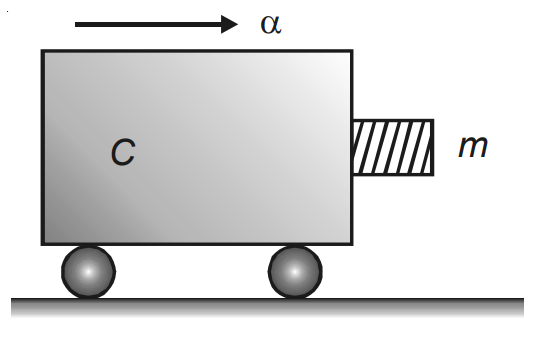 The block is pressed against the vertical face of the cart. When the cart accelerates with $\alpha$, the cart pushes the block with a normal force N that gives the block the same acceleration: $N = m\alpha$
The weight mg acts downward and can be balanced only by static friction acting upward along the face.
Maximum static friction: $f_{max} = \mu N = \mu m\alpha$
For the block not to fall: $f_{max} \geq mg$
$\mu m\alpha \geq mg$
$\alpha \geq \frac{g}{\mu}$
Variable Mass Systems
-
Sand is being dropped on a conveyor belt at the rate of $M$ kg/s. The force necessary to keep the belt moving with a constant velocity of $v$ m/s will be -Take the belt together with the sand lying on it as the system; its mass $m$ increases with time as sand drops on it.
Newton's second law: $F_{ext} = \dfrac{dp}{dt} = \dfrac{d(mv)}{dt}$
$F_{ext} = m\dfrac{dv}{dt} + v\dfrac{dm}{dt}$
The belt moves with constant velocity, so $\dfrac{dv}{dt} = 0$.
$\Rightarrow F_{ext} = v\dfrac{dm}{dt}$
Given $\dfrac{dm}{dt} = M$ kg/s, so $F_{ext} = Mv$ newton.
Alternative view: the sand falls with zero horizontal velocity and has to be given a horizontal velocity $v$. Every second a mass $M$ gains horizontal momentum $Mv$, so the reaction on the belt is $Mv$ backward, and a forward force $Mv$ is needed to keep the velocity constant.
This force acts in the direction of the velocity of the belt and equals $Mv$ newton.
Circular Motion in a Vertical Plane
-
A roller coaster is designed such that riders experience 'weightlessness' as they go round the top of a hill whose radius of curvature is 20 m. The speed of the car at the top of the hill is between -At the top of the hill the forces on the rider are the weight $mg$ (downward) and the normal reaction $N$ (upward).
The net force towards the centre provides the centripetal force: $mg - N = \dfrac{mv^2}{r}$
For weightlessness, $N = 0$:
$\dfrac{mv^2}{r} = mg$
$v^2 = rg = 20 \times 10 = 200$
$v = \sqrt{200} = 14.14$ m/s
(With $g = 9.8$ m/s$^2$, $v = \sqrt{196} = 14$ m/s.)
So the speed of the car at the top is between 14 m/s and 15 m/s.
Impulse and Change in Momentum
-
A 0.5 kg ball moving with a speed of 12 m/s strikes a hard wall at an angle of $30^\circ$ with the wall. It is reflected with the same speed and at the same angle. If the ball is in contact with the wall for 0.25 seconds, the average force acting on the wall is :-
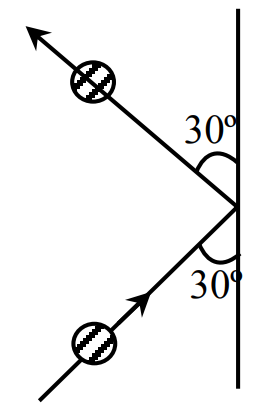 Resolve the velocity along the wall and perpendicular to the wall. The angle with the wall is $30^\circ$.
Component along the wall $= v\cos 30^\circ$; it is unchanged by the collision.
Component perpendicular to the wall $= v\sin 30^\circ$; it is reversed by the collision.
Change in momentum of the ball $= mv\sin 30^\circ - (-mv\sin 30^\circ) = 2mv\sin 30^\circ$
$\Delta p = 2 \times 0.5 \times 12 \times \dfrac{1}{2} = 6$ kg m/s
Average force $F = \dfrac{\Delta p}{\Delta t} = \dfrac{2mv\sin 30^\circ}{0.25} = \dfrac{6}{0.25}$
$F = 24$ N -
A body of mass 3 kg hits a wall at an angle of $60^\circ$ and returns at the same angle. The impact time was 0.2 s. Calculate the force exerted on the wall :
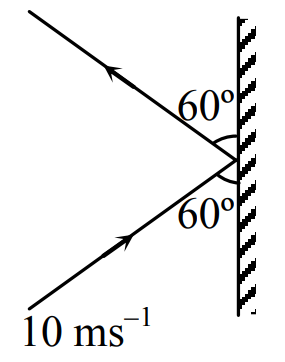 The velocity makes $60^\circ$ with the wall, i.e. $30^\circ$ with the normal to the wall.

The component along the wall ($v\sin 30^\circ$) is unchanged. The component along the normal ($v\cos 30^\circ$) is reversed.
Change in momentum $\Delta p = mv\cos 30^\circ - (-mv\cos 30^\circ) = 2mv\cos 30^\circ$
$F = \dfrac{\Delta p}{\Delta t} = \dfrac{2 \times 3 \times 10 \times \frac{\sqrt{3}}{2}}{0.2} = \dfrac{30\sqrt{3}}{0.2}$
$F = 150\sqrt{3}$ N
Pseudo Force and Accelerated Frames
-
A block of mass m is placed on a smooth wedge of inclination $\theta$. The whole system is accelerated horizontally so that the block does not slip on the wedge. The force exerted by the wedge on the block (g is acceleration due to gravity) will be :-The wedge is smooth, so the only force it exerts on the block is the normal reaction N, perpendicular to the inclined surface.
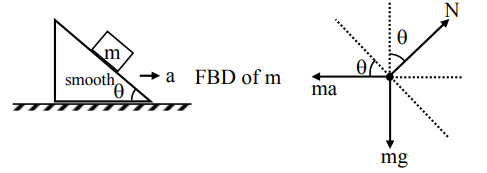
Forces on the block: weight mg vertically downward and normal reaction N at angle $\theta$ to the vertical.
The block does not slip, so it moves with the wedge with a purely horizontal acceleration a. Its vertical acceleration is zero.
Vertical balance: $N\cos\theta = mg$
$\Rightarrow N = \dfrac{mg}{\cos\theta}$
(Horizontal: $N\sin\theta = ma$, which gives the required acceleration $a = g\tan\theta$.)
So the force exerted by the wedge on the block is $\dfrac{mg}{\cos\theta}$.
Static Friction
-
On the horizontal surface of a truck a block of mass 1 kg is placed ($\mu$ = 0.6) and truck is moving with acceleration 5 m/s$^2$ then the frictional force on block will be : -In the frame of the truck, a pseudo force $F = ma = 1 \times 5 = 5$ N acts on the block backward.
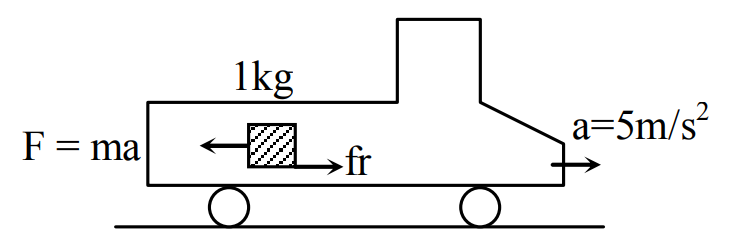
Limiting (maximum) static friction: $f_L = \mu_sN = \mu_smg = 0.6 \times 1 \times 10 = 6$ N
Since $F = 5$ N $\lt f_L = 6$ N, the block does not slip; it moves with the truck.
Static friction is self-adjusting and equals the force needed: $f_r = 5$ N
So the frictional force on the block is 5 N (it is this force that gives the block its 5 m/s$^2$ acceleration).
Newton's Second Law with Variable Force
-
An object of mass 3 kg is at rest. Now a force of $\vec{F} = 6t^2\hat{i} + 4t\hat{j}$ is applied on the object then velocity of object at t = 3 second is : -Acceleration: $\vec{a} = \dfrac{\vec{F}}{m} = \dfrac{6t^2\hat{i} + 4t\hat{j}}{3} = 2t^2\hat{i} + \dfrac{4}{3}t\hat{j}$
$d\vec{v} = \left(2t^2\hat{i} + \dfrac{4}{3}t\hat{j}\right)dt$
Integrating on both sides from rest (v = 0 at t = 0):
$\vec{v} = 2\left(\dfrac{t^3}{3}\right)\hat{i} + \dfrac{4}{3}\left(\dfrac{t^2}{2}\right)\hat{j} = \dfrac{2}{3}t^3\hat{i} + \dfrac{2}{3}t^2\hat{j}$
At t = 3 s: $\vec{v} = \dfrac{2}{3}(27)\hat{i} + \dfrac{2}{3}(9)\hat{j}$
$\vec{v} = 18\hat{i} + 6\hat{j}$
That is every question in Laws of Motion for this filter.
Want a score?
Answers here are not saved. Practise as a test to be marked and see your progress.
Practise as a test