Looking for classes? Ksquare Career Institute, Bengaluru →

Physics
Gravitation
66 questions from 37 papers, each with its answer.
- 66 questions
- 37 papers
- 3.74% of Physics
Gravitational Potential and Field
-
Two bodies of mass $m$ and $9m$ are placed at a distance $R$. The gravitational potential on the line joining the bodies where the gravitational field equals zero, will be ($G$ = gravitational constant):
Field is zero at $x=\frac{R}{4}$ from $m$; potential there is $-\frac{16Gm}{R}$.
Let the gravitational field be zero at a distance $x$ from the mass $m$. $\frac{Gm}{x^2}=\frac{G9m}{(R-x)^2}\Rightarrow R-x=3x$ or $x=\frac{R}{4}$ Gravitational potential at $\frac{R}{4}$: $=-\frac{Gm}{R/4}-\frac{G9m}{3R/4}$ $=-\frac{4Gm}{R}-\frac{12Gm}{R}=-\frac{16Gm}{R}$
Orbital Motion of Satellites
-
A satellite is orbiting just above the surface of the earth with period $T$. If $d$ is the density of the earth and $G$ is the universal constant of gravitation, the quantity $\frac{3\pi}{Gd}$ represents:
$T=2\pi\sqrt{\frac{R^3}{GM}}$ with $M=d\cdot\frac{4}{3}\pi R^3$ gives $T^2=\frac{3\pi}{Gd}$.
Time period of satellite: $T=2\pi\sqrt{\frac{R^3}{GM}}$ $=2\pi\sqrt{\frac{R^3}{Gd\,\frac{4}{3}\pi R^3}}$ $\Rightarrow T=\sqrt{\frac{3\pi}{Gd}}$ $\Rightarrow\frac{3\pi}{Gd}=T^2$
Dimensions of Gravitational Quantities
-
Match List-I and List-II
Pick the matching item from Column II for each row.
Column I
- A. Gravitational constant (G)
- B. Gravitational potential Energy
- C. Gravitational potential
- D. Gravitational Intensity
Column II
- I. $[L^2T^{-2}]$
- II. $[M^{-1}L^3T^{-2}]$
- III. $[LT^{-2}]$
- IV. $[ML^2T^{-2}]$
Correct answer: A → II, B → IV, C → I, D → III
Gravitational constant G – $[M^{-1}L^3T^{-2}]$ Gravitational potential energy – $[ML^2T^{-2}]$ Gravitational potential – $[L^2T^{-2}]$ Gravitational intensity – $[LT^{-2}]$ Correct match: A-II, B-IV, C-I, D-III.
Energy Conservation under Gravity
-
A particle is released from height $S$ from the surface of the Earth. At a certain height its kinetic energy is three times its potential energy. The height from the surface of earth and the speed of the particle at that instant are respectively:Total energy E = mgS. When KE = 3U: U + KE = 4U = E $4mgh = mgS \Rightarrow h = \frac{S}{4}$ The particle has fallen $\frac{3S}{4}$, so $v = \sqrt{2g\left(\frac{3S}{4}\right)} = \sqrt{\frac{3gS}{2}}$
Acceleration due to Gravity – Variation with Height
-
A body weighs 72 N on the surface of the earth. What is the gravitational force on it, at a height equal to half the radius of the earth?$mg_h = \frac{mg_0}{\left(1 + \frac{h}{R}\right)^2}$ $W = \frac{72}{\left(1 + \frac{R/2}{R}\right)^2} = \frac{72}{(3/2)^2} = \frac{4}{9} \times 72 = 32$ N
Acceleration due to Gravity – Variation with Depth
-
A body weighs 200 N on the surface of the earth. How much will it weigh half way down to the centre of the earth?Acceleration due to gravity at depth $d$: $g'=g\left(1-\frac{d}{R}\right)$ Multiplying by $m$: $mg'=mg\left(1-\frac{d}{R}\right)$ Half way down, $d=\frac{R}{2}$: $mg'=200\left(1-\frac{R}{2R}\right)=100\ N$
Gravitational Potential Energy
-
The work done to raise a mass $m$ from the surface of the earth to a height $h$, which is equal to the radius of the earth, is:Initial potential energy at the earth's surface: $U_i=-\frac{GMm}{R}$ Final potential energy at height $h=R$: $U_f=-\frac{GMm}{2R}$ Work done = change in PE: $W=U_f-U_i=\frac{GMm}{2R}$ Using $GM=gR^2$: $W=\frac{gR^2m}{2R}=\frac{1}{2}mgR$
-
A body of mass 'm' is taken from the earth's surface to the height equal to twice the radius (R) of the earth. The change in potential energy of body will be:Change in PE $= -\frac{GMm}{3R} - \left(-\frac{GMm}{R}\right) = \frac{2}{3}\frac{GMm}{R} = \frac{2}{3}mgR$
-
A body of mass m is placed on earth surface which is taken from earth surface to a height of h = 3R then change in gravitational potential energy is : -Gravitational potential energy at distance r from the earth's centre: $U = -\dfrac{GMm}{r}$
Initial (on the surface, r = R): $U_i = -\dfrac{GMm}{R}$
Final (h = 3R, so r = R + 3R = 4R): $U_f = -\dfrac{GMm}{4R}$
Change in GPE $= U_f - U_i = -\dfrac{GMm}{4R} + \dfrac{GMm}{R} = \dfrac{GMm}{R}\left(1 - \dfrac{1}{4}\right)$
$= \dfrac{3}{4}\dfrac{GMm}{R} = \dfrac{3}{4}\dfrac{GM}{R^2}mR = \dfrac{3}{4}mgR$ (since $g = \dfrac{GM}{R^2}$)
(The formula mgh cannot be used, because h is not small compared with R.) -
With what velocity should a particle be projected so that its height becomes equal to radius of earth -Apply energy conservation between the surface (r = R) and the highest point (r = 2R, where the speed is zero):
$-\dfrac{GMm}{R} + \dfrac{1}{2}mv^2 = -\dfrac{GMm}{2R}$
$\dfrac{1}{2}mv^2 = \dfrac{GMm}{R} - \dfrac{GMm}{2R} = \dfrac{GMm}{2R}$
$v = \sqrt{\dfrac{GM}{R}}$
So the particle must be projected with velocity $\left(\dfrac{GM}{R}\right)^{1/2}$.
Gravitational potential energy and work done against gravity
-
The amount of work done to raise a mass 'm' from the surface of the Earth to a height equal to the radius of the Earth 'R', will be:$W = \frac{mgh}{1 + \frac{h}{R}}$ With h = R: $W = \frac{mgR}{1 + \frac{R}{R}} = \frac{mgR}{2}$
Escape velocity
-
The escape velocity for earth is $v$. A planet having 9 times mass that of earth and radius, 16 times that of earth, has the escape velocity of:$V_e=\sqrt{\dfrac{2GM}{R}}\propto\sqrt{\dfrac{M}{R}}$. $\dfrac{(V_e)_p}{(V_e)_e}=\sqrt{\dfrac{M_p}{M_e}\times\dfrac{R_e}{R_p}}=\sqrt{\dfrac{9}{16}}=\dfrac{3}{4}$, so $(V_e)_p=\dfrac{3}{4}v$.
-
The ratio of escape velocity at earth ($v_e$) to the escape velocity at a planet ($v_p$) whose radius and mean density are twice as that of earth is
$v_e \propto R\sqrt{\rho}$, so doubling both gives $2\sqrt{2}$ times.
Escape velocity $V = \sqrt{\frac{2GM}{R}}$, with $M = \rho\times\frac{4}{3}\pi R^3$
For the planet: $R_p = 2R_e$, $\rho_p = 2\rho_e$, so $M_p = 2\rho_e\times\frac{4}{3}\pi(2R_e)^3 = 16M_e$
$V_p = \sqrt{\frac{2G(16M_e)}{2R_e}} = \sqrt{\frac{2GM_e}{R_e}\times8} = 2\sqrt{2}V_e$
$V_e : V_p = 1 : 2\sqrt{2}$ -
A black hole is an object whose gravitational field is so strong that even light cannot escape from it. To what approximate radius would earth (mass = $5.98\times10^{24}$ kg) have to be compressed to be a black hole?Escape velocity $= \sqrt{\frac{2GM}{R}} = c$ (speed of light)
$R = \frac{2GM}{c^2} = \frac{2\times 6.6\times10^{-11}\times 5.98\times10^{24}}{(3\times10^8)^2}$ m
$R \approx 10^{-2}$ m -
The Earth is assumed to be a sphere of radius $R$. A platform is arranged at a height $R$ from the surface of the Earth. The escape velocity of a body from this platform is $fv$, where $v$ is its escape velocity from the surface of the Earth. The value of $f$ is :-The platform is at a distance $R + R = 2R$ from the centre of the Earth.
By conservation of mechanical energy, for the body to just escape (zero energy at infinity): $-\dfrac{GMm}{R + R} + \dfrac{1}{2}m(fv)^2 = 0 + 0$
$\dfrac{1}{2}(fv)^2 = \dfrac{GM}{2R}$
$\Rightarrow fv = \sqrt{\dfrac{GM}{R}}$
But the escape velocity from the surface is $v = \sqrt{\dfrac{2GM}{R}}$
Therefore $f\sqrt{\dfrac{2GM}{R}} = \sqrt{\dfrac{GM}{R}}$
$\Rightarrow f = \dfrac{1}{\sqrt{2}}$
Variation of acceleration due to gravity with height
-
An object of mass 100 kg falls from point A to B as shown in figure. The change in its weight, corrected to the nearest integer is ($R_E$ is the radius of the earth) (Take $g=10\ m\,s^{-2}$)
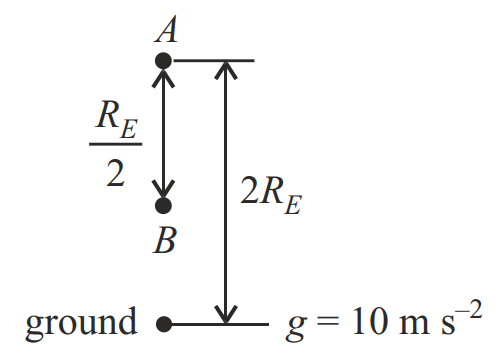 Acceleration due to gravity at height h: $g'=\dfrac{gR^2}{(R+h)^2}$, so $Mg'=Mg\dfrac{R^2}{(R+h)^2}$. At A (height $2R$ above surface), $Mg'=Mg\dfrac{R^2}{(3R)^2}=\dfrac{Mg}{9}$. At B (height $3R/4$ above surface), $Mg'=Mg\dfrac{R^2}{(7R/4)^2}=\dfrac{16Mg}{49}\approx\dfrac{4Mg}{25}$ (per given figure geometry). Change in weight $=Mg\left(\dfrac{4}{25}-\dfrac{1}{9}\right)\approx49$ N (using $M=100$ kg, $g=10\ m\,s^{-2}$).
Variation of g with depth
-
What is the depth at which the value of acceleration due to gravity becomes $\dfrac{1}{n}$ times the value that at the surface of earth? (radius of earth = R)At depth d, $g'=g\left(1-\dfrac{d}{R}\right)$. Setting $g'=\dfrac{g}{n}$: $\dfrac{1}{n}=1-\dfrac{d}{R}\Rightarrow\dfrac{d}{R}=1-\dfrac{1}{n}=\dfrac{n-1}{n}\Rightarrow d=\dfrac{R(n-1)}{n}$.
Escape velocity and velocity at infinity
-
The escape velocity of a body on the earth surface is 11.2 km/s. If the same body is projected upward with velocity 22.4 km/s, the velocity of this body at infinite distance from the centre of the earth will be:$V_\infty=\sqrt{V^2-V_e^2}$. Given $V=2V_e$. $V_\infty=\sqrt{(2V_e)^2-V_e^2}=\sqrt{3}V_e=11.2\sqrt3$ km/s.
Mean density of the earth in terms of g and R
-
If R is the radius of the earth and g is the acceleration due to gravity on the earth surface. Then the mean density of the earth will be:$g=\dfrac{4}{3}\pi GR\rho\Rightarrow\rho=\dfrac{3g}{4\pi GR}$.
Gravitational potential and field intensity
-
In a gravitational field, the gravitational potential is given by, $V=-\frac{K}{x}$ (J/kg). The gravitational field intensity at point (2, 0, 3) m is:$E_g=-\frac{dV}{dx}=-\frac{d}{dx}\left(-\frac{K}{x}\right)=-\frac{K}{x^2}$. At $x=2$: $E_g=-\frac{K}{(2)^2}=-\frac{K}{4}$.
Kepler's third law - satellites
-
The time period of a geostationary satellite is 24 h, at a height $6R_E$ ($R_E$ is radius of earth) from surface of earth. The time period of another satellite whose height is $2.5R_E$ from surface will be,$\frac{T_2}{T_1}=\left(\frac{r_2}{r_1}\right)^{3/2}=\left(\frac{3.5R}{7R}\right)^{3/2}=\frac{1}{2\sqrt{2}} \Rightarrow T_2=\frac{24}{2\sqrt{2}}=6\sqrt{2}$ h.
Acceleration due to gravity and universal gravitational constant
-
If the mass of the Sun were ten times smaller and the universal gravitational constant were ten times larger in magnitude, which of the following is not correct?
$g = GM_E/R^2$ increases tenfold; the Sun's mass is irrelevant to g.
If the universal gravitational constant becomes ten times, then $G' = 10G$. So, the acceleration due to gravity on the Earth ($g = GM_E/R^2$) increases. So the statement that 'g' on the Earth will not change is not correct.
Gravitational potential and acceleration due to gravity at height
-
At what height from the surface of earth the gravitation potential and the value of g are $-5.4 \times 10^{7}\ J\ kg^{-1}$ and $6.0\ ms^{-2}$ respectively? (Take, the radius of earth as 6400 km.)
$|V|/g' = R + h$.
Gravitational potential at height h: $V = -\frac{GM}{R + h}$ ...(i)
Gravitational acceleration at height h: $g' = \frac{GM}{(R + h)^2}$ ...(ii)
From (i) and (ii): $\frac{|V|}{g'} = R + h \Rightarrow h = \frac{|V|}{g'} - R$
$h = \frac{5.4\times10^{7}}{6} - 6400$ km $= 0.9\times10^{7}$ m $- 6400$ km
$h = 9000$ km $- 6400$ km $= 2600$ km
Energy of an orbiting satellite
-
The additional kinetic energy to be provided to a satellite of mass m revolving around a planet of mass M, to transfer it from a circular orbit of radius $R_1$ to another of radius $R_2$ ($R_2 > R_1$) isTotal energy of a satellite in a circular orbit of radius R: $E = KE + PE = \frac{GMm}{2R} - \frac{GMm}{R} = -\frac{GMm}{2R}$
Energy in the first orbit: $E_1 = -\frac{GMm}{2R_1}$; energy in the second orbit: $E_2 = -\frac{GMm}{2R_2}$
Energy to be supplied: $E_1 + \Delta E = E_2$
$\Delta E = E_2 - E_1 = -\frac{GMm}{2R_2} + \frac{GMm}{2R_1}$
$\Delta E = \frac{1}{2}GmM\left(\frac{1}{R_1} - \frac{1}{R_2}\right)$
Kepler's laws
-
A geostationary satellite is orbiting the earth at a height of 5R above the surface of the earth, R being the radius of the earth. The time period of another satellite in hours at a height of 2R from the surface of the earth is$T^2 \propto r^3$
Geostationary satellite: T = 24 h, $r_1 = R + 5R = 6R$. Other satellite: $r_2 = R + 2R = 3R$.
$\frac{24}{T} = \left(\frac{6R}{3R}\right)^{3/2} = 2^{3/2} = 2\sqrt2$
$T = \frac{24}{2\sqrt2} = 6\sqrt2$ h
Motion under mutual gravitation
-
Two spherical bodies of mass M and 5M and radii R and 2R are released in free space with initial separation between their centres equal to 12R. If they attract each other due to gravitational force only, then the distance covered by the smaller body before collision isAt collision the separation between centres is $R + 2R = 3R$.
Total distance covered by both bodies $= 12R - 3R = 9R$.
Only internal forces act, so the centre of mass stays at rest: $m_1x_1 = m_2x_2$
$Mx = 5M(9R - x) \Rightarrow 6x = 45R$
$x = 7.5R$
Orbital velocity
-
A remote-sensing satellite of earth revolves in a circular orbit at a height of $0.25\times10^6$ m above the surface of earth. If earth's radius is $6.38\times10^6$ m and g = 9.8 $ms^{-2}$, then the orbital speed of the satellite is:$v_0 = \sqrt{\frac{GM_e}{R_e + h}} = \sqrt{\frac{gR_e^2}{R_e + h}}$
$v_0 = \sqrt{\frac{9.8\times(6.38\times10^6)^2}{6.63\times10^6}} \approx \sqrt{60\times10^6}$ m/s
$v_0 \approx 7.76\times10^3$ m/s = 7.76 km/s
Gravitational potential
-
Infinite number of bodies, each of mass 2 kg are situated on x-axis at distance 1 m, 2 m, 4 m, 8 m, ...., respectively, from the origin. The resulting gravitational potential due to this system at the origin will be:$V = -G(2)\left[\frac{1}{1} + \frac{1}{2} + \frac{1}{4} + \frac{1}{8} + \dots\right]$
$= -2G\left[\frac{1}{1 - 1/2}\right] = -4G$ -
A particle of mass M is situated at the centre of a spherical shell of same mass and radius a. The magnitude of the gravitational potential at a point situated at $\frac{a}{2}$ distance from the centre will beThe point is at distance $\frac{a}{2}$ from the centre, i.e., inside the shell.
Potential due to the particle at the centre: $V_1 = -\frac{GM}{a/2} = -\frac{2GM}{a}$
Potential inside a spherical shell is constant and equal to its value on the surface: $V_2 = -\frac{GM}{a}$
Total potential: $V = V_1 + V_2 = -\frac{2GM}{a} - \frac{GM}{a} = -\frac{3GM}{a}$
Magnitude of the potential = $\frac{3GM}{a}$ -
A particle of mass M is situated at the centre of a spherical shell of same mass and radius a. The gravitational potential at a point situated at $\frac{a}{2}$ distance from the centre will beThe point is inside the shell, at a distance $\frac{a}{2}$ from the centre.
Potential due to the particle at the centre: $V_1 = -\frac{GM}{a/2} = -\frac{2GM}{a}$
Potential at any point inside a spherical shell equals that on its surface: $V_2 = -\frac{GM}{a}$
Total potential: $V = V_1 + V_2 = -\frac{2GM}{a} - \frac{GM}{a}$
$V = -\frac{3GM}{a}$
Variation of acceleration due to gravity
-
The dependence of acceleration due to gravity g on the distance r from the centre of the earth, assumed to be a sphere of radius R of uniform density, is as shown in figures below.
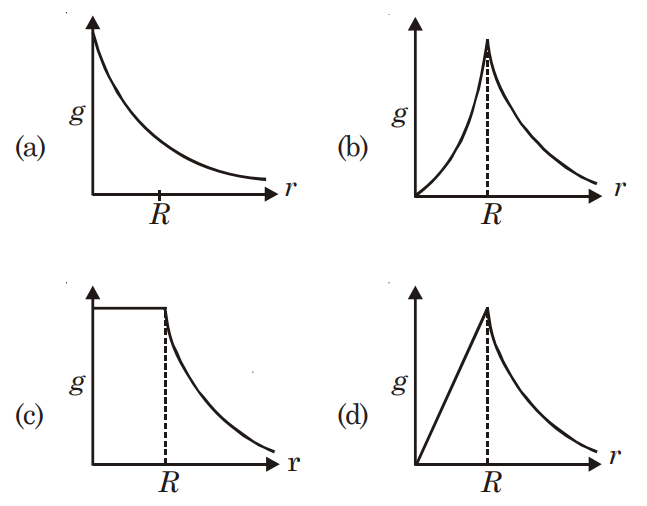
The correct figure isInside the earth (r < R), only the mass within radius r attracts: $g = \frac{GM_r}{r^2}$ with $M_r = M\frac{r^3}{R^3}$, so $g = \frac{GM}{R^3}r$
Thus inside the earth $g \propto r$: it is zero at the centre and increases linearly up to the surface.
At the surface (r = R) it has its maximum value $g = \frac{GM}{R^2}$.
Outside the earth (r > R): $g = \frac{GM}{r^2}$, so $g \propto \frac{1}{r^2}$; it falls off as a curve and tends to zero at large r.
The correct graph is therefore a straight line from the origin up to r = R, followed by a curve decreasing as $\frac{1}{r^2}$; this is the figure labelled (d).
That is every question in Gravitation for this filter.
Want a score?
Answers here are not saved. Practise as a test to be marked and see your progress.
Practise as a test