Looking for classes? Ksquare Career Institute, Bengaluru →

Physics
Mechanical Properties of Solids
15 questions from 14 papers, each with its answer.
- 15 questions
- 14 papers
- 0.85% of Physics
Elastic Moduli – Shear Modulus
-
The stretching of a spring is determined by the shear modulus of the material of the springReason: A coil spring of copper has more tensile strength than a steel spring of same dimensions.In the stretching of a coil spring, the shape of the wire changes (it is twisted), so the shear modulus of the material is used – Assertion is true. Young's modulus (and tensile strength) of copper is less than that of steel, $Y_{copper} < Y_{steel}$, so a copper spring does not have more tensile strength than a steel spring – Reason is false. So A is true but R is false.
Elastic Potential Energy of a Stretched Wire
-
When a block of mass $M$ is suspended by a long wire of length $L$, the length of the wire become ($L+l$). The elastic potential energy stored in the extended wire is:Elastic potential energy stored $=\frac{1}{2}\times\text{load}\times\text{extension}$
$U=\frac{1}{2}Mgl$
Elastic moduli - Young's modulus, bulk modulus, compressibility, Poisson's ratio
-
Match List I with List II:
Pick the matching item from Column II for each row.
Column I
- i. Young's Modulus
- ii. Compressibility
- iii. Bulk Modulus
- iv. Poisson's Ratio
Column II
- a. $\frac{\Delta d}{\Delta L}\left(\frac{L}{d}\right)$
- b. $\frac{FL}{A(\Delta L)}$
- c. $-\frac{1}{\Delta P}\left(\frac{\Delta V}{V}\right)$
- d. $-P\left(\frac{V}{\Delta V}\right)$
Correct answer: i → b, ii → c, iii → d, iv → a
Young's modulus $Y = \frac{FL}{A(\Delta L)}$ Compressibility $= \frac{1}{Bulk\ modulus} = -\frac{1}{\Delta P}\left(\frac{\Delta V}{V}\right)$ Bulk modulus $= -P\left(\frac{V}{\Delta V}\right)$ Poisson's ratio $= \frac{\Delta d / d}{\Delta L / L} = \frac{\Delta d}{\Delta L}\left(\frac{L}{d}\right)$ Correct match: i-b, ii-c, iii-d, iv-a.
Elastic potential energy density
-
The amount of elastic potential energy per unit volume (in SI unit) of a steel wire of length 100 cm to stretch it by 1 mm is (if Young's modulus of the wire = $2.0\times10^{11}\ Nm^{-2}$):$\dfrac{E.P.E}{Volume}=\dfrac{1}{2}(stress)(strain)=\dfrac{1}{2}(Y)(strain)^2=\dfrac{1}{2}(Y)\left(\dfrac{\Delta L}{L}\right)^2=\dfrac{1}{2}(2\times10^{11})\left(\dfrac{1\times10^{-3}}{100\times10^{-2}}\right)^2=10^5$.
Young's modulus – elongation of wires
-
Two wires are made of the same material and have the same volume. The first wire has cross-sectional area A and the second wire has cross-sectional area 3A. If the length of the first wire is increased by $\Delta l$ on applying a force F, how much force is needed to stretch the second wire by the same amount?
$\Delta l \propto Fl/A$; with $l \propto 1/A$ at fixed volume, $F \propto A^2$.
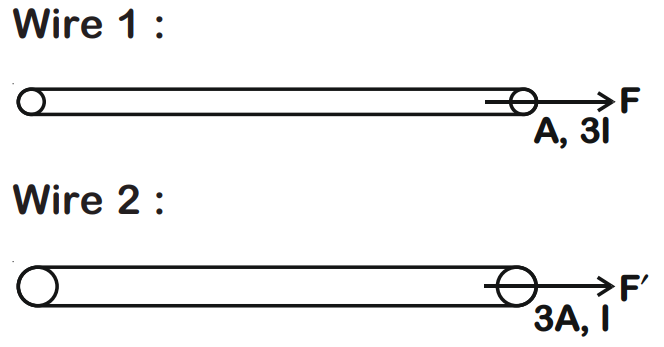
Same volume, so wire 1 has area A and length 3l; wire 2 has area 3A and length l.
For wire 1: $\Delta l = \left(\frac{F}{AY}\right)3l$ ...(i)
For wire 2: $\frac{F'}{3A} = Y\frac{\Delta l}{l} \Rightarrow \Delta l = \left(\frac{F'}{3AY}\right)l$ ...(ii)
From equations (i) and (ii): $\left(\frac{F}{AY}\right)3l = \left(\frac{F'}{3AY}\right)l$
$\Rightarrow F' = 9F$
Young's modulus
-
Copper of fixed volume 'V' is drawn into wire of length 'l'. When this wire is subjected to a constant force 'F', the extension produced in the wire is '$\Delta l$'. Which of the following graphs is a straight line?$Y = \frac{F/A}{\Delta l/l} \Rightarrow \Delta l = \frac{Fl}{AY}$
$V = Al \Rightarrow A = \frac{V}{l}$
$\Delta l = \frac{Fl^2}{VY}$, so $\Delta l \propto l^2$ and the graph of $\Delta l$ versus $l^2$ is a straight line.
That is every question in Mechanical Properties of Solids for this filter.
Want a score?
Answers here are not saved. Practise as a test to be marked and see your progress.
Practise as a test