Looking for classes? Ksquare Career Institute, Bengaluru →

Physics
Motion in a Straight Line
45 questions from 30 papers, each with its answer.
- 45 questions
- 30 papers
- 2.55% of Physics
Relative Velocity in One Dimension
-
Two cities X and Y are connected by a regular bus service with a bus leaving in either direction every $T\text{ min}$. A girl driving a scooty with a speed of $60\text{ km/h}$ in the direction X to Y notices that a bus goes past her every $30\text{ minutes}$ in the direction of her motion, and every $10\text{ minutes}$ in the opposite direction. Choose the correct option for the period $T$ of the bus service and the speed (assumed constant) of the buses.
Solving relative velocity equations gives bus speed $V = 120\text{ km/h}$ and bus service interval $T = 15\text{ minutes}$.
Distance between successive buses is $s = V \left(\frac{T}{60}\right)$. In the same direction, relative speed is $(V - 60)$, so $\frac{V (T/60)}{V - 60} = \frac{30}{60} \implies \frac{VT}{V - 60} = 30$. In the opposite direction, relative speed is $(V + 60)$, so $\frac{V (T/60)}{V + 60} = \frac{10}{60} \implies \frac{VT}{V + 60} = 10$. Dividing the two equations: $\frac{V + 60}{V - 60} = 3 \implies V + 60 = 3V - 180 \implies 2V = 240 \implies V = 120\text{ km/h}$. Substituting back: $T = 10 \times \frac{120 + 60}{120} = 10 \times 1.5 = 15\text{ min}$.
Motion under Gravity
-
A horizontal bridge is built across a river. A student standing on the bridge throws a small ball vertically upwards with a velocity $4\ ms^{-1}$. The ball strikes the water surface after 4 s. The height of bridge above water surface is (Take $g=10\ ms^{-2}$):
Taking upward as positive, $S=-h$, so $-h=ut-\frac{1}{2}gt^2$ gives $h=64\ m$.
Let height of bridge $=h$. Displacement of ball, $S=-h$ $S=ut+\frac{1}{2}at^2$ $-h=4\times4+\frac{1}{2}(-10)(4)^2$ $\Rightarrow h=64\ m$ -
A ball is dropped from a high rise platform at t = 0 starting from rest. After 6 seconds another ball is thrown downwards from the same platform with a speed v. The two balls meet at t = 18 s. What is the value of v? (Take g = 10 m/$s^2$)The first ball falls for 18 s from rest: $s_1 = \frac{1}{2}g(18)^2 = \frac{1}{2}\times10\times324 = 1620$ m
The second ball is thrown at t = 6 s, so it falls for 18 − 6 = 12 s: $s_2 = v\times12 + \frac{1}{2}g(12)^2 = 12v + 720$
They meet, so both have fallen the same distance: $12v + 720 = 1620$
$12v = 900$
v = 75 m/s -
If a ball is thrown vertically upwards with speed u, the distance covered during the last 't' seconds of its ascent is :Let the time of ascent be T. At the highest point the velocity becomes zero: $0 = u - gT \Rightarrow T = \dfrac{u}{g}$
Let h be the distance covered during the last t seconds of the ascent, i.e. from point B (at time $T - t$) to the top C.
Velocity at point B: $v_B = u - g(T - t) = u - g\left(\dfrac{u}{g} - t\right) = gt$
Distance from B to C (the ball decelerates from $v_B$ to 0 in time t):
$h = v_Bt - \dfrac{1}{2}gt^2 = gt^2 - \dfrac{1}{2}gt^2 = \dfrac{1}{2}gt^2$
Shortcut: the last t seconds of ascent are the time-reverse of the first t seconds of a free fall from rest, so $h = \dfrac{1}{2}gt^2$, independent of u.
So the distance covered during the last t seconds of ascent is $\dfrac{1}{2}gt^2$.
Velocity-time graphs of uniformly accelerated motion
-
The following plots show variation of velocity (v) with time (t), of a ball thrown vertically upward, and falling back. Which of the following plots is/are correct?
 Taking upward direction as positive, acceleration = $-g$ throughout the motion (constant), so the v-t graph is a straight line with negative slope. Initially velocity is positive and decreases (upward motion), becomes zero at the highest point, and then becomes increasingly negative (speed increases in the downward direction). So the correct plot is III only.
Free fall kinematics, $s = \frac{1}{2}gt^2$
-
When a ruler falls vertically, 5 different persons catch it with different reaction times. ($g = 9.8\ m\,s^{-2}$) I. Person A has reaction time of 0.20 s. II. Person B has reaction time of 0.22 s. III. Person C has reaction time of 0.18 s. IV. Person D has reaction time of 0.19 s. V. Person E has reaction time of 0.21 s. What is the CORRECT order of the distance travelled by the ruler for each person?Distance travelled by the ruler: $d = \frac{1}{2}gt^2$, so $d \propto t^2$ Larger reaction time means larger distance. Reaction times: II (0.22 s) > V (0.21 s) > I (0.20 s) > IV (0.19 s) > III (0.18 s) So the order of distance travelled is II > V > I > IV > III.
Position, velocity and acceleration relations
-
A particle is moving along x-axis with its position (x) varying with time (t) as $x=\alpha t^4+\beta t^2+\gamma t+\delta$. The ratio of its initial velocity to its initial acceleration, respectively, is:$v=\dfrac{dx}{dt}=4\alpha t^3+2\beta t+\gamma$, so $v_i=\gamma$. $a=\dfrac{dv}{dt}=12\alpha t^2+2\beta$, so $a_i=2\beta$. $\dfrac{v_i}{a_i}=\dfrac{\gamma}{2\beta}$.
Kinematics of free fall
-
A person sitting in the ground floor of a building notices through the window, of height 1.5 m, a ball dropped from the roof of the building crosses the window in 0.1 s. What is the velocity of the ball when it is at the topmost point of the window? ($g=10\ m/s^2$)Using $s=ut+\dfrac{1}{2}gt^2$ for the window crossing: $1.5=u(0.1)+\dfrac{1}{2}(10)(0.1)^2=0.1u+0.05\Rightarrow0.1u=1.45\Rightarrow u=14.5$ m/s, which is the velocity at the top of the window.
Average speed vs average velocity
-
Consider a particle moving along a straight line, whose position as a function of time is given by $s(t)=\alpha t^2-\beta t+\gamma$, where $\alpha=1$ ms$^{-2}$, $\beta=6$ ms$^{-1}$ and $\gamma=5$ m. The average speed of the particle, in ms$^{-1}$ from t = 0 to t = 6 s is:$s=t^2-6t+5 \Rightarrow v=\frac{ds}{dt}=(2t-6)$ m/s. The velocity is -6 m/s at t = 0, zero at t = 3 s and +6 m/s at t = 6 s. Distance = $|A_1|+|A_2|=2\left[\frac{1}{2}\times3\times6\right]=18$ m. Average speed $=\frac{18}{6}=3$ m/s.
Average velocity and average speed
-
A toy car with charge q moves on a frictionless horizontal plane surface under the influence of a uniform electric field $\vec{E}$. Due to the force $q\vec{E}$, its velocity increases from 0 to 6 m/s in one second duration. At that instant the direction of the field is reversed. The car continues to move for two more seconds under the influence of this field. The average velocity and the average speed of the toy car between 0 to 3 seconds are respectively
Displacement 3 m and distance 9 m over 3 s.
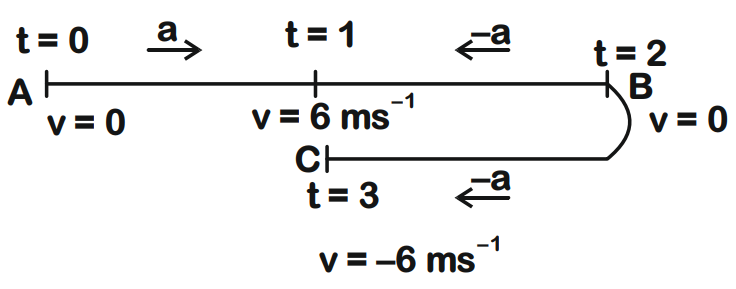
Acceleration $a = \frac{6 - 0}{1} = 6\ m s^{-2}$
For t = 0 to t = 1 s: $S_1 = \frac{1}{2}\times6(1)^2 = 3$ m ...(i)
For t = 1 s to t = 2 s: $S_2 = 6(1) - \frac{1}{2}\times6(1)^2 = 3$ m ...(ii)
For t = 2 s to t = 3 s: $S_3 = 0 - \frac{1}{2}\times6(1)^2 = -3$ m ...(iii)
Total displacement $S = S_1 + S_2 + S_3 = 3$ m
Average velocity $= \frac{3}{3} = 1\ m s^{-1}$
Total distance travelled = 9 m
Average speed $= \frac{9}{3} = 3\ m s^{-1}$
Acceleration as a function of position
-
A particle of unit mass undergoes one-dimensional motion such that its velocity varies according to $v(x) = \beta x^{-2n}$, where $\beta$ and n are constants and x is the position of the particle. The acceleration of the particle as a function of x is given by$a = v\frac{dv}{dx}$
$a = \beta x^{-2n}\cdot \beta(-2n)x^{-2n-1}$
$a = -2n\beta^2 x^{-4n-1}$
Free fall
-
A stone is dropped from a height h. It hits the ground with a certain momentum P. If the same stone is dropped from a height 100% more than the previous height, the momentum when it hits the ground will change bySpeed on hitting the ground: $v = \sqrt{2gh}$, so momentum $P = m\sqrt{2gh} \propto \sqrt h$
The new height is 100% more, i.e. 2h.
$\frac{P'}{P} = \sqrt{\frac{2h}{h}} = \sqrt2 \Rightarrow P' = \sqrt2P = 1.41P$
Change in momentum $= \frac{P' - P}{P}\times100 = 41\%$
Instantaneous velocity and acceleration
-
A particle moves a distance x in time t according to equation $x = (t + 5)^{-1}$. The acceleration of particle is proportional to$x = (t + 5)^{-1}$
Velocity $v = \frac{dx}{dt} = -(t + 5)^{-2}$
Acceleration $a = \frac{dv}{dt} = 2(t + 5)^{-3}$
From the velocity, $|v| = (t + 5)^{-2}$, so $(t + 5)^{-1} = |v|^{1/2}$
$a = 2\left[(t + 5)^{-1}\right]^3 = 2\left(|v|^{1/2}\right)^3 = 2|v|^{3/2}$
So $a \propto (\text{velocity})^{3/2}$
(In terms of distance, $a = 2x^3$, which is not among the choices.) -
The position $x$ of a particle with respect to time $t$ along x-axis is given by $x = 9t^2 - t^3$ where $x$ is in metres and $t$ in second. What will be the position of this particle when it achieves maximum speed along the +ve x direction?Speed: $v = \dfrac{dx}{dt} = \dfrac{d}{dt}(9t^2 - t^3) = 18t - 3t^2$
For maximum speed, $\dfrac{dv}{dt} = 0$
$\dfrac{dv}{dt} = 18 - 6t = 0 \Rightarrow t = 3$ s
Since $\dfrac{d^2v}{dt^2} = -6$ is negative, this is a maximum.
Position at $t = 3$ s: $x = 9(3)^2 - (3)^3$
$x = 81 - 27 = 54$ m
So the particle is at 54 m when it achieves its maximum speed along the +ve x direction. -
The displacement $x$ of a particle varies with time $t$ as $x = ae^{-\alpha t} + be^{\beta t}$, where $a$, $b$, $\alpha$ and $\beta$ are positive constants. The velocity of the particle will -$x = ae^{-\alpha t} + be^{\beta t}$
Velocity: $v = \dfrac{dx}{dt} = -a\alpha e^{-\alpha t} + b\beta e^{\beta t}$
It depends on $\alpha$ and $\beta$.
Acceleration: $\dfrac{dv}{dt} = a\alpha^2 e^{-\alpha t} + b\beta^2 e^{\beta t}$
All the constants are positive and exponentials are always positive, so $\dfrac{dv}{dt} \gt 0$ always.
Hence $v$ is an increasing function of $t$: the velocity goes on increasing with time.
Setting $\alpha = \beta$ does not make $v$ zero in general.
Motion with Variable Acceleration
-
A particle moving along x-axis has acceleration $f$, at time $t$, given by $f = f_0\left(1 - \dfrac{t}{T}\right)$, where $f_0$ and $T$ are constants. The particle at $t = 0$ has zero velocity. In the time interval between $t = 0$ and the instant when $f = 0$, the particle's velocity ($v_x$) isHere $f = f_0\left(1 - \dfrac{t}{T}\right)$, i.e. $\dfrac{dv}{dt} = f_0\left(1 - \dfrac{t}{T}\right)$
$dv = f_0\left(1 - \dfrac{t}{T}\right)dt$
Integrating: $v = \int f_0\left(1 - \dfrac{t}{T}\right)dt = f_0\left(t - \dfrac{t^2}{2T}\right) + C$, where $C$ is the constant of integration.
At $t = 0$, $v = 0$: $0 = f_0(0 - 0) + C \Rightarrow C = 0$
$\therefore v = f_0\left(t - \dfrac{t^2}{2T}\right)$
If $f = 0$, then $0 = f_0\left(1 - \dfrac{t}{T}\right) \Rightarrow t = T$
Hence the particle's velocity gained in the time interval $t = 0$ to $t = T$ is $v_x = \int_{t=0}^{t=T} f_0\left(1 - \dfrac{t}{T}\right)dt = f_0\left[t - \dfrac{t^2}{2T}\right]_0^T$
$v_x = f_0\left(T - \dfrac{T^2}{2T}\right) = f_0\left(T - \dfrac{T}{2}\right)$
$v_x = \dfrac{1}{2}f_0 T$
Instantaneous Velocity
-
A particle moves along a straight line OX. At a time $t$ (in seconds) the distance $x$ (in metres) of the particle from O is given by $x = 40 + 12t - t^3$. How long would the particle travel before coming to rest :-$x = 40 + 12t - t^3$
Velocity: $v = \dfrac{dx}{dt} = 12 - 3t^2$
The particle comes to rest when $v = 0$: $12 - 3t^2 = 0 \Rightarrow t^2 = 4 \Rightarrow t = 2$ s
Distance travelled by the particle before coming to rest $= x(\text{at } t = 2) - x(\text{at } t = 0)$
$x(2) = 40 + 12 \times 2 - 2^3 = 40 + 24 - 8 = 56$ m
$x(0) = 40$ m
Distance travelled $= 56 - 40 = 16$ m
Motion under Gravity: Time of Flight
-
A man throws balls with the same speed vertically upwards one after the other at an interval of 2 seconds. What should be the speed of the throw so that more than two balls are in the sky at any time ? (Given g = 9.8 m/s$^2$)A new ball is thrown every 2 s. For more than two balls to be in the air at any time, each ball must stay in the air for more than 2 × 2 = 4 s.
(If a ball stays exactly 4 s, the first ball lands just as the third ball is thrown, so at most two balls are in the air at that moment.)
Time of flight of a ball thrown up with speed u: $T = \dfrac{2u}{g}$
Condition: $\dfrac{2u}{g} \gt 4$
$\Rightarrow u \gt 2g = 2 \times 9.8 = 19.6$ m/s
So the speed of throw must be more than 19.6 m/s.
That is every question in Motion in a Straight Line for this filter.
Want a score?
Answers here are not saved. Practise as a test to be marked and see your progress.
Practise as a test