Looking for classes? Ksquare Career Institute, Bengaluru →

Physics
Oscillations
63 questions from 34 papers, each with its answer.
- 63 questions
- 34 papers
- 3.57% of Physics
Simple Harmonic Motion - Variable Mass Systems
-
In an oscillating spring mass system, a spring is connected to a box filled with sand. As the box oscillates, sand leaks slowly out of the box vertically so that the average frequency $\omega(t)$ and average amplitude $A(t)$ of the system change with time $t$. Which one of the following options schematically depicts these changes correctly?
Since mass $m(t)$ decreases, $\omega = \sqrt{k/m}$ increases, while lost sand carries away mechanical energy, steadily decreasing amplitude $A(t)$.
For a spring-mass system, the angular frequency is $\omega(t) = \sqrt{k/m(t)}$. As sand leaks out, total mass $m(t)$ decreases, which implies that $\omega(t)$ progressively increases. Simultaneously, as sand drops vertically out of the moving box, it carries away kinetic energy without an opposing reaction force, so the total mechanical energy of the remaining oscillator decreases, causing the average amplitude $A(t)$ to steadily decrease. Thus, graph (2) correctly shows $\omega(t)$ rising and $A(t)$ declining.
Simple Harmonic Motion – Graphs
-
The x–t graph of a particle performing simple harmonic motion is shown in the figure. The acceleration of the particle at $t=2\ s$ is:
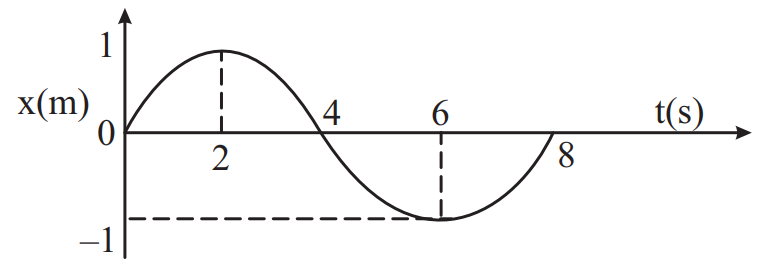
From the graph $A=1$, $T=8$, so $\omega=\frac{\pi}{4}$ and $a=-\omega^2x=-\frac{\pi^2}{16}$ at $x=1$.
From the x–t graph, $A=1$, $T=8$ $\Rightarrow\omega=\frac{2\pi}{T}=\frac{\pi}{4}$ At $t=2$, $x=1$: $a=-\omega^2x$ $\Rightarrow a=-\frac{\pi^2}{16}\times1=-\frac{\pi^2}{16}\ m/s^2$
Energy in Simple Harmonic Motion
-
A particle executing simple harmonic motion with amplitude A has the same potential and kinetic energies at the displacement$U=\dfrac{1}{2}kx^2$, $K=\dfrac{1}{2}kA^2-\dfrac{1}{2}kx^2$. Setting $U=K$: $\dfrac{1}{2}kx^2=\dfrac{1}{2}kA^2-\dfrac{1}{2}kx^2\Rightarrow x^2=\dfrac{A^2}{2}\Rightarrow x=\dfrac{A}{\sqrt2}$.
-
A body is executing simple harmonic motion with frequency $n$, the frequency of its potential energy is:Displacement in SHM of frequency n: $x = A\sin(2\pi nt)$ $U = \frac{1}{2}kx^2 = \frac{1}{2}kA^2\sin^2(2\pi nt) = \frac{1}{2}kA^2\left[\frac{1 - \cos(2\pi(2n)t)}{2}\right]$ So the frequency of potential energy = 2n.
Spring-Mass System
-
A spring is stretched by 5 cm by a force 10 N. The time period of the oscillations when a mass of 2 kg is suspended by it is:$F = kx \Rightarrow 10 = k(5 \times 10^{-2}) \Rightarrow k = 200$ N/m $T = 2\pi\sqrt{\frac{m}{k}} = 2\pi\sqrt{\frac{2}{200}} = \frac{2\pi}{10} = 0.628$ s
-
A mass of 2.0 kg is put on a flat pan attached to a vertical spring fixed on the ground. The mass of the spring and the pan is negligible. When pressed slightly and released the mass executes a simple harmonic motion. The spring constant is 200 N/m. What should be the minimum amplitude of the motion so that the mass gets detached from the pan (take $g = 10$ m/s$^2$)?The mass can get detached from the pan only at the upper extreme position, where the acceleration is directed downward and has its maximum value $\omega^2 a$.
At that point, taking downward as positive: $mg - R = m\omega^2 a$, where $R$ is the normal reaction of the pan.
$R = mg - m\omega^2 a$
The mass just loses contact when $R = 0$, i.e. $g = \omega^2 a$
$\Rightarrow a = \dfrac{g}{\omega^2} = \dfrac{mg}{K}$, as $\omega^2 = \dfrac{K}{m}$
$\Rightarrow a = \dfrac{2 \times 10}{200}$
$\Rightarrow a = \dfrac{1}{10}$ m $= 10$ cm
So the minimum amplitude is 10.0 cm. -
The time period of a mass suspended from a spring is T. If the spring is cut into four equal parts and the same mass is suspended from one of the parts, then the new time period will be -For a spring, the spring constant is inversely proportional to its length: $kl$ = constant.
Each quarter has length $\dfrac{l}{4}$, so its spring constant is $k' = 4k$.
Time period: $T = 2\pi\sqrt{\dfrac{m}{k}}$
$T' = 2\pi\sqrt{\dfrac{m}{4k}} = \dfrac{1}{2} \times 2\pi\sqrt{\dfrac{m}{k}} = \dfrac{T}{2}$
So the new time period is $\dfrac{T}{2}$.
Simple Harmonic Motion – Amplitude
-
The displacement of a particle executing simple harmonic motion is given by $y=A_0+A\sin\omega t+B\cos\omega t$. Then the amplitude of its oscillation is given by:$y=A_0+A\sin\omega t+B\cos\omega t$ Shifting origin: $y'=y-A_0=A\sin\omega t+B\cos\omega t$ The two SHMs have a phase difference of $90^\circ$, so the resultant amplitude is $R=\sqrt{A^2+B^2+2AB\cos90^\circ}=\sqrt{A^2+B^2}$
Simple Harmonic Motion and Uniform Circular Motion
-
The radius of circle, the period of revolution, initial position and sense of revolution are indicated in the fig. $y$-projection of the radius vector of rotating particle $P$ is:
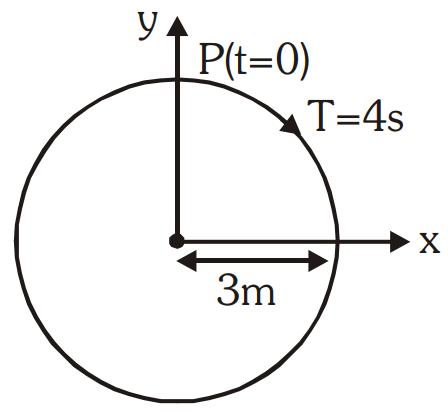
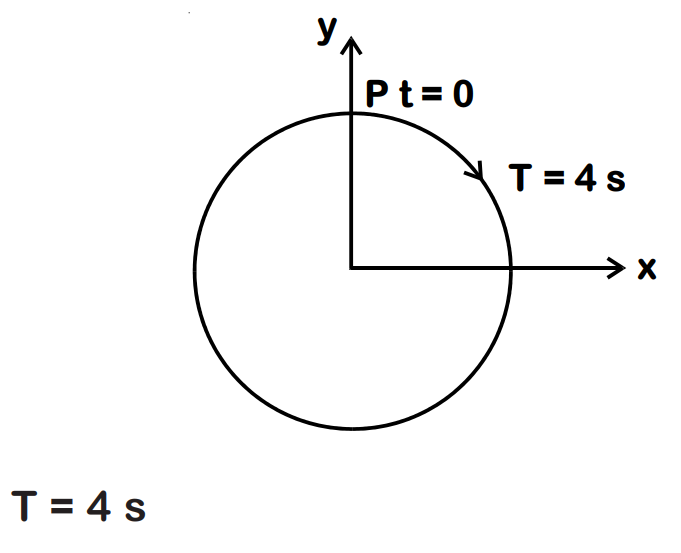
At $t=0$ the y-displacement is maximum, so the equation is a cosine function: $y=a\cos\omega t$
$\omega=\frac{2\pi}{T}=\frac{2\pi}{4}=\frac{\pi}{2}\ rad/s$, $a=3\ m$
$y(t)=3\cos\left(\frac{\pi t}{2}\right)$
Energy (kinetic energy) variation with time in SHM
-
For a simple pendulum, having time period T, the variation of kinetic energy (K.E.) with time (t) is represented by:$K.E. = \frac{1}{2}m\omega^2 A^2 \cos^2\omega t$ (oscillation starts from the extreme position) K.E. is always non-negative and varies as $\cos^2\omega t$, so it repeats twice in one time period (period of K.E. = $\frac{T}{2}$).
Total mechanical energy and speed at equilibrium in SHM
-
The sum of kinetic energy and potential energy of a simple pendulum bob is 0.02 joule. The speed of the simple pendulum bob at equilibrium position is approximately: (Consider mass of the bob = 20 g)Total energy $= \frac{1}{2}KA^2 = \frac{1}{2}m\omega^2A^2 = 0.02$ J At equilibrium, all energy is kinetic: $\frac{1}{2}mv_{max}^2 = 0.02$ J $v_{max}^2 = \frac{0.04}{20 \times 10^{-3}} = 2$ $v_{max} = 1.41$ m/s
SHM in vector form
-
The two-dimensional motion of a particle, described by $\vec{r}=(\hat{i}+2\hat{j})A\cos\omega t$ is a/an: A. parabolic path B. elliptical path C. periodic motion D. simple harmonic motion. Choose the correct answer from the options given below:Since $x=A\cos\omega t$ and $y=2A\cos\omega t$, we get $y=2x$, a straight line — not parabolic or elliptical. $\dfrac{d\vec r}{dt}=-(\hat i+2\hat j)\omega A\sin\omega t$ and $\dfrac{d^2\vec r}{dt^2}=-\omega^2\vec r$, i.e. $\vec a=-\omega^2\vec r$, which is the defining condition of SHM, and SHM is periodic. So only C and D apply.
Periodic functions
-
Identify the function which represents a periodic motion.A periodic function repeats itself after a fixed interval of time. $\sin t+\cos t$ is a periodic function (period $2\pi$), while $e^{-t}$, $e^t$ and $\log_e(t)$ are not periodic.
Simple pendulum immersed in a fluid
-
A simple pendulum oscillating in air has a period of $\sqrt3$ s. If it is completely immersed in non-viscous liquid, having density $\left(\dfrac{1}{4}\right)^{th}$ of the material of the bob, the new period will be:-$T_{air}=2\pi\sqrt{\dfrac{\ell}{g}}=\sqrt3$ sec. In the liquid, $g_{net}=g\left(1-\dfrac{\rho}{\sigma}\right)$ where $\rho$ is the density of the liquid and $\sigma$ is the density of the bob material. $T_{Liq}=2\pi\sqrt{\dfrac{\ell}{g_{net}}}=\dfrac{T_{air}}{\sqrt{1-\rho/\sigma}}=\dfrac{\sqrt3}{\sqrt{1-1/4}}=\dfrac{\sqrt3}{\sqrt3/2}=2$ sec.
Graphs of damped, undamped oscillations and SHM
-
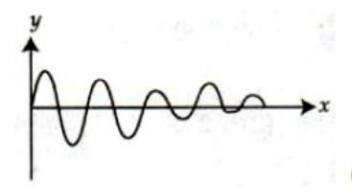
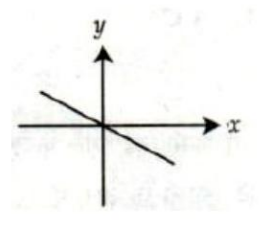
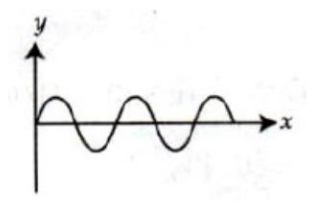
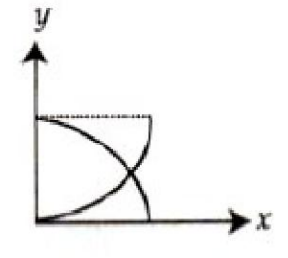
Match List - I (x-y graphs) with List - II (Situations). Choose the correct answer.
Pick the matching item from Column II for each row.
Column I
-
A. -
-
B. -
-
C. -
-
D. -
Column II
- I. Total mechanical energy is conserved
- II. Bob of a pendulum is oscillating under negligible air friction
- III. Restoring force of a spring
- IV. Bob of a pendulum is oscillating along with air friction
Correct answer: A → IV, B → III, C → II, D → I
Graph (a) shows decreasing amplitude, i.e. damped oscillation: a pendulum oscillating with air friction (a-iv). Graph (b) is a straight line with negative slope, i.e. restoring force of a spring $F=-kx$ (b-iii). Graph (c) shows constant amplitude, i.e. undamped oscillation: pendulum with negligible air friction (c-ii). Graph (d) shows KE and PE curves whose sum is constant: total mechanical energy is conserved (d-i). -
A. -
Simple pendulum and free fall
-
A mass falls from a height 'h' and its time of fall 't' is recorded in terms of time period T of a simple pendulum. On the surface of earth it is found that t = 2T. The entire set up is taken on the surface of another planet whose mass is half of that of earth and radius the same. Same experiment is repeated and corresponding times noted as t' and T'.$t=\sqrt{\frac{2h}{g}}\propto\frac{1}{\sqrt{g}}$ and $T=2\pi\sqrt{\frac{l}{g}}\propto\frac{1}{\sqrt{g}}$. The ratio of time of fall to time period is independent of g, hence $t'=2T'$.
Oscillations of a floating body
-
A cylindrical cork of uniform density floats in a liquid of density $\rho_1$. If the cork is depressed slightly and released, it oscillates harmonically with time period T. If the same cork floats in another liquid of density $\rho_2$, then the similar oscillation has time period 2T. The value of $\rho_2/\rho_1$ is:For a small depression x, the restoring force is $F=-\rho gAx$. Comparing with $F=-kx$ gives $k=\rho Ag$. $T=2\pi\sqrt{\frac{m}{\rho Ag}} \Rightarrow T\propto\frac{1}{\sqrt{\rho}}$. $\frac{T}{2T}=\sqrt{\frac{\rho_2}{\rho_1}} \Rightarrow \frac{\rho_2}{\rho_1}=\frac{1}{4}$.
Phase space of SHM - energy conservation
-
Consider a spring-mass simple harmonic oscillator in one dimension. The mass of the particle is m kg and the spring constant is k Nm$^{-1}$. At a given instant, the extension of the spring is x meter and the speed of the particle is v ms$^{-1}$. On the x - v plane, if the graph of v as a function of x is a circle, then the correct option is:Total energy $E=\frac{1}{2}mv^2+\frac{1}{2}kx^2 \Rightarrow \frac{v^2}{2E/m}+\frac{x^2}{2E/k}=1$. Comparing with $\frac{x^2}{a^2}+\frac{y^2}{b^2}=1$, the curve is a circle when $a^2=b^2 \Rightarrow \frac{2E}{m}=\frac{2E}{k} \Rightarrow k=m$.
Simple harmonic motion – velocity and acceleration
-
A particle executes linear simple harmonic motion with an amplitude of 3 cm. When the particle is at 2 cm from the mean position, the magnitude of its velocity is equal to that of its acceleration. Then its time period in seconds is
Set $\omega\sqrt{A^2 - x^2} = \omega^2x$ to find ω.
$v = \omega\sqrt{A^2 - x^2}$, $a = x\omega^2$ $v = a \Rightarrow \omega\sqrt{A^2 - x^2} = x\omega^2$ $\sqrt{(3)^2 - (2)^2} = 2\left(\frac{2\pi}{T}\right)$ $\sqrt{5} = \frac{4\pi}{T}$ $T = \frac{4\pi}{\sqrt{5}}$
Combination of springs
-
A spring of force constant k is cut into lengths of ratio 1 : 2 : 3. They are connected in series and the new force constant is k'. Then they are connected in parallel and force constant is k''. Then k' : k'' is
Pieces have constants 6k, 3k, 2k; series gives k, parallel gives 11k.
Spring constant $\propto \frac{1}{length}$, i.e. $k \propto \frac{1}{l}$ $k_1 = 6k$, $k_2 = 3k$, $k_3 = 2k$ In series: $\frac{1}{k'} = \frac{1}{6k} + \frac{1}{3k} + \frac{1}{2k} = \frac{6}{6k} \Rightarrow k' = k$ In parallel: $k'' = 6k + 3k + 2k = 11k$ $\frac{k'}{k''} = \frac{1}{11}$, i.e. $k' : k'' = 1 : 11$ -
A mass is suspended separately by two different springs in successive order then time period is $t_1$ and $t_2$ respectively. If it is connected by both springs as shown in figure then time period is $t_0$, the correct relation is : -
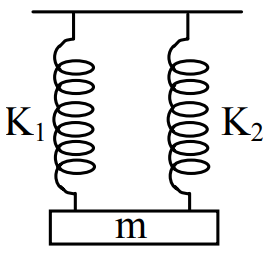 Time period of a spring-mass system: $T = 2\pi\sqrt{\dfrac{m}{K}}$, so $K = \dfrac{4\pi^2 m}{T^2}$, i.e. $K \propto \dfrac{1}{T^2}$ for the same mass.
With spring $K_1$ alone: $K_1 \propto \dfrac{1}{t_1^2}$; with $K_2$ alone: $K_2 \propto \dfrac{1}{t_2^2}$.
In the figure both springs support the mass side by side, so they are in parallel and their constants add: $K = K_1 + K_2$.
$\dfrac{1}{t_0^2} = \dfrac{1}{t_1^2} + \dfrac{1}{t_2^2}$
$\Rightarrow t_0^{-2} = t_1^{-2} + t_2^{-2}$
Velocity in SHM
-
A particle is executing SHM along a straight line. Its velocities at distances $x_1$ and $x_2$ from the mean position are $V_1$ and $V_2$, respectively. Its time period isIn SHM, $v = \omega\sqrt{a^2 - x^2}$.
$V_1^2 = \omega^2(a^2 - x_1^2)$ ...(1)
$V_2^2 = \omega^2(a^2 - x_2^2)$ ...(2)
Subtracting: $V_1^2 - V_2^2 = \omega^2(x_2^2 - x_1^2) \Rightarrow \omega = \sqrt{\frac{V_1^2 - V_2^2}{x_2^2 - x_1^2}}$
$T = \frac{2\pi}{\omega} = 2\pi\sqrt{\frac{x_2^2 - x_1^2}{V_1^2 - V_2^2}}$ -
A point performs simple harmonic oscillation of period $T$ and the equation of motion is given by $x = a\sin(\omega t + \pi/6)$. After the elapse of what fraction of the time period the velocity of the point will be equal to half of its maximum velocity ?$x = a\sin\left(\omega t + \dfrac{\pi}{6}\right)$
Velocity: $v = \dfrac{dx}{dt} = a\omega\cos\left(\omega t + \dfrac{\pi}{6}\right)$
Maximum velocity: $v_{max} = a\omega$
Given $v = \dfrac{v_{max}}{2}$: $\dfrac{a\omega}{2} = a\omega\cos\left(\omega t + \dfrac{\pi}{6}\right)$
$\cos\left(\omega t + \dfrac{\pi}{6}\right) = \dfrac{1}{2}$
$\omega t + \dfrac{\pi}{6} = \dfrac{\pi}{3} \Rightarrow \omega t = \dfrac{\pi}{6}$
$t = \dfrac{\pi}{6\omega} = \dfrac{\pi}{6} \times \dfrac{T}{2\pi}$
$t = \dfrac{T}{12}$
Damped oscillations
-
When an oscillator completes 100 oscillations its amplitude reduces to $\dfrac{1}{3}$ of initial value. What will be its amplitude, when it completes 200 oscillations : -For damped oscillations the amplitude decays exponentially: $A = A_0e^{-bt}$.
After 100 oscillations ($t = 100T$): $\dfrac{A_0}{3} = A_0e^{-b(100T)} \Rightarrow e^{-100bT} = \dfrac{1}{3}$
After 200 oscillations ($t = 200T$): $A = A_0e^{-b(200T)} = A_0(e^{-100bT})^2$
$\Rightarrow A = A_0\left(\dfrac{1}{3}\right)^2 = \dfrac{A_0}{9}$
So the amplitude becomes $\dfrac{1}{9}$ of the initial value. (In equal time intervals the amplitude falls by the same factor, here $\dfrac{1}{3}$ each time.)
Simple harmonic motion
-
Two particles are oscillating along two close parallel straight lines side by side, with the same frequency and amplitudes. They pass each other, moving in opposite directions when their displacement is half of the amplitude. The mean positions of the two particles lie on a straight line perpendicular to the paths of the two particles. The phase difference isLet the displacement of each particle be $x = A\sin\theta$, where $\theta$ is its phase.
When they cross, $x = \frac{A}{2}$ for both: $\frac{A}{2} = A\sin\theta$, so $\sin\theta = \frac{1}{2}$
$\theta = 30^\circ$ or $150^\circ$
Velocity is $v = A\omega\cos\theta$: at $\theta = 30^\circ$ the velocity is positive and at $\theta = 150^\circ$ it is negative.
Since the particles move in opposite directions, one has phase $30^\circ$ and the other $150^\circ$.
Phase difference = $150^\circ - 30^\circ = 120^\circ = \frac{2\pi}{3}$ -
A particle of mass m is released from rest and follows a parabolic path as shown. Assuming that the displacement of the mass from the origin is small, which graph correctly depicts the position of the particle as a function of time?
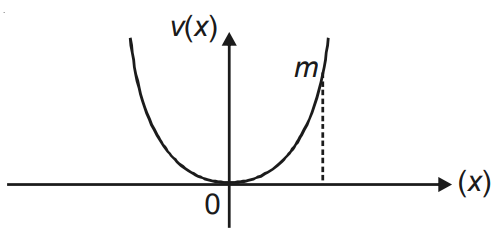 The potential energy curve is a parabola, $V(x) \propto x^2$, so the restoring force is $F = -\frac{dV}{dx} \propto -x$.
A force proportional to displacement and directed towards the origin gives simple harmonic motion about the origin.
The particle is released from rest at a point away from the origin, so at t = 0 it is at an extreme position: x is maximum and the velocity (slope of the x–t graph) is zero.
Hence $x(t) = A\cos\omega t$.
The correct graph is the cosine curve that starts from maximum displacement at t = 0 and oscillates about x = 0. -
Out of the following functions representing motion of a particle, which represents SHM?
(A) $y = \sin\omega t - \cos\omega t$
(B) $y = \sin^3\omega t$
(C) $y = 5\cos\left(\frac{3\pi}{4} - 3\omega t\right)$
(D) $y = 1 + \omega t + \omega^2t^2$A motion is SHM if the displacement is a single sine or cosine function of time, i.e., if $\frac{d^2y}{dt^2} \propto -y$.
(A) $y = \sin\omega t - \cos\omega t = \sqrt{2}\sin\left(\omega t - \frac{\pi}{4}\right)$: a single sine function, so it is SHM with angular frequency $\omega$.
(B) $y = \sin^3\omega t = \frac{1}{4}(3\sin\omega t - \sin3\omega t)$: a superposition of two SHMs of different frequencies; it is periodic but not SHM.
(C) $y = 5\cos\left(\frac{3\pi}{4} - 3\omega t\right) = 5\cos\left(3\omega t - \frac{3\pi}{4}\right)$: a single cosine function, so it is SHM with angular frequency $3\omega$.
(D) $y = 1 + \omega t + \omega^2t^2$: y keeps increasing with time, so the motion is not even periodic.
Hence only (A) and (C) represent SHM. -
The displacement of a particle along the x-axis is given by $x = a\sin^2\omega t$. The motion of the particle corresponds to$x = a\sin^2\omega t$
Velocity: $\frac{dx}{dt} = 2a\omega\sin\omega t\cos\omega t = a\omega\sin2\omega t$
Acceleration: $\frac{d^2x}{dt^2} = 2a\omega^2\cos2\omega t$
For SHM about the origin we need $\frac{d^2x}{dt^2} = -\omega'^2x$, i.e., acceleration proportional to $-x$.
Here $2a\omega^2\cos2\omega t$ is not proportional to $-a\sin^2\omega t$, so the condition $\frac{d^2x}{dt^2} \propto -x$ is not satisfied for the displacement x as given.
Hence the answer accepted is non simple harmonic motion.
Note: writing $x = \frac{a}{2} - \frac{a}{2}\cos2\omega t$ shows the motion is simple harmonic about the shifted mean position $x = \frac{a}{2}$ with frequency $\frac{\omega}{\pi}$; the key of the source PDF treats it as non-SHM because x is measured from the origin. -
Which one of the following equations of motion represents simple harmonic motion? (where k, $k_0$, $k_1$ and a are all positive)A motion is simple harmonic if the acceleration is directly proportional to the displacement from a fixed (mean) position and is directed towards it: acceleration = $-\omega^2\times$(displacement from mean position).
Acceleration = –k(x + a): put $X = x + a$. Then acceleration = –kX, which is proportional to X and opposite to it. This is SHM about the mean position x = –a.
Acceleration = kx and acceleration = k(x + a): the acceleration is in the same direction as the displacement, so the particle moves farther away; there is no restoring effect.
Acceleration = $-k_0x + k_1x^2$: the acceleration is not linear in x, so the motion is not simple harmonic.
Hence the equation representing SHM is acceleration = –k(x + a).
SHM of a Floating Body
-
A rectangular block of mass $m$ and area of cross-section $A$ floats in a liquid of density $\rho$. If it is given a small vertical displacement from equilibrium it undergoes oscillation with a time period $T$. Then :-In equilibrium the weight of the block is balanced by the upthrust.
When the block is pushed down by a small distance $x$, an extra volume $Ax$ of liquid is displaced, giving an extra upthrust $Ax\rho g$.
Restoring force $= Ax\rho g = kx \Rightarrow k = A\rho g$
The restoring force is proportional to the displacement and opposite to it, so the motion is simple harmonic.
$T = 2\pi\sqrt{\dfrac{m}{k}} = 2\pi\sqrt{\dfrac{m}{A\rho g}}$
So $T \propto \sqrt{m}$, $T \propto \dfrac{1}{\sqrt{\rho}}$ and $T \propto \dfrac{1}{\sqrt{A}}$.
Among the given relations, the correct one is $T \propto \dfrac{1}{\sqrt{A}}$.
That is every question in Oscillations for this filter.
Want a score?
Answers here are not saved. Practise as a test to be marked and see your progress.
Practise as a test