Looking for classes? Ksquare Career Institute, Bengaluru →

Physics
Kinetic Theory
34 questions from 27 papers, each with its answer.
- 34 questions
- 27 papers
- 1.93% of Physics
Speed of Gas Molecules (RMS Speed)
-
The temperature of a gas is $-50^\circ C$. To what temperature the gas should be heated so that the rms speed is increased by 3 times?
As $v_{rms}\propto\sqrt{T}$, the key treats 'increased by 3 times' as $4v$, so $T_f=16T_i=3295^\circ C$.
$T_i=-50^\circ C=223\ K$ $v_{rms}\propto\sqrt{T}$ As $v_{rms}$ increased by 3 times, $(v_{rms})_f=4(v_{rms})_{initial}$ $T_f=16T_i=16\times223=3568\ K$ $T_f=(3568-273)^\circ C=3295^\circ C$
Ideal Gas Equation and Molar Volume
-
The volume occupied by the molecules contained in 4.5 kg water at STP, if the intermolecular forces vanish away is :If intermolecular forces vanish, water behaves like an ideal gas at STP (1 mole occupies 22.4 L). $V = (no.\ of\ moles) \times 22.4 \times 10^{-3}\ m^3 = \frac{mass}{molar\ mass} \times 22.4 \times 10^{-3}\ m^3$ $V = \frac{4.5 \times 10^3}{18} \times 22.4 \times 10^{-3} = 5.6\ m^3$
Kinetic Theory of Gases – Speed, Pressure and Energy
-
Match Column-I and Column-II and choose the correct match from the given choices.
Pick the matching item from Column II for each row.
Column I
- A. Root mean square speed of gas molecules
- B. Pressure exerted by ideal gas
- C. Average kinetic energy of a molecules
- D. Total internal energy of 1 mole of a diatomic gas
Column II
- P. $\frac{1}{3}nm\bar{v}^2$
- Q. $\sqrt{\frac{3RT}{M}}$
- R. $\frac{5}{2}RT$
- S. $\frac{3}{2}k_BT$
Correct answer: A → Q, B → P, C → S, D → R
Root mean square speed: $v_{rms} = \sqrt{\frac{3RT}{M}}$ Pressure exerted by an ideal gas: $P = \frac{1}{3}\rho v_{rms}^2 = \frac{1}{3}nm\bar{v}^2$ Average kinetic energy of a molecule: $\frac{3}{2}k_BT$ Total internal energy of 1 mole of a diatomic gas: $U = \frac{f}{2}RT = \frac{5}{2}RT$ Correct match: A-Q, B-P, C-S, D-R.
Mean Free Path
-
The mean free path of molecules in an ideal gas A is half that of another ideal gas B. The diameter of the spherical molecules of gas A is twice the diameter of the molecules of B. If number densities of the gases A and B are $n_A$ and $n_B$, respectively, the correct option is:$\lambda=\frac{1}{\sqrt{2}\pi d^2n} \Rightarrow n\propto\frac{1}{\lambda d^2}$. $\frac{n_A}{n_B}=\frac{\lambda_B}{\lambda_A}\times\left(\frac{d_B}{d_A}\right)^2=2\times\left(\frac{1}{2}\right)^2=\frac{1}{2}$, so $n_A=\frac{n_B}{2}$.
Ideal Gas Equation
-
A cylinder contains hydrogen gas at pressure of 249 kPa and temperature $27^\circ C$. Its density is: ($R=8.3\ J\,mol^{-1}K^{-1}$)$PM = \rho RT \Rightarrow \rho = \frac{PM}{RT}$ $P = 249 \times 10^3\ N/m^2$, $M = 2 \times 10^{-3}$ kg/mol, T = 300 K $\rho = \frac{249 \times 10^3 \times 2 \times 10^{-3}}{8.3 \times 300} = 0.2\ kg/m^3$
-
At $10^\circ C$ the value of the density of a fixed mass of an ideal gas divided by its pressure is $x$. At $110^\circ C$ this ratio is -Ideal gas equation: $PV = nRT = \dfrac{m}{M_0}RT$, where $M_0$ is the molar mass.
$P = \dfrac{m}{V}\cdot\dfrac{RT}{M_0} = \rho\,\dfrac{RT}{M_0}$
$\Rightarrow \dfrac{\rho}{P} = \dfrac{M_0}{RT}$, i.e. $\dfrac{\rho}{P} \propto \dfrac{1}{T}$
$T_1 = 10 + 273 = 283$ K and $T_2 = 110 + 273 = 383$ K
$\dfrac{(\rho/P)_2}{(\rho/P)_1} = \dfrac{T_1}{T_2} = \dfrac{283}{383}$
$\left(\dfrac{\rho}{P}\right)_2 = \dfrac{283}{383}\,x$
Root mean square speed of gas molecules
-
A flask contains argon and chlorine in the ratio of 2 : 1 by mass. The temperature of the mixture is $27^\circ C$. The ratio of root mean square speed of the molecules of the two gases $\left(\frac{v_{rms}^{Ar}}{v_{rms}^{Cl}}\right)$ is: (Atomic mass of argon = 40.0 u and molecular mass of chlorine = 70.0 u)$v_{rms} = \sqrt{\frac{3RT}{M_w}}$ At constant temperature, $v_{rms} \propto \frac{1}{\sqrt{M_w}}$ (independent of the mass ratio in the mixture) $\frac{v_{rms}^{Ar}}{v_{rms}^{Cl}} = \sqrt{\frac{M_{w,Cl}}{M_{w,Ar}}} = \sqrt{\frac{70}{40}} = \frac{\sqrt{7}}{2}$
Ideal Gas Equation
-
An oxygen cylinder of volume $30\text{ litre}$ has $18.20\text{ moles}$ of oxygen. After some oxygen is withdrawn from the cylinder, its gauge pressure drops to $11\text{ atmospheric pressure}$ at temperature $27^\circ\text{C}$. The mass of the oxygen withdrawn from the cylinder is nearly equal to:
[Given: $R = \frac{100}{12}\text{ J mol}^{-1}\text{K}^{-1}$, molecular mass of $O_2 = 32$, $1\text{ atm pressure} = 1.01 \times 10^5\text{ N/m}^2$]Absolute pressure is $P_{abs} = 11 + 1 = 12\text{ atm}$. Moles remaining $\approx 14.55\text{ mol}$. Moles withdrawn $\Delta n = 3.65\text{ mol}$, corresponding to mass $3.65 \times 32\text{ g} \approx 0.116\text{ kg}$.
Absolute pressure inside cylinder: $P_f = P_{gauge} + P_{atm} = 11 + 1 = 12\text{ atm} = 12 \times 1.01 \times 10^5\text{ Pa}$. Volume $V = 30\text{ L} = 30 \times 10^{-3}\text{ m}^3$, temperature $T = 27 + 273 = 300\text{ K}$. Moles remaining: $n_f = \frac{P_f V}{R T} = \frac{12 \times 1.01 \times 10^5 \times 0.03}{(100/12) \times 300} = \frac{36360}{2500} \approx 14.55\text{ mol}$. Moles withdrawn: $\Delta n = n_i - n_f = 18.20 - 14.55 = 3.65\text{ mol}$. Mass of oxygen withdrawn: $m = \Delta n \times M_{O_2} = 3.65 \times 32\text{ g} = 116.8\text{ g} \approx 0.116\text{ kg}$.
Charles's Law (Isobaric T-V Graphs)
-
The following graph represents the T-V curves of an ideal gas (where T is the temperature and V the volume) at three pressures $P_1$, $P_2$ and $P_3$ compared with those of Charles's law represented as dotted lines.
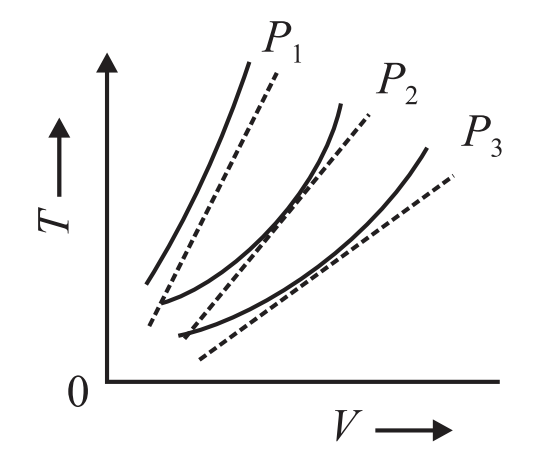 From the ideal gas equation $PV = nRT$: $T = \left(\frac{P}{nR}\right)V$, i.e. $T \propto V$ with slope $\frac{P}{nR}$ So a steeper T-V line corresponds to a higher pressure. From the graph, the $P_1$ curve is steepest and $P_3$ is least steep. So $P_1 > P_2 > P_3$.
Degrees of freedom and specific heats of gases
-
According to the law of equipartition of energy, the number of vibrational modes of a polyatomic gas of constant $\gamma=\dfrac{C_p}{C_v}$ is ($C_p$, $C_v$ are the specific heat capacities of the gas at constant pressure and constant volume, respectively):A polyatomic gas has 3 translational, 3 rotational, and f vibrational modes. $U=\left(3+f\right)k_BT$ (each vibrational mode contributing $k_BT$). So $C_V=(3+f)R$, $C_P=(4+f)R$, and $\gamma=\dfrac{4+f}{3+f}$. Solving, $4+f=3\gamma+f\gamma\Rightarrow4-3\gamma=f(\gamma-1)\Rightarrow f=\dfrac{4-3\gamma}{\gamma-1}$.
Mean free path of gas molecules
-
The Mean Free Path $\lambda$ for a gas molecule depends upon diameter d of the molecule asThe mean free path is given by $\lambda=\dfrac{1}{\sqrt2\,\pi d^2 n}$, where $n$ is the number density and $d$ is the molecular diameter. Hence $\lambda\propto\dfrac{1}{d^2}$.
Ideal gas equation - density form
-
An ideal gas equation can be written as $\rho=\dfrac{M_0}{RT}P$ where $\rho$ and $M_0$ are respectively,Starting from $PV=nRT=\dfrac{m}{M_0}RT$, dividing by V gives $P=\dfrac{m}{VM_0}RT=\dfrac{\rho}{M_0}RT$, i.e. $\rho=\dfrac{M_0P}{RT}$, where $\rho$ is the mass density of the gas and $M_0$ is its molar mass.
Pressure of a mixture of ideal gases
-
A container of volume 200 cm$^3$ contains 0.2 mole of hydrogen gas and 0.3 mole of argon gas. The pressure of the system at temperature 200 K ($R=8.3\ JK^{-1}mol^{-1}$) will be:-$P_{mix}=\dfrac{(\mu_1+\mu_2)RT_{mix}}{V_{mix}}=\dfrac{(0.2+0.3)\times8.3\times200}{200\times10^{-6}}=\dfrac{0.5\times8.3\times200}{200\times10^{-6}}=4.15\times10^6$ Pa.
Specific heat capacities of gases
-
The value of $\gamma\left(=\frac{C_p}{C_v}\right)$, for hydrogen, helium and another ideal diatomic gas X (whose molecules are not rigid but have an additional vibrational mode), are respectively equal to:$\gamma=\frac{f+2}{f}$. $H_2$ (diatomic, f = 5): 7/5; He (monoatomic, f = 3): 5/3; X with an extra vibrational mode (f = 7): 9/7.
-
The amount of heat energy required to raise the temperature of 1 g of Helium at NTP, from $T_1$ K to $T_2$ K is:Number of moles in 1 g He $= \frac{1}{4}$
Heat required $= nC_v\Delta T = \frac{1}{4}\left(\frac{3}{2}R\right)(T_2 - T_1)$
$= \frac{3}{8}N_ak_B(T_2 - T_1)$
Degrees of freedom and specific heat ratio
-
An ideal gas is made of polyatomic molecules. Each of the molecules has three translational, three rotational and f number of vibrational modes. If the ratio of heat capacities $C_P/C_V$ of the gas is 8/7, then the value of f is:Total degrees of freedom $F=\frac{2}{\gamma-1}$. Each vibrational mode contributes 2, so $6+2f=\frac{2}{\frac{8}{7}-1}=14 \Rightarrow 2f=8 \Rightarrow f=4$.
RMS speed of gas molecules and escape velocity
-
At what temperature will the rms speed of oxygen molecules become just sufficient for escaping from the Earth's atmosphere? (Given: Mass of oxygen molecule (m) $= 2.76 \times 10^{-26}$ kg, Boltzmann's constant $k_B = 1.38 \times 10^{-23}\ J K^{-1}$)
Set $\sqrt{3k_BT/m}$ equal to the escape speed 11.2 km/s and solve for T.
$V_{escape} = 11200$ m/s Say at temperature T the rms speed attains $V_{escape}$. So, $\sqrt{\frac{3k_BT}{m_{O_2}}} = 11200$ m/s On solving, $T = \frac{(11200)^2 \times 2.76\times10^{-26}}{3\times 1.38\times10^{-23}} = 8.360 \times 10^{4}$ K
Speed of sound and specific heats
-
4.0 g of a gas occupies 22.4 litres at NTP. The specific heat capacity of the gas at constant volume is 5.0 $JK^{-1}mol^{-1}$. If the speed of sound in this gas at NTP is 952 $ms^{-1}$, then the heat capacity at constant pressure is (Take gas constant R = 8.3 $JK^{-1}mol^{-1}$)Molar mass M = 4.0 g = $4\times10^{-3}$ kg/mol
$v = \sqrt{\frac{\gamma RT}{M}} \Rightarrow \gamma = \frac{Mv^2}{RT} = \frac{4\times10^{-3}\times 952^2}{8.3\times 273} \approx 1.6$
$C_p = \gamma C_v = 1.6\times 5.0 = 8.0$ $JK^{-1}mol^{-1}$
That is every question in Kinetic Theory for this filter.
Want a score?
Answers here are not saved. Practise as a test to be marked and see your progress.
Practise as a test