Looking for classes? Ksquare Career Institute, Bengaluru →

Physics
Dual Nature of Radiation and Matter
82 questions from 38 papers, each with its answer.
- 82 questions
- 38 papers
- 4.65% of Physics
de Broglie Wavelength
-
An electron and an alpha particle are accelerated by the same potential difference. Let $\lambda_e$ and $\lambda_\alpha$ denote the de-Broglie wavelengths of the electron and the alpha particle, respectively, then:De-Broglie wavelength $\lambda=\dfrac{h}{\sqrt{2mqV}}$, so $\lambda\propto\dfrac{1}{\sqrt{mq}}$. Since $m_\alpha\gg m_e$, $\lambda_e>\lambda_\alpha$.
-
The wavelength $\lambda_e$ of an electron and $\lambda_P$ of a photon of same energy E are related by:Photon: $\lambda_P = \frac{h}{p} = \frac{hc}{E}$
Electron: $\lambda_e = \frac{h}{p} = \frac{h}{\sqrt{2mE}} \Rightarrow E = \frac{h^2}{2m\lambda_e^2}$
So $\lambda_P \propto \lambda_e^2$ -
A parallel beam of fast moving electrons is incident normally on a narrow slit. A fluorescent screen is placed at a large distance from the slit. If the speed of the electrons is increased, which of the following statements is correct?As the speed of the electrons increases, their de Broglie wavelength decreases.
The angular width of the central maximum ($\propto \lambda$) therefore decreases. -
An $\alpha$-particle moves in a circular path of radius 0.83 cm in the presence of a magnetic field of 0.25 Wb/$m^2$. The de Broglie wavelength associated with the particle will beRadius of the path: $r = \frac{p}{qB} = \frac{p}{2eB} \Rightarrow p = 2eBr$
$p = 2\times1.6\times10^{-19}\times0.25\times0.83\times10^{-2}$ kg m/s
$\lambda = \frac{h}{p} = \frac{6.6\times10^{-34}}{0.83\times10^{-2}\times2\times1.6\times10^{-19}\times0.25}$
$\lambda = 9.94\times10^{-13}$ m ≈ 0.01 Å -
If the momentum of an electron is changed by P, then the de Broglie wavelength associated with it changes by 0.5%. The initial momentum of electron will be$\lambda = \frac{h}{p}$, so for small changes $\frac{\Delta p}{p} = \frac{\Delta\lambda}{\lambda}$ (in magnitude)
Here $\Delta p = P$ and $\frac{\Delta\lambda}{\lambda} = \frac{0.5}{100}$
$\frac{P}{p} = \frac{0.5}{100} \Rightarrow p = 200P$ -
A particle of mass 1 mg has the same wavelength as an electron moving with a velocity of $3 \times 10^{6}$ m s$^{-1}$. The velocity of the particle is :
(mass of electron $= 9.1 \times 10^{-31}$ kg)de Broglie wavelength associated with the electron moving with velocity $v_e$: $\lambda_e = \dfrac{h}{m_e v_e}$
$\lambda_e = \dfrac{h}{9.1 \times 10^{-31} \times 3 \times 10^{6}}$
Wavelength of the particle of mass 1 mg $= 1 \times 10^{-6}$ kg moving with velocity $v$: $\lambda_p = \dfrac{h}{1 \times 10^{-6} \times v}$
As given, $\lambda_e = \lambda_p$
$\Rightarrow \dfrac{h}{9.1 \times 10^{-31} \times 3 \times 10^{6}} = \dfrac{h}{10^{-6} \times v}$
$\Rightarrow 10^{-6} \times v = 9.1 \times 10^{-31} \times 3 \times 10^{6}$
$\Rightarrow v = \dfrac{27.3 \times 10^{-25}}{10^{-6}}$ m/s
$v = 2.73 \times 10^{-18}$ m/s $\approx 2.7 \times 10^{-18}$ m s$^{-1}$
Properties of Photon
-
If $c$ is the velocity of light in free space, the correct statements about photon among the following are: A. The energy of a photon is $E=h\nu$. B. The velocity of a photon is $c$. C. The momentum of a photon, $p=\frac{h\nu}{c}$. D. In a photon-electron collision, both total energy and total momentum are conserved. E. Photon possesses positive charge. Choose the correct answer from the options given below:A. $E = h\nu$ – correct B. A photon travels with the speed of light c – correct C. Momentum of a photon $p = \frac{h\nu}{c}$ – correct D. Total energy and momentum are conserved in a photon-electron collision – correct E. Photons are electrically neutral (and massless) – incorrect So A, B, C and D only are correct.
Cut-off Wavelength of X-rays
-
The minimum wavelength of X-rays produced by an electron accelerated through a potential difference of $V$ volts is proportional to:
$eV=\frac{hc}{\lambda_{min}}$, so $\lambda_{min}\propto\frac{1}{V}$.
$eV$ = energy of electron; for minimum wavelength, maximum loss of energy: $eV=\left(\frac{hc}{\lambda}\right)$ $\lambda\propto\left(\frac{1}{V}\right)$
Photoelectric Effect
-
A certain metallic surface is illuminated with monochromatic light of wavelength $\lambda$. The stopping potential for photo-electric current for this light is $3V_0$. If the same surface is illuminated with light of wavelength $2\lambda$, the stopping potential is $V_0$. The threshold wavelength for this surface for photo-electric effect is$eV_0 = \frac{hc}{\lambda} - W$
For $\lambda$: $3eV_0 = \frac{hc}{\lambda} - W$ ...(1)
For $2\lambda$: $eV_0 = \frac{hc}{2\lambda} - W$ ...(2)
Substituting (2) in (1): $\frac{3hc}{2\lambda} - 3W = \frac{hc}{\lambda} - W \Rightarrow \frac{hc}{2\lambda} = 2W \Rightarrow W = \frac{hc}{4\lambda}$
Threshold wavelength $\lambda_0 = \frac{hc}{W} = 4\lambda$ -
A photoelectric surface is illuminated successively by monochromatic light of wavelength $\lambda$ and $\frac{\lambda}{2}$. If the maximum kinetic energy of the emitted photoelectrons in the second case is 3 times that in the first case, the work function of the surface of the material is: (h = Planck's constant, c = speed of light)$KE_1 = \frac{hc}{\lambda} - \phi$; $KE_2 = \frac{2hc}{\lambda} - \phi$
$KE_2 = 3KE_1$: $\frac{2hc}{\lambda} - \phi = 3\left(\frac{hc}{\lambda} - \phi\right)$
$2\phi = \frac{hc}{\lambda} \Rightarrow \phi = \frac{hc}{2\lambda}$ -
When the energy of the incident radiation is increased by 20%, the kinetic energy of the photoelectrons emitted from a metal surface increased from 0.5 eV to 0.8 eV. The work function of the metal is:$h\nu = \phi_0 + K_{max}$
$h\nu = \phi_0 + 0.5$ ...(i)
$1.2h\nu = \phi_0 + 0.8$ ...(ii)
Solving, $\phi_0 = 1.0$ eV -
Monochromatic radiation emitted when electron on hydrogen atom jumps from first excited to the ground state irradiates a photosensitive material. The stopping potential is measured to be 3.57 V. The threshold frequency of the material isPhoton energy for n = 2 → n = 1: $E = 13.6\left(1 - \frac{1}{4}\right) = 10.2$ eV
Einstein's equation: $eV_0 = E - h\nu_{th}$
$h\nu_{th} = 10.2 - 3.57 = 6.63$ eV $= 6.63\times1.6\times10^{-19}$ J
$\nu_{th} = \frac{6.63\times1.6\times10^{-19}}{6.6\times10^{-34}} \approx 1.6\times10^{15}$ Hz -
Two radiations of photons energies 1 eV and 2.5 eV, successively illuminate a photosensitive metallic surface of work function 0.5 eV. The ratio of the maximum speeds of the emitted electrons isEinstein's equation: $\frac{1}{2}mv_{max}^2 = h\nu - W$
$\frac{(v_1)_{max}}{(v_2)_{max}} = \sqrt{\frac{h\nu_1 - W}{h\nu_2 - W}} = \sqrt{\frac{1 - 0.5}{2.5 - 0.5}}$
$= \sqrt{\frac{0.5}{2}} = \sqrt{\frac{1}{4}} = \frac{1}{2}$
So the ratio is 1 : 2. -
The figure shows a plot of photo current versus anode potential for a photo sensitive surface for three different radiations. Which one of the following is a correct statement?
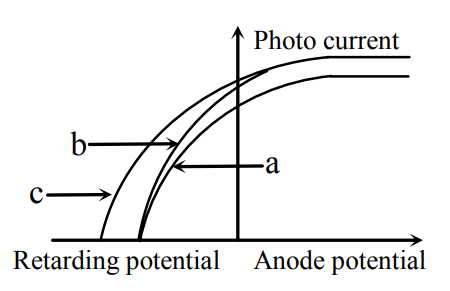 The stopping (retarding) potential depends only on the frequency of the incident radiation: $eV_0 = h\nu - \phi_0$. Curves with the same stopping potential have the same frequency.
The saturation photocurrent depends only on the intensity of the radiation. Curves with different saturation currents have different intensities.
In the figure, curves (a) and (b) start from the same retarding potential, so they have the same frequency; their saturation currents are different, so their intensities are different.
Curve (c) starts from a different retarding potential, so its frequency is different from that of (a) and (b); hence (b) and (c) are not of the same frequency.
Hence the correct statement is that curves (a) and (b) represent incident radiations of the same frequency but of different intensities.
Particle Nature of Light – Photon
-
The number of photons per second on an average emitted by the source of monochromatic light of wavelength 600 nm, when it delivers the power of $3.3\times10^{-3}$ watt will be: ($h=6.6\times10^{-34}\ Js$)$P = \frac{nhc}{\lambda} \Rightarrow n = \frac{P\lambda}{hc}$ $n = \frac{3.3 \times 10^{-3} \times 600 \times 10^{-9}}{6.6 \times 10^{-34} \times 3 \times 10^8} = 10^{16}$ photons per second
Photoelectric Effect and de Broglie Wavelength
-
Light of wavelength 500 nm is incident on a metal with work function 2.28 eV. The de Broglie wavelength of the emitted electron is:Photon energy: $E = \frac{12400}{5000}$ eV = 2.48 eV
$(KE)_{max} = 2.48 - 2.28 = 0.20$ eV
$\lambda = \frac{h}{\sqrt{2mE}} \approx 28$ Å for the fastest electrons
Slower electrons have longer wavelengths, so $\lambda \ge 2.8\times10^{-9}$ m.
Photoelectric Effect – Threshold Frequency
-
Light of frequency 1.5 times the threshold frequency is incident on a photosensitive material. What will be the photoelectric current if the frequency is halved and intensity is doubled?$\nu = \frac{3}{2}\nu_0$ New frequency $\nu' = \frac{\nu}{2} = \frac{3}{4}\nu_0$ Since $\nu' < \nu_0$ (below threshold frequency), no photoelectric emission takes place, whatever the intensity. So the photoelectric current will be zero.
de Broglie Relation
-
An electron is accelerated from rest through a potential difference of $V$ volt. If the de Broglie wavelength of the electron is $1.227\times10^{-2}\ nm$, the potential difference is:For an electron accelerated through V volts: $\lambda = \frac{12.27}{\sqrt{V}}$ Å $\sqrt{V} = \frac{12.27 \times 10^{-10}}{1.227 \times 10^{-11}} = 10^2$ $V = 10^4$ V
-
An electron is accelerated through a potential difference of 10,000 V. Its de Broglie wavelength is, (nearly): ($m_e=9\times10^{-31}\ kg$)For an electron accelerated through a potential $V$: $\lambda=\frac{12.27}{\sqrt{V}}\ \text{Å}$ $\lambda=\frac{12.27}{\sqrt{10000}}\times10^{-10}\ m=12.27\times10^{-12}\ m$ $\lambda\approx12.2\times10^{-12}\ m$
Wave-particle duality, photoelectric and Compton effect
-
Match List I with List II:
Pick the matching item from Column II for each row.
Column I
- i. $E = h\nu$
- ii. Diffraction and Interference
- iii. $\lambda = h/p$
- iv. Compton effect
Column II
- a. de Broglie wavelength
- b. Particle nature of light
- c. Wave nature of light
- d. Energy of photon
Correct answer: i → d, ii → c, iii → b, iv → a
$E = h\nu$ is the energy of a photon. Diffraction and interference are characteristics of waves, so they show the wave nature of light. $\lambda = \frac{h}{p}$ is the wavelength proposed by de Broglie. Compton effect can be explained only by using the quantum/particle nature of light. Correct match: i-d, ii-c, iii-a, iv-b.
Photoelectric effect - Einstein's photoelectric equation
-
If $\phi$ is the work function of photosensitive material in eV and light of wavelength of numerical value $\lambda=\dfrac{hc}{e}$ metre, is incident on it with energy above its threshold value at an instant then the maximum kinetic energy of the photoelectron ejected by it at that instant (Take h - Plank's constant, c - velocity of light in free space) is (in SI units):$(KE)_{max}=\dfrac{hc}{\lambda}-\phi_0$. Given $\lambda=\dfrac{hc}{e}$, so $\dfrac{hc}{\lambda}=e$. Hence $(KE)_{max}=e-\phi$.
de Broglie wavelength of electron from kinetic energy
-
The de Broglie wavelength of an electron moving with kinetic energy of 144 eV is nearly$\lambda=\dfrac{h}{\sqrt{2mKE}}=\dfrac{1.227}{\sqrt{KE(\text{in eV})}}$ nm $=\dfrac{1.227}{\sqrt{144}}=\dfrac{1.227}{12}\approx0.102$ nm $=102\times10^{-3}$ nm.
Experimental verification of matter waves
-
The wave nature of electrons was experimentally verified by,The Davisson-Germer experiment (electron diffraction from a nickel crystal) experimentally verified the wave nature of electrons, confirming de Broglie's hypothesis.
de Broglie wavelength of an accelerated electron
-
The de Broglie wavelength associated with an electron, accelerated by a potential difference of 81 V is given by:$\lambda_e=\dfrac{12.27}{\sqrt V}$ Å $=\dfrac{12.27}{\sqrt{81}}=\dfrac{12.27}{9}=1.36$ Å $=0.136$ nm (since $1$ Å $=\dfrac{1}{10}$ nm).
Photoelectric effect - Einstein's equation
-
The maximum kinetic energy of the emitted photoelectrons in photoelectric effect is independent of:By Einstein's photoelectric equation, $KE_{max}=h\nu-\phi_0$, which depends on frequency (and hence wavelength) of incident radiation and the work function, but is independent of the intensity of the incident radiation.
-
When the light of frequency $2\nu_0$ (where $\nu_0$ is threshold frequency), is incident on a metal plate, the maximum velocity of electrons emitted is $v_1$. When the frequency of the incident radiation is increased to $5\nu_0$, the maximum velocity of electrons emitted from the same plate is $v_2$. The ratio of $v_1$ to $v_2$ is
KE ratio is $h\nu_0 : 4h\nu_0$, so the speed ratio is 1 : 2.
$E = W_0 + \frac{1}{2}mv^2$ $h(2\nu_0) = h\nu_0 + \frac{1}{2}mv_1^2 \Rightarrow h\nu_0 = \frac{1}{2}mv_1^2$ ...(i) $h(5\nu_0) = h\nu_0 + \frac{1}{2}mv_2^2 \Rightarrow 4h\nu_0 = \frac{1}{2}mv_2^2$ ...(ii) Divide (i) by (ii): $\frac{1}{4} = \frac{v_1^2}{v_2^2}$ $\frac{v_1}{v_2} = \frac{1}{2}$, i.e. 1 : 2 -
The photoelectric threshold wavelength of silver is $3250 \times 10^{-10}$ m. The velocity of the electron ejected from a silver surface by ultraviolet light of wavelength $2536 \times 10^{-10}$ m is (Given $h = 4.14 \times 10^{-15}$ eVs and $c = 3 \times 10^{8}\ ms^{-1}$)
$KE = hc/\lambda - hc/\lambda_0 \approx 1.08$ eV gives $v \approx 6\times10^5$ m/s.
$\lambda_0 = 3250\times10^{-10}$ m, $\lambda = 2536\times10^{-10}$ m $\phi = \frac{1242\ eV\text{-}nm}{325\ nm} = 3.82$ eV $h\nu = \frac{1242\ eV\text{-}nm}{253.6\ nm} = 4.89$ eV $KE_{max} = (4.89 - 3.82)$ eV = 1.077 eV $\frac{1}{2}mv^2 = 1.077\times1.6\times10^{-19}$ $v = \sqrt{\frac{2\times1.077\times1.6\times10^{-19}}{9.1\times10^{-31}}}$ $v = 0.6\times10^{6}$ m/s $= 6\times10^{5}$ m/s Note: the source key accepts both $6\times10^5$ and $0.6\times10^6$ m/s, which are the same value.
Einstein's photoelectric equation
-
The potential difference that must be applied to stop the fastest photoelectrons emitted by a nickel surface, having work function 5.01 eV, when ultraviolet light of 200 nm falls on it, must beEnergy of the incident photon: $E = \frac{hc}{\lambda} = \frac{1240\ eV\,nm}{200\ nm} = 6.2$ eV
Einstein's equation: $KE_{max} = \frac{hc}{\lambda} - \phi_0 = 6.2 - 5.01 = 1.19$ eV $\approx 1.2$ eV
$eV_0 = KE_{max}$, so the magnitude of the stopping potential is 1.2 V.
To stop the electrons the collector must be made negative with respect to the emitter (a retarding potential), so the applied potential difference is written with a negative sign.
Required potential difference = −1.2 V -
The work function of a surface of a photosensitive material is 6.2 eV. The wavelength of the incident radiation for which the stopping potential is 5 V lies in the :Einstein's photoelectric equation: $E_{incident} = W + K_{max}$, with $K_{max} = eV_0$ where $V_0$ is the stopping potential.
$\dfrac{hc}{\lambda} = 6.2\,e + 5\,e = 11.2$ eV
$\lambda = \dfrac{hc}{11.2 \times 1.6 \times 10^{-19}}$
$\lambda = \dfrac{6.63 \times 10^{-34} \times 3 \times 10^{8}}{11.2 \times 1.6 \times 10^{-19}}$
$\lambda = 1.1 \times 10^{-7}$ m $= 110$ nm
Visible light lies between about 400 nm and 700 nm, and the ultraviolet region extends from about 400 nm down to about 10 nm.
Hence this wavelength lies in the ultraviolet region. -
A photosensitive metallic surface has work function $h\nu_0$. If photons of energy $2h\nu_0$ fall on this surface, the electrons come out with a maximum velocity of $4 \times 10^{6}$ m/s. When the photon energy is increased to $5h\nu_0$, then maximum velocity of photo electrons will beEinstein's equation: photon energy = work function + $\dfrac{1}{2}mv_{max}^2$
First case: $2h\nu_0 = h\nu_0 + \dfrac{1}{2}m(4 \times 10^{6})^2 \Rightarrow \dfrac{1}{2}m(4 \times 10^{6})^2 = h\nu_0$
Second case: $5h\nu_0 = h\nu_0 + \dfrac{1}{2}mv^2 \Rightarrow \dfrac{1}{2}mv^2 = 4h\nu_0$
So $\dfrac{1}{2}mv^2 = 4 \times \dfrac{1}{2}m(4 \times 10^{6})^2$
$v^2 = 4 \times (4 \times 10^{6})^2$
$v = 2 \times 4 \times 10^{6} = 8 \times 10^{6}$ m/s
Threshold wavelength and stopping potential
-
A ray of light with wavelength $\lambda$ is incident on three different photoelectric cells namely 1, 2 and 3. The threshold wavelength of these photoelectric cells are $\lambda_1$, $\lambda_2$ and $\lambda_3$, respectively and the magnitude of stopping potentials of these cells are $V_1$, $V_2$ and $V_3$, respectively. The relation between $\lambda$ and threshold wavelengths are $\lambda_1\lambda$ and $\lambda_3\gg\lambda$. The correct option is:Photoelectric emission needs the incident wavelength to be less than the threshold wavelength. (i) $\lambda_1\lambda$: emission occurs. (iii) $\lambda_3\gg\lambda$: emission occurs. The threshold frequency of cell 3 is lower than that of cell 2 (larger threshold wavelength, smaller work function), so $V_3>V_2$. Hence $V_1=0$, $V_2<V_3$.
Momentum of photon and electron
-
A photon and an electron, each of 20 eV energy, move in free space. The ratio of linear momentum of electron $p_e$ to that of photon $p_{Ph}$, $\frac{p_e}{p_{Ph}}$ is: [Take speed of light = $3\times10^8$ ms$^{-1}$, charge of electron = $-1.6\times10^{-19}$ C and mass of electron = $9\times10^{-31}$ kg]With $E_e=E_{Ph}=E$: $\frac{p_e}{p_{Ph}}=\frac{\sqrt{2mE}}{E/c}=\sqrt{\frac{2m}{E}}\times c=\sqrt{\frac{2\times9\times10^{-31}}{20\times1.6\times10^{-19}}}\times3\times10^8=\frac{3}{4}\times10^{-6}\times3\times10^8=225$.
de Broglie wavelength of accelerated electron
-
An electron of mass m with an initial velocity $\vec{V} = V_0\hat{i}\ (V_0 > 0)$ enters an electric field $\vec{E} = -E_0\hat{i}$ ($E_0$ = constant > 0) at t = 0. If $\lambda_0$ is its de-Broglie wavelength initially, then its de-Broglie wavelength at time t is
The electron speeds up, so $\lambda = h/mV$ decreases as $\lambda_0/(1 + eE_0t/mV_0)$.
Initial de-Broglie wavelength $\lambda_0 = \frac{h}{mV_0}$ ...(i)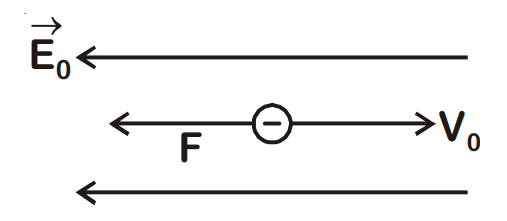
Acceleration of electron $a = \frac{eE_0}{m}$ (along +x, since the field is along –x)
Velocity after time t: $V = V_0 + \frac{eE_0}{m}t$
So, $\lambda = \frac{h}{mV} = \frac{h}{m\left(V_0 + \frac{eE_0}{m}t\right)} = \frac{h}{mV_0\left[1 + \frac{eE_0}{mV_0}t\right]}$ ...(ii)
Divide (ii) by (i): $\lambda = \frac{\lambda_0}{\left[1 + \frac{eE_0}{mV_0}t\right]}$
Photoelectric effect – stopping potential and threshold wavelength
-
When a metallic surface is illuminated with radiation of wavelength $\lambda$, the stopping potential is V. If the same surface is illuminated with radiation of wavelength $2\lambda$, the stopping potential is $\frac{V}{4}$. The threshold wavelength for the metallic surface is
Write Einstein's equation for both wavelengths and eliminate eV.
Photoelectric equation: $eV = \frac{hc}{\lambda} - \phi$, where $\phi = \frac{hc}{\lambda_{th}}$
Case I: $eV = \frac{hc}{\lambda} - \frac{hc}{\lambda_{th}}$ ...(i)
Case II: $\frac{eV}{4} = \frac{hc}{2\lambda} - \frac{hc}{\lambda_{th}} \Rightarrow eV = \frac{2hc}{\lambda} - \frac{4hc}{\lambda_{th}}$ ...(ii)
Subtracting (ii) from (i): $0 = -\frac{hc}{\lambda} + \frac{3hc}{\lambda_{th}} \Rightarrow \frac{3hc}{\lambda_{th}} = \frac{hc}{\lambda}$
$\lambda_{th} = 3\lambda$
de Broglie wavelength – electron vs photon
-
An electron of mass m and a photon have same energy E. The ratio of de-Broglie wavelength associated with them is (c being velocity of light)
Electron: $h/\sqrt{2mE}$; photon: $hc/E$.
For the electron: $\lambda_e = \frac{h}{p} = \frac{h}{\sqrt{2mE}}$ ...(iii) (since $E = \frac{p^2}{2m}$)
For the photon: $E = \frac{hc}{\lambda_p} \Rightarrow \lambda_p = \frac{hc}{E}$ ...(iv)
$\frac{\lambda_e}{\lambda_p} = \frac{h/\sqrt{2mE}}{hc/E} = \frac{E}{c\sqrt{2mE}} = \frac{1}{c}\left(\frac{E}{2m}\right)^{\frac{1}{2}}$
X-ray cut-off wavelength and de Broglie wavelength
-
Electrons of mass m with de-Broglie wavelength $\lambda$ fall on the target in an X-ray tube. The cutoff wavelength ($\lambda_0$) of the emitted X-ray is:
Entire electron KE converts to one X-ray photon at cut-off.
$\lambda = \frac{h}{p} \Rightarrow p = \frac{h}{\lambda}$; $E = \frac{p^2}{2m} = \frac{h^2}{2m\lambda^2}$
For the X-ray cut-off: $E = \frac{hc}{\lambda_0}$
$\frac{hc}{\lambda_0} = \frac{h^2}{2m\lambda^2} \Rightarrow \lambda_0 = \frac{2mc\lambda^2}{h}$
Photon picture of radiation
-
A 200 W sodium street lamp emits yellow light of wavelength 0.6 $\mu$m. Assuming it to be 25% efficient in converting electrical energy to light, the number of photons of yellow light it emits per second isLight energy emitted per second $= 200\times\frac{25}{100} = 50$ W = 50 J/s
Energy of one photon $= \frac{hc}{\lambda} = \frac{6.6\times10^{-34}\times3\times10^8}{0.6\times10^{-6}} = 3.3\times10^{-19}$ J
Number of photons per second $= \frac{50}{3.3\times10^{-19}} = \frac{50\times0.6\times10^{-6}}{6.6\times10^{-34}\times3\times10^8} = 1.5\times10^{20}$
Discovery of the Electron
-
J.J. Thomson's cathode-ray tube experiment demonstrated thatThomson deflected cathode rays with crossed electric and magnetic fields and measured their specific charge, $\dfrac{e}{m} \approx 1.76 \times 10^{11}$ C/kg.
He found that this value is the same whatever gas is used in the tube and whatever the cathode material, so cathode rays consist of identical particles (electrons) present in all atoms. They are not negatively charged ions.
The value was about 1837 times larger than the e/m of the hydrogen ion (proton), since the electron has the same magnitude of charge but much smaller mass:
$\left(\dfrac{e}{m}\right)_{electron} \gg \left(\dfrac{e}{m}\right)_{proton}$, with $\left(\dfrac{e}{m}\right)_{proton} = \dfrac{1}{1837}\left(\dfrac{e}{m}\right)_{electron}$
The nucleus was discovered later by Rutherford's alpha scattering experiment.
So the experiment demonstrated that the e/m of electrons is much greater than the e/m of protons.
That is every question in Dual Nature of Radiation and Matter for this filter.
Want a score?
Answers here are not saved. Practise as a test to be marked and see your progress.
Practise as a test