Looking for classes? Ksquare Career Institute, Bengaluru →

Physics
Work, Energy and Power
71 questions from 36 papers, each with its answer.
- 71 questions
- 36 papers
- 4.02% of Physics
Work-Energy Theorem
-
An object moving along horizontal x-direction with kinetic energy 10 J is displaced through $x=(3\hat{i})$ m by the force $\vec{F}=(-2\hat{i}+3\hat{j})$ N. The kinetic energy of the object at the end of the displacement x isBy the work-energy theorem, $W=\Delta KE$. $W=\vec{F}\cdot\vec{x}=(-2\hat{i}+3\hat{j})\cdot(3\hat{i})=-6$ J. So $K_f-10=-6\Rightarrow K_f=4$ J.
-
Consider a drop of rain water having mass 1 g falling from a height of 1 km. It hits the ground with a speed of 50 m/s. Take g constant with a value 10 m/$s^2$. The work done by the (i) gravitational force and the (ii) resistive force of air is
$W_g = mgh = 10$ J; $W_a = \Delta K - W_g$.
$W_g + W_a = K_f - K_i$ $mgh + W_a = \frac{1}{2}mv^2 - 0$ $10^{-3}\times10\times10^{3} + W_a = \frac{1}{2}\times10^{-3}\times(50)^2$ $W_a = -8.75$ J, i.e. work done by air resistance is –8.75 J and work done by gravity is 10 J. -
A block of mass 10 kg, moving in x direction with a constant speed of 10 m$s^{-1}$, is subjected to a retarding force F = 0.1x J/m during its travel from x = 20 m to 30 m. Its final KE will beWork done by the retarding force: $W = -\int_{20}^{30} 0.1x\,dx = -0.1\left[\frac{x^2}{2}\right]_{20}^{30} = -0.05(900 - 400) = -25$ J
Initial KE $= \frac{1}{2}\times 10\times 10^2 = 500$ J
By the work-energy theorem, $KE_{final} = KE_{initial} + W = 500 - 25 = 475$ J -
The upper half of an inclined plane of inclination $\theta$ is perfectly smooth while lower half is rough. A block starting from rest at the top of the plane will again come to rest at the bottom, if the coefficient of friction between the block and lower half of the plane is given by:Let each half have length s. Work-energy theorem ($W = \Delta KE$):
$(mg\sin\theta)(2s) - (\mu mg\cos\theta)(s) = 0 - 0$
$\mu = 2\tan\theta$ -
A vertical spring with force constant $k$ is fixed on a table. A ball of mass $m$ at a height $h$ above the free upper end of the spring falls vertically on the spring so that the spring is compressed by a distance $d$. The net work done in the process isThe ball falls through a total height $(h + d)$: $h$ before touching the spring and $d$ while compressing it.
Work done by gravity $= +mg(h + d)$
The spring force opposes the compression, so the work done by the spring force $= -\dfrac{1}{2}kd^2$
Net work done $= mg(h + d) - \dfrac{1}{2}kd^2$
The ball starts from rest and is momentarily at rest at maximum compression, so by the work-energy theorem this net work is zero: the gravitational potential energy lost by the ball gets converted into the elastic potential energy of the spring, $mg(h + d) = \dfrac{1}{2}kd^2$.
So the expression for the net work done is $mg(h + d) - \dfrac{1}{2}kd^2$.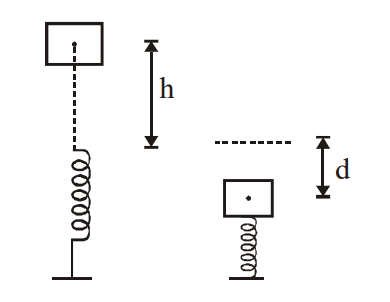
-
A body of mass 3 kg is under a constant force which causes a displacement $s$ in metres in it, given by the relation $s = \dfrac{1}{3}t^2$, where $t$ is in seconds. Work done by the force in 2 seconds is :-By the work-energy theorem: $W = \Delta KE = \dfrac{1}{2}mv_2^2 - \dfrac{1}{2}mv_1^2$
Now $s = \dfrac{1}{3}t^2 \Rightarrow v = \dfrac{ds}{dt} = \dfrac{2}{3}t$
At $t = 0$: $v_1 = 0$
At $t = 2$ s: $v_2 = \dfrac{2}{3} \times 2 = \dfrac{4}{3}$ m s$^{-1}$
Therefore $W = \dfrac{1}{2} \times 3 \times \left(\dfrac{4}{3}\right)^2 - \dfrac{1}{2} \times 3 \times (0)^2$
$W = \dfrac{3}{2} \times \dfrac{16}{9} = \dfrac{8}{3}$ J
Check: $a = \dfrac{2}{3}$ m s$^{-2}$, $F = ma = 2$ N, $s = \dfrac{4}{3}$ m, so $W = Fs = \dfrac{8}{3}$ J.
Vertical Circular Motion
-
A bob of heavy mass $m$ is suspended by a light string of length $l$. The bob is given a horizontal velocity $v_0$ as shown in figure. If the string gets slack at some point P making an angle $\theta$ from the horizontal, the ratio of the speed $v$ of the bob at point P to its initial speed $v_0$ is:
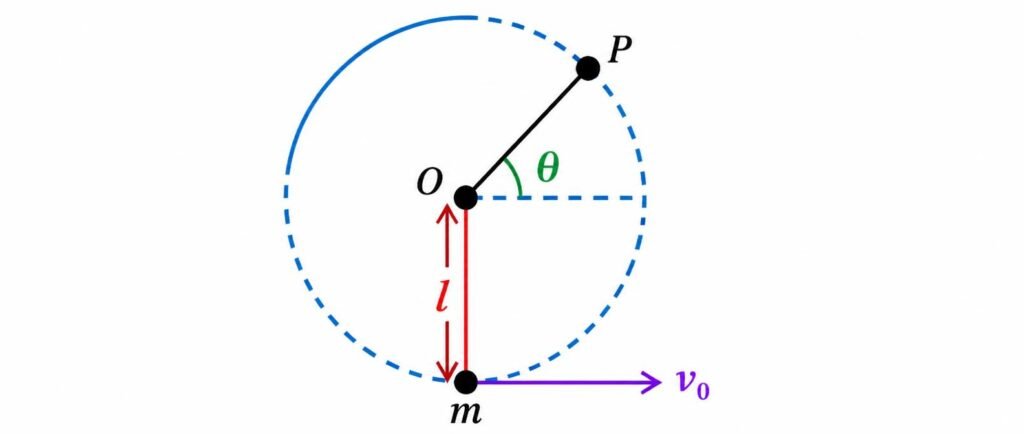
Setting tension $T = 0$ at slack point P gives $v = \sqrt{gl \sin\theta}$. Using conservation of energy gives $v_0 = \sqrt{gl(2 + 3\sin\theta)}$, so $v/v_0 = \sqrt{\frac{\sin\theta}{2 + 3\sin\theta}}$.
At point P where the string goes slack, tension $T = 0$. The radial component of gravity provides the necessary centripetal force: $mg \sin\theta = \frac{m v^2}{l} \implies v^2 = gl \sin\theta$. By conservation of mechanical energy between the lowest point and point P: $\frac{1}{2} m v_0^2 = \frac{1}{2} m v^2 + mg(l + l \sin\theta)$. Multiplying by $2/m$: $v_0^2 = v^2 + 2gl(1 + \sin\theta) = gl \sin\theta + 2gl + 2gl \sin\theta = gl(2 + 3\sin\theta)$. Thus, the ratio of speeds is $\frac{v}{v_0} = \sqrt{\frac{gl \sin\theta}{gl(2 + 3\sin\theta)}} = \left(\frac{\sin\theta}{2 + 3\sin\theta}\right)^{1/2}$.
Potential Energy of a Spring
-
Two similar springs P and Q have spring constants $K_P$ and $K_Q$, such that $K_P > K_Q$. They are stretched, first by the same amount (case a), then by the same force (case b). The work done by the springs $W_P$ and $W_Q$ are related as in case (a) and case (b), respectively:Given $K_P > K_Q$.
Case (a), same extension x: $W = \frac{1}{2}Kx^2 \Rightarrow W \propto K$, so $W_P > W_Q$.
Case (b), same force F: $x = \frac{F}{K}$, so $W = \frac{F^2}{2K} \Rightarrow W \propto \frac{1}{K}$, so $W_Q > W_P$. -
A block of mass M is attached to the lower end of a vertical spring. The spring is hung from a ceiling and has force constant value k. The mass is released from rest with the spring initially unstretched. The maximum extension produced in the length of the spring will beThe block is released from rest and comes momentarily to rest again at the maximum extension x, so its kinetic energy is zero at both positions.
Loss of gravitational potential energy = gain in elastic potential energy of the spring.
$Mgx = \frac{1}{2}kx^2$
$x = \frac{2Mg}{k}$
(This is twice the equilibrium extension Mg/k, because the block overshoots the equilibrium position and oscillates about it.)
Power
-
An electric lift with a maximum load of 2000 kg (lift + passengers) is moving up with a constant speed of $1.5\ ms^{-1}$. The frictional force opposing the motion is 3000 N. The minimum power delivered by the motor to the lift in watts is : ($g=10\ ms^{-2}$)The lift moves with constant velocity, so a = 0. Tension (force by motor) $T = W + f = 2000 \times 10 + 3000 = 23000$ N Power $= Tv = 23000 \times 1.5 = 34500$ W
-
A particle of mass m is driven by a machine that delivers a constant power k watts. If the particle starts from rest the force on the particle at time t isWork done in time t: $W = Pt = kt$
By the work-energy theorem, $\frac{1}{2}mv^2 = kt \Rightarrow v = \sqrt{\frac{2kt}{m}}$
$P = Fv \Rightarrow F = \frac{k}{v} = k\sqrt{\frac{m}{2kt}} = \sqrt{\frac{mk}{2t}}$
$F = \sqrt{\frac{mk}{2}}\,t^{-1/2}$ -
A car of mass m starts from rest and accelerates so that the instantaneous power delivered to the car has a constant magnitude $P_0$. The instantaneous velocity of this car is proportional to$P_0 = Fv = m\frac{dv}{dt}v$
$v\,dv = \frac{P_0}{m}dt$
Integrating from rest: $\frac{v^2}{2} = \frac{P_0}{m}t$
$v = \sqrt{\frac{2P_0t}{m}} \Rightarrow v \propto t^{1/2}$ -
A body projected vertically from the earth reaches a height equal to earth's radius before returning to the earth. The power exerted by the gravitational force is greatestPower delivered by a force is $P = \vec{F}\cdot\vec{v} = Fv\cos\theta$
Just after projection, the velocity is upward and gravity is downward, so $\theta = 180^\circ$ and the power is negative.
At the highest point, v = 0, so the power is zero.
Just before the body hits the earth, the velocity is downward, i.e., along the force ($\theta = 0^\circ$, $\cos\theta = 1$).
At that instant the speed is maximum and the gravitational force is also maximum (the body is nearest to the earth), so $P = Fv$ is the greatest.
Hence the power is greatest at the instant just before the body hits the earth. -
An engine pumps water through a hose pipe. Water passes through the pipe and leaves it with a velocity of 2 m/s. The mass per unit length of water in the pipe is 100 kg/m. What is the power of the engine?Mass of water flowing out per second: $\frac{dm}{dt} = (\text{mass per unit length})\times v = 100\times2 = 200$ kg/s
Force exerted by the engine on the water = rate of change of momentum = $v\frac{dm}{dt} = 2\times200 = 400$ N
Power = force × velocity = $Fv = 400\times2$
In symbols, with $\lambda$ = mass per unit length: $P = \lambda v^3 = 100\times2^3$
P = 800 W -
An engine pumps water continuously through a hose. Water leaves the hose with a velocity v and m is the mass per unit length of the water jet. What is the rate at which kinetic energy is imparted to water?In time dt, a length $v\,dt$ of the water jet leaves the hose.
Mass of water leaving in time dt: $dM = m\times v\,dt$, so $\frac{dM}{dt} = mv$
Kinetic energy carried by this mass: $dK = \frac{1}{2}(dM)v^2$
Rate at which kinetic energy is imparted: $\frac{dK}{dt} = \frac{1}{2}\frac{dM}{dt}v^2 = \frac{1}{2}(mv)v^2$
$\frac{dK}{dt} = \frac{1}{2}mv^3$
Collisions – Impulse
-
A ball of mass 0.15 kg is dropped from a height 10 m, strikes the ground and rebounds to the same height. The magnitude of impulse imparted to the ball is ($g=10\ m/s^2$) nearly:Velocity just before striking the ground: $v_1 = \sqrt{2gh} = \sqrt{2 \times 10 \times 10} = 10\sqrt{2}$ m/s (downward) It rebounds to the same height, so the speed just after is the same, $10\sqrt{2}$ m/s (upward). Impulse $= m|\Delta v| = 0.15 \times [10\sqrt{2} - (-10\sqrt{2})] = 0.15 \times 20\sqrt{2}$ $= 3\sqrt{2} \approx 4.2$ kg m/s
Collisions – Elastic Collision in One Dimension
-
Body A of mass $4m$ moving with speed $u$ collides with another body B of mass $2m$, at rest. The collision is head on and elastic in nature. After the collision the fraction of energy lost by the colliding body A is:Fractional loss of KE of the colliding body in a head-on elastic collision: $\frac{\Delta KE}{KE}=\frac{4m_1m_2}{(m_1+m_2)^2}$ $=\frac{4\times4m\times2m}{(4m+2m)^2}=\frac{32m^2}{36m^2}=\frac{8}{9}$
Energy conservation in free fall and rebound
-
An object falls from a height of 10 m above the ground. After striking the ground it loses 50% of its kinetic energy. The height upto which the object can rebounce from the ground is:KE before striking ground: $K_1=mgh_1=mg(10)$. After losing 50%, $K_2=\dfrac{1}{2}K_1=mg(5)$. Since $K_2=mgh_2$, $h_2=5$ m.
Elastic collisions - maximum energy transfer
-
A bullet of mass m hits a block of mass M elastically. The transfer of energy is the maximum, when:In a one-dimensional elastic collision, the maximum energy transfer from the bullet to the block occurs when the masses are equal, i.e. $M=m$.
Instantaneous power as dot product of force and velocity
-
A particle moves with a velocity $(5\hat{i}-3\hat{j}+6\hat{k})$ m s$^{-1}$ horizontally under the action of constant force $(10\hat{i}+10\hat{j}+20\hat{k})$N. The instantaneous power supplied to the particle is:$P=\vec F\cdot\vec V=(10\hat i+10\hat j+20\hat k)\cdot(5\hat i-3\hat j+6\hat k)=50-30+120=140$ W.
Energy released in explosion
-
A particle of mass 5m at rest suddenly breaks on its own into three fragments. Two fragments of mass m each move along mutually perpendicular direction with speed v each. The energy released during the process is:Momentum conservation: $mv\hat{i}+mv\hat{j}+3m\vec{v}'=0 \Rightarrow |\vec{v}'|=\frac{\sqrt{2}v}{3}$. Energy released $=\frac{1}{2}mv^2+\frac{1}{2}mv^2+\frac{1}{2}(3m)\frac{2v^2}{9}=\frac{4}{3}mv^2$.
Work done by a variable force - friction
-
A particle of mass M moves along a horizontal x axis from x = 0 to x = L. The coefficient of kinetic friction varies as a function of x as $\mu_k(x)=\mu_0-\alpha x$, where $\mu_0$, $\alpha$ are constants of appropriate dimensions, so that $\mu_k(L)=0$. The total work done by the frictional force during the motion is $n\mu_0MgL$, where g is the acceleration due to gravity. The value of n is:$\mu_k=\mu_0-\alpha x$ and $\mu_k(L)=0 \Rightarrow \alpha=\frac{\mu_0}{L}$. Work done by kinetic friction $=-\int_0^L(\mu_0-\alpha x)mg\,dx=-\left[\mu_0mgL-\alpha mg\frac{L^2}{2}\right]=-\left[\mu_0mgL-\frac{\mu_0}{L}mg\frac{L^2}{2}\right]=-\frac{\mu_0mgL}{2}$. Comparing the magnitude with $n\mu_0mgL$: $n=\frac{1}{2}$.
Motion in a vertical circle – energy conservation
-
A body initially at rest and sliding along a frictionless track from a height h (as shown in the figure) just completes a vertical circle of diameter AB = D. The height h is equal to
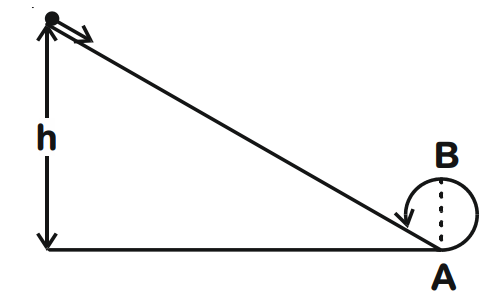
Minimum speed at the bottom is $\sqrt{5gR}$, so $h = 5R/2 = 5D/4$.
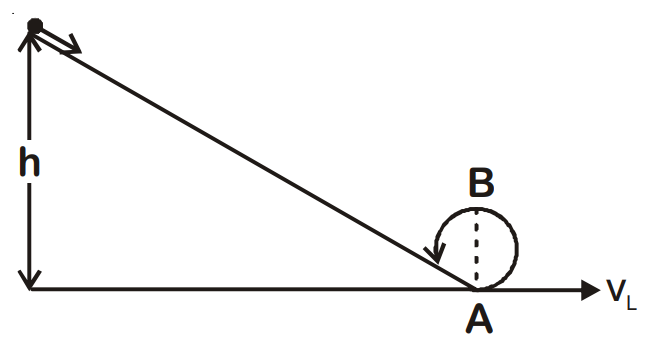
As the track is frictionless, total mechanical energy remains constant.
$T.M.E_I = T.M.E_F \Rightarrow 0 + mgh = \frac{1}{2}mv_L^2 + 0$
$h = \frac{v_L^2}{2g}$
For completing the vertical circle, $v_L = \sqrt{5gR}$
$h = \frac{5gR}{2g} = \frac{5}{2}R = \frac{5}{4}D$
Power delivered by a time-varying force
-
A body of mass 1 kg begins to move under the action of a time dependent force $\vec{F} = (2t\hat{i} + 3t^2\hat{j})$ N, where $\hat{i}$ and $\hat{j}$ are unit vectors along X and Y axis. What power will be developed by the force at the time (t)?
Integrate a(t) to get v(t), then $P = \vec{F}\cdot\vec{v}$.
$\vec{a} = \frac{\vec{F}}{m} = 2t\hat{i} + 3t^2\hat{j}$ (m = 1 kg)
$d\vec{v} = (2t\hat{i} + 3t^2\hat{j})dt \Rightarrow \vec{v} = t^2\hat{i} + t^3\hat{j}$
Power $P = \vec{F}\cdot\vec{v} = (2t\hat{i} + 3t^2\hat{j})\cdot(t^2\hat{i} + t^3\hat{j})$
$P = (2t^3 + 3t^5)$ W
Note: the source solution's final line prints $(2t^3 + 4t^5)$ W, which is the keyed option; the dot product actually gives $2t^3 + 3t^5$, which matches none of the options. Please check this question before use.
Motion in a vertical circle
-
A stone is tied to a string of length '$l$' and is whirled in a vertical circle with the other end of the string as the centre. At a certain instant of time, the stone is at its lowest position and has a speed 'u'. The magnitude of the change in velocity as it reaches a position where the string is horizontal (g being acceleration due to gravity) is :-Let A be the lowest point (speed $V_A = u$, horizontal) and P the point where the string is horizontal (height $l$ above A).
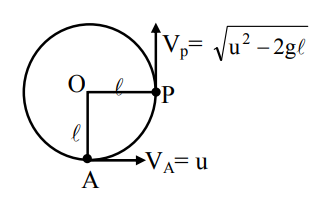
By conservation of energy between A and P: $\dfrac{1}{2}mu^2 = \dfrac{1}{2}mV_P^2 + mgl$
$\Rightarrow V_P = \sqrt{u^2 - 2gl}$
At A the velocity is horizontal; at P (string horizontal) the velocity is vertical. So the angle between $\vec{V}_A$ and $\vec{V}_P$ is $90^\circ$.
Magnitude of change in velocity $= |\vec{V}_P - \vec{V}_A| = \sqrt{V_P^2 + V_A^2}$ (because the two vectors are perpendicular)
$= \sqrt{(u^2 - 2gl) + u^2} = \sqrt{2u^2 - 2gl}$
$= \sqrt{2(u^2 - gl)}$
Collision with ballistic pendulum
-
A bullet of mass 10g moving horizontally with a velocity of 400 $ms^{-1}$ strikes a wooden block of mass 2 kg which is suspended by a light inextensible string of length 5 m. As a result, the centre of gravity of the block is found to rise a vertical distance of 10 cm. The speed of the bullet after it emerges out horizontally from the block will be:
Get block speed from its rise, then conserve momentum.
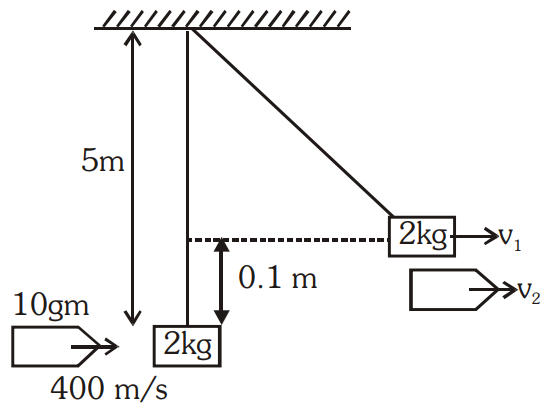
Momentum conservation: $\frac{10}{1000}\times400 + 0 = 2\times v_1 + \frac{10}{1000}\times v_2 \Rightarrow 4 = 2v_1 + 0.01v_2$ ...(1)
Work–energy theorem for the block: $2\times10\times0.1 = \frac{1}{2}\times2\times v_1^2 \Rightarrow v_1 = \sqrt{2} = 1.4$ m/s
Putting $v_1$ in (1): $4 = 2\times1.4 + 0.01v_2 \Rightarrow v_2 = 120$ m/s
Collisions
-
A ball moving with velocity 2 m/s collides head on with another stationary ball of double the mass. If the coefficient of restitution is 0.5, then their velocities (in m/s) after collision will beLet the masses be m and 2m and the velocities after collision be $v_1$ and $v_2$.
Conservation of momentum: $m\times2 + 2m\times0 = mv_1 + 2mv_2$, so $v_1 + 2v_2 = 2$ ... (i)
Coefficient of restitution: $e = \frac{v_2 - v_1}{u_1 - u_2}$, so $v_2 - v_1 = 0.5\times(2 - 0) = 1$ ... (ii)
Adding (i) and (ii): $3v_2 = 3$, so $v_2 = 1$ m/s
From (ii): $v_1 = v_2 - 1 = 0$
The velocities after collision are 0 and 1 m/s.
Conservation of energy
-
A ball is thrown vertically downwards from a height of 20 m with an initial velocity $u_0$. It collides with the ground, loses 50 percent of its energy in collision and rebounds to the same height. The initial velocity $u_0$ is: (Take g = 10 $ms^{-2}$)Rebound speed: $v = \sqrt{2gh} = \sqrt{2\times10\times20} = 20$ m/s
Energy just after rebound: $E = \frac{1}{2}mv^2 = 200m$
50% is lost in the collision, so the energy just before collision = 400m.
$\frac{1}{2}mu_0^2 + mgh = 400m \Rightarrow \frac{1}{2}u_0^2 + 200 = 400 \Rightarrow u_0 = 20$ m/s
Elastic collisions
-
On a frictionless surface, a block of mass M moving at speed v collides elastically with another block of same mass M which is initially at rest. After collision the first block moves at an angle $\theta$ to its initial direction and has a speed $\frac{v}{3}$. The second block's speed after the collision is:In an elastic collision kinetic energy is conserved:
$\frac{1}{2}Mv^2 = \frac{1}{2}M\left(\frac{v}{3}\right)^2 + \frac{1}{2}Mv'^2$
$v' = \sqrt{v^2 - \frac{v^2}{9}} = \frac{2\sqrt2}{3}v$
Conservation of momentum
-
A body of mass (4m) is lying in x-y plane at rest. It suddenly explodes into three pieces. Two pieces, each of mass (m) move perpendicular to each other with equal speeds (v). The total kinetic energy generated due to explosion is:The third piece has mass 2m. By conservation of linear momentum: $2mv_1 = \sqrt2\,mv \Rightarrow v_1 = \frac{v}{\sqrt2}$
Total KE $= \frac{1}{2}mv^2 + \frac{1}{2}mv^2 + \frac{1}{2}(2m)v_1^2 = mv^2 + \frac{mv^2}{2} = \frac{3}{2}mv^2$
Collisions in two dimensions
-
Two spheres A and B of masses $m_1$ and $m_2$ respectively collide. A is at rest initially and B is moving with velocity v along x-axis. After collision B has a velocity $\frac{v}{2}$ in a direction perpendicular to the original direction. The mass A moves after collision in the directionLet A move with speed $v_1$ at angle $\theta$ to the x-axis after the collision.
Momentum along x: $m_1v_1\cos\theta = m_2v$ ...(i)
Momentum along y: $m_1v_1\sin\theta = m_2\frac{v}{2}$ ...(ii) (equal and opposite to B's y-momentum)
Dividing (ii) by (i): $\tan\theta = \frac{1}{2}$
$\theta = \tan^{-1}\left(\frac{1}{2}\right)$ to the x-axis
Potential energy and equilibrium
-
The potential energy of a particle in a force field is: $U = \frac{A}{r^2} - \frac{B}{r}$, where A and B are positive constants and r is the distance of particle from the centre of the field. For stable equilibrium the distance of the particle is$F = -\frac{dU}{dr} = -\left(-\frac{2A}{r^3} + \frac{B}{r^2}\right) = \frac{2A}{r^3} - \frac{B}{r^2}$
For equilibrium F = 0: $\frac{2A}{r^3} = \frac{B}{r^2}$
$r = \frac{2A}{B}$
At this r, $\frac{d^2U}{dr^2} > 0$ (U is a minimum), so the equilibrium is stable.
Conservation of Momentum and Energy
-
A shell of mass 200 g is ejected from a gun of mass 4 kg by an explosion that generates 1.05 kJ of energy. The initial velocity of the shell is -Let $m_1 = 4$ kg (gun) recoil with speed $v_1$ and $m_2 = 0.2$ kg (shell) move with speed $v_2$.
Conservation of momentum (system initially at rest): $m_1 v_1 = m_2 v_2$
$4\,v_1 = \dfrac{200}{1000}\,v_2 \Rightarrow v_1 = \dfrac{v_2}{20}$ ...(1)
The energy of the explosion appears as kinetic energy: $\dfrac{1}{2}m_1 v_1^2 + \dfrac{1}{2}m_2 v_2^2 = 1.05 \times 10^{3}$ J
$\dfrac{1}{2} \times 4 \times v_1^2 + \dfrac{1}{2} \times 0.2 \times v_2^2 = 1050$
$2v_1^2 + 0.1\,v_2^2 = 1050$ ...(2)
Substituting (1) in (2): $2 \times \dfrac{v_2^2}{400} + 0.1\,v_2^2 = 1050$
$0.005\,v_2^2 + 0.1\,v_2^2 = 1050 \Rightarrow 0.105\,v_2^2 = 1050$
$v_2^2 = 10000 \Rightarrow v_2 = 100$ m/s
So the initial velocity of the shell is 100 m s$^{-1}$.
Relation between Kinetic Energy and Momentum
-
If kinetic energy of a body is increased by 300% then percentage change in momentum will beMomentum and kinetic energy: $P = \sqrt{2mE}$
Increase of 300 percent means $E_2 = E_1 + 3E_1 = 4E_1$.
$P_2 = \sqrt{2m(4E_1)} = 2\sqrt{2mE_1} = 2P_1$
Percentage change $= \dfrac{P_2 - P_1}{P_1} \times 100 = \dfrac{2P_1 - P_1}{P_1} \times 100 = 100$ percent
So the momentum increases by 100%.
That is every question in Work, Energy and Power for this filter.
Show all 71 questions Next: System of Particles and Rotational Motion
Want a score?
Answers here are not saved. Practise as a test to be marked and see your progress.
Practise as a test