Looking for classes? Ksquare Career Institute, Bengaluru →

Physics
Atoms
55 questions from 36 papers, each with its answer.
- 55 questions
- 36 papers
- 3.12% of Physics
Bohr Model and Magnetic Moment
-
A model for quantized motion of an electron in a uniform magnetic field $B$ states that the flux passing through the orbit of the electron is $n(h/e)$ where $n$ is an integer, $h$ is Planck's constant and $e$ is the magnitude of electron's charge. According to the model, the magnetic moment of an electron in its lowest energy state will be ($m$ is the mass of the electron):
For $n=1$, flux $\Phi = B \pi r^2 = h/e \implies r^2 = \frac{h}{\pi e B}$. Orbital current is $I = \frac{e^2 B}{2\pi m}$, yielding magnetic moment $\mu = I A = \frac{he}{2\pi m}$.
The quantized flux is $\Phi = B A = B (\pi r^2) = n \frac{h}{e}$. For the lowest state ($n = 1$), $r^2 = \frac{h}{\pi e B}$. In a magnetic field, the centripetal balance gives $\frac{m v^2}{r} = e v B \implies v = \frac{e B r}{m}$. The orbital period is $T = \frac{2\pi r}{v} = \frac{2\pi m}{e B}$. The effective current is $I = \frac{e}{T} = \frac{e^2 B}{2\pi m}$. The orbital magnetic moment is $\mu = I A = I (\pi r^2) = \left(\frac{e^2 B}{2\pi m}\right) \left(\frac{h}{e B}\right) = \frac{h e}{2\pi m}$ (Bohr magneton).
Bohr's Postulates and Generalized Central Force
-
A particle of mass $m$ is moving around the origin with a constant force $F$ pulling it towards the origin. If Bohr model is used to describe its motion, the radius $r$ of the $n^{\text{th}}$ orbit and the particle's speed $v$ in the orbit depend on $n$ as:
Centripetal balance $\frac{mv^2}{r} = F \implies v \propto r^{1/2}$. Angular momentum quantization $mvr = \frac{nh}{2\pi} \implies r^{3/2} \propto n \implies r \propto n^{2/3}$ and $v \propto n^{1/3}$.
For circular motion under a constant centripetal force $F$: $\frac{m v^2}{r} = F = \text{constant} \implies v = \sqrt{\frac{F r}{m}} \implies v \propto r^{1/2}$. According to the Bohr quantization postulate: $L = m v r = \frac{n h}{2\pi}$. Substituting $v \propto r^{1/2}$: $m (r^{1/2}) r \propto n \implies r^{3/2} \propto n \implies r \propto n^{2/3}$. Consequently, the orbital speed scales as: $v \propto r^{1/2} \propto (n^{2/3})^{1/2} = n^{1/3}$. Therefore, $r \propto n^{2/3}$ and $v \propto n^{1/3}$.
Hydrogen Spectral Series (Balmer Series)
-
Match the List-I (spectral lines of Hydrogen for transitions from) with List-II (Wavelengths) below.
Pick the matching item from Column II for each row.
Column I
- A. $n_2=3$ to $n_1=2$
- B. $n_2=4$ to $n_1=2$
- C. $n_2=5$ to $n_1=2$
- D. $n_2=6$ to $n_1=2$
Column II
- I. 410.2 nm
- II. 434.1 nm
- III. 656.3 nm
- IV. 486.1 nm
Correct answer: A → III, B → IV, C → II, D → I
$\frac{1}{\lambda} = R\left(\frac{1}{n_1^2} - \frac{1}{n_2^2}\right)$ Here $n_1 = 2$ is fixed (Balmer series), so as $n_2$ increases, $\frac{1}{\lambda}$ increases, i.e. the wavelength decreases. $n_2 = 3 \rightarrow 2$: 656.3 nm (longest) $n_2 = 4 \rightarrow 2$: 486.1 nm $n_2 = 5 \rightarrow 2$: 434.1 nm $n_2 = 6 \rightarrow 2$: 410.2 nm (shortest) Correct match: A-III, B-IV, C-II, D-I.
Spectral Series of Hydrogen
-
In hydrogen spectrum, the shortest wavelength in the Balmer series is $\lambda$. The shortest wavelength in the Bracket series is :
Series limit gives $\lambda=\frac{4}{R}$ (Balmer) and $\lambda'=\frac{16}{R}$ (Brackett), so $\lambda'=4\lambda$.
$\because\frac{1}{\lambda}=R\left(\frac{1}{n_2^2}-\frac{1}{n_1^2}\right)$ Balmer: $\frac{1}{\lambda}=R\left(\frac{1}{2^2}\right)\Rightarrow\lambda=\frac{4}{R}$ Brackett: $\frac{1}{\lambda'}=R\left(\frac{1}{4^2}\right)\Rightarrow\lambda'=\frac{16}{R}$ $\Rightarrow\lambda'=4\lambda$
Bohr Model – Energy Levels
-
Let $T_1$ and $T_2$ be the energy of an electron in the first and second excited states of hydrogen atom, respectively. According to the Bohr's model of an atom, the ratio $T_1:T_2$ is :First excited state: n = 2, $T_1 = -13.6\frac{Z^2}{n^2} = -\frac{13.6}{4}$ eV Second excited state: n = 3, $T_2 = -\frac{13.6}{9}$ eV $T_1 : T_2 = \frac{1}{4} : \frac{1}{9} = 9 : 4$
Bohr Model of the Hydrogen Atom – Limitations
-
For which one of the following, Bohr model is not valid?The Bohr model is valid only for single-electron (hydrogen-like) species, such as H, deuterium and $He^+$. A singly ionised neon atom ($Ne^+$) has more than one electron, so the Bohr model is not valid for it.
Bohr Model – Energy of an Electron in an Orbit
-
The total energy of an electron in an atom in an orbit is $-3.4\ eV$. Its kinetic and potential energies are, respectively:In Bohr's model, $K.E.=-T.E.$ and $U=2\,T.E.$ Given $T.E.=-3.4\ eV$ $\Rightarrow K.E.=3.4\ eV$ $\Rightarrow U=2(-3.4)=-6.8\ eV$
Hydrogen spectrum - spectral series
-
The spectral series which corresponds to the electronic transition from the levels $n_2=5,6,\ldots$ to the level $n_1=4$ isTransitions ending at $n_1=4$ correspond to the Brackett series (Pfund is $n_1=5$, Lyman is $n_1=1$, Balmer is $n_1=2$).
Energy level transitions and photon wavelength
-
Some energy levels of a molecule are shown in the figure with their wavelengths of transitions. Then:
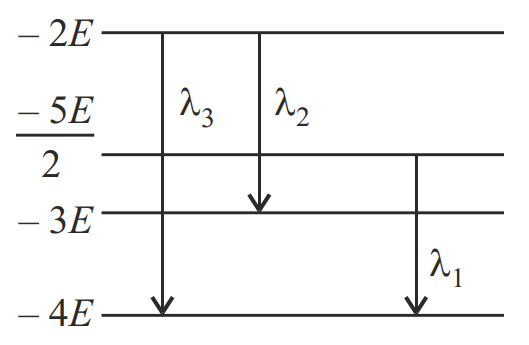 From the energy level diagram: $\dfrac{hc}{\lambda_1}=-\dfrac{5E}{2}+4E=\dfrac{3E}{2}$; $\dfrac{hc}{\lambda_2}=-2E+3E=E$; $\dfrac{hc}{\lambda_3}=-2E+4E=2E$. Comparing $\lambda_2,\lambda_3$: $\dfrac{1}{\lambda_3}=\dfrac{2}{\lambda_2}\Rightarrow\lambda_2=2\lambda_3$. Comparing $\lambda_1,\lambda_2$: $3\lambda_1=2\lambda_2\Rightarrow\lambda_1\lambda_1,\ \lambda_2=2\lambda_3$.
Bohr model - total energy of electron in nth orbit
-
The total energy of an electron in the nth stationary orbit of the hydrogen atom can be obtained byFor the hydrogen atom, the total energy of the electron in the nth orbit is $E_n=\dfrac{-13.6}{n^2}$ eV.
Bohr model - ionization energy from an excited state
-
The ground state energy of hydrogen atom is $-13.6$ eV. The energy needed to ionize hydrogen atom from its second excited state will be:$E_n=\dfrac{-13.6Z^2}{n^2}$ eV. Ground state: $n=1$; second excited state: $n=3$. $\dfrac{E_3}{E_1}=\left(\dfrac{n_1}{n_3}\right)^2=\left(\dfrac{1}{3}\right)^2=\dfrac{1}{9}$. $E_3=\dfrac{E_1}{9}=\dfrac{13.6\ eV}{9}=1.51$ eV. Ionization energy from the second excited state equals $|E_3|=1.51$ eV.
Hydrogen spectrum - Lyman series
-
The wavelength of Lyman series of hydrogen atom appears in:$\dfrac{1}{\lambda}=R\left(\dfrac{1}{1^2}-\dfrac{1}{n^2}\right)$ for $n=2,3,4,\ldots$. Calculating the range: $(\lambda_L)_{max}=\dfrac{4}{3R}=\dfrac{4}{3}\times912\ \text{Å}=1216$ Å, and $(\lambda_L)_{min}=\dfrac{1}{R}\approx912$ Å. The range of $\lambda$ is 912 Å to 1216 Å, which lies in the UV region.
Bohr model - angular momentum quantization and orbit energy
-
The angular momentum of an electron moving in an orbit of hydrogen atom is $1.5\left(\dfrac{h}{\pi}\right)$. The energy in the same orbit is nearly.Given $mvr=1.5\dfrac{h}{\pi}$. Comparing with $mvr=n\dfrac{h}{2\pi}$: $\dfrac{n}{2}=1.5\Rightarrow n=3$. $E_3=\dfrac{-13.6}{3^2}\ eV\approx-1.5$ eV.
Bohr model - radius and velocity
-
Consider that an electron is revolving in an excited state of Hydrogen atom with velocity $\sqrt{25.6}\times10^5$ ms$^{-1}$. The radius of the orbit is $x\times10^{-9}$ m. The value of x is: [Take the mass of electron to be $9\times10^{-31}$ kg, charge of electron = $-1.6\times10^{-19}$ C and $\frac{1}{4\pi\varepsilon_0}=9\times10^9$ Nm$^2$C$^{-2}$]$\frac{mv^2}{r}=\frac{1}{4\pi\varepsilon_0}\frac{e^2}{r^2} \Rightarrow r=\frac{9\times10^9\times(1.6\times10^{-19})^2}{9\times10^{-31}\times25.6\times10^{10}}=\frac{256\times10^{-40}}{256\times10^4\times10^5}\times\frac{10^9}{10^{-31}}=1\times10^{-9}$ m. So x = 1.
Bohr model
-
Consider 3rd orbit of $He^+$ (Helium), using non-relativistic approach, the speed of electron in this orbit will be [given K = $9\times 10^9$ constant, Z = 2 and h (Planck's constant) = $6.6\times 10^{-34}$ Js]$v_n = \frac{2\pi KZe^2}{nh} = \left(\frac{Z}{n}\right)\frac{2\pi Ke^2}{h}$
$\frac{2\pi Ke^2}{h} = \frac{2\times 3.14\times 9\times10^9\times(1.6\times10^{-19})^2}{6.6\times10^{-34}} \approx 2.2\times 10^6$ m/s
$v_3 = \frac{2}{3}\times 2.2\times 10^6 = 1.46\times 10^6$ m/s
Hydrogen spectrum
-
Hydrogen atom in ground state is excited by a monochromatic radiation of $\lambda$ = 975 Å. Number of spectral lines in the resulting spectrum emitted will beEnergy of the photon: $E = \frac{12400}{975}$ eV ≈ 12.75 eV
Energy of the excited state $= -13.6 + 12.75 = -0.85$ eV, which is the n = 4 level.
Number of spectral lines from n = 4: $\frac{n(n-1)}{2} = \frac{4\times3}{2} = 6$ -
An electron of a stationary hydrogen atom passes from the fifth energy level to the ground level. The velocity that the atom acquired as a result of photon emission will be (m is the mass of the electron, R, Rydberg constant and h, Planck's constant)Energy of the emitted photon: $E = hcR\left(\frac{1}{1^2} - \frac{1}{5^2}\right) = \frac{24}{25}hcR$
Momentum of the photon: $p = \frac{E}{c} = \frac{24hR}{25}$
By conservation of momentum the atom recoils with an equal momentum.
Velocity $= \frac{p}{m} = \frac{24hR}{25m}$ -
Electron in hydrogen atom first jumps from third excited state to second excited state and then from second excited to the first excited state. The ratio of the wavelengths $\lambda_1 : \lambda_2$ emitted in the two cases isThird excited state is n = 4, second excited state is n = 3 and first excited state is n = 2.
$\frac{1}{\lambda_1} = R\left(\frac{1}{3^2} - \frac{1}{4^2}\right) = R\left(\frac{1}{9} - \frac{1}{16}\right) = \frac{7R}{144}$
$\frac{1}{\lambda_2} = R\left(\frac{1}{2^2} - \frac{1}{3^2}\right) = R\left(\frac{1}{4} - \frac{1}{9}\right) = \frac{5R}{36}$
$\frac{\lambda_1}{\lambda_2} = \frac{5R/36}{7R/144} = \frac{20}{7}$ -
The wavelength of the first line of Lyman series for hydrogen atom is equal to that of the second line of Balmer series for a hydrogen like ion. The atomic number Z of hydrogen like ion isRydberg formula: $\frac{1}{\lambda} = RZ^2\left(\frac{1}{n_1^2} - \frac{1}{n_2^2}\right)$
First line of Lyman series of hydrogen (Z = 1, $n_1 = 1$, $n_2 = 2$): $\frac{1}{\lambda} = R\left(1 - \frac{1}{4}\right) = \frac{3R}{4}$
Second line of Balmer series of the ion ($n_1 = 2$, $n_2 = 4$): $\frac{1}{\lambda} = RZ^2\left(\frac{1}{4} - \frac{1}{16}\right) = \frac{3RZ^2}{16}$
The wavelengths are equal: $\frac{3R}{4} = \frac{3RZ^2}{16}$
$Z^2 = 4$
Z = 2 -
The ionization energy of the electron in the hydrogen atom in its ground state is 13.6 eV. The atoms are excited to higher energy levels to emit radiations of 6 wavelengths. Maximum wavelength of emitted radiation corresponds to the transition betweenNumber of spectral lines emitted when atoms de-excite from level n: $N = \frac{n(n - 1)}{2}$
$\frac{n(n - 1)}{2} = 6$ gives $n(n - 1) = 12$, so n = 4. The atoms are excited to the n = 4 level.
Maximum wavelength corresponds to minimum energy of the photon, since $E = \frac{hc}{\lambda}$.
The energy levels get closer as n increases, so the smallest energy gap among the levels 1 to 4 is between n = 4 and n = 3.
$E_4 - E_3 = 13.6\left(\frac{1}{9} - \frac{1}{16}\right) = 0.66$ eV, which is less than $E_3 - E_2$ = 1.89 eV and $E_2 - E_1$ = 10.2 eV.
Hence the maximum wavelength corresponds to the transition from n = 4 to n = 3. -
Ionization potential of hydrogen atom is 13.6 eV. Hydrogen atoms in the ground state are excited by monochromatic radiation of photon energy 12.1 eV. According to Bohr's theory, the spectral lines emitted by hydrogen will be :-Energy of the $n$th level: $E_n = -\dfrac{13.6}{n^2}$ eV. The atom absorbs 12.1 eV and goes from $n = 1$ to the level $n$.
According to the question: $12.1 = 13.6\left(\dfrac{1}{1^2} - \dfrac{1}{n^2}\right)$
$\dfrac{13.6}{n^2} = 13.6 - 12.1 = 1.5$
$\Rightarrow n^2 = \dfrac{13.6}{1.5} \approx 9 \Rightarrow n = 3$
Number of spectral lines emitted when the electron returns from the $n$th level $= \dfrac{n(n - 1)}{2}$
$= \dfrac{(3)(2)}{2} = 3$
The three lines correspond to the transitions $3 \rightarrow 2$, $2 \rightarrow 1$ and $3 \rightarrow 1$. -
Maximum frequency of emission is obtained for the transition :Emission occurs only when an electron falls from a higher to a lower level; n = 1 to 2 and n = 2 to 6 are absorptions.
Frequency $\nu \propto \Delta E = 13.6\left(\dfrac{1}{n_f^2} - \dfrac{1}{n_i^2}\right)$ eV
n = 2 to 1: $\Delta E = 13.6\left(1 - \dfrac{1}{4}\right) = 10.2$ eV
n = 6 to 2: $\Delta E = 13.6\left(\dfrac{1}{4} - \dfrac{1}{36}\right) = 3.02$ eV
So the transition n = 2 to n = 1 gives the maximum frequency of emission.
Bohr model and photoelectric effect
-
An electron in the hydrogen atom jumps from excited state n to the ground state. The wavelength so emitted illuminates a photosensitive material having work function 2.75 eV. If the stopping potential of the photoelectron is 10 V, then the value of n isStopping potential 10 V means the maximum kinetic energy of the photoelectrons is 10 eV.
Energy of the incident photon: $E = KE_{max} + \phi_0 = 10 + 2.75 = 12.75$ eV
This photon is emitted in the transition from level n to the ground state (n = 1) of hydrogen: $E = 13.6\left(1 - \frac{1}{n^2}\right)$ eV
$12.75 = 13.6 - \frac{13.6}{n^2}$
$\frac{13.6}{n^2} = 13.6 - 12.75 = 0.85$
$n^2 = \frac{13.6}{0.85} = 16$
n = 4 -
The electron in the hydrogen atom jumps from excited state (n = 3) to its ground state (n = 1) and the photons thus emitted irradiate a photosensitive material. If the work function of the material is 5.1 eV, the stopping potential is estimated to be (the energy of the electron in $n^{th}$ state $E_n = -\frac{13.6}{n^2}$ eV)$E_3 = -\frac{13.6}{9} = -1.51$ eV and $E_1 = -13.6$ eV
Energy of the emitted photon: $h\nu = E_3 - E_1 = -1.51 - (-13.6) = 12.09$ eV $\approx 12.1$ eV
Einstein's equation: $KE_{max} = h\nu - \phi_0 = 12.1 - 5.1 = 7.0$ eV
$eV_0 = KE_{max}$
Stopping potential $V_0 = 7$ V
Bohr model of hydrogen atom
-
Out of the following which one is not a possible energy for a photon to be emitted by hydrogen atom according to Bohr's atomic model?Energy levels of hydrogen: $E_n = -\frac{13.6}{n^2}$ eV, i.e., $E_1 = -13.6$, $E_2 = -3.4$, $E_3 = -1.51$, $E_4 = -0.85$, $E_5 = -0.54$ eV, ... $E_\infty = 0$.
A photon is emitted only with an energy equal to the difference of two levels.
13.6 eV: $E_\infty - E_1 = 0 - (-13.6) = 13.6$ eV, possible.
1.9 eV: $E_3 - E_2 = -1.51 + 3.4 = 1.89$ eV, possible.
0.65 eV: $E_4 - E_3 = -0.85 + 1.51 = 0.66$ eV, possible.
11.1 eV: transitions to n = 1 give 10.2 eV (from n = 2) and 12.09 eV (from n = 3); no pair of levels differs by 11.1 eV.
Hence 11.1 eV is not a possible photon energy.
Alpha-particle scattering
-
An alpha nucleus of energy $\frac{1}{2}mv^2$ bombards a heavy nuclear target of charge Ze. Then the distance of closest approach for the alpha nucleus will be proportional toAt the distance of closest approach $r_0$, all the kinetic energy of the alpha particle is converted into electrostatic potential energy.
$\frac{1}{2}mv^2 = \frac{1}{4\pi\varepsilon_0}\frac{(2e)(Ze)}{r_0}$
$r_0 = \frac{1}{4\pi\varepsilon_0}\frac{2Ze^2}{\frac{1}{2}mv^2} = \frac{4Ze^2}{4\pi\varepsilon_0mv^2}$
So $r_0 \propto Ze$, $r_0 \propto \frac{1}{v^2}$ and $r_0 \propto \frac{1}{m}$.
Among the given choices, the correct proportionality is $r_0 \propto \frac{1}{m}$.
Discharge Through Gases and Atomic Excitation
-
In the phenomenon of electric discharge through gases at low pressure, the coloured glow in the tube appears as a result of -In a discharge tube at low pressure, the charged particles (electrons) emitted from the cathode are accelerated by the applied electric field.
These fast particles collide with the atoms of the gas present in the tube.
In such a collision, energy is transferred to the atom and its electrons are raised from the ground state to higher (excited) energy levels.
The excited state is unstable, so the electrons quickly fall back to lower energy levels.
During each downward transition a photon of definite energy $h\nu = E_2 - E_1$ is emitted, which is seen as light of a definite colour.
Since the energy levels are characteristic of each gas, every gas gives its own colour of glow (for example, neon gives an orange-red glow).
Thus the coloured glow appears as a result of the excitation of the electrons in the atoms of the gas, produced by the collisions of the cathode particles with the gas atoms.
Energy Levels and Spectral Lines
-
Energy levels A, B and C of a certain atom correspond to increasing values of energy, i.e. $E_A \lt E_B \lt E_C$. If $\lambda_1$, $\lambda_2$ and $\lambda_3$ are wavelengths of radiations corresponding to transitions C to B, B to A and C to A respectively, which of the following relations is correct -The energy of the photon emitted in a transition equals the energy difference between the levels: $\Delta E = \dfrac{hc}{\lambda}$.
C to B: $E_C - E_B = \dfrac{hc}{\lambda_1}$; B to A: $E_B - E_A = \dfrac{hc}{\lambda_2}$; C to A: $E_C - E_A = \dfrac{hc}{\lambda_3}$
Since $(E_C - E_B) + (E_B - E_A) = (E_C - E_A)$:
$\dfrac{hc}{\lambda_1} + \dfrac{hc}{\lambda_2} = \dfrac{hc}{\lambda_3}$
$\dfrac{1}{\lambda_3} = \dfrac{1}{\lambda_1} + \dfrac{1}{\lambda_2} = \dfrac{\lambda_1 + \lambda_2}{\lambda_1\lambda_2}$
$\Rightarrow \lambda_3 = \dfrac{\lambda_1\lambda_2}{\lambda_1 + \lambda_2}$
Atomic Hydrogen
-
The life span of atomic hydrogen is :Atomic hydrogen (free H atoms) is produced by passing hydrogen through an electric arc or by dissociating $H_2$ at very high temperature.
H atoms are very reactive and quickly recombine to form $H_2$ molecules, releasing a large amount of energy ($H + H \rightarrow H_2$, about 436 kJ/mol). This is used in the atomic hydrogen torch.
So the life span of atomic hydrogen is only a fraction of a second.
That is every question in Atoms for this filter.
Want a score?
Answers here are not saved. Practise as a test to be marked and see your progress.
Practise as a test