Looking for classes? Ksquare Career Institute, Bengaluru →

Physics
Wave Optics
40 questions from 24 papers, each with its answer.
- 40 questions
- 24 papers
- 2.27% of Physics
Polarisation by Reflection - Brewster's Law
-
Unpolarised light is incident from air on a plane surface of a material of refractive index '$\mu$'. At a particular angle of incidence 'i', it is found that the reflected and refracted rays are perpendicular to each other. Which of the following options is correct for this situation?
At Brewster's angle ($\tan i = \mu$) the reflected light is plane-polarised perpendicular to the plane of incidence.
When reflected light rays and refracted rays are perpendicular, reflected light is polarised with its electric field vector perpendicular to the plane of incidence.
Also, $\tan i = \mu$ (Brewster angle).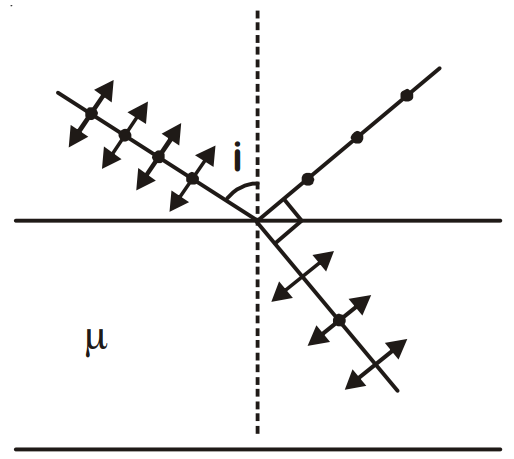
So the reflected light is polarised with its electric vector perpendicular to the plane of incidence.
Polarisation and Malus's Law
-
The intensity of transmitted light when a polaroid sheet, placed between two crossed polarizers at $22.5^\circ$ from the polarization axis of one of the polaroids, is ($I_0$ is the intensity of polarised light after passing through the first polaroid):
By Malus's law, $I = I_0 \cos^2(22.5^\circ) \cos^2(67.5^\circ) = \frac{I_0}{4} \sin^2(45^\circ) = \frac{I_0}{8}$.
Let the first polaroid have its pass axis along $0^\circ$, and the final crossed analyzer along $90^\circ$. The middle polaroid is placed at $\theta = 22.5^\circ$. By Malus\'s Law: Light intensity after passing through the middle polaroid is $I_1 = I_0 \cos^2(22.5^\circ)$. The angle between the middle polaroid and the analyzer is $90^\circ - 22.5^\circ = 67.5^\circ$. Light transmitted through the final analyzer is $I_2 = I_1 \cos^2(67.5^\circ) = I_0 \cos^2(22.5^\circ) \sin^2(22.5^\circ)$. Using the identity $\sin\theta \cos\theta = \frac{1}{2}\sin 2\theta$: $I_2 = I_0 \left[\frac{1}{2} \sin(45^\circ)\right]^2 = I_0 \left[\frac{1}{2} \times \frac{1}{\sqrt{2}}\right]^2 = I_0 \left(\frac{1}{2\sqrt{2}}\right)^2 = \frac{I_0}{8}$.
Young's Double Slit Experiment
-
For Young's double slit experiment, two statements are given below: Statement I: If screen is moved away from the plane of slits, angular separation of the fringes remains constant. Statement II: If the monochromatic source is replaced by another monochromatic source of larger wavelength, the angular separation of fringes decreases. In the light of the above statements, choose the correct answer from the options given below:
$\Delta\theta=\frac{\lambda}{d}$ depends on $\lambda$ but not on the screen distance.
$\Delta\theta=\frac{\lambda}{d}$ $\Delta\theta$ is proportional to $\lambda$ but independent of $D$. -
In a Young's double slit experiment, a student observes 8 fringes in a certain segment of screen when a monochromatic light of 600 nm wavelength is used. If the wavelength of light is changed to 400 nm, then the number of fringes he would observe in the same region of the screen isFringe position $y = n\lambda\frac{D}{d}$; for the same segment of the screen, $n_1\lambda_1 = n_2\lambda_2$ $8 \times 600 = n_2 \times 400$ $n_2 = 12$
-
In a double slit experiment, when light of wavelength 400 nm was used, the angular width of the first minima formed on a screen placed 1 m away, was found to be $0.2^\circ$. What will be the angular width of the first minima, if the entire experimental apparatus is immersed in water ($\mu_{water}=4/3$)?In air, angular fringe width $\theta_0=\frac{\lambda}{d}$. In water, the wavelength becomes $\frac{\lambda}{\mu}$, so $\theta_w=\frac{\theta_0}{\mu}$ $\theta_w=\frac{0.2^\circ}{4/3}=0.15^\circ$
-
Two slits in Young's experiment have widths in the ratio 1 : 25. The ratio of intensity at the maxima and minima in the interference pattern, $\frac{I_{max}}{I_{min}}$ is:Intensity ∝ slit width: $\frac{I_1}{I_2} = \frac{1}{25} \Rightarrow \sqrt{\frac{I_2}{I_1}} = 5$
$\frac{I_{max}}{I_{min}} = \left(\frac{\sqrt{I_2} + \sqrt{I_1}}{\sqrt{I_2} - \sqrt{I_1}}\right)^2 = \left(\frac{5 + 1}{5 - 1}\right)^2 = \frac{9}{4}$ -
In the Young's double-slit experiment, the intensity of light at a point on the screen where the path difference is $\lambda$ is K, ($\lambda$ being the wavelength of light used). The intensity at a point where the path difference is $\frac{\lambda}{4}$, will be:Path difference $\lambda$ → phase difference $2\pi$; path difference $\frac{\lambda}{4}$ → phase difference $\frac{\pi}{2}$.
$K = 4I_0$
$K' = 4I_0\cos^2\left(\frac{\pi}{4}\right) = 2I_0 = \frac{K}{2}$ -
In Young's double slit experiment, the slits are 2 mm apart and are illuminated by photons of two wavelengths $\lambda_1$ = 12000 Å and $\lambda_2$ = 10000 Å. At what minimum distance from the common central bright fringe on the screen 2 m from the slit will a bright fringe from one interference pattern coincide with a bright fringe from the other?For coincidence, $n_1\lambda_1 = n_2\lambda_2$
$\frac{n_1}{n_2} = \frac{\lambda_2}{\lambda_1} = \frac{10000}{12000} = \frac{5}{6}$, so the minimum $n_1$ and $n_2$ are 5 and 6.
$x_{min} = \frac{n_1\lambda_1D}{d} = \frac{5(12000\times10^{-10})(2)}{2\times10^{-3}} = 6\times10^{-3}$ m = 6 mm
Polarisation – Brewster's Law
-
The Brewsters angle $i_b$ for an interface should be:By Brewster's law: $\mu = \tan i_b$ For any interface (denser medium), $1 < \mu < \infty$ $1 < \tan i_b < \infty \Rightarrow \tan^{-1}(1) < i_b < \tan^{-1}(\infty)$ $45^\circ < i_b < 90^\circ$
Young's double slit experiment - intensity distribution
-
In Young's double slit experiment, using monochromatic light of wavelength $\lambda$, the intensity of light at a point on the screen where the path difference is $\lambda$ is K units. The intensity of light at a point where the path difference is $\frac{\lambda}{3}$ will be:At path difference $\lambda$ (phase difference $2\pi$), intensity is maximum: $K = 4I$, where I is the intensity of each source. Resultant intensity $I_R = K\cos^2\frac{\Delta\phi}{2}$ For path difference $\frac{\lambda}{3}$, $\Delta\phi = \frac{2\pi}{3} = 120^\circ$ $I_R = K\cos^2\left(\frac{120^\circ}{2}\right) = K\cos^2 60^\circ = \frac{K}{4}$
Interference and diffraction - conservation of energy
-
In interference and diffraction, the light energy is redistributed. If it reduces in one region, producing a dark fringe, it increases in another region, producing a bright fringe. I. As there is no gain or loss of energy, these phenomena are consistent with the principle of conservation of energy. II. Diffraction and interference are characteristics exhibited only by light waves. Choose the CORRECT answer from the options given below:Statement I is true: in interference and diffraction, energy remains conserved; only redistribution of energy takes place. Statement II is false: these phenomena are exhibited by all types of waves, not only light waves. So I is true, but II is false.
Young's double slit experiment - fringe width
-
Two slits in Young's double slit experiment are 1.5 mm apart and the screen is placed at a distance of 1 m from the slits. If the wavelength of light used is $600\times10^{-9}$ m then the fringe separation isFringe width $\beta=\dfrac{\lambda D}{d}=\dfrac{600\times10^{-9}\times1}{1.5\times10^{-3}}=4\times10^{-4}$ m.
Interference - coherent sources
-
Interference pattern can be observed due to superposition of the following waves: A. $y=a\sin\omega t$ B. $y=a\sin2\omega t$ C. $y=a\sin(\omega t-\phi)$ D. $y=a\sin3\omega t$. Choose the correct answer from the options given below.For sustained interference, the two sources must be coherent, i.e. have the same frequency and a constant phase difference. Waves A ($y=a\sin\omega t$) and C ($y=a\sin(\omega t-\phi)$) have the same angular frequency $\omega$ with a constant phase difference, so they are coherent and can produce interference.
Polarization - Malus's law
-
A beam of unpolarized light of intensity $I_0$ is passed through a polaroid A, then through another polaroid B, oriented at $60^\circ$ and finally through another polaroid C, oriented at $45^\circ$ relative to B as shown. The intensity of emergent light is:
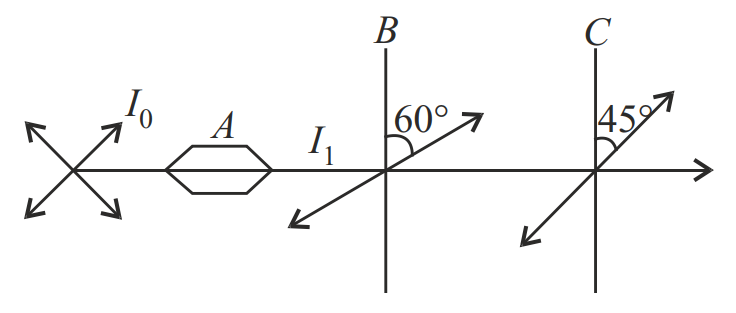 After polaroid A: $I_1=\dfrac{I_0}{2}$. After B (at $60^\circ$ to A): $I_2=I_1\cos^2 60^\circ=\dfrac{I_0}{2}\times\dfrac{1}{4}=\dfrac{I_0}{8}$. After C (at $45^\circ$ to B): $I_3=I_2\cos^2 45^\circ=\dfrac{I_0}{8}\times\dfrac{1}{2}=\dfrac{I_0}{16}$.
Interference - conditions for maxima
-
Two coherent sources of light interfere and produce fringe pattern on a screen. For central maximum, the phase difference between the two waves will be,A central (bright) maximum occurs where the path difference is zero, which corresponds to a phase difference of zero between the two interfering waves.
Single slit diffraction
-
At the first minimum adjacent to the central maximum of a single-slit diffraction pattern, the phase difference between the Huygen's wavelet from the edge of the slit and the wavelet from the mid point of the slit is:For the first minimum, $a\sin\theta = \lambda$.
Path difference between the edge and the mid-point wavelets: $\Delta x = \frac{a}{2}\sin\theta = \frac{\lambda}{2}$
$\Delta\phi = \frac{2\pi}{\lambda}\cdot\frac{\lambda}{2} = \pi$ radian
Young's double slit experiment in a medium
-
Young's double slit experiment is first performed in air and then in a medium other than air. It is found that $8^{th}$ bright fringe in the medium lies where $5^{th}$ dark fringe lies in air. The refractive index of the medium is nearly
Fringe width in a medium is reduced by a factor $\mu$.
$X_1 = X_{5th\ dark} = (2\times5 - 1)\frac{\lambda D}{2d}$ $X_2 = X_{8th\ bright} = 8\frac{\lambda D}{\mu d}$ $X_1 = X_2 \Rightarrow \frac{9}{2}\frac{\lambda D}{d} = 8\frac{\lambda D}{\mu d}$ $\mu = \frac{16}{9} = 1.78$
Young's double slit experiment – intensity at a point
-
The intensity at the maximum in a Young's double slit experiment is $I_0$. Distance between two slits is $d = 5\lambda$, where $\lambda$ is the wavelength of light used in the experiment. What will be the intensity infront of one of the slits on the screen placed at a distance D = 10 d?
Path difference λ/4 gives phase π/2 and intensity $I_0/2$.
Intensity $I = I_0\cos^2\left(\frac{\phi}{2}\right)$ ...(i), where $\phi = \frac{2\pi}{\lambda}\Delta X$ ...(ii)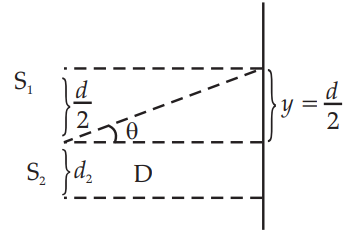
In front of one slit, $y = \frac{d}{2}$, so $\Delta X = d\frac{y}{D} = \frac{d\times\frac{d}{2}}{10d} = \frac{d}{20}$
With $d = 5\lambda$: $\Delta X = \frac{5\lambda}{20} = \frac{\lambda}{4}$ ...(iii)
$\phi = \frac{2\pi}{\lambda}\times\frac{\lambda}{4} = \frac{\pi}{2}$
$I = I_0\cos^2\left(\frac{\pi}{4}\right) = I_0\left(\frac{1}{\sqrt{2}}\right)^2 = \frac{I_0}{2}$
Single slit diffraction – minima and secondary maxima
-
In a diffraction pattern due to a single slit of width a, the first minimum is observed at an angle 30° when light of wavelength 5000 Å is incident on the slit. The first secondary maximum is observed at an angle of
First minimum at $\sin\theta = \lambda/a$; first secondary maximum at $\sin\theta' = 3\lambda/2a$.
For the first minimum: $a\sin\theta = \lambda \Rightarrow a = \frac{5\times10^{-7}}{\sin30^\circ} = 10\times10^{-7}$ m
For the first secondary maximum: $a\sin\theta' = \left(1 + \frac{1}{2}\right)\lambda$
$\sin\theta' = \frac{3}{2}\times\frac{5\times10^{-7}}{10\times10^{-7}} = \frac{3}{4}$
$\theta' = \sin^{-1}\left(\frac{3}{4}\right)$
Interference – maximum and minimum intensity
-
The interference pattern is obtained with two coherent light sources of intensity ratio n. In the interference pattern, the ratio $\frac{I_{max} - I_{min}}{I_{max} + I_{min}}$ will be:
$I_{max} - I_{min} = 4\sqrt{I_1I_2}$ and $I_{max} + I_{min} = 2(I_1 + I_2)$.
Let $\frac{I_1}{I_2} = \frac{n}{1}$
$\frac{I_{max} - I_{min}}{I_{max} + I_{min}} = \frac{(\sqrt{I_1} + \sqrt{I_2})^2 - (\sqrt{I_1} - \sqrt{I_2})^2}{(\sqrt{I_1} + \sqrt{I_2})^2 + (\sqrt{I_1} - \sqrt{I_2})^2} = \frac{4\sqrt{I_1I_2}}{2(I_1 + I_2)}$
Dividing numerator and denominator by $I_2$: ratio $= \frac{2\sqrt{I_1/I_2}}{\left(\frac{I_1}{I_2} + 1\right)} = \frac{2\sqrt{n}}{n + 1}$
Young's double slit and diffraction
-
In a double slit experiment, the two slits are 1 mm apart and the screen is placed 1 m away. A monochromatic light of wavelength 500 nm is used. What will be the width of each slit for obtaining ten maxima of double slit within the central maxima of single slit pattern?Fringe width of the double slit: $\beta = \frac{\lambda D}{d}$, so ten maxima occupy $\frac{10\lambda D}{d}$.
Width of the single slit central maximum: $\frac{2\lambda D}{a}$
$\frac{10\lambda D}{d} = \frac{2\lambda D}{a} \Rightarrow a = \frac{d}{5}$
$a = \frac{1}{5}$ mm $= 0.2$ mm
Resolving Power of Telescope
-
A telescope has an objective lens of 10 cm diameter and is situated at a distance of one kilometer from two objects. The minimum distance between these two objects, which can be resolved by the telescope, when the mean wavelength of light is 5000 Å, is of the order of-
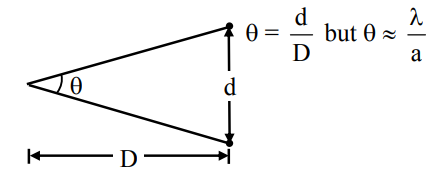
Let d be the separation of the two objects and D their distance from the telescope. The angle they subtend at the objective is $\theta = \dfrac{d}{D}$.
The limit of resolution of a telescope with aperture a is $\theta \approx \dfrac{\lambda}{a}$ (the exact relation is $\theta = \dfrac{1.22\lambda}{a}$, but only the order of magnitude is asked).
For just resolving: $\dfrac{d}{D} = \dfrac{\lambda}{a} \Rightarrow d = \dfrac{\lambda D}{a}$
$\lambda = 5000$ Å $= 5000 \times 10^{-10}$ m, $D = 1$ km $= 10^3$ m, $a = 10$ cm $= 10 \times 10^{-2}$ m
$d = \dfrac{5000 \times 10^{-10} \times 10^3}{10 \times 10^{-2}} = 5 \times 10^{-3}$ m
$d = 5$ mm (with the factor 1.22 it is about 6 mm, still of the order of a few mm).
So the minimum resolvable distance is of the order of 5 mm.
Resolving Power
-
Diameter of human eye lens is 2 mm. What will be the minimum distance between two points to resolve them, which are situated at a distance of 50 meter from eye. The wavelength of light is 5000 Å :-For an aperture of diameter d, the limit of resolution is $\theta \approx \dfrac{\lambda}{d}$ (taking the approximate relation, as in the source; the exact one has a factor 1.22).
Two points separated by y at a distance D subtend $\dfrac{y}{D}$. For resolution: $\dfrac{y}{D} \geq \dfrac{\lambda}{d} \Rightarrow y \geq \dfrac{\lambda D}{d}$
$\lambda = 5000$ Å $= 5 \times 10^{-7}$ m, $D = 50$ m, $d = 2$ mm $= 2 \times 10^{-3}$ m
$y \geq \dfrac{5 \times 10^{-7}}{2 \times 10^{-3}} \times 50 = 1.25 \times 10^{-2}$ m
$y \geq 1.25$ cm
So the minimum distance between the two points is 1.25 cm.
That is every question in Wave Optics for this filter.
Show all 40 questions Next: Dual Nature of Radiation and Matter
Want a score?
Answers here are not saved. Practise as a test to be marked and see your progress.
Practise as a test