Looking for classes? Ksquare Career Institute, Bengaluru →

Physics
Waves
59 questions from 33 papers, each with its answer.
- 59 questions
- 33 papers
- 3.34% of Physics
Beats
-
In a guitar, two strings A and B made of same material are slightly out of tune and produce beats of frequency 6 Hz. When tension in B is slightly decreased, the beat frequency increases to 7 Hz. If the frequency of A is 530 Hz, the original frequency of B will be:Initially $|f_A - f_B| = 6$ Hz. When tension in B is decreased, $f_B$ decreases. Since the beat frequency increases to 7 Hz, $f_A > f_B$. $f_A - f_B = 6 \Rightarrow f_B = 530 - 6 = 524$ Hz (original)
-
Three sound waves of equal amplitudes have frequencies (n – 1), n, (n + 1). They superimpose to give beats. The number of beats produced per second will be:
The resultant repeats with the largest frequency difference, 2 Hz.
Net beat frequency = LCM of individual beat frequencies = LCM of [(n, n–1), (n, n+1), (n–1, n+1)] = LCM of (1, 1, 2) = 2 Hz
So the number of beats per second = 2 -
A source of unknown frequency gives 4 beats/s, when sounded with a source of known frequency 250 Hz. The second harmonic of the source of unknown frequency gives five beats per second, when sounded with a source of frequency 513 Hz. The unknown frequency isFrequency of the unknown source = 246 Hz or 254 Hz
Its second harmonic = 492 Hz or 508 Hz
Only 508 Hz gives 5 beats per second with 513 Hz, so the unknown frequency = 254 Hz -
Two sources of sound placed close to each other, are emitting progressive waves given by $y_1 = 4\sin600\pi t$ and $y_2 = 5\sin608\pi t$. An observer located near these two sources of sound will hear:$\omega_1 = 600\pi \Rightarrow f_1 = 300$ Hz; $\omega_2 = 608\pi \Rightarrow f_2 = 304$ Hz
Beat frequency $= 304 - 300 = 4$ beats per second
$\frac{I_{max}}{I_{min}} = \frac{(A_1 + A_2)^2}{(A_1 - A_2)^2} = \frac{(4 + 5)^2}{(5 - 4)^2} = \frac{81}{1}$
So the observer hears 4 beats per second with intensity ratio 81 : 1. -
Two identical piano wires, kept under the same tension T, have a fundamental frequency of 600 Hz. The fractional increase in the tension of one of the wires which will lead to occurrence of 6 beats/s when both the wires oscillate together would beFundamental frequency of a stretched wire: $f = \frac{1}{2L}\sqrt{\frac{T}{\mu}}$, so $f \propto \sqrt{T}$
For a small change: $\frac{\Delta f}{f} = \frac{1}{2}\frac{\Delta T}{T}$
6 beats per second means the frequencies differ by $\Delta f = 6$ Hz.
$\frac{6}{600} = \frac{1}{2}\frac{\Delta T}{T}$
$\frac{\Delta T}{T} = 2\times\frac{6}{600} = \frac{1}{50}$
$\frac{\Delta T}{T} = 0.02$ -
A tuning fork of frequency 512 Hz makes 4 beats per second with the vibrating string of a piano. The beat frequency decreases to 2 beats per sec when the tension in the piano string is slightly increased. The frequency of the piano string before increasing the tension wasBeat frequency = difference of the two frequencies, so the string frequency is either 512 + 4 = 516 Hz or 512 − 4 = 508 Hz.
Frequency of a string $f \propto \sqrt{T}$, so increasing the tension increases its frequency.
If the string were at 516 Hz, raising its frequency would increase the difference from 512 Hz, and the beats would increase.
If the string were at 508 Hz, raising its frequency (to 510 Hz) brings it closer to 512 Hz, and the beats decrease to 2 per second, as observed.
Hence the original frequency of the piano string was 508 Hz. -
Each of the two strings of length 51.6 cm and 49.1 cm are tensioned separately by 20 N force. Mass per unit length of both the strings is same and equal to 1 g/m. When both the strings vibrate simultaneously the number of beats isFundamental frequency of a stretched string: $f = \frac{1}{2L}\sqrt{\frac{T}{\mu}}$
T = 20 N, $\mu$ = 1 g/m = $10^{-3}$ kg/m: $\sqrt{\frac{T}{\mu}} = \sqrt{\frac{20}{10^{-3}}} = \sqrt{2\times10^4} = 141.4$ m/s
$f_1 = \frac{141.4}{2\times0.516} = 137.0$ Hz
$f_2 = \frac{141.4}{2\times0.491} = 144.0$ Hz
Number of beats per second = $f_2 - f_1 = 144 - 137$
= 7
Phase difference in a travelling wave
-
For a travelling harmonic wave $y(x, t) = 2.0 \cos 2\pi(10t - 0.0080x + 0.35)$, where x and y are in cm and t in s. The phase difference between oscillatory motion of two points separated by a distance of 0.5 m is:Comparing with $y = A\cos(\omega t - kx + \phi)$: $k = 2\pi \times 0.0080$ rad/cm $\Delta x = 0.5$ m = 50 cm $\Delta\phi = k\,\Delta x = 2\pi \times 0.008 \times 50$ $\Delta\phi = 0.8\pi$ rad
Travelling wave equation - frequency
-
The displacement of a travelling wave $y=C\sin\dfrac{2\pi}{\lambda}(at-x)$ where t is time, x is distance and $\lambda$ is the wavelength, all in S.I. units. Then the frequency of the wave is$y=C\sin\left(\dfrac{2\pi}{\lambda}at-\dfrac{2\pi}{\lambda}x\right)$. Comparing with $y=A\sin(\omega t-kx)$: $\omega=2\pi f=\dfrac{2\pi a}{\lambda}\Rightarrow f=\dfrac{a}{\lambda}$.
Vibration of strings - fundamental frequency and length
-
The length of the string of a musical instrument is 90 cm and has a fundamental frequency of 120 Hz. Where should it be pressed to produce fundamental frequency of 180 Hz?For a stretched string, fundamental frequency $f\propto\dfrac{1}{l}$ (same tension and mass per unit length), so $f_1l_1=f_2l_2\Rightarrow120\times90=180\times l_2\Rightarrow l_2=60$ cm.
Harmonics in closed and open organ pipes
-
The 4th overtone of a closed organ pipe is same as that of 3rd overtone of an open pipe. The ratio of the length of the closed pipe to the length of the open pipe is:For a closed pipe, $n_{cop}=(2M+1)^{th}$ harmonic $=(2\times4+1)\times\dfrac{V}{4\ell_c}=\dfrac{9V}{4\ell_c}$ (4th overtone). For an open pipe, $n_{oop}=(M+1)^{th}$ harmonic $=(3+1)\dfrac{V}{2\ell_o}=\dfrac{4V}{2\ell_o}$ (3rd overtone). Equating: $\dfrac{9V}{4\ell_c}=\dfrac{4V}{2\ell_o}\Rightarrow\dfrac{\ell_c}{\ell_o}=\dfrac{18}{16}=\dfrac{9}{8}$.
Speed of sound and temperature - organ pipes
-
An organ pipe filled with a gas at $27^\circ C$ resonates at 400 Hz in its fundamental mode. If it is filled with the same gas at $90^\circ C$, the resonance frequency at the same mode will be:$f=\frac{v}{\lambda}$ with $\lambda$ fixed, and $v\propto\sqrt{T}$. $\frac{f_1}{f_2}=\sqrt{\frac{T_1}{T_2}}=\sqrt{\frac{300}{363}}=\frac{1}{1.1} \Rightarrow f_2=400\times1.1=440$ Hz.
Harmonics in open and closed pipes
-
For sound waves, if the number of nodes for the $5^{th}$ harmonic of an open-ended pipe is n and that for the $9^{th}$ harmonic of the same pipe with one of its ends closed is m, the ratio $\frac{n}{m}$ isFor both open and closed pipes, number of nodes = m + 1, where m is the number of the overtone. Open pipe: 5th harmonic = 4th overtone, so n = 4 + 1 = 5. Closed pipe: 9th harmonic = 4th overtone, so m = 4 + 1 = 5. Hence $\frac{n}{m}=\frac{5}{5}=1$.
Closed organ pipe – harmonics
-
The two nearest harmonics of a tube closed at one end and open at other end are 220 Hz and 260 Hz. What is the fundamental frequency of the system?
Successive odd harmonics differ by twice the fundamental.
Two successive frequencies of a closed pipe: $\frac{nv}{4l} = 220$ ...(i) and $\frac{(n + 2)v}{4l} = 260$ ...(ii) Dividing (ii) by (i): $\frac{n + 2}{n} = \frac{260}{220} = \frac{13}{11}$ $11n + 22 = 13n \Rightarrow n = 11$ So $11\frac{v}{4l} = 220 \Rightarrow \frac{v}{4l} = 20$ So the fundamental frequency is 20 Hz.
Doppler effect – echo from a cliff
-
A siren emitting a sound of frequency 800 Hz moves away from an observer towards a cliff at a speed of 15 $ms^{-1}$. Then, the frequency of sound that the observer hears in the echo reflected from the cliff is (Take, velocity of sound in air = 330 $ms^{-1}$)'Out of Syllabus'
Speed of transverse waves on a string
-
A uniform rope of length L and mass $m_1$ hangs vertically from a rigid support. A block of mass $m_2$ is attached to the free end of the rope. A transverse pulse of wavelength $\lambda_1$ is produced at the lower end of the rope. The wavelength of the pulse when it reaches the top of the rope is $\lambda_2$. The ratio $\frac{\lambda_2}{\lambda_1}$ is
Frequency is fixed and $\lambda \propto \sqrt{T}$.
Wave velocity $v = \sqrt{\frac{T}{\mu}}$ and $v = f\lambda$ with f constant, so $\lambda \propto \sqrt{T}$
Tension at the bottom $= m_2g$; tension at the top $= (m_1 + m_2)g$
$\frac{\lambda_1}{\lambda_2} = \sqrt{\frac{m_2g}{(m_1 + m_2)g}}$
$\frac{\lambda_2}{\lambda_1} = \sqrt{\frac{m_1 + m_2}{m_2}}$
Organ pipes – overtones
-
The second overtone of an open organ pipe has the same frequency as the first overtone of a closed pipe L metre long. The length of the open pipe will be
Equate $3v/2l_0$ with $3v/4L$.
Second overtone (3rd harmonic) of the open pipe: $\frac{3\lambda}{2} = l_0 \Rightarrow \lambda = \frac{2l_0}{3}$
First overtone (3rd harmonic) of the closed pipe: $\frac{3\lambda}{4} = l_C \Rightarrow \lambda = \frac{4l_C}{3} = \frac{4L}{3}$
So $\frac{2l_0}{3} = \frac{4L}{3} \Rightarrow l_0 = 2L$
Organ pipes
-
The fundamental frequency of a closed organ pipe of length 20 cm is equal to the second overtone of an organ pipe open at both the ends. The length of organ pipe open at both ends isFundamental frequency of the closed pipe: $\frac{v}{4L_C}$
Second overtone of the open pipe: $\frac{3v}{2L_O}$
$\frac{v}{4L_C} = \frac{3v}{2L_O} \Rightarrow L_O = 6L_C$
$L_O = 6\times 20 = 120$ cm -
The number of possible natural oscillations of air column in a pipe closed at one end of length 85 cm whose frequencies lie below 1250 Hz are: (velocity of sound = 340 $ms^{-1}$)For a closed organ pipe, $f_n = (2n + 1)\frac{v}{4l}$, with $\frac{v}{4l} = \frac{340}{4\times0.85} = 100$ Hz
$f_0 = 100$ Hz, $f_1 = 300$ Hz, $f_2 = 500$ Hz, $f_3 = 700$ Hz, $f_4 = 900$ Hz, $f_5 = 1100$ Hz
These six frequencies are below 1250 Hz.
Doppler effect
-
A source of sound S emitting waves of frequency 100 Hz and an observer O are located at some distance from each other. The source is moving with a speed of 19.4 $ms^{-1}$ at an angle of $60^\circ$ with the source observer line as shown in the figure. The observer is at rest. The apparent frequency observed by the observer (velocity of sound in air 330 $ms^{-1}$) is:
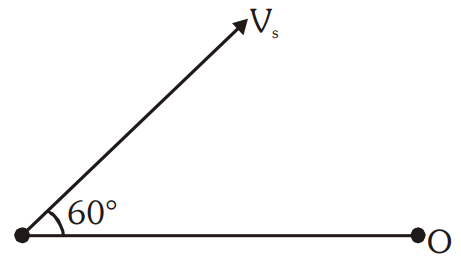 Component of source velocity towards the observer: $v_s\cos 60^\circ = \frac{19.4}{2} = 9.7$ m/s
$f_0 = f_s\left(\frac{v}{v - v_s\cos60^\circ}\right) = 100\left(\frac{330}{330 - 9.7}\right) \approx 103$ Hz -
A speeding motorcyclist sees traffic jam ahead of him. He slows down to 36 km/hour. He finds that traffic has eased and a car moving ahead of him at 18 km/hour is honking at a frequency of 1392 Hz. If the speed of sound is 343 m/s, the frequency of the honk as heard by him will be:$v_0 = 36$ km/h = 10 m/s (observer), $v_s = 18$ km/h = 5 m/s (source)
$n' = n\left[\frac{v + v_0}{v + v_s}\right] = 1392\left[\frac{343 + 10}{343 + 5}\right] = 1412$ Hz -
A train moving at a speed of 220 $ms^{-1}$ towards a stationary object, emits a sound of frequency 1000 Hz. Some of the sound reaching the object gets reflected back to the train as echo. The frequency of the echo as detected by the driver of the train is: (speed of sound in air is 330 $ms^{-1}$)The train is both the moving source and, for the echo, the moving observer approaching the reflector.
$f' = f\left(\frac{v + v_o}{v - v_s}\right) = 1000\times\frac{330 + 220}{330 - 220}$
$= 1000\times\frac{550}{110} = 5000$ Hz -
The driver of a car travelling with speed 30 m/s towards a hill sounds a horn of frequency 600 Hz. If the velocity of sound in air is 330 m/s, the frequency of reflected sound as heard by driver isStep 1: the hill is a stationary observer and the car is a source moving towards it. Frequency received (and reflected) by the hill: $f_1 = f\frac{v}{v - v_s} = 600\times\frac{330}{330 - 30}$
Step 2: the hill now acts as a stationary source of frequency $f_1$, and the driver is an observer moving towards it. Frequency heard by the driver: $f_2 = f_1\frac{v + v_o}{v} = f_1\times\frac{330 + 30}{330}$
Combining: $f_2 = f\frac{v + v_c}{v - v_c} = 600\times\frac{360}{300}$
$f_2 = 600\times1.2$
$f_2 = 720$ Hz -
A car is moving towards a high cliff. The car driver sounds a horn of frequency 'f'. The reflected sound heard by the driver has a frequency 2f. If 'v' be the velocity of sound then the velocity of the car, in the same velocity units, will be -The problem is done in two stages. First the cliff acts as a stationary observer receiving sound from the moving source (the car).
Frequency received by the cliff: $f' = \left(\dfrac{v}{v - v_{car}}\right) f$
Next, the cliff acts as a stationary source of frequency $f'$, and the driver is an observer moving towards it.
Frequency heard by the driver: $f'' = \left(\dfrac{v + v_{car}}{v}\right) f' = \left(\dfrac{v + v_{car}}{v - v_{car}}\right) f$
Given $f'' = 2f$: $\dfrac{v + v_{car}}{v - v_{car}} = 2$
$\Rightarrow v + v_{car} = 2v - 2v_{car}$
$\Rightarrow 3v_{car} = v$
$\Rightarrow v_{car} = \dfrac{v}{3}$ -
A whistle revolves in a circle with angular speed ω = 20 rad/sec using a string of length 50 cm. If the frequency of sound from the whistle is 385 Hz, then what is the minimum frequency heard by an observer which is far away from the centre : - (Vsound = 340 m/s)Speed of the whistle: $v_s = \omega R = 20 \times 0.5 = 10$ m/s.
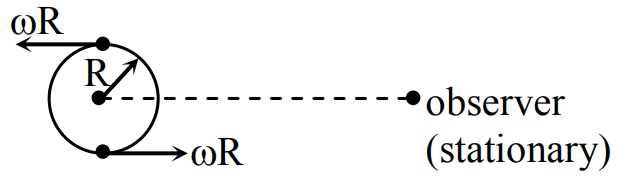
The minimum frequency is heard when the whistle is moving directly away from the observer:
$n_{min} = n_0\left(\dfrac{V}{V + \omega R}\right) = 385 \times \dfrac{340}{340 + 10} = 385 \times \dfrac{340}{350}$
$n_{min} = 374$ Hz
(The maximum, when it moves towards the observer, is $n_0\dfrac{V}{V - \omega R} = 385 \times \dfrac{340}{330} \approx 397$ Hz.)
Equation of a progressive wave
-
The equation of a simple harmonic wave is given by $y = 3\sin\frac{\pi}{2}(50t - x)$ where x and y are in metres and t is in seconds. The ratio of maximum particle velocity to the wave velocity isComparing with $y = A\sin(\omega t - kx)$: $A = 3$ m, $\omega = 25\pi$ rad/s, $k = \frac{\pi}{2}$ $m^{-1}$
Maximum particle velocity: $v_{max} = A\omega$
Wave velocity: $v_w = \frac{\omega}{k}$
$\frac{v_{max}}{v_w} = \frac{A\omega}{\omega/k} = Ak = 3\times\frac{\pi}{2} = \frac{3}{2}\pi$
Travelling waves
-
A transverse wave is represented by $y = A\sin(\omega t - kx)$. For what value of the wavelength is the wave velocity equal to the maximum particle velocity?Wave velocity: $v = \frac{\omega}{k}$
Particle velocity: $v_p = \frac{\partial y}{\partial t} = A\omega\cos(\omega t - kx)$; its maximum value is $A\omega$.
Setting them equal: $\frac{\omega}{k} = A\omega$
$\frac{1}{k} = A$; since $k = \frac{2\pi}{\lambda}$, $\frac{\lambda}{2\pi} = A$
$\lambda = 2\pi A$ -
A wave in a string has an amplitude of 2 cm. The wave travels in the +ve direction of x-axis with a speed of 128 m/s and it is noted that 5 complete waves fit in 4 m length of the string. The equation describing the wave isAmplitude: A = 2 cm = 0.02 m
5 complete waves fit in 4 m, so $\lambda = \frac{4}{5} = 0.8$ m
Wave number: $k = \frac{2\pi}{\lambda} = \frac{2\times3.14}{0.8} = 7.85$ rad/m
Angular frequency: $\omega = vk = 128\times7.85 = 1005$ rad/s
For a wave travelling in the +x direction the x and t terms have opposite signs: $y = A\sin(kx - \omega t)$
y = (0.02) m sin (7.85x – 1005t)
Note: the source prints '7.58x' in the first option; this is a misprint for 7.85x and has been corrected.
Reverberation: Sabine's Formula
-
The time of reverberation of a room A is one second. What will be the time (in seconds) of reverberation of a room, having all the dimensions double of those of room A -By Sabine's formula, the time of reverberation is $T = \dfrac{0.16\,V}{\Sigma aS}$, i.e. $T \propto \dfrac{V}{A}$
Here $V$ is the volume of the room and $A$ is the area of its absorbing surfaces.
When all the dimensions are doubled, the volume becomes $2^3 = 8$ times and the surface area becomes $2^2 = 4$ times.
$\dfrac{T'}{T} = \dfrac{V'/A'}{V/A} = \dfrac{8}{4} = 2$
$T' = 2 \times 1 = 2$ seconds
Phase of a Wave
-
The phase difference between two waves, represented by
$y_1 = 10^{-6}\sin\left\{100t + \dfrac{x}{50} + 0.5\right\}$ m
$y_2 = 10^{-6}\cos\left\{100t + \dfrac{x}{50}\right\}$ m
Where x is expressed in metres and t is expressed in seconds, is approximately : -To compare phases, write both waves as sine functions.
$y_1 = 10^{-6}\sin\left\{100t + \dfrac{x}{50} + 0.5\right\}$
$y_2 = 10^{-6}\cos\left\{100t + \dfrac{x}{50}\right\} = 10^{-6}\sin\left\{\dfrac{\pi}{2} + 100t + \dfrac{x}{50}\right\}$ (since $\cos\theta = \sin(\theta + \frac{\pi}{2})$)
Phase of $y_1$ $= 100t + \dfrac{x}{50} + 0.5$; phase of $y_2$ $= 100t + \dfrac{x}{50} + \dfrac{\pi}{2}$
Phase difference between $y_1$ and $y_2$ $= \dfrac{\pi}{2} - 0.5$
$= 1.57 - 0.5 \approx 1.07$ radians
So the phase difference is approximately 1.07 radians.
Vibrations of Strings
-
If the tension and diameter of a sonometer wire of fundamental frequency n are doubled and density is halved then its fundamental frequency will becomeFundamental frequency of a stretched wire: $n = \dfrac{1}{2l}\sqrt{\dfrac{T}{\mu}}$, where the mass per unit length $\mu = \pi r^2\rho$.
$n = \dfrac{1}{2l}\sqrt{\dfrac{T}{\pi r^2\rho}}$
New values: $T_1 = 2T$, diameter doubled so $r_1 = 2r$, $\rho_1 = \dfrac{\rho}{2}$
$n_1 = \dfrac{1}{2l}\sqrt{\dfrac{2T}{\pi(2r)^2\frac{\rho}{2}}} = \dfrac{1}{2l}\sqrt{\dfrac{2T}{2\pi r^2\rho}} = \dfrac{1}{2l}\sqrt{\dfrac{T}{\pi r^2\rho}} = n$
So there is no change: the frequency remains n. -
A string is cut into three parts, having fundamental frequencies $n_1$, $n_2$ and $n_3$ respectively. Then original fundamental frequency 'n' is related by the expression as :For the same tension and mass per unit length, the fundamental frequency $n = \dfrac{1}{2l}\sqrt{\dfrac{T}{\mu}}$, so $l = \dfrac{k}{n}$ with k constant.
The lengths of the pieces add up to the original length: $l = l_1 + l_2 + l_3$
$\dfrac{k}{n} = \dfrac{k}{n_1} + \dfrac{k}{n_2} + \dfrac{k}{n_3}$
$\Rightarrow \dfrac{1}{n} = \dfrac{1}{n_1} + \dfrac{1}{n_2} + \dfrac{1}{n_3}$
Superposition of Waves
-
Two waves having equation $x_1 = a\sin(\omega t + \phi_1)$ and $x_2 = a\sin(\omega t + \phi_2)$. If in the resultant wave the frequency and amplitude remain equal to those of the superimposing waves, then phase difference between them : -Resultant amplitude of two waves of equal amplitude a with phase difference $\phi$:
$A^2 = a^2 + a^2 + 2a^2\cos\phi$
Given A = a: $a^2 = 2a^2 + 2a^2\cos\phi \Rightarrow \cos\phi = -\dfrac{1}{2}$
$\phi = \dfrac{2\pi}{3}$ (i.e. $120^\circ$)
The frequency of the resultant is the same, $\omega$, as the frequencies of both waves are equal.
Doppler Effect and Beats
-
Two stationary sources each emitting waves of wavelength $\lambda$. An observer moves from one source to other with velocity u. Then number of beats heard by him :[add image: observer moving with speed u from source $S_1$ towards source $S_2$]
The observer moves away from the first source: $n_1 = n\left(\dfrac{v - u}{v}\right) = \left(1 - \dfrac{u}{v}\right)n$
and towards the second source: $n_2 = n\left(\dfrac{v + u}{v}\right) = \left(1 + \dfrac{u}{v}\right)n$
Beat frequency $= |n_2 - n_1| = \dfrac{2nu}{v}$
Since $v = n\lambda$, $\dfrac{n}{v} = \dfrac{1}{\lambda}$: beats $= \dfrac{2u}{\lambda}$
That is every question in Waves for this filter.
Want a score?
Answers here are not saved. Practise as a test to be marked and see your progress.
Practise as a test