Looking for classes? Ksquare Career Institute, Bengaluru →

Physics
Thermodynamics
54 questions from 37 papers, each with its answer.
- 54 questions
- 37 papers
- 3.06% of Physics
Thermodynamic Processes on a P-V Diagram
-
An ideal gas undergoes four different processes from the same initial state as shown in the figure below. Those processes are adiabatic, isothermal isobaric and isochoric. The curve which represents the adiabatic process among 1, 2, 3 and 4 is :
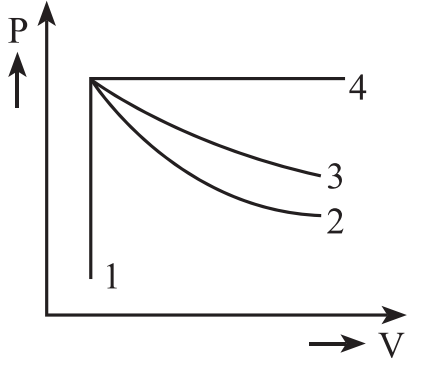 1: isochoric (vertical line, V constant)
2: adiabatic (steepest curve, $PV^\gamma$ = constant)
3: isothermal (less steep curve, PV = constant)
4: isobaric (horizontal line, P constant) So curve 2 represents the adiabatic process. -
Thermodynamic processes are indicated in the following diagram. Match the following
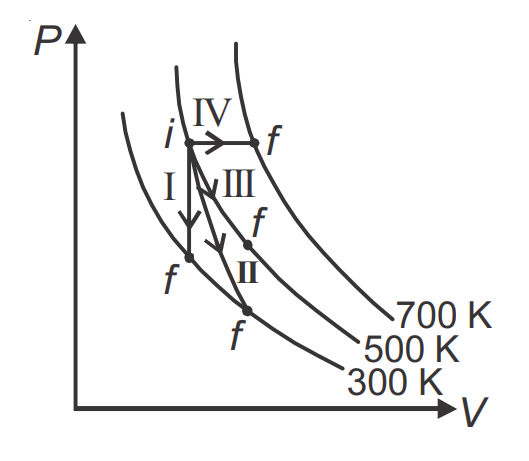
Pick the matching item from Column II for each row.
Column I
- P. Process I
- Q. Process II
- R. Process III
- S. Process IV
Column II
- a. Adiabatic
- b. Isobaric
- c. Isochoric
- d. Isothermal
Correct answer: P → c, Q → a, R → d, S → b
Vertical line = isochoric, horizontal = isobaric, along isotherm = isothermal, steeper curve = adiabatic.
Process I = Isochoric Process II = Adiabatic Process III = Isothermal Process IV = Isobaric Correct match: P-c, Q-a, R-d, S-b.
Thermodynamic Processes – Free Expansion
-
Two cylinders A and B of equal capacity are connected to each other via a stop cock. A contains an ideal gas at standard temperature and pressure. B is completely evacuated. The entire system is thermally insulated. The stop cock is suddenly opened. The process is:The entire system is thermally insulated, so no heat exchange takes place with the surroundings (Q = 0). Hence the process is adiabatic (it is a free expansion into vacuum).
First law of thermodynamics
-
Figure below shows two paths that may be taken by a gas to go from a state A to a state C.
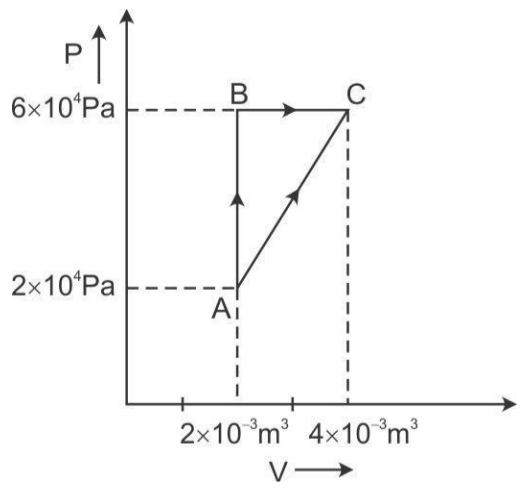
In process AB, 400 J of heat is added to the system and in process BC, 100 J of heat is added to the system. The heat absorbed by the system in the process AC will beFrom the graph: A $(2\times10^{-3}\ m^3,\ 2\times10^4$ Pa$)$, B $(2\times10^{-3}\ m^3,\ 6\times10^4$ Pa$)$, C $(4\times10^{-3}\ m^3,\ 6\times10^4$ Pa$)$.
For the cyclic process ABCA, $\Delta U = 0$, so net heat = net work = area enclosed.
$Q_{AB} + Q_{BC} + Q_{CA} = \frac{1}{2}\times(4\times10^{-3} - 2\times10^{-3})\times(6\times10^4 - 2\times10^4)$
$400 + 100 + Q_{CA} = \frac{1}{2}\times(2\times10^{-3})\times(4\times10^4) = 40$ J
$Q_{CA} = -460$ J, so $Q_{AC} = 460$ J -
An ideal gas goes from state A to state B via three different processes as indicated in the P-V diagram. If $Q_1$, $Q_2$, $Q_3$ indicate the heat absorbed by the gas along the three processes and $\Delta U_1$, $\Delta U_2$, $\Delta U_3$ indicate the change in internal energy along the three processes respectively, then
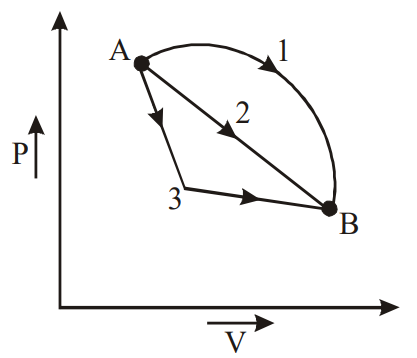 Internal energy is a state function. All three processes have the same initial state A and final state B, so $\Delta U_1 = \Delta U_2 = \Delta U_3$.
Work done = area under the P–V curve. Path 1 lies highest and path 3 lowest, so $W_1 > W_2 > W_3$.
First law: $Q = \Delta U + W$; with equal $\Delta U$, $Q_1 > Q_2 > Q_3$.
Thermodynamic state variables
-
The equilibrium state of a thermodynamic system is described by A. Pressure B. Total heat C. Temperature D. Volume E. Work done. Choose the most appropriate answer from the options given below.The equilibrium state of a thermodynamic system is described by its state variables: Pressure (A), Volume (D) and Temperature (C). Total heat (B) and Work done (E) are path variables, not state variables. So the correct set is A, C and D only.
Thermodynamic processes - P-V diagrams
-
The P-V diagram for an ideal gas in a piston cylinder assembly undergoing a thermodynamic process is shown in the figure. The process is
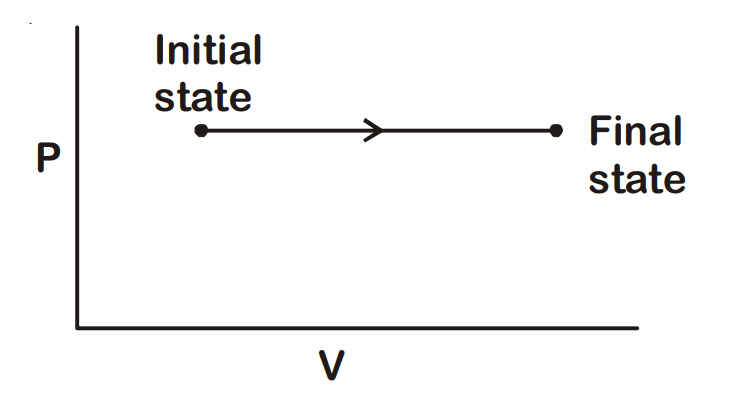 A horizontal line on a P-V diagram represents a process at constant pressure, i.e. an isobaric process.
Carnot engine and its efficiency
-
The efficiency of a Carnot engine depends uponThe efficiency of a Carnot engine is $\eta=1-\dfrac{T_2}{T_1}$, where $T_1$ is the source temperature and $T_2$ is the sink temperature — it depends on both temperatures.
Work done in an isobaric process from a P-V diagram
-
For the given cycle during isobaric process is:
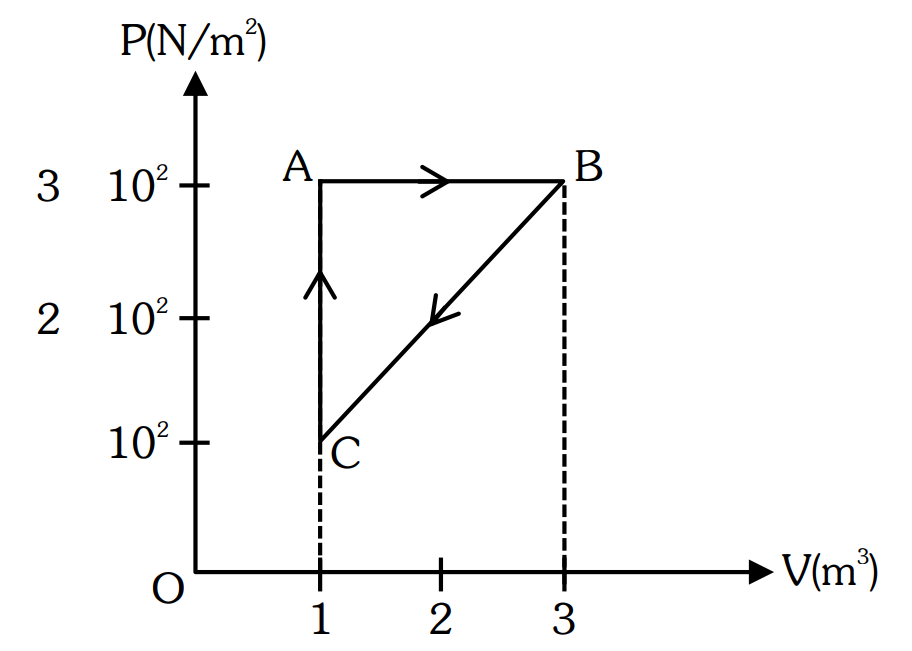 AB is the isobaric process (constant pressure $3\times10^2\ N/m^2$, volume changing from 1 to 3 $m^3$). $W_{AB}=P(V_2-V_1)=3\times10^2\times(3-1)=3\times100\times2=600$ J.
Polytropic process
-
An ideal gas follows a process described by the equation $PV^2=C$ from the initial $(P_1,V_1,T_1)$ to final $(P_2,V_2,T_2)$ thermodynamic states, where C is a constant. Then:$PV^2=C$ with $PV=nRT$ gives $TV=$ constant and $\frac{T^2}{P}=$ constant. So if $P_1>P_2$ then $V_2>V_1$ and $T_1>T_2$; and if $V_2>V_1$ then $T_2<T_1$.
First law of thermodynamics – change in internal energy
-
A sample of 0.1 g of water at $100^\circ C$ and normal pressure ($1.013 \times 10^{5}\ N m^{-2}$) requires 54 cal of heat energy to convert to steam at $100^\circ C$. If the volume of the steam produced is 167.1 cc, the change in internal energy of the sample, is
$\Delta U = Q - P\Delta V$.
$\Delta Q = \Delta U + \Delta W$ $54\times4.18 = \Delta U + 1.013\times10^{5}(167.1\times10^{-6} - 0)$ $\Delta U = 225.7 - 16.9 = 208.7$ J
Carnot engine and refrigerator – coefficient of performance
-
A Carnot engine having an efficiency of $\frac{1}{10}$ as heat engine, is used as a refrigerator. If the work done on the system is 10 J, the amount of energy absorbed from the reservoir at lower temperature is
COP of the reversed engine is $(1-\eta)/\eta = 9$.
Coefficient of performance $\beta = \frac{1 - \eta}{\eta} = \frac{1 - \frac{1}{10}}{\frac{1}{10}} = 9$ $\beta = \frac{Q_2}{W}$ $Q_2 = 9\times10 = 90$ J
Work done in isothermal and adiabatic compression
-
A gas is compressed isothermally to half its initial volume. The same gas is compressed separately through an adiabatic process until its volume is again reduced to half. Then
The adiabatic curve is steeper, enclosing more area on compression.
Isothermal compression from V to $\frac{V}{2}$: $W = nRT\ln\left(\frac{V_f}{V_i}\right) = nRT\ln\left(\frac{1}{2}\right)$
Adiabatic compression: $W = \frac{k(V_f^{1-\gamma} - V_i^{1-\gamma})}{1 - \gamma}$, with $PV^\gamma$ = constant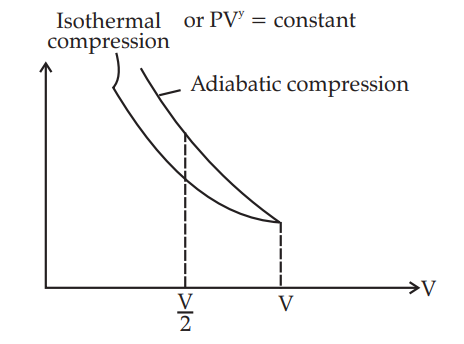
The area under the adiabatic compression curve is greater than that under the isothermal compression curve.
Hence compressing the gas through the adiabatic process requires more work.
Refrigerator – coefficient of performance
-
A refrigerator works between 4°C and 30°C. It is required to remove 600 calories of heat every second in order to keep the temperature of the refrigerated space constant. The power required is [Take, 1 cal = 4.2 J]'Out of Syllabus'
Refrigerator – heat rejected per unit work
-
The temperature inside a refrigerator is $t_2$°C and the room temperature is $t_1$°C. The amount of heat delivered to the room for each joule of electrical energy consumed ideally will be:
$Q_1/W = T_1/(T_1 - T_2)$.
Heat delivered to the room $= Q_1$
COP $\beta = \frac{t_2 + 273}{t_1 - t_2} = \frac{Q_2}{W} = \frac{Q_1 - W}{W} = \frac{Q_1}{W} - 1$
$\Rightarrow \frac{Q_1}{W} = 1 + \frac{t_2 + 273}{t_1 - t_2} = \frac{t_1 + 273}{t_1 - t_2}$
Heat engines and refrigerators
-
A Carnot engine having an efficiency of $\eta = \frac{1}{10}$ as heat engine is used as a refrigerator. If the work done on the system is 10 J, the amount of energy absorbed from the reservoir at lower temperature isCoefficient of performance $\beta = \frac{Q_2}{W}$, and $\beta = \frac{1-\eta}{\eta}$
$\beta = \frac{1 - \frac{1}{10}}{\frac{1}{10}} = 9$
$Q_2 = \beta W = 9\times 10 = 90$ J
Internal energy of an ideal gas
-
One mole of an ideal diatomic gas undergoes a transition from A to B along a path AB as shown in the figure.
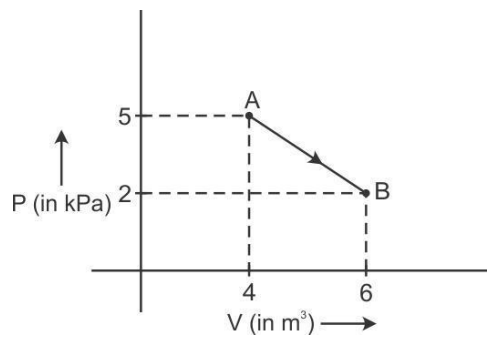
The change in internal energy of the gas during the transition isFrom the graph: A (4 $m^3$, 5 kPa) and B (6 $m^3$, 2 kPa).
$\Delta U = nC_v\Delta T$ with $C_v = \frac{R}{\gamma - 1}$ and $n\Delta T = \frac{P_2V_2 - P_1V_1}{R}$
$\Delta U = \frac{P_2V_2 - P_1V_1}{\gamma - 1}$
For a diatomic gas, $\gamma - 1 = \frac{2}{5}$:
$\Delta U = \frac{(2\times10^3\times 6) - (5\times10^3\times 4)}{2/5} = \frac{-8\times10^3}{2/5}$
$\Delta U = -20$ kJ
Isothermal and adiabatic processes
-
A monoatomic gas at a pressure P, having a volume V expands isothermally to a volume 2V and then adiabatically to a volume 16V. The final pressure of the gas is: (take $\gamma = \frac{5}{3}$)Isothermal: $P_1V_1 = P_2V_2 \Rightarrow PV = P_2(2V) \Rightarrow P_2 = \frac{P}{2}$
Adiabatic: $P_2V_2^\gamma = P_3V_3^\gamma \Rightarrow \frac{P}{2}(2V)^\gamma = P_3(16V)^\gamma$
$P_3 = \frac{P}{2}\left(\frac{1}{8}\right)^{5/3} = \frac{P}{64}$
Work in a cyclic process
-
A thermodynamic system undergoes cyclic process ABCDA as shown in fig. The work done by the system in the cycle is:
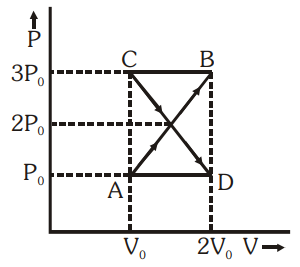 Work done in the cycle = area enclosed by the P–V loops; the two triangular loops are traversed in opposite senses.
$W = \frac{1}{2}(2P_0 - P_0)(2V_0 - V_0) + \left[-\frac{1}{2}(3P_0 - 2P_0)(2V_0 - V_0)\right]$
$W = \frac{P_0V_0}{2} - \frac{P_0V_0}{2} = 0$ -
A thermodynamic system is taken through the cycle ABCD as shown in figure. Heat rejected by the gas during the cycle is
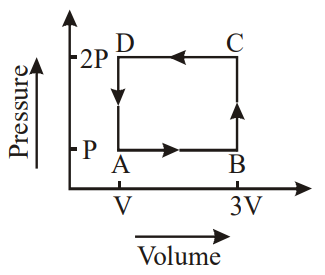 The cycle is a rectangle with pressures P and 2P and volumes V and 3V.
Area enclosed $= (2P - P)(3V - V) = 2PV$
The cycle is traversed anticlockwise, so the work done by the gas is negative: $W = -2PV$
For a complete cycle $\Delta E = 0$, so $Q = W + \Delta E = -2PV$
So the heat rejected by the gas is 2PV.
Adiabatic process
-
During an adiabatic process, the pressure of a gas is found to be proportional to the cube of its temperature. The ratio of $\frac{C_p}{C_v}$ for the gas is:$P \propto T^3$ and $PV = nRT$ give $PV^{3/2}$ = constant.
Comparing with $PV^\gamma$ = constant: $\gamma = \frac{C_p}{C_v} = \frac{3}{2}$ -
A mass of diatomic gas ($\gamma = 1.4$) at a pressure of 2 atmospheres is compressed adiabatically so that its temperature rises from $27^\circ C$ to $927^\circ C$. The pressure of the gas in the final state is$T_1 = 27 + 273 = 300$ K; $T_2 = 927 + 273 = 1200$ K; $P_1 = 2$ atm.
For an adiabatic process $P^{1-\gamma}T^\gamma$ = constant, so $\frac{P_2}{P_1} = \left(\frac{T_2}{T_1}\right)^{\frac{\gamma}{\gamma - 1}}$
$\frac{\gamma}{\gamma - 1} = \frac{1.4}{0.4} = \frac{7}{2}$
$P_2 = 2\times\left(\frac{1200}{300}\right)^{7/2} = 2\times(4)^{7/2}$
$(4)^{7/2} = 2^7 = 128$
$P_2 = 2\times128 = 256$ atm -
One mole of an ideal gas at an initial temperature of T K does 6 R joules of work adiabatically. If the ratio of specific heats of this gas at constant pressure and at constant volume is $\dfrac{5}{3}$, the final temperature of gas will be :-In an adiabatic process no heat is exchanged: $Q = 0$, so by the first law $0 = \Delta U + W \Rightarrow \Delta U = -W$.
The gas does work $W = 6R$, so $\Delta U = -6R$.
For an ideal gas, $\Delta U = \mu C_V \Delta T$, with $C_V = \dfrac{R}{\gamma - 1}$.
Here $\gamma = \dfrac{5}{3}$, so $C_V = \dfrac{R}{\frac{5}{3} - 1} = \dfrac{3}{2}R$
Therefore $-6R = 1 \times \dfrac{3}{2}R\,\Delta T$
$\Rightarrow \Delta T = -4$ K
$T_{final} = (T - 4)$ K (the gas cools as it does work at the cost of its internal energy).
Carnot Engine
-
An engine has an efficiency of $\dfrac{1}{6}$. When the temperature of sink is reduced by $62^\circ C$, its efficiency is doubled. Temperature of the source isEfficiency of the engine: $\eta = 1 - \dfrac{T_2}{T_1}$, where $T_1$ is the temperature of the source and $T_2$ that of the sink (in kelvin).
According to the problem, $\dfrac{1}{6} = 1 - \dfrac{T_2}{T_1}$ ...(1)
From (1): $\dfrac{T_2}{T_1} = \dfrac{5}{6}$
When the temperature of the sink is reduced by $62^\circ C$ (a fall of 62 K), the efficiency is doubled: $2\left(\dfrac{1}{6}\right) = 1 - \dfrac{T_2 - 62}{T_1}$ ...(2)
$\dfrac{1}{3} = 1 - \dfrac{T_2}{T_1} + \dfrac{62}{T_1} = \dfrac{1}{6} + \dfrac{62}{T_1}$
$\dfrac{62}{T_1} = \dfrac{1}{3} - \dfrac{1}{6} = \dfrac{1}{6}$
$T_1 = 62 \times 6 = 372$ K
$T_1 = 372 - 273 = 99^\circ C$ = temperature of the source.
(The sink is at $T_2 = \dfrac{5}{6} \times 372 = 310$ K $= 37^\circ C$.) -
A Carnot engine whose sink is at 300 K has an efficiency of 40%. By how much should the temperature of source be increased so as to increase its efficiency by 50% of original efficiency :-Efficiency of a Carnot engine: $\eta = 1 - \dfrac{T_2}{T_1}$, where $T_1$ is the source temperature and $T_2$ the sink temperature.
$1 - \dfrac{300}{T_1} = 0.4 \Rightarrow \dfrac{300}{T_1} = 0.6 \Rightarrow T_1 = 500$ K
The efficiency is to be increased by 50 percent of the original efficiency: $\eta' = 0.4 + 0.4 \times \dfrac{50}{100} = 0.6$
Let the source temperature be increased by $\Delta T$, the sink remaining at 300 K.
$0.6 = 1 - \dfrac{300}{500 + \Delta T}$
$\dfrac{300}{500 + \Delta T} = 0.4 \Rightarrow 500 + \Delta T = 750$
$\Rightarrow \Delta T = 250$ K -
The ratio $\dfrac{W}{Q}$ for a Carnot engine is $\dfrac{1}{6}$. Now the temp. of sink is reduced by $62^\circ C$, then this ratio becomes twice, therefore the initial temp. of the sink and source are respectively :$\dfrac{W}{Q} = \eta = 1 - \dfrac{T_L}{T_H} = \dfrac{1}{6} \Rightarrow \dfrac{T_L}{T_H} = \dfrac{5}{6}$
When the sink temperature is reduced by 62 (a change of 62 °C = 62 K), the efficiency becomes $\dfrac{2}{6}$:
$1 - \dfrac{T_L - 62}{T_H} = \dfrac{2}{6} \Rightarrow \dfrac{T_L - 62}{T_H} = \dfrac{2}{3}$
$\Rightarrow 3T_L - 186 = 2T_H$. Substituting $T_L = \dfrac{5}{6}T_H$: $\dfrac{5}{2}T_H - 186 = 2T_H$
$\dfrac{1}{2}T_H = 186 \Rightarrow T_H = 372$ K $= 99^\circ C$
$T_L = \dfrac{5}{6} \times 372 = 310$ K $= 37^\circ C$
So the initial temperatures of the sink and source are $37^\circ C$ and $99^\circ C$.
That is every question in Thermodynamics for this filter.
Want a score?
Answers here are not saved. Practise as a test to be marked and see your progress.
Practise as a test