Looking for classes? Ksquare Career Institute, Bengaluru →

One mole of an ideal diatomic gas undergoes a transition from A to B along a path AB as shown in the figure.
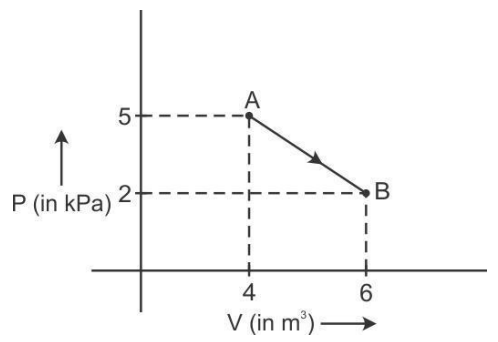
The change in internal energy of the gas during the transition is
The change in internal energy of the gas during the transition is
A
20 kJ
B
-20 kJ
C
20 J
D
-12 kJ
Detailed Solution
From the graph: A (4 $m^3$, 5 kPa) and B (6 $m^3$, 2 kPa).
$\Delta U = nC_v\Delta T$ with $C_v = \frac{R}{\gamma - 1}$ and $n\Delta T = \frac{P_2V_2 - P_1V_1}{R}$
$\Delta U = \frac{P_2V_2 - P_1V_1}{\gamma - 1}$
For a diatomic gas, $\gamma - 1 = \frac{2}{5}$:
$\Delta U = \frac{(2\times10^3\times 6) - (5\times10^3\times 4)}{2/5} = \frac{-8\times10^3}{2/5}$
$\Delta U = -20$ kJ
$\Delta U = nC_v\Delta T$ with $C_v = \frac{R}{\gamma - 1}$ and $n\Delta T = \frac{P_2V_2 - P_1V_1}{R}$
$\Delta U = \frac{P_2V_2 - P_1V_1}{\gamma - 1}$
For a diatomic gas, $\gamma - 1 = \frac{2}{5}$:
$\Delta U = \frac{(2\times10^3\times 6) - (5\times10^3\times 4)}{2/5} = \frac{-8\times10^3}{2/5}$
$\Delta U = -20$ kJ