Looking for classes? Ksquare Career Institute, Bengaluru →

Internal energy of an ideal gas
Concepts tested here
- Delta U = nCv Delta T
All Questions
2015 AIPMT-I 1 question
-
One mole of an ideal diatomic gas undergoes a transition from A to B along a path AB as shown in the figure.
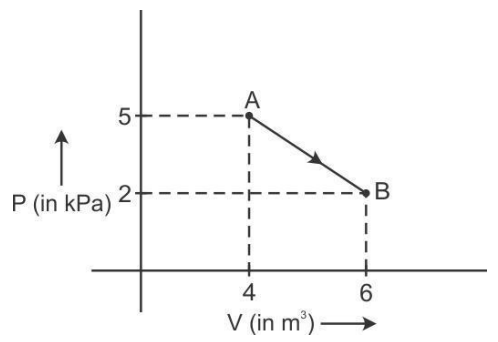
The change in internal energy of the gas during the transition isFrom the graph: A (4 $m^3$, 5 kPa) and B (6 $m^3$, 2 kPa).
$\Delta U = nC_v\Delta T$ with $C_v = \frac{R}{\gamma - 1}$ and $n\Delta T = \frac{P_2V_2 - P_1V_1}{R}$
$\Delta U = \frac{P_2V_2 - P_1V_1}{\gamma - 1}$
For a diatomic gas, $\gamma - 1 = \frac{2}{5}$:
$\Delta U = \frac{(2\times10^3\times 6) - (5\times10^3\times 4)}{2/5} = \frac{-8\times10^3}{2/5}$
$\Delta U = -20$ kJ