Looking for classes? Ksquare Career Institute, Bengaluru →

Thermodynamics
Thermodynamic Processes
4 questions from 4 papers, each with its answer.
- questions
- 4
- papers
- 4
- years asked, 2017–2026
- 1 of 10
- of Thermodynamics
- 7.41%
Appears in
Concepts tested
- adiabatic process
- Isochoric process
- P-V diagram of isothermal and isobaric processes
- Work in compression processes
All Questions
2019 1 question
-
In which of the following processes, heat is neither absorbed nor released by a system?In an adiabatic process there is no exchange of heat between the system and the surroundings, i.e. $\Delta Q=0$. Hence heat is neither absorbed nor released in an adiabatic process.
2015 AIPMT-II 1 question
-
An ideal gas is compressed to half its initial volume by means of several processes. Which of the process results in the maximum work done on the gas?
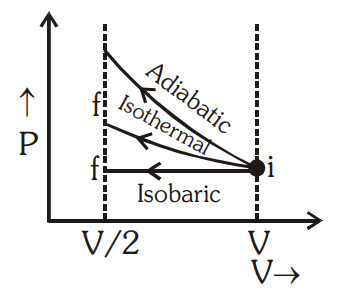
Work done on the gas equals the area under the P–V curve; the adiabatic curve is the steepest, so it encloses the largest area.
$W_{isochoric} = 0$ and $W_{adiabatic} > W_{isothermal} > W_{isobaric}$
2012 AIPMT-PRE 1 question
-
One mole of an ideal gas goes from an initial state A to final state B via two processes: It first undergoes isothermal expansion from volume V to 3V and then its volume is reduced from 3V to V at constant pressure. The correct P-V diagram representing the two processes is:Isothermal expansion: PV = constant, so as the volume goes from V to 3V the pressure falls along a rectangular hyperbola.
Then the volume is reduced from 3V back to V at constant pressure: a horizontal straight line directed towards smaller volume.
So the diagram shows a falling hyperbola from A (at V) to 3V, followed by a horizontal line back to V ending at B, which lies below A.
2009 AIPMT 1 question
-
In thermodynamic processes which of the following statements is not true?Adiabatic process: no heat is exchanged, so the system is insulated from the surroundings, and for an ideal gas $PV^\gamma$ = constant. Both statements are true.
Isothermal process: the temperature remains constant (true).
Isochoric process: it is the volume that remains constant; the pressure changes with temperature ($P \propto T$).
The process in which pressure remains constant is the isobaric process.
Hence the statement that is not true is 'In an isochoric process pressure remains constant'.