Looking for classes? Ksquare Career Institute, Bengaluru →

Physics
System of Particles and Rotational Motion
100 questions from 38 papers, each with its answer.
- 100 questions
- 38 papers
- 5.67% of Physics
Conservation of Angular Momentum
-
A mass m moves in a circle on a smooth horizontal plane with velocity $v_0$ at a radius $R_0$. The mass is attached to a string which passes through a smooth hole in the plane as shown.
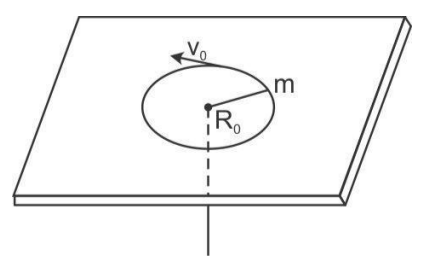
The tension in the string is increased gradually and finally m moves in a circle of radius $\frac{R_0}{2}$. The final value of the kinetic energy isThe tension is a central force, so angular momentum about the hole is conserved.
$mv_0R_0 = mv\frac{R_0}{2} \Rightarrow v = 2v_0$
$KE_f = \frac{1}{2}m(2v_0)^2 = 2mv_0^2$ -
A small mass attached to a string rotates on a frictionless table top as shown. If the tension in the string is increased by pulling the string causing the radius of the circular motion to decrease by a factor of 2, the kinetic energy of the mass will
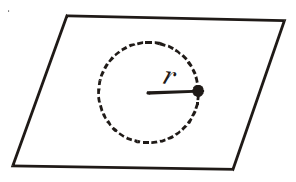 The tension acts along the string towards the centre, so its torque about the centre is zero and the angular momentum of the mass is conserved.
$mvr = mv'r'$ with $r' = \frac{r}{2}$
$mvr = mv'\frac{r}{2}$, so $v' = 2v$
Initial kinetic energy: $KE = \frac{1}{2}mv^2$
Final kinetic energy: $KE' = \frac{1}{2}m(2v)^2 = 4\times\frac{1}{2}mv^2 = 4KE$
So the kinetic energy increases by a factor of 4 (the extra energy comes from the work done in pulling the string). -
A circular disk of moment of inertia $I_t$ is rotating in a horizontal plane, about its symmetry axis, with a constant angular speed $\omega_i$. Another disk of moment of inertia $I_b$ is dropped coaxially onto the rotating disk. Initially the second disk has zero angular speed. Eventually both the disks rotate with a constant angular speed $\omega_f$. The energy lost by the initially rotating disc to friction isNo external torque acts on the two-disk system, so angular momentum is conserved: $I_t\omega_i = (I_t + I_b)\omega_f$
$\omega_f = \frac{I_t\omega_i}{I_t + I_b}$
Initial kinetic energy: $K_i = \frac{1}{2}I_t\omega_i^2$
Final kinetic energy: $K_f = \frac{1}{2}(I_t + I_b)\omega_f^2 = \frac{1}{2}\frac{I_t^2\omega_i^2}{(I_t + I_b)}$
Energy lost: $\Delta E = K_i - K_f = \frac{1}{2}I_t\omega_i^2\left[1 - \frac{I_t}{I_t + I_b}\right]$
$\Delta E = \frac{1}{2}\frac{I_bI_t}{(I_t + I_b)}\omega_i^2$
Rigid Body Equilibrium
-
A uniform rod of mass $20\text{ kg}$ and length $5\text{ m}$ leans against a smooth vertical wall making an angle of $60^\circ$ with it. The other end rests on a rough horizontal floor. The friction force that the floor exerts on the rod is (take $g = 10\text{ m/s}^2$):
Torque balance about the ground contact point gives normal force from wall $N_w = \frac{W}{2} \cot 30^\circ = 100\sqrt{3}\text{ N}$. Horizontal equilibrium requires friction $f = N_w = 100\sqrt{3}\text{ N}$.
The rod makes an angle of $60^\circ$ with the vertical wall, so its angle with the horizontal floor is $\theta = 90^\circ - 60^\circ = 30^\circ$. Weight of the rod is $W = mg = 20 \times 10 = 200\text{ N}$, acting at the midpoint. Taking torque about the bottom contact point O: $\sum \tau_O = 0 \implies N_w (l \sin\theta) = W \left(\frac{l}{2}\right) \cos\theta \implies N_w = \frac{W}{2} \cot\theta = \frac{200}{2} \cot 30^\circ = 100\sqrt{3}\text{ N}$. For horizontal translational equilibrium, the friction force exerted by the floor balances $N_w$: $f = N_w = 100\sqrt{3}\text{ N}$.
Moment of Inertia of Bodies with Cavities
-
A sphere of radius $R$ is cut from a larger solid sphere of radius $2R$ as shown in the figure (cavity tangent to the outer sphere and passing through origin). The ratio of the moment of inertia of the smaller sphere to that of the rest part of the sphere about the Y-axis is:
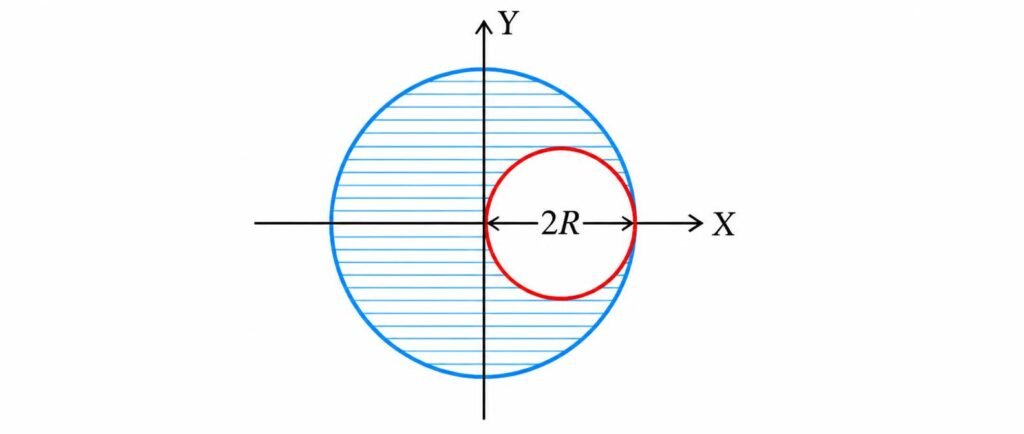
Using parallel axis theorem, $I_s = \frac{7}{5} m_s R^2$ and $I_L = \frac{64}{5} m_s R^2$. Remaining part has $I_r = \frac{57}{5} m_s R^2$. Ratio is $I_s / I_r = 7/57$.
Mass of smaller sphere is $m_s = \frac{4}{3}\pi R^3 \rho$. Large complete sphere has mass $M = \frac{4}{3}\pi (2R)^3 \rho = 8 m_s$. Moment of inertia of large sphere about Y-axis through its center: $I_L = \frac{2}{5} M (2R)^2 = \frac{2}{5}(8m_s)(4R^2) = \frac{64}{5} m_s R^2$. The center of the small sphere is shifted by distance $d = R$ from the Y-axis. By the parallel axis theorem: $I_s = I_{cm} + m_s d^2 = \frac{2}{5} m_s R^2 + m_s R^2 = \frac{7}{5} m_s R^2$. Moment of inertia of the remaining part about the Y-axis is $I_r = I_L - I_s = \frac{64}{5} m_s R^2 - \frac{7}{5} m_s R^2 = \frac{57}{5} m_s R^2$. The required ratio is $\frac{I_s}{I_r} = \frac{(7/5) m_s R^2}{(57/5) m_s R^2} = \frac{7}{57}$.
Rolling Motion
-
A wheel of a bullock cart is rolling on a level road as shown in the figure below. If its linear speed is $v$ in the direction shown, which one of the following options is correct ($P$ and $Q$ are any highest and lowest points on the wheel respectively)?
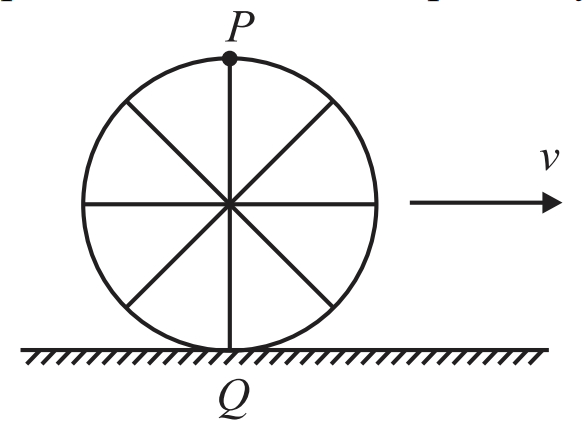 [add image: rolling wheel with top point P moving at 2v and contact point Q at rest] For pure rolling, the lowest point Q (point of contact) is instantaneously at rest: $v_Q = v - v = 0$. The highest point P moves with speed $v_P = v + v = 2v$. So point P moves faster than point Q.
-
The ratio of the accelerations for a solid sphere (mass 'm' and radius 'R') rolling down an incline of angle '$\theta$' without slipping and slipping down the incline without rolling is:Rolling without slipping: $a_1 = \frac{g\sin\theta}{1 + \frac{K^2}{R^2}}$
Slipping without rolling: $a_2 = g\sin\theta$
$\frac{a_1}{a_2} = \frac{1}{1 + \frac{K^2}{R^2}} = \frac{1}{1 + \frac{2}{5}} = \frac{5}{7}$ -
A small object of uniform density rolls up a curved surface with an initial velocity 'v'. It reaches upto a maximum height of $\frac{3v^2}{4g}$ with respect to the initial position. The object isConservation of mechanical energy: $\frac{1}{2}mv^2\left(1 + \frac{K^2}{R^2}\right) = mgh$
$\frac{1}{2}mv^2\left(1 + \frac{K^2}{R^2}\right) = mg\left(\frac{3v^2}{4g}\right) \Rightarrow \frac{K^2}{R^2} = \frac{1}{2}$
So the object is a disc. -
A solid cylinder of mass 3 kg is rolling on a horizontal surface with velocity 4 $ms^{-1}$. It collides with a horizontal spring of force constant 200 $Nm^{-1}$. The maximum compression produced in the spring will beAt maximum compression all the kinetic energy (translational + rotational) is stored in the spring:
$\frac{1}{2}mv^2 + \frac{1}{2}I\omega^2 = \frac{1}{2}kx^2$, with $I = \frac{mR^2}{2}$ and $\omega = \frac{v}{R}$
$\frac{1}{2}\times3\times(4)^2 + \frac{1}{2}\times\frac{3R^2}{2}\times\left(\frac{4}{R}\right)^2 = \frac{1}{2}\times200\times x^2$
$24 + 12 = 100x^2 \Rightarrow x^2 = 0.36$
$x = 0.6$ m -
A solid cylinder and a hollow cylinder, both of the same mass and same external diameter, are released from the same height at the same time on an inclined plane. Both roll down without slipping. Which one will reach the bottom first?Acceleration of a body rolling without slipping down an incline: $a = \frac{g\sin\theta}{1 + \frac{k^2}{R^2}}$, where k is the radius of gyration.
Time to cover a length l of the incline from rest: $t = \sqrt{\frac{2l}{a}} = \sqrt{\frac{2l\left(1 + \frac{k^2}{R^2}\right)}{g\sin\theta}}$
Solid cylinder: $I = \frac{1}{2}MR^2$, so $\frac{k^2}{R^2} = \frac{1}{2}$
Hollow cylinder: its mass is farther from the axis, so $\frac{k^2}{R^2}$ is larger (it equals 1 for a thin shell).
A smaller $\frac{k^2}{R^2}$ gives a larger acceleration and a shorter time, independent of mass and of the angle of inclination.
Hence the solid cylinder reaches the bottom first. -
A drum of radius R and mass M, rolls down without slipping along an inclined plane of angle $\theta$. The frictional force -When a body rolls without slipping, the point of contact is momentarily at rest, so the friction acting is static friction and does no net work. Hence it does not dissipate energy as heat.
For a body rolling down an incline, friction acts up the incline.
It opposes the translational motion, reducing the linear acceleration from $g\sin\theta$ to $\dfrac{g\sin\theta}{1 + I/MR^2}$.
At the same time its torque about the centre ($fR$) produces the angular acceleration, i.e. it increases the rotational motion.
So the friction takes away part of the energy that would have gone into translation and puts it into rotation; the total mechanical energy is conserved.
Hence the frictional force converts translational energy to rotational energy. -
A solid cylinder of mass M and radius R rolls without slipping down an inclined plane of length L and height h. What is the speed of its centre of mass when the cylinder reaches its bottom -In rolling without slipping, friction does no work, so mechanical energy is conserved. The loss in potential energy becomes translational plus rotational kinetic energy:
$Mgh = \dfrac{1}{2}Mv^2 + \dfrac{1}{2}I\omega^2 = \dfrac{1}{2}Mv^2\left(1 + \dfrac{K^2}{R^2}\right)$ (using $I = MK^2$ and $v = R\omega$)
$\Rightarrow v = \sqrt{\dfrac{2gh}{1 + K^2/R^2}}$
For a solid cylinder $I = \dfrac{1}{2}MR^2$, so $\dfrac{K^2}{R^2} = \dfrac{1}{2}$
$v = \sqrt{\dfrac{2gh}{1 + \frac{1}{2}}} = \sqrt{\dfrac{4gh}{3}}$
The speed does not depend on the length L of the incline, only on the height h.
Moment of Inertia and Radius of Gyration
-
The ratio of radius of gyration of a solid sphere of mass $M$ and radius $R$ about its own axis to the radius of gyration of the thin hollow sphere of same mass and radius about its axis is:
The ratio comes to $\sqrt{3}:\sqrt{5}$; the printed key marks this question 'None'.
Radius of gyration of a solid sphere: $K_S=\sqrt{\frac{2}{5}}R$ Radius of gyration of a hollow sphere: $K_H=\sqrt{\frac{2}{3}}R$ $\Rightarrow \frac{K_S}{K_H}=\sqrt{\frac{3}{5}}=\frac{\sqrt{3}}{\sqrt{5}}$ Answer key in the source: (None). -
The ratio of the radius of gyration of a thin uniform disc about an axis passing through its centre and normal to its plane to the radius of gyration of the disc about its diameter is:For a disc about the axis through its centre, normal to its plane: $I_1 = \frac{mR^2}{2}$ About its diameter: $I_2 = \frac{mR^2}{4}$ Radius of gyration $k = \sqrt{\frac{I}{m}}$ $\frac{k_1}{k_2} = \sqrt{\frac{I_1}{I_2}} = \sqrt{\frac{mR^2/2}{mR^2/4}} = \sqrt{2}$ So $k_1 : k_2 = \sqrt{2} : 1$
Rotational Kinematics
-
The angular speed of a fly wheel moving with uniform angular acceleration changes from 1200 rpm to 3120 rpm in 16 seconds. The angular acceleration in $rad/s^2$ is :$\omega = \omega_0 + \alpha t \Rightarrow \alpha = \frac{\omega - \omega_0}{t}$ $\alpha = \frac{(3120 - 1200)}{16}$ rpm per s $= \frac{1920}{16} \times \frac{2\pi}{60}$ rad/$s^2$ $= 4\pi$ rad/$s^2$
Equilibrium of a Rigid Body – Moments
-
A uniform rod of length 200 cm and mass 500 g is balanced on a wedge placed at 40 cm mark. A mass of 2 kg is suspended from the rod at 20 cm and another unknown mass $m$ is suspended from the rod at 160 cm mark as shown in the figure. Find the value of $m$ such that the rod is in equilibrium. ($g=10\ m/s^2$)
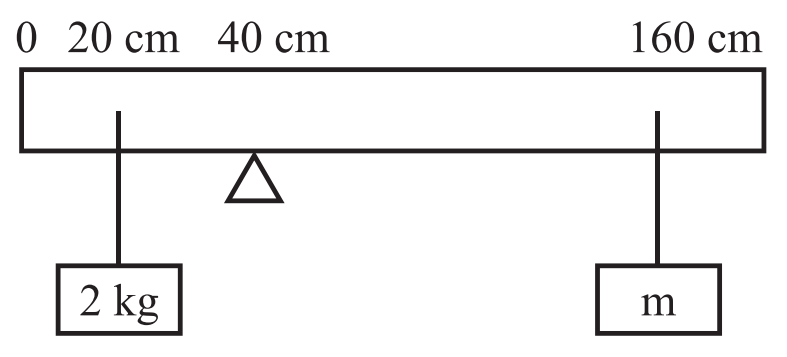
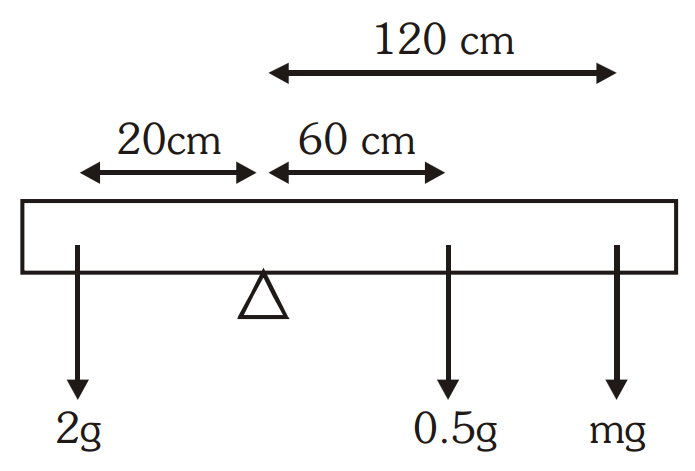
Weight of the rod (0.5 kg) acts at its centre (100 cm), i.e. 60 cm from the wedge. The 2 kg mass is 20 cm from the wedge and m is 120 cm from it.
Balancing torques about the wedge: $2g \times 20 = 0.5g \times 60 + mg \times 120$ $40 = 30 + 120m \Rightarrow m = \frac{1}{12}$ kg
Moment of Inertia
-
From a circular ring of mass $M$ and radius $R$ an arc corresponding to a $90^\circ$ sector is removed. The moment of inertia of the remaining part of the ring about an axis passing through the centre of the ring and perpendicular to the plane of the ring is $K$ times $MR^2$. Then the value of $K$ is:Removing a $90^\circ$ arc leaves $\frac{3}{4}$ of the ring: $M_{remain} = \frac{3}{4}M$ All of the remaining mass is at distance R from the axis: $I = M_{remain}R^2 = \frac{3}{4}MR^2 \Rightarrow K = \frac{3}{4}$
-
Three identical spherical shells, each of mass m and radius r are placed as shown in figure. Consider an axis XX' which is touching two shells and passing through diameter of third shell. Moment of inertia of the system consisting of these three spherical shells about XX' axis is
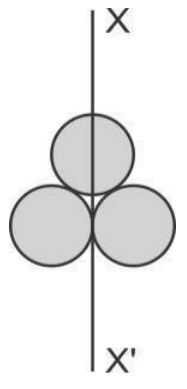 About a diameter of a thin spherical shell: $I = \frac{2}{3}mr^2$, so $I_1 = \frac{2}{3}mr^2$.
About a tangent (parallel axis theorem): $I = \frac{2}{3}mr^2 + mr^2 = \frac{5}{3}mr^2$, so $I_2 = I_3 = \frac{5}{3}mr^2$.
$I_{XX'} = \frac{2}{3}mr^2 + \frac{5}{3}mr^2 + \frac{5}{3}mr^2 = 4mr^2$ -
Point masses $m_1$ and $m_2$ are placed at the opposite ends of a rigid rod of length L, and negligible mass. The rod is to be set rotating about an axis perpendicular to it. The position of point P on this rod through which the axis should pass so that the work required to set the rod rotating with angular velocity $\omega_0$ is minimum, is given by:
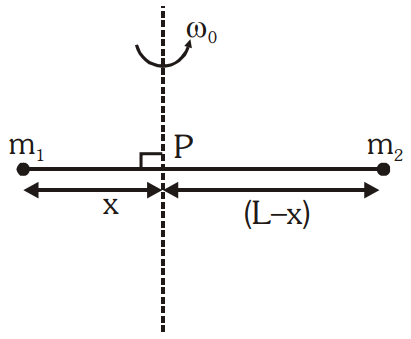 Work required $= \frac{1}{2}I\omega_0^2$, which is minimum when I is minimum, i.e. when the axis passes through the centre of mass.
$m_1x = m_2(L - x)$
$x = \frac{m_2L}{m_1 + m_2}$ -
From a circular disc of radius R and mass 9M, a small disc of mass M and radius $\frac{R}{3}$ is removed concentrically. The moment of inertia of the remaining disc about an axis perpendicular to the plane of the disc and passing through its centre isMoment of inertia of a disc about its axis: $I = \frac{1}{2}(\text{mass})(\text{radius})^2$
Complete disc: $I_1 = \frac{1}{2}(9M)R^2 = \frac{9MR^2}{2}$
Removed disc (same axis, since it is concentric): $I_2 = \frac{1}{2}M\left(\frac{R}{3}\right)^2 = \frac{MR^2}{18}$
Remaining disc: $I = I_1 - I_2 = \frac{9MR^2}{2} - \frac{MR^2}{18} = \frac{81MR^2 - MR^2}{18}$
$I = \frac{80MR^2}{18} = \frac{40}{9}MR^2$ -
Four identical thin rods each of mass M and length l, form a square frame. Moment of inertia of this frame about an axis through the centre of the square and perpendicular to its plane isMoment of inertia of one rod about an axis through its own centre and perpendicular to its length: $I_{cm} = \frac{Ml^2}{12}$
The centre of the square is at a perpendicular distance $\frac{l}{2}$ from the centre of each rod.
By the parallel axis theorem, for one rod about the axis through the centre of the square: $I_1 = \frac{Ml^2}{12} + M\left(\frac{l}{2}\right)^2 = \frac{Ml^2}{12} + \frac{Ml^2}{4} = \frac{Ml^2}{3}$
For the four rods: $I = 4\times\frac{Ml^2}{3}$
$I = \frac{4}{3}Ml^2$ -
A thin rod of length $L$ and mass $M$ is bent at its midpoint into two halves so that the angle between them is $90^\circ$. The moment of inertia of the bent rod about an axis passing through the bending point and perpendicular to the plane defined by the two halves of the rod is -After bending, each half is a thin rod of mass $\dfrac{M}{2}$ and length $\dfrac{L}{2}$.
The axis passes through the bending point, which is one end of each half, and is perpendicular to both halves.
Moment of inertia of a thin rod of mass $m$ and length $l$ about a perpendicular axis through its end $= \dfrac{ml^2}{3}$
For one half: $I_1 = \dfrac{(M/2)(L/2)^2}{3} = \dfrac{ML^2}{24}$
Moment of inertia of the system: $I = \dfrac{(M/2)(L/2)^2}{3} + \dfrac{(M/2)(L/2)^2}{3}$
$I = \dfrac{ML^2}{24} + \dfrac{ML^2}{24}$
$I = \dfrac{ML^2}{12}$
The angle between the halves does not matter, because every element stays at the same distance from the axis.
Torque and Angular Momentum
-
Find the torque about the origin when a force of $3\hat{j}\ N$ acts on a particle whose position vector is $2\hat{k}\ m$.$\vec{\tau} = \vec{r} \times \vec{F} = 2\hat{k} \times 3\hat{j}$ $= 6(\hat{k} \times \hat{j}) = -6\hat{i}$ N m
Rolling Motion – Kinetic Energy
-
A disc of radius 2 m and mass 100 kg rolls on a horizontal floor. Its centre of mass has speed of 20 cm/s. How much work is needed to stop it?Work required = change in kinetic energy; final KE = 0. For a rolling disc: $KE_i=\frac{1}{2}mv^2+\frac{1}{2}I\omega^2=\frac{1}{2}mv^2+\frac{1}{2}\cdot\frac{1}{2}mr^2\cdot\frac{v^2}{r^2}=\frac{3}{4}mv^2$ $KE_i=\frac{3}{4}\times100\times(20\times10^{-2})^2=3\ J$ $|\Delta KE|=3\ J$
Rotational Dynamics – Torque and Angular Acceleration
-
A solid cylinder of mass 2 kg and radius 4 cm is rotating about its axis at the rate of 3 rpm. The torque required to stop after $2\pi$ revolutions is:By the work–energy theorem: $W=\frac{1}{2}I(\omega_f^2-\omega_i^2)$ $\theta=2$ revolutions $=2\times2\pi=4\pi\ rad$; $\omega_i=3\ rpm=\frac{2\pi\times3}{60}\ rad/s$ $-\tau\theta=\frac{1}{2}\cdot\frac{1}{2}mr^2(0-\omega_i^2)$ $\tau=\frac{\frac{1}{4}\times2\times(4\times10^{-2})^2\times\left(\frac{2\pi\times3}{60}\right)^2}{4\pi}$ $\tau=\frac{0.0008\times(0.1\pi)^2}{4\pi}=2\pi\times10^{-6}\ N\,m$ (the original paper lists this option as $2\pi\times10^{-6}\ N\,m$)
Rotational kinematics - angular acceleration and revolutions
-
The angular speed of a flywheel is increased from 600 rpm to 1200 rpm in 10 s. The number of revolutions completed by the flywheel during this time is:$\omega_i = 600$ rpm $= 20\pi$ rad/s ; $\omega_f = 1200$ rpm $= 40\pi$ rad/s ; t = 10 s $\theta = \left(\frac{\omega_i + \omega_f}{2}\right)t = \left(\frac{40\pi + 20\pi}{2}\right) \times 10 = 300\pi$ rad Number of revolutions $= \frac{300\pi}{2\pi} = 150$
Radius of gyration and parallel axis theorem
-
The radius of gyration of a solid sphere of mass 5 kg about XY is 5 m as shown in figure. The radius of the sphere is $\dfrac{5x}{\sqrt{7}}$ m, then the value of x is:
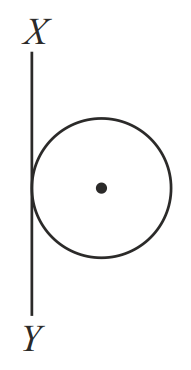 For a solid sphere about a tangent axis: $I_{XY}=I_g+MR^2=\dfrac{2}{5}MR^2+MR^2=\dfrac{7}{5}MR^2=7R^2$ (since $M=5$ kg). Also $I_{XY}=MK^2=5\times5^2=125$. So $7R^2=125\Rightarrow R=\sqrt{\dfrac{125}{7}}=\dfrac{5\sqrt5}{\sqrt7}$, matching $\dfrac{5x}{\sqrt7}$ gives $x=\sqrt5$.
Uniform angular velocity
-
Let $\omega_1,\omega_2$ and $\omega_3$ be the angular speed of the second hand, minute hand and hour hand of a smoothly running analog clock, respectively. If $x_1,x_2$ and $x_3$ are their respective angular distances in 1 minute then the factor which remains constant (k) isEach hand moves with constant angular speed, so the angular distance covered in 1 minute is $x=\omega\times t$ where $t=60$ s is the same for all hands. Hence $\dfrac{\omega_1}{x_1}=\dfrac{\omega_2}{x_2}=\dfrac{\omega_3}{x_3}=\dfrac{1}{t}=k$.
Centre of mass of a system of particles
-
Three identical spheres, each of mass M, are placed at the corners of a right angle triangle with mutually perpendicular sides equal to 2 m (see figure). Taking the point of intersection of the two mutually perpendicular sides as the origin, find the position vector of centre of mass.
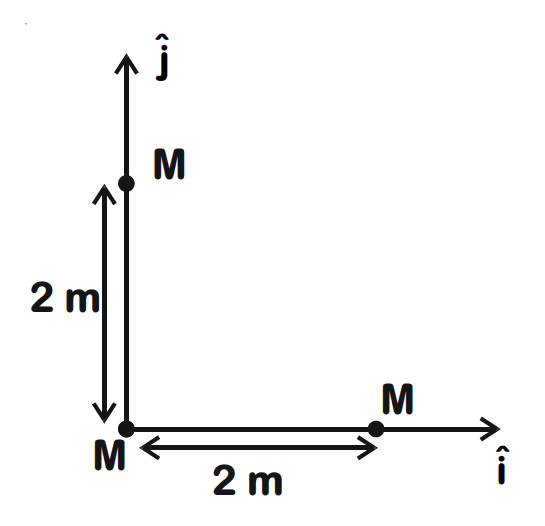 With masses at the origin, at $(2,0)$ and at $(0,2)$ (all mass M): $x_{cm}=\dfrac{M(0)+M(2)+M(0)}{3M}=\dfrac{2}{3}$, similarly $y_{cm}=\dfrac{2}{3}$. So position vector of COM $=\dfrac{2}{3}(\hat i+\hat j)$.
Angular acceleration
-
The angular speed of the wheel of a vehicle is increased from 360 rpm to 1200 rpm in 14 second. Its angular acceleration is,$\omega_1=360$ rpm $=\dfrac{360\times2\pi}{60}=12\pi\ rad/s$. $\omega_2=1200$ rpm $=\dfrac{1200\times2\pi}{60}=40\pi\ rad/s$. $\alpha=\dfrac{\omega_2-\omega_1}{t}=\dfrac{40\pi-12\pi}{14}=\dfrac{28\pi}{14}=2\pi\ rad/s^2$.
Centre of mass - conservation under internal forces
-
Two particles A and B initially at rest, move towards each other under mutual force of attraction. At an instance when the speed of A is v and speed of B is 3v, the speed of centre of mass is:Since the only forces acting are internal (mutual attraction between A and B), the net external force on the system is zero. So the velocity of the centre of mass remains constant, equal to its initial value of zero (both particles initially at rest).
Torque and rotational kinematics
-
A constant torque of 100 N m turns a wheel of moment of inertia 300 kg m$^2$ about an axis passing through its centre. Starting from rest, its angular velocity after 3s is:-$\tau=I\alpha\Rightarrow\alpha=\dfrac{\tau}{I}=\dfrac{100}{300}=\dfrac{1}{3}$ rad/sec$^2$. $\omega_i=0$; $\omega_f=\omega_i+\alpha t=0+\dfrac{1}{3}\times3=1$ rad/sec.
Rotational kinetic energy
-
An energy of 484 J is spent in increasing the speed of a flywheel from 60 rpm to 360 rpm. The moment of inertia of the flywheel is$\omega_i=60\times\frac{2\pi}{60}=2\pi$ rad/s and $\omega_f=360\times\frac{2\pi}{60}=12\pi$ rad/s. Energy spent $=\Delta KE=\frac{1}{2}I(\omega_f^2-\omega_i^2)$, so $484=\frac{1}{2}I[(12\pi)^2-(2\pi)^2]=70\pi^2 I$, giving $I=\frac{484}{70\pi^2}\approx0.7$ kg m$^2$.
Motion of centre of mass
-
When a fire cracker (rocket) explodes in mid air, its fragments fly in such a way that they continue moving in the same path, which the fire cracker would have followed, had it not exploded.Reason: Explosion of cracker (rocket) occurs due to internal forces only and no external force acts for this explosion.Assertion is false: it is the centre of mass of the fragments that continues along the original path, not the individual fragments. Reason is true: the explosion is caused by internal forces only, so the motion of the centre of mass is unchanged.
-
A solid sphere of radius R is placed on smooth horizontal surface. A horizontal force 'F' is applied at height 'h' from the lowest point. For the maximum acceleration of centre of mass, which is correct : -The surface is smooth, so there is no friction. The only horizontal external force on the sphere is F.
By Newton's second law for the centre of mass: $a_{cm} = \dfrac{F_{ext}}{M} = \dfrac{F}{M}$
This does not depend on where the force is applied. The height h only changes the torque about the centre, i.e. how much the sphere spins, not the acceleration of its centre of mass.
Since the surface is smooth, rolling without slipping is not possible; the sphere simply moves linearly (with some rotation if $h \neq R$).
So there is no relation between h and R for the maximum acceleration of the centre of mass; it is always $\dfrac{F}{M}$.
Kinematics of rotational motion
-
A particle starting from rest, moves in a circle of radius 'r'. It attains a velocity of $V_0$ m/s in the $n^{th}$ round. Its angular acceleration will be:$\theta=2\pi n$, $\omega_f=\frac{V_0}{r}$, $\omega_i=0$. $\omega_f^2=2\alpha\theta \Rightarrow \alpha=\frac{(V_0/r)^2}{2(2\pi n)}=\frac{V_0^2}{4\pi nr^2}$.
Rolling motion on an incline
-
A solid cylinder of mass 2 kg and radius 50 cm rolls up an inclined plane of angle inclination $30^\circ$. The centre of mass of cylinder has speed of 4 m/s. The distance travelled by the cylinder on the incline surface will be: (Take $g=10$ m/s$^2$)For a solid cylinder $\frac{k^2}{R^2}=\frac{1}{2}$. $\frac{1}{2}mv^2\left(1+\frac{k^2}{R^2}\right)=mgh \Rightarrow \frac{1}{2}\times2\times16\times\frac{3}{2}=2\times10\times h \Rightarrow h=1.2$ m. Distance along incline $=\frac{h}{\sin30^\circ}=2.4$ m.
Moment of inertia - parallel axis theorem
-
A solid sphere A of radius R and mass M is attached at a point to a smaller solid sphere B of radius r < R and mass m < M. Assume that the line joining their centres lies along the horizontal. The moment of inertia of the system calculated about a vertical axis passing through the centre of A is $I_A$ and that calculated about a vertical axis passing through the centre of B is $I_B$. The difference $I_A-I_B$ is:
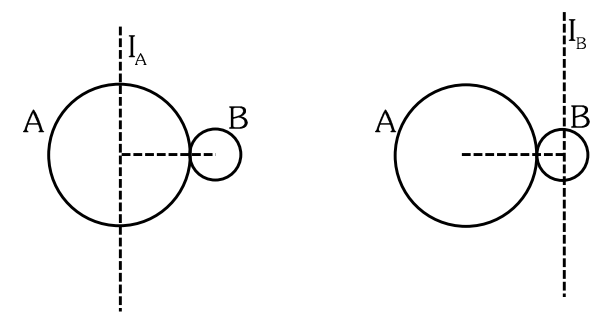 $I_A=\frac{2}{5}MR^2+\frac{2}{5}mr^2+m(R+r)^2$ and $I_B=\frac{2}{5}mr^2+\frac{2}{5}MR^2+M(R+r)^2$. $I_A-I_B=m(R+r)^2-M(R+r)^2=(m-M)(R+r)^2$.
Angular momentum about different points
-
A thin horizontal disc is rotating about a vertical axis passing through its fixed centre O. Its angular momentum is $L_A$ and $L_B$ computed about points A and B, respectively, with OB = 2 × OA. The value of $\frac{L_A}{L_B}$ is:
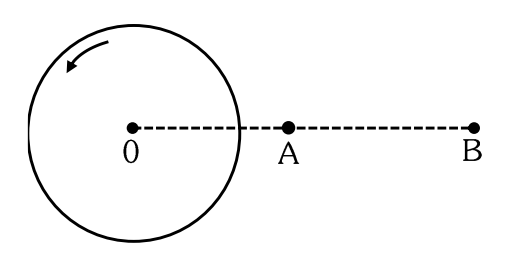 For a body in pure rotation, the angular momentum is the same about every point: $L=I\omega$. So $L_A=\frac{MR^2}{2}\omega$ and $L_B=\frac{MR^2}{2}\omega$, giving $\frac{L_A}{L_B}=1$.
Torque as a vector product
-
The moment of the force, $\vec{F} = 4\hat{i} + 5\hat{j} - 6\hat{k}$ at (2, 0, –3), about the point (2, –2, –2), is given by
Torque about a point = (position relative to that point) × force.
$\vec{\tau} = (\vec{r} - \vec{r}_0)\times\vec{F}$ ...(i) $\vec{r} - \vec{r}_0 = (2\hat{i} + 0\hat{j} - 3\hat{k}) - (2\hat{i} - 2\hat{j} - 2\hat{k}) = 0\hat{i} + 2\hat{j} - \hat{k}$ $\vec{\tau} = \begin{vmatrix} \hat{i} & \hat{j} & \hat{k} \\ 0 & 2 & -1 \\ 4 & 5 & -6 \end{vmatrix} = -7\hat{i} - 4\hat{j} - 8\hat{k}$
Centre of mass, centre of gravity and couple
-
Which of the following statements are correct? (a) Centre of mass of a body always coincides with the centre of gravity of the body. (b) Centre of mass of a body is the point at which the total gravitational torque on the body is zero (c) A couple on a body produce both translational and rotational motion in a body. (d) Mechanical advantage greater than one means that small effort can be used to lift a large load.
CM and CG differ in non-uniform fields; a couple causes only rotation.
The centre of mass may or may not coincide with the centre of gravity, so (a) is incorrect. A couple produces only rotational motion, so (c) is incorrect. So statements (b) and (d) are correct.
Conservation of angular momentum – energy loss
-
Two discs of same moment of inertia rotating about their regular axis passing through centre and perpendicular to the plane of disc with angular velocities $\omega_1$ and $\omega_2$. They are brought into contact face to face coinciding the axis of rotation. The expression for loss of energy during this process is
Loss = $\frac{1}{2}\frac{I_1I_2}{I_1+I_2}(\omega_1-\omega_2)^2$.
$\Delta KE = \frac{1}{2}\frac{I_1I_2}{I_1 + I_2}(\omega_1 - \omega_2)^2$ $= \frac{1}{2}\frac{I^2}{(2I)}(\omega_1 - \omega_2)^2$ $= \frac{1}{4}I(\omega_1 - \omega_2)^2$
Torque and angular acceleration
-
An automobile moves on a road with a speed of 54 km$h^{-1}$. The radius of its wheels is 0.45 m and the moment of inertia of the wheel about its axis of rotation is 3 kg$m^2$. If the vehicle is brought to rest in 15 s, the magnitude of average torque transmitted by its brakes to wheel is:$v = 54\times\frac{5}{18} = 15$ m/s
$\omega_0 = \frac{v}{R} = \frac{15}{0.45} = \frac{100}{3}$ rad/s
$\alpha = \frac{\omega_f - \omega_0}{t} = -\frac{100}{45}$ rad/$s^2$
$|\tau| = I\alpha = 3\times\frac{100}{45} = 6.66$ kg $m^2s^{-2}$ -
A solid cylinder of mass 50 kg and radius 0.5 m is free to rotate about the horizontal axis. A massless string is wound round the cylinder with one end attached to it and other hanging freely. Tension in the string required to produce an angular acceleration of 2 revolutions $s^{-2}$ is:$\alpha = 2$ rev/$s^2$ $= 4\pi$ rad/$s^2$
$I = \frac{1}{2}MR^2 = \frac{1}{2}(50)(0.5)^2 = \frac{25}{4}$ kg $m^2$
$\tau = I\alpha \Rightarrow TR = I\alpha$
$T = \frac{I\alpha}{R} = \frac{\frac{25}{4}\times 4\pi}{0.5} = 50\pi$ N = 157 N -
A rod PQ of mass M and length L is hinged at end P. The rod is kept horizontal by a massless string tied to point Q as shown in figure. When string is cut, the initial angular acceleration of the rod is:
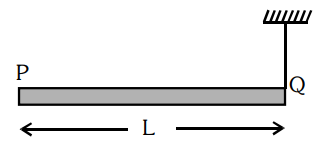 $\tau = I\alpha \Rightarrow Mg\left(\frac{L}{2}\right) = \left(\frac{ML^2}{3}\right)\alpha$
$\alpha = \frac{3g}{2L}$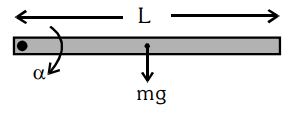
-
A uniform rod AB of length $l$ and mass $m$ is free to rotate about point A. The rod is released from rest in the horizontal position. Given that the moment of inertia of the rod about A is $\dfrac{ml^2}{3}$, the initial angular acceleration of the rod will be
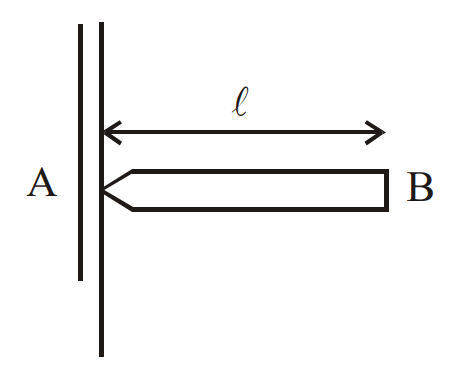
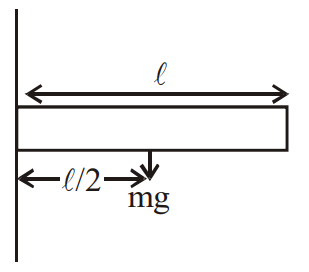
The weight $mg$ of the rod acts at its centre of mass, at a distance $\dfrac{l}{2}$ from A.
With the rod horizontal, the weight will produce a torque about A: $\tau = mg \times \dfrac{l}{2}$
Also, $\tau = I\alpha$, where $I = \dfrac{ml^2}{3}$ is the moment of inertia about A and $\alpha$ is the angular acceleration.
$\therefore \dfrac{ml^2}{3}\,\alpha = mg \times \dfrac{l}{2}$
$\alpha = \dfrac{mgl}{2} \times \dfrac{3}{ml^2}$
$\Rightarrow \alpha = \dfrac{3g}{2l}$ -
A uniform rod of length $l$ and mass $m$ is free to rotate in a vertical plane about A. The rod, initially in horizontal position, is released. The initial angular acceleration of the rod is (Moment of inertia of rod about A is $\dfrac{ml^2}{3}$) :
 The weight $mg$ of the rod acts at its centre, at a distance $\dfrac{l}{2}$ from A.
Torque of the weight about A when the rod is horizontal: $\tau = (mg)\left(\dfrac{l}{2}\right)$
Here $\tau = I\alpha$, with $I = \dfrac{ml^2}{3}$
$\Rightarrow (mg)\left(\dfrac{l}{2}\right) = \left(\dfrac{ml^2}{3}\right)(\alpha)$
$\alpha = \dfrac{mgl}{2} \times \dfrac{3}{ml^2}$
$\Rightarrow \alpha = \dfrac{3g}{2l}$
Moment of inertia – disc with a hole (parallel axis theorem)
-
From a disc of radius R and mass M, a circular hole of diameter R, whose rim passes through the centre is cut. What is the moment of inertia of the remaining part of the disc about a perpendicular axis, passing through the centre?
Subtract the hole's MI (via parallel axis theorem) from the full disc.
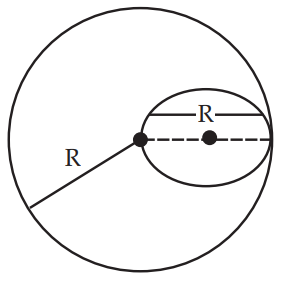
Mass per unit area $\rho = \frac{M}{\pi R^2}$; mass of removed part $M' = \rho\pi\left(\frac{R}{2}\right)^2 = \frac{M}{4}$
By the parallel axis theorem, MI of removed part about the centre: $I_1 = \frac{1}{2}M'\left(\frac{R}{2}\right)^2 + M'\left(\frac{R}{2}\right)^2 = \frac{MR^2}{32} + \frac{MR^2}{16} = \frac{3MR^2}{32}$
MI of the full disc about the centre $I = \frac{MR^2}{2}$
$I_{net} = I - I_1 = \frac{16MR^2}{32} - \frac{3MR^2}{32} = \frac{13MR^2}{32}$
Rolling motion on an inclined plane
-
A disc and a sphere of same radius but different masses roll off on two inclined planes of the same altitude and length. Which one of the two objects gets to the bottom of the plane first?
$a = g\sin\theta/(1 + k^2/R^2)$; the sphere has smaller $k^2/R^2$.
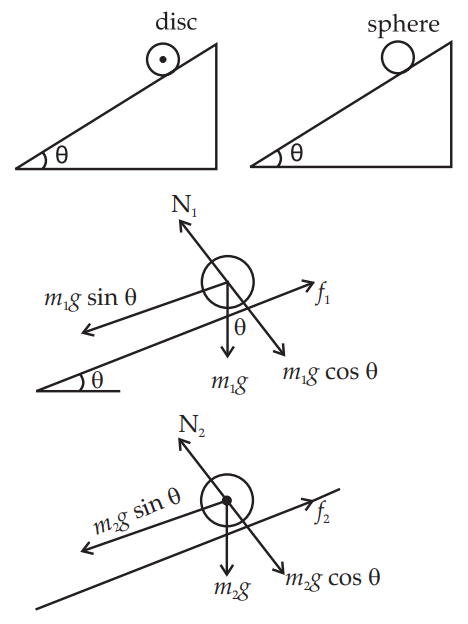
For the disc ($I_1 = \frac{1}{2}m_1R^2$): $m_1g\sin\theta - f_1 = m_1a_1$ and $f_1R = I_1\alpha_1$, giving $a_1 = \frac{2}{3}g\sin\theta$
For the sphere ($I_2 = \frac{2}{5}m_2R^2$): $m_2g\sin\theta - f_2 = m_2a_2$ and $f_2R = I_2\alpha_2$, giving $a_2 = \frac{5}{7}g\sin\theta$
$\frac{5}{7}g\sin\theta > \frac{2}{3}g\sin\theta$, so $a_2 > a_1$
Hence the sphere reaches the bottom first.
Rotational kinematics – centripetal and tangential acceleration
-
A uniform circular disc of radius 50 cm at rest is free to turn about an axis which is perpendicular to its plane and passes through its centre. It is subjected to a torque which produces a constant angular acceleration of 2.0 rad $s^{-2}$. Its net acceleration in $ms^{-2}$ at the end of 2.0 s is approximately
Combine centripetal and tangential components at the rim.
$\omega = \omega_0 + \alpha t = 0 + 2\times2 = 4$ rad/s
Centripetal acceleration $a_c = R\omega^2 = 0.5\times16 = 8\ m/s^2$
Tangential acceleration $a_t = R\alpha = 0.5\times2 = 1\ m/s^2$
$a_{net} = \sqrt{a_c^2 + a_t^2} = \sqrt{64 + 1} = \sqrt{65} \approx 8\ m/s^2$
Torque
-
ABC is an equilateral triangle with O as its centre. $\vec F_1$, $\vec F_2$ and $\vec F_3$ represent three forces acting along the sides AB, BC and AC respectively. If the total torque about O is zero then the magnitude of $\vec F_3$ is
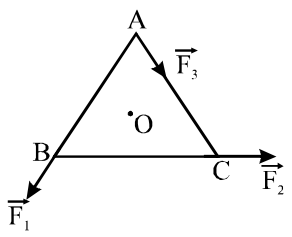
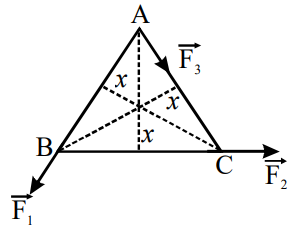
O is the centre of the equilateral triangle, so its perpendicular distance x from each side is the same.
$F_1$ and $F_2$ turn the triangle in one sense about O, while $F_3$ turns it in the opposite sense.
Net torque zero: $F_1x + F_2x - F_3x = 0$
$F_3 = F_1 + F_2$
Radius of Gyration
-
The ratio of the radii of gyration of a circular disc about a tangential axis in the plane of the disc and of a circular ring of the same radius about a tangential axis in the plane of the ring is:-Disc: moment of inertia about a diameter $= \dfrac{1}{4}MR^2$. By the parallel axis theorem, about a tangent in its plane:
$I_{disc} = \dfrac{1}{4}MR^2 + MR^2 = \dfrac{5}{4}MR^2 = MK_{disc}^2$
Ring: moment of inertia about a diameter $= \dfrac{1}{2}MR^2$. About a tangent in its plane:
$I_{ring} = \dfrac{1}{2}MR^2 + MR^2 = \dfrac{3}{2}MR^2 = MK_{ring}^2$
$\dfrac{K_{disc}^2}{K_{ring}^2} = \dfrac{5/4}{3/2} = \dfrac{5}{6}$
$\Rightarrow \dfrac{K_{disc}}{K_{ring}} = \sqrt{\dfrac{5}{6}}$
So the ratio of the radii of gyration is $\sqrt{5} : \sqrt{6}$.
Angular Momentum of a Particle
-
A particle of mass $m$ moves in the XY plane with a velocity $v$ along the straight line AB. If the angular momentum of the particle with respect to origin O is $L_A$ when it is at A and $L_B$ when it is at B, then
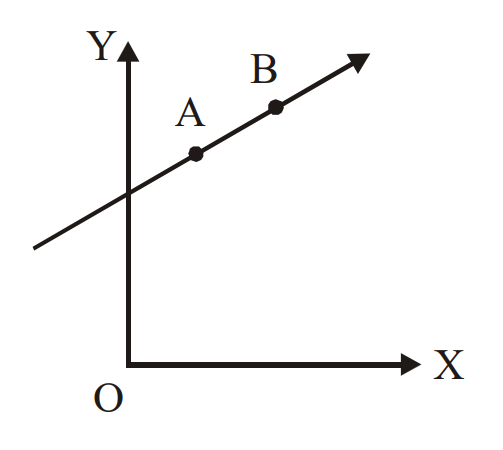
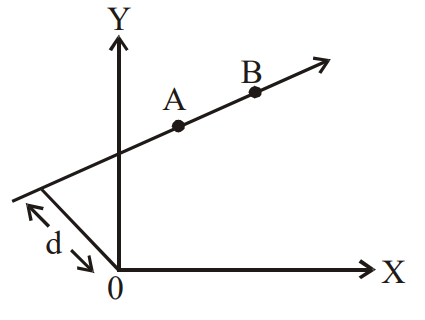
Angular momentum = linear momentum $\times$ perpendicular distance of the line of action of the linear momentum from the origin.
Let $d$ be the perpendicular distance of the line AB from the origin O.
$L_A = p_A \times d$ and $L_B = p_B \times d$
The particle moves with the same velocity $v$ along the same straight line, so the linear momenta are equal: $p_A = p_B = mv$.
The perpendicular distance $d$ of the line of motion from O is the same for every point of the line.
Therefore $L_A = L_B = mvd$.
The angular momentum of a particle moving with constant velocity is constant about any fixed point, because no torque acts on it.
Centripetal Force on a Rotating Body
-
A tube of length $L$ is filled completely with an incompressible liquid of mass $M$ and closed at both the ends. The tube is then rotated in a horizontal plane about one of its ends with a uniform angular velocity $\omega$. The force exerted by the liquid at the other end is :-
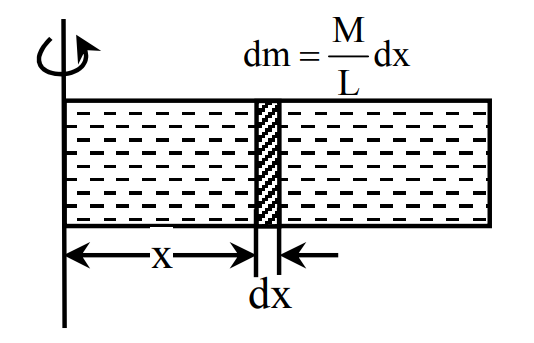
Consider a small element of liquid of mass $dm = \dfrac{M}{L}dx$ at a distance $x$ from the axis of rotation.
Centripetal force needed for this element: $dF = (dm)(\omega^2)(x)$
The total centripetal force for the whole liquid is supplied by the far end of the tube, so the liquid exerts an equal force on that end.
Required force $F = \int dF = \int_0^L \dfrac{M}{L}\omega^2 x\,dx$
$F = \dfrac{M\omega^2}{L}\left[\dfrac{x^2}{2}\right]_0^L = \dfrac{M\omega^2}{L} \times \dfrac{L^2}{2}$
$F = \dfrac{M\omega^2 L}{2}$
(The same result follows by treating the whole mass as concentrated at the centre of mass, at a distance $\dfrac{L}{2}$ from the axis.)
Moment of Inertia of a System of Particles
-
Three particles, each of mass m gram, are situated at the vertices of an equilateral triangle ABC of side $l$ cm (as shown in the figure). The moment of inertia of the system about a line AX perpendicular to AB and in the plane of ABC, in gram cm$^2$ units will be :-
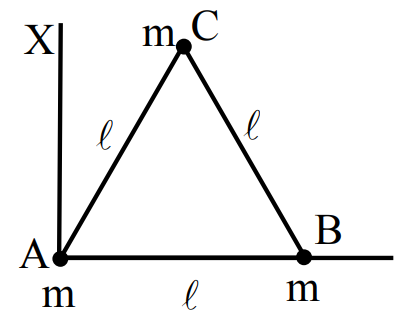 Moment of inertia of point masses: $I = \sum m r^2$, where r is the perpendicular distance of each mass from the axis AX.
Mass at A lies on the axis, so its distance $= 0$.
Mass at B: AB is perpendicular to AX, so its distance from AX $= l$.
Mass at C: its distance from AX is the horizontal distance of C from A $= l\cos 60^\circ = l\sin 30^\circ = \dfrac{l}{2}$.
$I_{AX} = m(0)^2 + ml^2 + m\left(\dfrac{l}{2}\right)^2$
$= ml^2 + \dfrac{ml^2}{4} = \dfrac{5}{4}ml^2$
Kinetic Energy of Rolling Motion
-
A ball rolls without slipping. The radius of gyration of the ball about an axis passing through its centre of mass is K. If radius of the ball be R, then the fraction of total energy associated with its rotational energy will be :For rolling without slipping, $v = R\omega$ and $I = mK^2$.
Total kinetic energy: $T.K.E. = \dfrac{1}{2}mv^2 + \dfrac{1}{2}I\omega^2 = \dfrac{1}{2}mv^2\left(1 + \dfrac{K^2}{R^2}\right)$
Rotational kinetic energy: $R.K.E. = \dfrac{1}{2}I\omega^2 = \dfrac{1}{2}mK^2\dfrac{v^2}{R^2} = \dfrac{1}{2}mv^2\left(\dfrac{K^2}{R^2}\right)$
Fraction $= \dfrac{R.K.E.}{T.K.E.} = \dfrac{K^2/R^2}{1 + K^2/R^2} = \dfrac{K^2}{K^2 + R^2}$
Centre of Mass of a Non-uniform Rod
-
A rod of length is 3m and its mass acting per unit length is directly proportional to distance x from one of its end then its centre of gravity from that end will be at : -Mass per unit length: $\lambda = kx$, where k is a constant and x is measured from the given end O.
Mass of a small element of length dx: $dm = kx\,dx$
$x_{cm} = \dfrac{\int x\,dm}{\int dm} = \dfrac{\int_0^3 x(kx)\,dx}{\int_0^3 kx\,dx} = \dfrac{\left[\dfrac{x^3}{3}\right]_0^3}{\left[\dfrac{x^2}{2}\right]_0^3}$
$= \dfrac{27/3}{9/2} = \dfrac{9}{4.5} = 2$ m
So the centre of gravity is 2 m from that end (closer to the heavier end).
Rolling on an Inclined Plane
-
For a hollow cylinder and a solid cylinder rolling without slipping on an inclined plane, then which of these reaches earlier on the ground :For a body rolling down an incline: $a = \dfrac{g\sin\theta}{1 + K^2/R^2}$
Solid cylinder: $\dfrac{K^2}{R^2} = \dfrac{1}{2}$, so $a = \dfrac{2}{3}g\sin\theta$
Hollow cylinder: $\dfrac{K^2}{R^2} = 1$, so $a = \dfrac{1}{2}g\sin\theta$
The solid cylinder has the larger acceleration (less of its energy goes into rotation), so it reaches the ground first.
So the solid cylinder reaches earlier.
That is every question in System of Particles and Rotational Motion for this filter.
Want a score?
Answers here are not saved. Practise as a test to be marked and see your progress.
Practise as a test