Looking for classes? Ksquare Career Institute, Bengaluru →

Physics
System of Particles and Rotational Motion
100 questions from 38 papers, each with its answer.
- 100 questions
- 38 papers
- 5.67% of Physics
Conservation of Angular Momentum
-
A circular platform is mounted on a frictionless vertical axle. Its radius R = 2 m and its moment of inertia about the axle is 200 kg $m^2$. It is initially at rest. A 50 kg man stands on the edge of the platform and begins to walk along the edge at the speed of 1 $ms^{-1}$ relative to the ground. Time taken by the man to complete one revolution isAngular velocity of the man relative to the ground: $\omega_m = \frac{v}{R} = \frac{1}{2}$ rad/s
Moment of inertia of the man about the axle: $I_m = mR^2 = 50\times(2)^2 = 200$ kg $m^2$
The system starts from rest and there is no external torque, so the platform turns the opposite way: $I_p\omega_p = I_m\omega_m$
$200\times\omega_p = 200\times\frac{1}{2} \Rightarrow \omega_p = \frac{1}{2}$ rad/s (opposite direction)
Angular velocity of the man relative to the platform: $\omega = \omega_m - (-\omega_p) = \frac{1}{2} + \frac{1}{2} = 1$ rad/s
Time for one revolution: $T = \frac{2\pi}{\omega} = 2\pi$ s
Moment of inertia of a ring about a diametric-type axis
-
A thin wire of length 'L' and linear mass density 'm' is bent into a circular ring (in x-y plane) with centre 'C' as shown in figure. The moment of inertia of the ring about an axis $yy'$ will be:
 Mass of wire $M = mL$ (m = linear mass density) $L = 2\pi R \Rightarrow R = \frac{L}{2\pi}$ Axis $yy'$ is tangent to the ring in its plane. By the parallel axis theorem: $I_{yy'} = \frac{MR^2}{2} + MR^2 = \frac{3}{2}MR^2$ $= \frac{3}{2}(mL)\left(\frac{L^2}{4\pi^2}\right)$ $I_{yy'} = \frac{3mL^3}{8\pi^2}$
Linear momentum of a system of particles
-
A frictionless circular wire of unit radius is fixed on the horizontal plane. Two point particles of unit mass start moving simultaneously from point A ($\theta=\frac{\pi}{2}$) with identical uniform angular speeds in opposite directions, and meet again at point B ($\theta=-\frac{\pi}{2}$). During this time, which of the following figures schematically represent the magnitude of the total linear momentum P of the system, as a function of $\theta$?
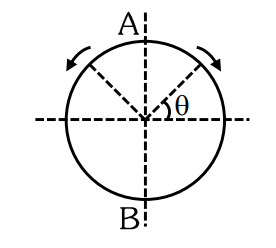 Taking $\theta$ as the angle of each particle from the horizontal: $\vec{P}_1+\vec{P}_2=(mv\sin\theta\hat{i}-mv\cos\theta\hat{j})+(-mv\sin\theta\hat{i}-mv\cos\theta\hat{j})$, so $P_{total}=|\vec{P}_1+\vec{P}_2|=2mv\cos\theta$. At $\theta=\pm\frac{\pi}{2}$, $P_{total}=0$; at $\theta=0$, $P_{total}=2mv$ (maximum). The graph is a single hump between $\frac{\pi}{2}$ and $-\frac{\pi}{2}$.
Centre of mass and centre of gravity
-
(a) Centre of gravity (C.G.) of a body is the point at which the weight of the body acts
(b) Centre of mass coincides with the centre of gravity if the earth is assumed to have infinitely large radius
(c) To evaluate the gravitational field intensity due to any body at an external point, the entire mass of the body can be considered to be concentrated at its C.G.
(d) The radius of gyration of any body rotating about an axis is the length of the perpendicular dropped from the C.G. of the body to the axis
Which one of the following pairs of statements is correct?(a) is correct: the centre of gravity is defined as the point through which the resultant weight of the body acts, i.e., the point about which the total gravitational torque is zero.
(c) is not correct in general: treating the whole mass as concentrated at one point works for a spherically symmetric body, but not for a body of arbitrary shape.
The answer accepted in the key pairs (a) with (d), giving '(d) and (a)'.
Note: this key is doubtful. By definition the radius of gyration k is given by $I = Mk^2$ (the distance from the axis at which the whole mass could be concentrated to give the same moment of inertia); it is not the perpendicular distance of the C.G. from the axis, so (d) is strictly false. Statement (b) is true: if the earth's radius were infinitely large, g would be uniform over the body and the centre of gravity would coincide with the centre of mass. On physical grounds the correct pair is (a) and (b); the key of the source PDF is retained here and should be verified.
Moment of Inertia of a Lamina
-
For the adjoining diagram, a triangular lamina is shown. The correct relation between $I_1$, $I_2$ and $I_3$ is (I – moment of inertia)
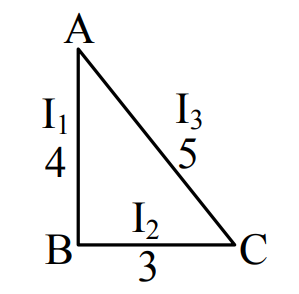 For a triangular lamina, the moment of inertia about a side depends on how far the mass lies from that side. About a side, $I = \dfrac{1}{6}Mh^2$, where h is the height (altitude) of the triangle on that side.
Altitude on AB (length 4) is BC = 3, so $I_1 = \dfrac{1}{6}M(3)^2 = 1.5M$.
Altitude on BC (length 3) is AB = 4, so $I_2 = \dfrac{1}{6}M(4)^2 = 2.67M$.
Altitude on AC (length 5) is $\dfrac{3 \times 4}{5} = 2.4$, so $I_3 = \dfrac{1}{6}M(2.4)^2 = 0.96M$.
So about the longest side the moment of inertia is least, and about the shortest side it is greatest: $I_2 \gt I_1 \gt I_3$.
Hence $I_2 \gt I_1$.
That is every question in System of Particles and Rotational Motion for this filter.
Want a score?
Answers here are not saved. Practise as a test to be marked and see your progress.
Practise as a test