Looking for classes? Ksquare Career Institute, Bengaluru →

Physics
Moving Charges and Magnetism
89 questions from 37 papers, each with its answer.
- 89 questions
- 37 papers
- 5.05% of Physics
Biot-Savart Law – Field due to Straight Wires and Arc
-
A very long conducting wire is bent in a semi-circular shape from A to B as shown in figure. The magnetic field at point P for steady current configuration is given by:
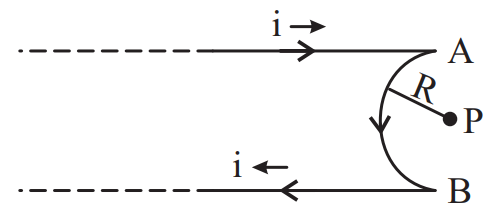
Semicircle gives $\frac{\mu_0 i}{4R}$ and the two straight wires each give $\frac{\mu_0 i}{4\pi R}$ in the opposite sense.
$\vec{B}_P=\vec{B}_{upper\ wire}\otimes+\vec{B}_{semi-circle}\odot+\vec{B}_{lower\ wire}\otimes$ $B_P=-\frac{\mu_0 i}{4\pi R}+\frac{\mu_0 i}{4R}-\frac{\mu_0 i}{4\pi R}$ $=\frac{\mu_0 i}{4R}\left(1-\frac{2}{\pi}\right)$ pointing away from the page -
A wire carrying current I has the shape as shown in adjoining figure. Linear parts of the wire are very long and parallel to X-axis, while semicircular portion of radius R is lying in Y–Z plane. Magnetic field at point O is
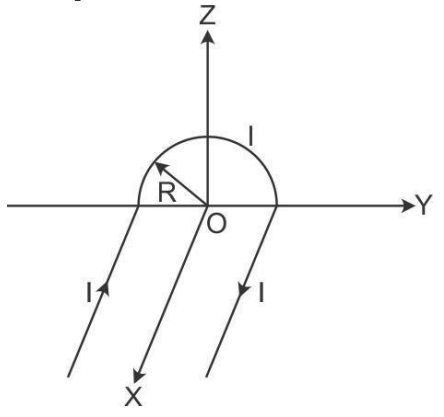 Field of a straight wire: $B = \frac{\mu_0 I}{4\pi R}(\sin\phi_1 + \sin\phi_2)$
Each semi-infinite straight part gives $\frac{\mu_0 I}{4\pi R}(\sin 90^\circ + \sin 0^\circ) = \frac{\mu_0 I}{4\pi R}$ along $-\hat k$.
$\vec B_L = 2\times\frac{\mu_0 I}{4\pi R}(-\hat k)$
Semicircular part: $\vec B_S = \frac{1}{2}\cdot\frac{\mu_0 I}{2R}(-\hat i) = \frac{\mu_0 I\pi}{4\pi R}(-\hat i)$
$\vec B = \vec B_L + \vec B_S = -\frac{\mu_0 I}{4\pi R}(\pi\hat i + 2\hat k)$
Force on a Current-carrying Conductor in a Magnetic Field
-
A metallic rod of mass per unit length $0.5\ kg\ m^{-1}$ is lying horizontally on a smooth inclined plane which makes an angle of $30^\circ$ with the horizontal. The rod is not allowed to slide down by flowing a current through it when a magnetic field of induction 0.25 T is acting on it in the vertical direction. The current flowing in the rod to keep it stationary is
Balance $mg\sin\theta$ with the component $IlB\cos\theta$ of the horizontal magnetic force.
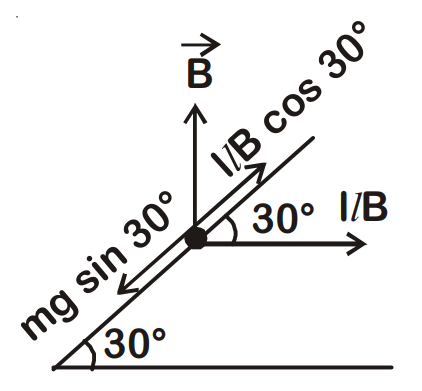
For equilibrium along the incline: $mg\sin30^\circ = IlB\cos30^\circ$
$I = \frac{mg}{lB}\tan30^\circ = \frac{0.5\times9.8}{0.25\times\sqrt{3}}$
$= 11.32$ A
Lorentz Force
-
In the product $\vec{F}=q(\vec{v}\times\vec{B})=q\vec{v}\times(B\hat{i}+B\hat{j}+B_0\hat{k})$. For $q=1$ and $\vec{v}=2\hat{i}+4\hat{j}+6\hat{k}$ and $\vec{F}=4\hat{i}-20\hat{j}+12\hat{k}$. What will be the complete expression for $\vec{B}$?$\vec{F} = q(\vec{v} \times \vec{B})$ with q = 1: $4\hat{i} - 20\hat{j} + 12\hat{k} = \begin{vmatrix} \hat{i} & \hat{j} & \hat{k} \\ 2 & 4 & 6 \\ B & B & B_0 \end{vmatrix}$ Comparing components: $4 = 4B_0 - 6B$, $-20 = -2B_0 + 6B$, $12 = 2B - 4B$ Solving: B = –6, $B_0 = -8$ $\vec{B} = -6\hat{i} - 6\hat{j} - 8\hat{k}$
-
When a proton is released from rest in a room, it starts with an initial acceleration $a_0$ towards west. When it is projected towards north with a speed $v_0$ it moves with an initial acceleration $3a_0$ towards west. The electric and magnetic fields in the room are:$\vec a = \frac{q}{m}(\vec E + \vec v\times\vec B)$
Released from rest: $\vec a = \frac{q}{m}\vec E = a_0$ (west) $\Rightarrow E = \frac{ma_0}{e}$ (west)
Projected north, the acceleration due to the magnetic force $= 3a_0 - a_0 = 2a_0$ (west)
$ev_0B = 2ma_0 \Rightarrow B = \frac{2ma_0}{ev_0}$ (down)
That is every question in Moving Charges and Magnetism for this filter.
Want a score?
Answers here are not saved. Practise as a test to be marked and see your progress.
Practise as a test