Looking for classes? Ksquare Career Institute, Bengaluru →

Physics
Moving Charges and Magnetism
89 questions from 37 papers, each with its answer.
- 89 questions
- 37 papers
- 5.05% of Physics
Motion in Combined Electric and Magnetic Fields
-
An electron (mass $9 \times 10^{-31}\text{ kg}$ and charge $1.6 \times 10^{-19}\text{ C}$) moving with speed $c/100$ ($c =$ speed of light) is injected into a magnetic field $B$ of magnitude $9 \times 10^{-4}\text{ T}$ perpendicular to its direction of motion. We wish to apply a uniform electric field $\vec{E}$ together with the magnetic field so that the electron does not deflect from its path. Then (speed of light $c = 3 \times 10^8\text{ ms}^{-1}$):
For zero net force, $\vec{E}$ must be perpendicular to both $\vec{v}$ and $\vec{B}$, with magnitude $E = vB = (3 \times 10^6)(9 \times 10^{-4}) = 27 \times 10^2\text{ V/m}$.
For an undeflected charged particle (velocity selector principle), the Lorentz force must be zero: $q(\vec{E} + \vec{v} \times \vec{B}) = 0 \implies \vec{E} = -(\vec{v} \times \vec{B})$. Thus $\vec{E}$ must be perpendicular to $\vec{B}$ and $\vec{v}$. The velocity is $v = \frac{c}{100} = \frac{3 \times 10^8}{100} = 3 \times 10^6\text{ m/s}$. The required electric field magnitude is $E = vB = (3 \times 10^6\text{ m/s})(9 \times 10^{-4}\text{ T}) = 27 \times 10^2\text{ V m}^{-1}$. -
A uniform electric field and a uniform magnetic field are acting along the same direction in a certain region. If an electron is projected in the region such that its velocity is pointed along the direction of fields, then the electronMagnetic force: $\vec{F}_m = q(\vec{v}\times\vec{B})$. The velocity is parallel to $\vec{B}$, so $\vec{v}\times\vec{B} = 0$ and there is no magnetic force; the electron does not turn.
Electric force: $\vec{F}_e = q\vec{E} = -e\vec{E}$. Since the electron has negative charge, this force is opposite to $\vec{E}$.
The velocity is along $\vec{E}$, so the electric force is opposite to the velocity.
The electron is therefore retarded along its line of motion.
Hence its speed will decrease. -
A particle of mass $m$, charge $Q$ and kinetic energy $T$ enters a transverse uniform magnetic field of induction $\vec{B}$. After 3 seconds the kinetic energy of the particle will be -The magnetic force on a moving charge is $\vec{F} = Q(\vec{v} \times \vec{B})$.
This force is always perpendicular to both the velocity $\vec{v}$ and the magnetic field $\vec{B}$.
Power delivered by the force: $P = \vec{F}\cdot\vec{v} = 0$, because $\vec{F} \perp \vec{v}$.
Equivalently, the work done in a small displacement is $dW = \vec{F}\cdot d\vec{r} = 0$, because $\vec{F} \perp d\vec{r}$.
A force that does no work cannot change the kinetic energy or the speed of the particle; it only changes the direction of motion (the particle moves on a circular path).
Hence after 3 seconds (or after any time) the kinetic energy is still $T$. -
A beam of electron passes undeflected through mutually perpendicular electric and magnetic fields. If the electric field is switched off, and the same magnetic field is maintained, the electrons moveThe beam passes undeflected, so the electric force balances the magnetic force: $eE = evB$.
This is possible only when the velocity of the electrons is perpendicular to both the electric and the magnetic field (velocity selector), with $v = \dfrac{E}{B}$.
When the electric field is switched off, only the magnetic force $F = evB$ acts on the electrons.
This force is always perpendicular to the velocity, so it does no work and the speed stays constant; it only changes the direction of motion.
A force of constant magnitude that is always perpendicular to the velocity acts as a centripetal force: $evB = \dfrac{mv^2}{r}$, giving $r = \dfrac{mv}{eB}$.
Since the electrons travel in a magnetic field perpendicular to their velocity, they move in a circular orbit. -
Under the influence of a uniform magnetic field a charged particle is moving in a circle of radius $R$ with constant speed $v$. The time period of the motion
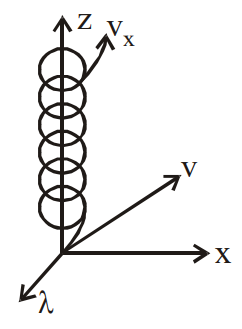
The magnetic force provides the centripetal force: $qvB = \dfrac{mv^2}{R}$
$\Rightarrow R = \dfrac{mv}{qB}$
Time period: $T = \dfrac{2\pi R}{v} = \dfrac{2\pi}{v} \times \dfrac{mv}{qB}$
$T = \dfrac{2\pi m}{qB}$
The speed $v$ cancels out: a faster particle moves in a proportionally bigger circle, so the time for one revolution is the same.
The time period depends only on the mass, the charge and the magnetic field, so it is independent of both $R$ and $v$.
Magnetic Dipole Moment of Current Loop
-
A $2\text{ amp}$ current is flowing through two different small circular copper coils having radii ratio $1:2$. The ratio of their respective magnetic moments will be:
Magnetic moment is $M = NIA = I(\pi r^2) \propto r^2$. Thus $M_1/M_2 = (r_1/r_2)^2 = (1/2)^2 = 1/4$.
The magnetic dipole moment of a current loop is $M = N I A = N I (\pi r^2)$. Since the current $I$ and number of turns $N$ are identical, the magnetic moment is directly proportional to the square of the coil radius: $M \propto r^2$. Therefore, $\frac{M_1}{M_2} = \left(\frac{r_1}{r_2}\right)^2 = \left(\frac{1}{2}\right)^2 = \frac{1}{4}$. -
A charged particle (charge $q$) is moving in a circle of radius $R$ with uniform speed $v$. The associated magnetic moment $\mu$ is given byA charge moving in a circle is equivalent to a current loop.
Time period of revolution: $T = \dfrac{2\pi R}{v}$
Equivalent current: $I = \dfrac{q}{T} = \dfrac{qv}{2\pi R}$
Magnetic moment: $\mu = IA$, with area $A = \pi R^2$
$\mu = \dfrac{qv}{2\pi R}(\pi R^2)$
$\mu = \dfrac{qvR}{2}$ -
If number of turns, area and current through a coil are given by n, A and i respectively then its magnetic moment will be : -Magnetic moment of a single current loop: $m = iA$.
For a coil of n turns, each turn contributes the same moment, so $M = niA$.
Its direction is along the axis of the coil, given by the right hand rule.
Magnetic Field due to a Circular Coil
-
A tightly wound 100 turns coil of radius 10 cm carries a current of 7 A. The magnitude of the magnetic field at the centre of the coil is (Take permeability of free space as $4\pi \times 10^{-7}$ SI units):$B = \frac{\mu_0 N I}{2R}$ $B = \frac{4\pi \times 10^{-7} \times 100 \times 7}{2 \times 10 \times 10^{-2}}$ $= \frac{28\pi \times 10^{-4}}{2} = 14\pi \times 10^{-4}$ T $\approx 44 \times 10^{-4}$ T $= 4.4$ mT
-
A closely packed coil having 1000 turns has an average radius of 62.8 cm. If the current carried by the wire of the coil is 1 A, the value of magnetic field produced at the centre of the coil will be (permeability of free space $=4\pi\times10^{-7}$ H/m) nearly:$B=\frac{\mu_0 NI}{2R}=\frac{4\pi\times10^{-7}\times1000\times1}{2\times62.8\times10^{-2}}=10^{-3}$ T.
-
A long wire carrying a steady current is bent into a circular loop of one turn. The magnetic field at the centre of the loop is B. It is then bent into a circular coil of n turns. The magnetic field at the centre of this coil of n turns will be:
n turns and radius R/n give $n^2$ times the field.
Since $l = 2\pi R = n(2\pi r) \Rightarrow r = \frac{R}{n}$
For one turn: $B = \frac{\mu_0i}{2R}$
For n turns: $B' = \frac{\mu_0ni}{2r} = \frac{\mu_0n^2i}{2R} = n^2B$ -
An electron moving in a circular orbit of radius r makes n rotations per second. The magnetic field produced at the centre has magnitude:Field at the centre of a circular current: $B = \frac{\mu_0 I}{2r}$
Equivalent current: $I = \frac{e}{T} = ne$
$B = \frac{\mu_0 ne}{2r}$ -
Two similar coils of radius R are lying concentrically with their planes at right angles to each other. The currents flowing in them are I and 2I, respectively. The resultant magnetic field induction at the centre will beField at the centre of each coil: $B_1 = \frac{\mu_0I}{2R}$ and $B_2 = \frac{\mu_0(2I)}{2R}$
The planes are perpendicular, so the two fields are perpendicular to each other.
$B = \sqrt{B_1^2 + B_2^2} = \sqrt{\left(\frac{\mu_0I}{2R}\right)^2 + \left(\frac{2\mu_0I}{2R}\right)^2} = \frac{\sqrt5\mu_0I}{2R}$ -
Charge q is uniformly spread on a thin ring of radius R. The ring rotates about its axis with a uniform frequency f Hz. The magnitude of magnetic induction at the center of the ring isA rotating charged ring is equivalent to a circular current loop.
The charge q passes any point f times per second, so the current is $I = \frac{q}{T} = qf$
Magnetic field at the centre of a circular loop of radius R: $B = \frac{\mu_0I}{2R}$
$B = \frac{\mu_0qf}{2R}$ -
A thin ring of radius R meter has charge q coulomb uniformly spread on it. The ring rotates about its axis with a constant frequency of f revolutions/s. The value of magnetic induction in Wb/$m^2$ at the centre of the ring isA rotating charged ring is equivalent to a circular current.
The charge q crosses any point f times each second, so the current is $I = qf$
Field at the centre of a circular loop of radius R: $B = \frac{\mu_0I}{2R}$
$B = \frac{\mu_0qf}{2R}$
Force on a Current-carrying Conductor in a Magnetic Field
-
A square current carrying loop is suspended in a uniform magnetic field acting in the plane of the loop. If the force on one arm of the loop is $\vec{F}$, the net force on the remaining three arms of the loop isThe net force on a closed current-carrying loop in a uniform magnetic field is zero: $\oint I\,d\vec{l}\times\vec{B} = I\left(\oint d\vec{l}\right)\times\vec{B} = 0$
Let $\vec{F}_1 = \vec{F}$ be the force on one arm and $\vec{F}_2$ the net force on the remaining three arms.
$\vec{F}_1 + \vec{F}_2 = 0$
$\vec{F}_2 = -\vec{F}_1 = -\vec{F}$
Magnetic Field of a Solenoid
-
A long solenoid of radius 1 mm has 100 turns per mm. If 1 A current flows in the solenoid, the magnetic field strength at the centre of the solenoid is :$B = \mu_0 n i = \mu_0\frac{N}{\ell}i$ $n = 100$ turns per mm $= \frac{100}{10^{-3}}$ turns per m $B = 4\pi \times 10^{-7} \times \frac{100}{10^{-3}} \times 1 = 12.56 \times 10^{-2}$ T
-
A long solenoid of 50 cm length having 100 turns carries a current of 2.5 A. The magnetic field at the centre of the solenoid is: ($\mu_0=4\pi\times10^{-7}\ T\,m\,A^{-1}$)$B = \mu_0 nI$, with $n = \frac{N}{L} = \frac{100}{50 \times 10^{-2}} = 200$ turns/m $B = 4\pi \times 10^{-7} \times 200 \times 2.5 = 6.28 \times 10^{-4}$ T
-
A long solenoid carrying a current produces a magnetic field B along its axis. If the current is doubled and the number of turns per cm is halved, the new value of the magnetic field is -Magnetic field inside a long solenoid: $B = \mu_0 n i$, where n is the number of turns per unit length.
New values: $n' = \dfrac{n}{2}$, $i' = 2i$
$B' = \mu_0 n' i' = \mu_0 \cdot \dfrac{n}{2} \cdot 2i = \mu_0 n i = B$
So the magnetic field remains B.
Lorentz Force
-
Two identical bar magnets are fixed with their centres at a distance d apart. A stationary charge Q is placed at P in between the gap of the two magnets at a distance D from the centre O as shown in the figure.
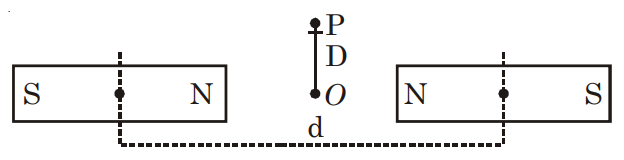
The force on the charge Q isMagnetic force on a charge: $\vec{F} = Q(\vec{v}\times\vec{B})$
The charge is stationary, so v = 0.
$F = QvB\sin\theta = 0$, whatever the magnetic field at P due to the two magnets may be.
A magnetic field exerts a force only on a moving charge; a steady magnet produces no electric field to act on a charge at rest.
Hence the force on the charge Q is zero. -
Under the influence of a uniform magnetic field, a charged particle moves with constant speed v in a circle of radius R. The time period of rotation of the particleThe magnetic force provides the centripetal force: $qvB = \frac{mv^2}{R}$, so $R = \frac{mv}{qB}$
Time period: $T = \frac{2\pi R}{v} = \frac{2\pi}{v}\times\frac{mv}{qB}$
$T = \frac{2\pi m}{qB}$
T depends only on the mass, the charge and the field; v and R cancel out (a faster particle moves in a proportionately bigger circle).
Hence the time period is independent of both v and R. -
When a charged particle moving with velocity $\vec{V}$ is subjected to a magnetic field of induction $\vec{B}$, the force on it is non-zero. This implies that :-Magnetic force on a moving charge: $\vec{F} = q(\vec{V} \times \vec{B})$
Its magnitude is $F = qVB\sin\theta$, where $\theta$ is the angle between $\vec{V}$ and $\vec{B}$.
When $\theta = 0^\circ$ or $\theta = 180^\circ$, $\sin\theta = 0$ and therefore $F = 0$.
For every other value of $\theta$, $\sin\theta \neq 0$ and the force is non-zero.
The force is maximum at $\theta = 90^\circ$, but it is not necessary that the angle be $90^\circ$ for the force to be non-zero.
So a non-zero force implies that the angle between $\vec{V}$ and $\vec{B}$ can have any value other than zero and $180^\circ$. -
A charged particle moves through a magnetic field in a direction perpendicular to it. Then theMagnetic force on a moving charge: $\vec{F} = q(\vec{v} \times \vec{B})$. This force is always perpendicular to the velocity $\vec{v}$.
A force perpendicular to the velocity does no work, so the kinetic energy and hence the speed of the particle remain constant.
The force continuously changes the direction of motion, so the particle moves in a circle. Its velocity (a vector) and its acceleration (directed towards the centre, changing in direction) both change.
So the speed of the particle remains unchanged. -
A charge 'q' moves in a region where electric field and magnetic field both exist, then force on it is : -The total force on a charge in combined electric and magnetic fields is the Lorentz force: $\vec{F}_L = \vec{F}_e + \vec{F}_m$
Electric force: $\vec{F}_e = q\vec{E}$
Magnetic force: $\vec{F}_m = q(\vec{V} \times \vec{B})$ (note the order: velocity first, then field)
$\vec{F}_L = q\vec{E} + q(\vec{V} \times \vec{B})$
Magnetic field lines of a straight conductor
-
The shape of the magnetic field lines due to an infinite long, straight current carrying conductor is:Magnetic field lines around an infinitely long straight current-carrying conductor are concentric circles centred on the wire.
Force between two parallel current-carrying conductors
-
Two very long, straight, parallel conductors A and B carry current of 5 A and 10 A respectively and are at a distance of 10 cm from each other. The direction of current in two conductors is same. The force acting per unit length between two conductors is: ($\mu_0=4\pi\times10^{-7}$ SI unit)Parallel currents in the same direction attract. $\frac{F}{l}=\frac{\mu_0 i_1 i_2}{2\pi d}=\frac{2\times10^{-7}\times5\times10}{10\times10^{-2}}=10^{-4}$ N/m.
Magnetic field of a toroid
-
Two toroids 1 and 2 have total number of turns 200 and 100 respectively with average radii 40 cm and 20 cm respectively. If they carry same current i, the ratio of the magnetic fields along the two loops is:$B=\frac{\mu_0Ni}{2\pi r}$. $\frac{B_1}{B_2}=\frac{N_1}{N_2}\times\frac{r_2}{r_1}=\frac{200}{100}\times\frac{20}{40}=1:1$.
Cyclotron frequency
-
An electron is moving in a circular path under the influence of a transverse magnetic field of $3.57 \times 10^{-2}$ T. If the value of e/m is $1.76 \times 10^{11}$ C/kg, the frequency of revolution of the electron is:
$f = (e/m)B/2\pi$.
$f = \frac{eB}{2\pi m}$
$f = \frac{1.76\times10^{11}\times3.57\times10^{-2}}{2\times3.14}$
$f = 10^{9}$ Hz or 1 GHz
Torque on a current loop
-
A current loop in a magnetic field:The potential energy of the loop is $U = -MB\cos\theta$.
It is in equilibrium when $\vec M$ is parallel to $\vec B$ ($\theta = 0^\circ$, stable) and when it is antiparallel ($\theta = 180^\circ$, unstable).
Moving coil galvanometer
-
A galvanometer has a coil of resistance 100 ohm and gives a full scale deflection for 30 mA current. If it is to work as a voltmeter of 30 volt range, the resistance required to be added will beA galvanometer is converted into a voltmeter by connecting a high resistance R in series with it.
At full scale: $V = I_g(G + R)$
$R = \frac{V}{I_g} - G$
$R = \frac{30}{30\times10^{-3}} - 100 = 1000 - 100$
$R = 900\ \Omega$ -
A galvanometer having a coil resistance of 60 $\Omega$ shows full scale deflection when a current of 1.0 amp passes through it. It can be converted into an ammeter to read currents upto 5.0 amp byA galvanometer is converted into an ammeter by connecting a low resistance (shunt) S in parallel with it.
At full scale, the galvanometer carries $I_g = 1.0$ A and the shunt carries the rest: $I - I_g = 5.0 - 1.0 = 4.0$ A
The potential difference across both is the same: $I_gG = (I - I_g)S$
$S = \frac{I_gG}{I - I_g} = \frac{1.0\times60}{4.0}$
$S = 15\ \Omega$, connected in parallel -
A galvanometer acting as a voltmeter will have :-A voltmeter is connected in parallel across the part of the circuit whose potential difference is to be measured.
It should draw almost no current from the circuit, otherwise it would change the very potential difference it measures. So a voltmeter must have a very high resistance.
To convert a galvanometer of resistance $G$ into a voltmeter of range $V$, a high resistance $R$ is connected in series with its coil, such that $V = I_g(G + R)$, i.e. $R = \dfrac{V}{I_g} - G$.
(A low resistance in parallel, i.e. a shunt, converts a galvanometer into an ammeter instead.)
So a galvanometer acting as a voltmeter has a high resistance in series with its coil. -
To convert a galvanometer into a voltmeter one should connect a : -A voltmeter is connected in parallel across the element whose potential difference is to be measured, and must draw negligible current. So it must have a very high resistance.
A galvanometer is converted into a voltmeter by connecting a high resistance R in series with it: $R = \dfrac{V}{I_g} - G$.
(A low resistance in parallel, a shunt, converts it into an ammeter.)
So one should connect a high resistance in series with the galvanometer. -
Tangent galvanometer is used to measure : -A tangent galvanometer works on the tangent law: when a current I flows through its coil, the magnetic needle deflects through an angle $\theta$ such that $B = B_H\tan\theta$.
Since $B = \dfrac{\mu_0 nI}{2r}$, we get $I = \dfrac{2rB_H}{\mu_0 n}\tan\theta$, i.e. $I \propto \tan\theta$.
So a tangent galvanometer is used to measure current (it can also be used to find $B_H$).
Motion of Charge in Magnetic Field: Cyclotron Frequency
-
An electron having mass 'm' and kinetic energy E enters in uniform magnetic field B perpendicularly, then its frequency will be : -The magnetic force provides the centripetal force: $evB = \dfrac{mv^2}{r} \Rightarrow r = \dfrac{mv}{eB}$
Time period: $T = \dfrac{2\pi r}{v} = \dfrac{2\pi m}{eB}$
Frequency: $f = \dfrac{1}{T} = \dfrac{eB}{2\pi m}$
The frequency does not depend on the speed or kinetic energy E of the electron; only the radius does.
(The expression $\dfrac{2\pi m}{eB}$ is the time period, not the frequency.)
Velocity Selector
-
In Thomson mass spectrograph $\vec{E} \perp \vec{B}$ then the velocity of undeflected electron beam will be :In crossed electric and magnetic fields, the electric force eE and the magnetic force evB on the electron act in opposite directions.
The beam goes undeflected when these forces balance: $eE = evB$
$\Rightarrow v = \dfrac{E}{B}$
So the velocity of the undeflected beam is $\dfrac{|\vec{E}|}{|\vec{B}|}$.
That is every question in Moving Charges and Magnetism for this filter.
Want a score?
Answers here are not saved. Practise as a test to be marked and see your progress.
Practise as a test