Looking for classes? Ksquare Career Institute, Bengaluru →

Physics
Gravitation
66 questions from 37 papers, each with its answer.
- 66 questions
- 37 papers
- 3.74% of Physics
Kepler's Laws of Planetary Motion
-
The radius of Martian orbit around the Sun is about 4 times the radius of the orbit of Mercury. The Martian year is $687\text{ Earth days}$. Then which of the following is the length of 1 year on Mercury?
From Kepler's third law $T^2 \propto r^3$, $T_{\text{Mercury}} = \frac{T_{\text{Mars}}}{4^{3/2}} = \frac{687}{8} \approx 86\text{ days}$, closest to $88\text{ earth days}$.
According to Kepler's Third Law of planetary motion: $T^2 \propto r^3 \implies \left(\frac{T_{\text{Mars}}}{T_{\text{Mercury}}}\right)^2 = \left(\frac{r_{\text{Mars}}}{r_{\text{Mercury}}}\right)^3$. Given $r_{\text{Mars}} = 4\, r_{\text{Mercury}}$: $\left(\frac{T_{\text{Mars}}}{T_{\text{Mercury}}}\right)^2 = 4^3 = 64 \implies \frac{T_{\text{Mars}}}{T_{\text{Mercury}}} = \sqrt{64} = 8$. Thus, $T_{\text{Mercury}} = \frac{T_{\text{Mars}}}{8} = \frac{687\text{ days}}{8} \approx 85.875\text{ days}$. Among the choices, the correct option is $88\text{ earth days}$.
Acceleration Due to Gravity Above Earth's Surface
-
A body weighs $48\text{ N}$ on the surface of the earth. The gravitational force experienced by the body due to the earth at a height equal to one-third the radius of the earth from its surface is:
At height $h = R/3$, distance from centre is $r = 4R/3$. Gravity varies as $1/r^2$, so $F = 48 \times (3/4)^2 = 48 \times 9/16 = 27\text{ N}$.
Gravitational force varies inversely with the square of the distance from the Earth's centre: $F(r) = \frac{G M m}{r^2}$. At the surface, $r_1 = R$ and $F_1 = 48\text{ N}$. At height $h = R/3$, the radial distance is $r_2 = R + \frac{R}{3} = \frac{4R}{3}$. The new gravitational force is $F_2 = F_1 \left(\frac{R}{r_2}\right)^2 = 48 \times \left(\frac{R}{4R/3}\right)^2 = 48 \times \left(\frac{3}{4}\right)^2 = 48 \times \frac{9}{16} = 3 \times 9 = 27\text{ N}$.
Acceleration due to Gravity
-
The mass of a planet is $\frac{1}{10}$th that of the earth and its diameter is half that of the earth. The acceleration due to gravity on that planet is:Acceleration due to gravity $g = \frac{GM}{R^2}$ For the planet: $M' = \frac{M}{10}$, $R' = \frac{R}{2}$ $g' = \frac{G(M/10)}{(R/2)^2} = \frac{4GM}{10R^2} = \frac{4}{10}g$ $g' = \frac{4}{10} \times 9.8 = 3.92\ ms^{-2}$
-
A spherical planet has a mass $M_p$ and diameter $D_p$. A particle of mass m falling freely near the surface of this planet will experience an acceleration due to gravity, equal to$g = \frac{GM_p}{R^2}$, and $R = \frac{D_p}{2}$
$g = \frac{GM_p}{(D_p/2)^2} = \frac{4GM_p}{D_p^2}$
It does not depend on the mass m of the particle. -
Imagine a new planet having the same density as that of earth but it is 3 times bigger than the earth in size. If the acceleration due to gravity on the surface of earth is $g$ and that on the surface of the new planet is $g'$, then -$g = \dfrac{GM}{R^2}$, and the mass is $M = \dfrac{4}{3}\pi R^3\rho$
$g = \dfrac{G \cdot \frac{4}{3}\pi R^3\rho}{R^2} = \dfrac{4}{3}\pi G\rho R$
So for the same density, $g \propto R$.
The new planet has a radius 3 times that of the earth.
$\dfrac{g'}{g} = \dfrac{3R}{R} = 3$
$\Rightarrow g' = 3g$ -
The density of newly discovered planet is twice that of earth. The acceleration due to gravity at the surface of the planet is equal to that at the surface of the earth. If the radius of the earth is R, the radius of the planet would be :-Acceleration due to gravity at the surface: $g = \dfrac{GM}{R^2}$
Mass in terms of density: $M = \dfrac{4}{3}\pi R^3 \rho$
$g = \dfrac{G \cdot \frac{4}{3}\pi R^3\rho}{R^2} = \dfrac{4}{3}\pi G\rho R$
So $g \propto \rho R$
According to the question $g_{planet} = g_{earth}$:
$\dfrac{4}{3}\pi G\rho_{planet}R_{planet} = \dfrac{4}{3}\pi G\rho_{earth}R_{earth}$
With $\rho_{planet} = 2\rho_{earth}$: $2\rho_{earth}R_{planet} = \rho_{earth}R$
$\Rightarrow R_{planet} = \dfrac{R}{2}$ -
The acceleration due to gravity on the planet A is 9 times the acceleration due to gravity on planet B. A man jumps to a height of 2m on the surface of A. What is the height of jump by the same person on the planet B.The man jumps with the same take-off speed u on both planets, so the kinetic energy he gives himself is the same.
At the highest point this kinetic energy becomes potential energy: $\dfrac{1}{2}mu^2 = mgh$, so $gh$ = constant, i.e. $h \propto \dfrac{1}{g}$.
Height of jump on planet B $= \dfrac{g_A}{g_B} \times$ height of jump on planet A
$h_B = 9 \times 2 = 18$ m
So the man jumps 18 m on planet B.
Gravitational Field Intensity
-
A body of mass 60 g experiences a gravitational force of 3.0 N, when placed at a particular point. The magnitude of the gravitational field intensity at that point is :Gravitational field intensity $I_g = \frac{F}{m}$ $I_g = \frac{3}{60 \times 10^{-3}} = 50$ N/kg
-
Dependence of intensity of gravitational field (E) of earth with distance (r) from centre of earth is correctly represented by:Inside the earth ($r < R$) the field grows linearly with distance: $E = \frac{GMr}{R^3} \propto r$.
Outside ($r > R$) it falls off as $E = \frac{GM}{r^2} \propto \frac{1}{r^2}$.
So E rises as a straight line from zero at the centre to a maximum at r = R and then decreases as $\frac{1}{r^2}$.
Escape Speed
-
Two planets $P_1$ and $P_2$ with equal mass have radii $R_1$ and $R_2$, respectively, where $R_2=\frac{R_1}{2}$. The escape speeds of $P_1$ and $P_2$ are $v_1$ and $v_2$, respectively. Then $\frac{v_2}{v_1}$ is:$v_{es}=\sqrt{\frac{2GM}{R}}$. With equal masses, $\frac{v_2}{v_1}=\sqrt{\frac{R_1}{R_2}}=\sqrt{2}$.
-
The escape velocity from the Earth's surface is $v$. The escape velocity from the surface of another planet having a radius, four times that of Earth and same mass density is:$v_e = \sqrt{\frac{2GM}{R}} = \sqrt{\frac{2G}{R} \times \frac{4}{3}\pi R^3\rho} = \sqrt{\frac{8\pi G\rho}{3}}R$ For the same density, $v_e \propto R$ $\frac{v_e'}{v} = \frac{4R}{R} \Rightarrow v_e' = 4v$
-
A particle of mass m is thrown upwards from the surface of the earth, with a velocity u. The mass and the radius of the earth are, respectively, M and R. G is gravitational constant and g is acceleration due to gravity on the surface of the earth. The minimum value of u so that the particle does not return back to earth isThe particle does not return if it can just reach infinity, where both its kinetic and potential energies are zero. The minimum u is the escape velocity.
Conservation of energy: $\frac{1}{2}mu^2 - \frac{GMm}{R} = 0$
$u^2 = \frac{2GM}{R}$
$u = \sqrt{\frac{2GM}{R}}$
(Using $g = \frac{GM}{R^2}$ this is also $\sqrt{2gR}$.) -
For a planet having mass equal to mass of the earth but radius one fourth of radius of the earth, then escape velocity for this planet will beEscape velocity: $v_{es} = \sqrt{\dfrac{2GM}{R}}$; for the earth, $v_{es} = 11.2$ km/s.
For the planet, $M' = M_e$ and $R' = \dfrac{R_e}{4}$:
$v'_{es} = \sqrt{\dfrac{2GM_e \times 4}{R_e}} = 2\sqrt{\dfrac{2GM_e}{R_e}}$
$v'_{es} = 2 \times 11.2 = 22.4$ km/s
Gravitational Potential Energy
-
Assuming that the gravitational potential energy of an object at infinity is zero, the change in potential energy (final - initial) of an object of mass m, when taken to a height h from the surface of earth (of radius R), is given by,$\Delta U=-GMm\left[\frac{1}{R+h}-\frac{1}{R}\right]=\frac{GMmh}{R(R+h)}$.
Conservative nature of gravitational force
-
A gravitational field is present in a region and a mass is shifted from A to B through different paths as shown. If $W_1$, $W_2$ and $W_3$ represent the work done by the gravitational force along the respective paths, then:
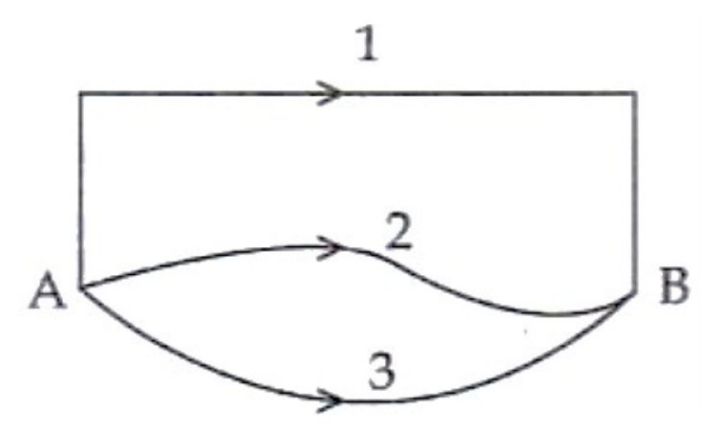 Gravitational force is conservative, so work done by it is path independent. Hence $W_1=W_2=W_3$.
Kepler's third law
-
In a solar system, the time-period of revolution of a planet tracing a circular orbit of radius R is proportional to:By Kepler's third law, $T^2\propto R^3 \Rightarrow T\propto R^{3/2}$.
Kepler's laws – speed of a planet in an elliptical orbit
-
The kinetic energies of a planet in an elliptical orbit about the Sun, at positions A, B and C are $K_A$, $K_B$ and $K_C$, respectively. AC is the major axis and SB is perpendicular to AC at the position of the Sun S as shown in the figure. Then
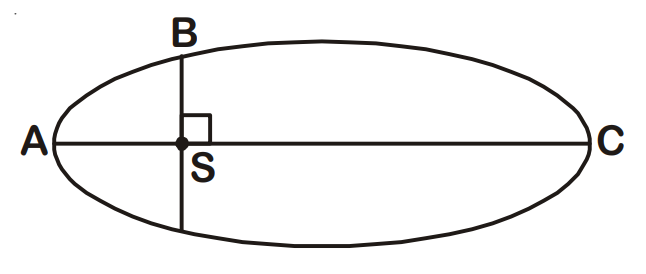
The planet moves fastest at perihelion and slowest at aphelion.
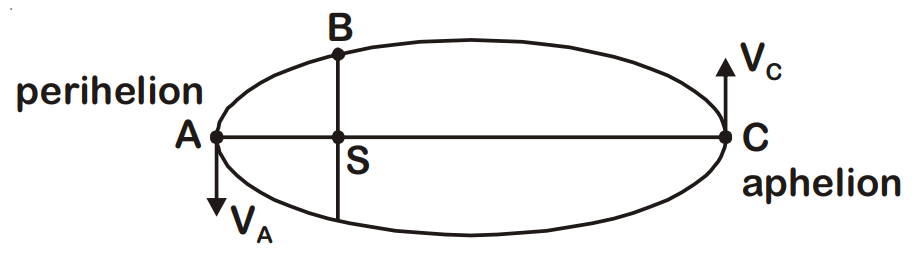
Point A is perihelion and C is aphelion.
So, $V_A > V_B > V_C$
So, $K_A > K_B > K_C$
Variation of g with height and depth
-
The acceleration due to gravity at a height 1 km above the earth is the same as at a depth d below the surface of earth. Then
For small h, equal g requires d = 2h.
Above the earth's surface: $g' = g\left(1 - \frac{2h}{R_e}\right)$, so $\Delta g = g\frac{2h}{R_e}$ ...(1) Below the earth's surface: $g' = g\left(1 - \frac{d}{R_e}\right)$, so $\Delta g = g\frac{d}{R_e}$ ...(2) From (1) and (2): $d = 2h = 2\times1$ km = 2 km
Universal law of gravitation
-
Two astronauts are floating in gravitational free space after having lost contact with their spaceship. The two will:
Mutual gravitational attraction draws them together.
Both astronauts are in a state of weightlessness; the gravitational force between them pulls them towards each other. -
Two spheres of masses m and M are situated in air and the gravitational force between them is F. The space around the masses is now filled with a liquid of specific density 3. The gravitational force will now be :Newton's law of gravitation: $F = \dfrac{GmM}{r^2}$
The gravitational constant G is a universal constant. Unlike the electric force (which depends on the permittivity of the medium), the gravitational force between two masses does not depend on the medium between them.
So filling the space with a liquid of specific density 3 does not change the force between the two spheres.
The gravitational force remains F.
Variation of g with distance from the centre
-
Starting from the centre of the earth having radius R, the variation of g (acceleration due to gravity) is shown by:
Linear inside, $1/r^2$ outside.
$g = \left(\frac{GM_e}{R_e^3}\right)r$ for $0 < r \le R_e$ (increases linearly)
$g = \frac{GM_e}{r^2}$ for $r \ge R_e$ (decreases as $1/r^2$)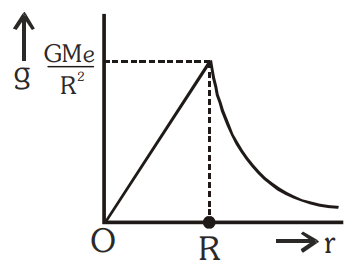
Energy of an orbiting satellite
-
A satellite of mass m is orbiting the earth (of radius R) at a height h from its surface. The total energy of the satellite in terms of $g_0$, the value of acceleration due to gravity at the earth's surface, is:
$E = -GMm/2r$ with $GM = g_0R^2$.
Total energy $= -\frac{GM_em}{2(R + h)}$
$\because g_0 = \frac{GM_e}{R^2} \Rightarrow GM_e = g_0R^2$
$\therefore$ Energy $= -\frac{mg_0R^2}{2(R + h)}$ -
For a satellite moving in an orbit around the earth, the ratio of kinetic energy to potential energy is -For a satellite of mass $m$ in an orbit of radius $r$: $\dfrac{GMm}{r^2} = \dfrac{mv^2}{r} \Rightarrow mv^2 = \dfrac{GMm}{r}$
Kinetic energy: $K = \dfrac{1}{2}mv^2 = \dfrac{GMm}{2r}$
Potential energy: $U = -\dfrac{GMm}{r}$
$\dfrac{K}{U} = \dfrac{GMm/2r}{-GMm/r} = -\dfrac{1}{2}$
So the magnitude of the ratio of kinetic energy to potential energy is $\dfrac{1}{2}$ (the negative sign only shows that the potential energy is negative).
Kepler's laws
-
Kepler's third law states that square of period of revolution (T) of a planet around the Sun is proportional to third power of average distance r between Sun and planet, i.e. $T^2 = Kr^3$, here K is constant. If the masses of Sun and planet are M and m, respectively, then as per Newton's law of gravitation, force of attraction between them is $F = \frac{GMm}{r^2}$, here G is gravitational constant. The relation between G and K is described asOrbital speed: $v = \sqrt{\frac{GM}{r}}$
$T = \frac{2\pi r}{v} = \frac{2\pi r^{3/2}}{\sqrt{GM}}$
$T^2 = \frac{4\pi^2}{GM}r^3$
Comparing with $T^2 = Kr^3$: $K = \frac{4\pi^2}{GM} \Rightarrow GMK = 4\pi^2$ -
A planet moving along an elliptical orbit is closest to the sun at a distance $r_1$ and farthest away at a distance of $r_2$. If $v_1$ and $v_2$ are the linear velocities at these points respectively, then the ratio $\frac{v_1}{v_2}$ isThe gravitational force of the sun on the planet is a central force, so its torque about the sun is zero and the angular momentum of the planet is conserved.
At the closest and farthest points the velocity is perpendicular to the radius vector, so L = mvr at both points.
$mv_1r_1 = mv_2r_2$
$v_1r_1 = v_2r_2$
$\frac{v_1}{v_2} = \frac{r_2}{r_1}$ -
The figure shows elliptical orbit of a planet m about the sun S. The shaded area SCD is twice the shaded area SAB. If $t_1$ is the time for the planet to move from C to D and $t_2$ is the time to move from A to B, then
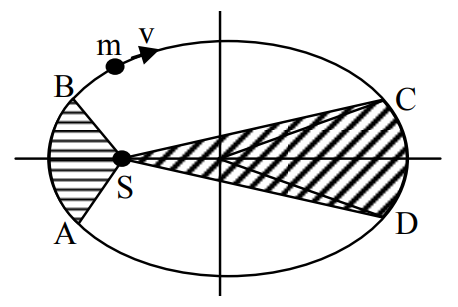 Kepler's second law: the line joining the sun and the planet sweeps out equal areas in equal intervals of time, i.e., the areal velocity $\frac{dA}{dt}$ is constant.
So the area swept is proportional to the time taken: $A \propto t$
$\frac{t_1}{t_2} = \frac{\text{area SCD}}{\text{area SAB}}$
Given area SCD = 2 × area SAB: $\frac{t_1}{t_2} = 2$
$t_1 = 2t_2$
Motion of satellites
-
A satellite S is moving in an elliptical orbit around the earth. The mass of the satellite is very small compared to the mass of the earth. Then,The only force on S is earth's gravity, which always points towards the centre of the earth, so the acceleration is always directed towards the centre.
Being a central force, it conserves angular momentum (both magnitude and direction) and total mechanical energy; the speed, and so the linear momentum, changes along the ellipse.
Variation of g with height
-
The height at which the weight of a body becomes $\frac{1}{16}$th, its weight on the surface of earth (radius R), is$g' = \frac{g}{\left(1 + \frac{h}{R}\right)^2}$
$\frac{g}{16} = \frac{g}{\left(1 + \frac{h}{R}\right)^2} \Rightarrow \left(1 + \frac{h}{R}\right)^2 = 16$
$1 + \frac{h}{R} = 4 \Rightarrow h = 3R$ -
A body of weight 72 N moves from the surface of earth to a height half of the radius of the earth, then gravitational force exerted on it will be :On the surface: $F = mg = 72$ N
At height h: $g' = g\left(\dfrac{R_e}{R_e + h}\right)^2 = g\left(\dfrac{R_e}{R_e + R_e/2}\right)^2 = g\left(\dfrac{2}{3}\right)^2 = \dfrac{4}{9}g$
$F' = mg' = mg \times \dfrac{4}{9} = 72 \times \dfrac{4}{9}$
$F' = 32$ N
Gravitational field of a spherical shell
-
Which one of the following plots represents the variation of gravitational field on a particle with distance r due to a thin spherical shell of radius R? (r is measured from the centre of the spherical shell)Inside a thin spherical shell (r < R) the gravitational field is zero.
At the surface it jumps to its maximum value $\frac{GM}{R^2}$.
Outside (r > R) it falls off as $\frac{GM}{r^2}$.
So the graph is zero up to r = R, rises abruptly at R and then decreases as $\frac{1}{r^2}$.
Escape and orbital velocity
-
If $v_e$ is escape velocity and $v_o$ is orbital velocity of a satellite for orbit close to the earth's surface, then these are related byEscape velocity: $v_e = \sqrt{\frac{2GM}{R}}$
Orbital velocity close to the surface: $v_o = \sqrt{\frac{GM}{R}}$
$\frac{v_e}{v_o} = \sqrt2 \Rightarrow v_e = \sqrt2v_o$
Earth satellites
-
The radii of circular orbits of two satellites A and B of the earth are 4R and R, respectively. If the speed of satellite A is 3V, then the speed of satellite B will beOrbital speed of a satellite in a circular orbit of radius r: $v = \sqrt{\frac{GM}{r}}$, so $v \propto \frac{1}{\sqrt{r}}$
$\frac{v_B}{v_A} = \sqrt{\frac{r_A}{r_B}} = \sqrt{\frac{4R}{R}} = 2$
$v_B = 2v_A = 2\times3V$
$v_B = 6V$ -
Two satellites of earth, $S_1$ and $S_2$, are moving in the same orbit. The mass of $S_1$ is four times the mass of $S_2$. Which one of the following statements is true?For a satellite of mass $m$ in a circular orbit of radius $r$: $\dfrac{GMm}{r^2} = \dfrac{mv^2}{r}$
The orbital velocity of a satellite is $v = \sqrt{\dfrac{GM}{r}}$, where $M$ is the mass of the earth.
It does not depend upon the mass of the satellite.
Both satellites are in the same orbit (same $r$), so both will move with the same speed.
The time period $T = \dfrac{2\pi r}{v}$ is also the same for both.
Potential energy $-\dfrac{GMm}{r}$ and kinetic energy $\dfrac{1}{2}mv^2$ depend on $m$, so they are four times as large for $S_1$; they are not equal.
So the true statement is that $S_1$ and $S_2$ are moving with the same speed.
That is every question in Gravitation for this filter.
Want a score?
Answers here are not saved. Practise as a test to be marked and see your progress.
Practise as a test