Looking for classes? Ksquare Career Institute, Bengaluru →

Physics
Kinetic Theory
34 questions from 27 papers, each with its answer.
- 34 questions
- 27 papers
- 1.93% of Physics
Kinetic Theory of an Ideal Gas – Average Kinetic Energy
-
The average thermal energy for a mono-atomic gas is: ($k_B$ is Boltzmann constant and $T$, absolute temperature)A monoatomic gas has 3 (translational) degrees of freedom. Average thermal energy per molecule $= 3 \times \frac{1}{2}k_BT = \frac{3}{2}k_BT$
Mean Free Path
-
The mean free path for a gas, with molecular diameter $d$ and number density $n$ can be expressed as:Mean free path $\lambda = \frac{1}{\sqrt{2}\,n\pi d^2}$
-
The mean free path of molecules of a gas, (radius 'r') is inversely proportional to:Mean free path $\lambda_m = \frac{1}{\sqrt2\,\pi d^2n}$, where d = diameter of the molecule
So $\lambda_m \propto \frac{1}{r^2}$
Ideal Gas Equation
-
Two vessels separately contain two ideal gases A and B at the same temperature, the pressure of A being twice that of B. Under such conditions, the density of A is found to be 1.5 times the density of B. The ratio of molecular weight of A and B is:$P = \frac{\rho RT}{M} \Rightarrow M = \frac{\rho RT}{P}$
$\frac{M_A}{M_B} = \frac{\rho_A}{\rho_B}\cdot\frac{T_A}{T_B}\cdot\frac{P_B}{P_A} = 1.5\times 1\times\frac{1}{2} = \frac{3}{4}$ -
In the given (V – T) diagram, what is the relation between pressure $P_1$ and $P_2$?
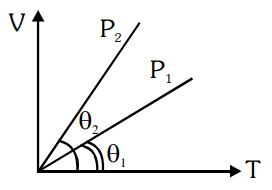 $PV = nRT \Rightarrow V = \left(\frac{nR}{P}\right)T$, so slope $= \frac{nR}{P}$
The line for $P_2$ is steeper ($\theta_2 > \theta_1$), so $\frac{1}{P_2} > \frac{1}{P_1} \Rightarrow P_1 > P_2$ -
The equation of state for 5g of oxygen at a pressure P and temperature T, when occupying a volume V, will be :- (Where R is the gas constant.)Ideal gas equation: $PV = \mu RT$, where $\mu$ is the number of moles.
Molar mass of oxygen ($O_2$) = 32 g/mol.
$\mu = \dfrac{\text{mass}}{\text{molar mass}} = \dfrac{5}{32}$ moles
$\therefore PV = \left(\dfrac{5}{32}\right)RT$
Kinetic Theory of an Ideal Gas – Temperature and Kinetic Energy
-
Increase in temperature of a gas filled in a container would lead to:For an ideal gas, internal (kinetic) energy $U=\frac{f}{2}nRT$. So an increase in temperature leads to an increase in the kinetic energy of the gas molecules. The mass does not change, pressure increases (not decreases) in a fixed container, and intermolecular distance does not decrease.
RMS speed of gas molecules
-
Three vessels of equal capacity have gases at the same temperature and pressure. The first vessel contains helium (monoatomic), the second contains fluorine (diatomic) and the third contains sulfur hexafluoride (polyatomic). The correct statement, among the following is:$v_{rms}=\sqrt{\frac{3RT}{M}}$ is independent of the degrees of freedom and depends only on molar mass at a given temperature. Helium has the smallest molar mass, so its rms speed is the largest. (Equal volumes at the same T and P contain equal numbers of molecules.)
Specific heat capacities of gases
-
The molar specific heats of an ideal gas at constant pressure and volume are denoted by $C_P$ and $C_V$, respectively. If $\gamma = \frac{C_P}{C_V}$ and R is the universal gas constant, then $C_V$ is equal to:$C_P - C_V = R$ and $\gamma = \frac{C_P}{C_V}$
$\gamma C_V - C_V = R \Rightarrow C_V = \frac{R}{\gamma - 1}$ -
The molar specific heat at constant pressure of an ideal gas is $\left(\dfrac{7}{2}\right)R$. The ratio of specific heat at constant pressure to that at constant volume is :-Given $C_P = \dfrac{7}{2}R$
By Mayer's relation, $C_P - C_V = R$
$\Rightarrow C_V = C_P - R = \dfrac{7}{2}R - R = \dfrac{5}{2}R$
$\gamma = \dfrac{C_P}{C_V} = \dfrac{\frac{7}{2}R}{\frac{5}{2}R}$
$\gamma = \dfrac{7}{5}$
(This is the value for a diatomic gas.)
Law of equipartition of energy – internal energy of a gas mixture
-
A gas mixture consists of 2 moles of $O_2$ and 4 moles of Ar at temperature T. Neglecting all vibrational modes, the total internal energy of the system is
Diatomic $O_2$ has f = 5 and monatomic Ar has f = 3.
$U = n_1\frac{f_1}{2}RT + n_2\frac{f_2}{2}RT$ $= 2\times\frac{5}{2}RT + 4\times\frac{3}{2}RT$ $= 5RT + 6RT$ $U = 11RT$
RMS speed – dependence on temperature
-
The molecules of a given mass of a gas have r.m.s velocity of 200 $ms^{-1}$ at 27°C and $1.0 \times 10^{5}\ Nm^{-2}$ pressure. When the temperature and pressure of the gas are respectively, 127 °C and $0.05 \times 10^{5}\ Nm^{-2}$, the rms velocity of its molecules in $ms^{-1}$ is
$v_{rms} \propto \sqrt{T}$, independent of pressure.
$V_{rms} = \sqrt{\frac{3RT}{m}}$; $V_{rms}$ does not depend on pressure.
$\frac{(V_{rms})_2}{(V_{rms})_1} = \sqrt{\frac{T_f}{T_i}}$, with $T_i = 300$ K, $T_f = 400$ K
$(V_{rms})_2 = 200\sqrt{\frac{400}{300}} = 200\sqrt{\frac{4}{3}} = \frac{400}{\sqrt{3}}$ m/s
Ideal gas equation – density
-
A given sample of an ideal gas occupies a volume V at a pressure P and absolute temperature T. The mass of each molecule of the gas is m. Which of the following gives the density of the gas?
$\rho = nm = (P/kT)m$.
Gas equation: $\frac{P}{\rho} = \frac{RT}{M_w}$
$\rho = \frac{PM_w}{RT} = \frac{P\times(mN_A)}{kN_AT} = \frac{Pm}{kT}$
Degrees of freedom and specific heats
-
The ratio of the specific heats $\frac{C_P}{C_V} = \gamma$ in terms of degrees of freedom (n) is given by$C_v = \frac{n}{2}R$ and $C_p = \left(\frac{n}{2} + 1\right)R$
$\gamma = \frac{C_p}{C_v} = \frac{\frac{n}{2} + 1}{\frac{n}{2}} = \frac{n+2}{n}$
$\gamma = 1 + \frac{2}{n}$ -
To find out degree of freedom, the correct expression is :For a gas with f degrees of freedom: $C_V = \dfrac{f}{2}R$ and $C_P = \left(\dfrac{f}{2} + 1\right)R$
$\because \gamma = \dfrac{C_P}{C_V} = 1 + \dfrac{2}{f}$
$\Rightarrow \dfrac{2}{f} = \gamma - 1 \Rightarrow f = \dfrac{2}{\gamma - 1}$
Check: for a monatomic gas, $\gamma = \dfrac{5}{3}$ gives f = 3.
Specific heat capacity of gases
-
If $c_p$ and $c_v$ denote the specific heats (per unit mass) of an ideal gas of molecular weight M, then (where R is the molar gas constant)Mayer's relation holds for molar specific heats: $C_p - C_v = R$
Molar specific heat = molecular weight × specific heat per unit mass: $C_p = Mc_p$ and $C_v = Mc_v$
$Mc_p - Mc_v = R$
$c_p - c_v = \frac{R}{M}$
That is every question in Kinetic Theory for this filter.
Want a score?
Answers here are not saved. Practise as a test to be marked and see your progress.
Practise as a test