Looking for classes? Ksquare Career Institute, Bengaluru →

Physics
Mechanical Properties of Fluids
34 questions from 22 papers, each with its answer.
- 34 questions
- 22 papers
- 1.93% of Physics
Surface Tension
-
The wettability of a surface by a liquid depends primarily on:Wetting depends on the angle of contact: a liquid wets the surface when the angle is acute and does not wet it when the angle is obtuse.
Bernoulli's Principle and Applications
-
The venturi-meter works on:
A venturi-meter works on Bernoulli's principle.
Factual (theory based).
Hydrostatic pressure
-
Two copper vessels A and B have the same base area but of different shapes. A takes twice the volume of water as that B requires to fill upto a particular common height. Then the correct statement among the following is:Pressure at the bottom of a liquid column is $P=h\rho g$, which depends only on the height of the liquid. Since water is filled up to the same height in both vessels, the pressure on the base is the same.
Pressure in a U-tube
-
In a U-tube as shown in figure, water and oil are in the left side and right side of the tube respectively. The heights from the bottom for water and oil columns are 15 cm and 20 cm respectively. The density of the oil is: [take $\rho_{water}=1000$ kg/m$^3$]
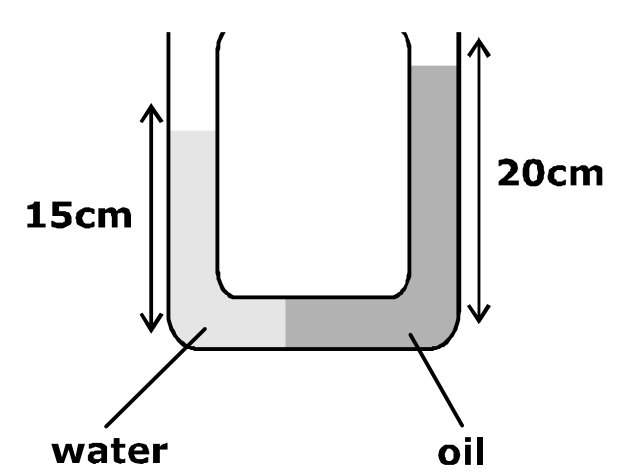 Equating pressures at the lowest level: $\rho_{oil}gh_{oil}=\rho_wgh_w \Rightarrow \rho_{oil}=\frac{1000\times15}{20}=750$ kg/m$^3$.
Surface tension – surface energy
-
A rectangular film of liquid is extended from (4 cm × 2 cm) to (5 cm × 4 cm). If the work done is $3 \times 10^{-4}$ J, the value of the surface tension of the liquid is:
Liquid film has two free surfaces.
$W = T(2\Delta A)$ (the film has two surfaces); $\Delta A = 20 - 8 = 12\ cm^2$
$T = \frac{W}{2\Delta A} = \frac{3\times10^{-4}}{2\times12\times10^{-4}} = 0.125\ Nm^{-1}$
Equation of continuity
-
The cylindrical tube of a spray pump has radius R, one end of which has n fine holes, each of radius r. If the speed of the liquid in the tube is V, the speed of the ejection of the liquid through the holes is:Equation of continuity: $Av$ = constant
$\pi R^2V = n\pi r^2v_1$
$v_1 = \frac{VR^2}{nr^2}$
Pressure and power
-
The heart of a man pumps 5 litres of blood through the arteries per minute at a pressure of 150 mm of mercury. If the density of mercury be $13.6\times10^3$ kg/$m^3$ and g = 10 m/$s^2$ then the power of heart in watt is:Pressure: $P = \rho gh = 13.6\times10^3\times 10\times 0.15$ Pa
Pumping rate: $\frac{dV}{dt} = \frac{5\times10^{-3}}{60}$ $m^3$/s
Power $= P\frac{dV}{dt} = \frac{13.6\times 5\times 0.15}{6} = 1.70$ W
That is every question in Mechanical Properties of Fluids for this filter.
Want a score?
Answers here are not saved. Practise as a test to be marked and see your progress.
Practise as a test